Access Fee Cap Coming to Options?

With maker-taker pricing settling into options, the Securities and Exchange Commission is paying attention to exchange access fees.

Robert Colby, deputy director of the Division of Trading and Markets, said the SEC is “watching this area-access fees in options.” For now, he said, the “fees involved might increase overall costs, but not enough to affect the attractiveness of the quotes.”

As the options industry undergoes significant change, complaints involving access fees are emerging from top market makers. Matt Andresen, president of Citadel Execution Services, the giant broker-dealer subsidiary of Citadel Investment Group, said the shift to maker-taker pricing by NYSE Arca Options has led to “disruptive behavior” in the form of intentionally locked and crossed markets. Access-fee caps would reduce the incentive for that behavior, he said.

“We’ve seen a major spike in the frequency and duration of locked and crossed markets in options,” Andresen told Traders Magazine. “It seems to be driven predominantly by quoters on Arca.” In a locked market, a trader posts a contra-sided order at the same price as the national best bid or offer. In a crossed market, the trader posts a bid that’s higher than the best offer or an offer that’s lower than the best bid.

Locked and crossed markets are “one of the most distortive effects of rogue pricing,” according to Andresen. In his view, the high fees to take liquidity on Arca and the Boston Options Exchange–50 cents and 45 cents per contract, respectively–subsidize high rebates, which creates an economic incentive for traders to find ways to earn that rebate.

An Arca spokesperson noted that “it’s not uncommon for competing market models to occasionally bump up against each other as markets move.” He added that NYSE Arca Options uses private routing instead of the intermarket linkage system, “which provides our platform with a faster linkage turnaround with significantly less delay. NYSE Arca will never lock a market using an order routed to us.”

Kevin Murphy, head of U.S. broker-dealer sales at Citi, also observed that some market participants are now playing a “rebate game.” Spurred by high rebates for providing liquidity, they can profit by breaking even on their trading, as long as they earn a rebate on their executions. “Options is a quote-driven market” and those traders “don’t add much value,” he said.

Andresen believes market structure changes in options could force the SEC to implement fee caps in the options market, as it did in equities in Regulation NMS. “We’ve seen this movie before, and if the SEC has the same reaction as in equities, we’ll soon have fee caps,” he said. Locked and crossed markets are frowned on by market centers and regulators.

According to Chris Nagy, who oversees order routing, sales and strategy at TD Ameritrade, the issue about access fees is part of a broader set of concerns. “The issue of whether make-or-take pricing or capping access fees is good or bad is irrelevant,” he said. “The real issue is that two disparate fee structures coexist in the market with no rules to prevent manipulation and promote fair and transparent markets for the benefit of the options investor.”

(c) 2008 Traders Magazine and SourceMedia, Inc. All Rights Reserved.

http://www.tradersmagazine.com http://www.sourcemedia.com

Exchanges to SEC: Penny Pilot is Bad for Business

Three of the options industry’s six exchanges are calling on the Securities and Exchange Commission to halt the progress of the ongoing penny pilot.

The International Securities Exchange, the Chicago Board Options Exchange and the American Stock Exchange, which collectively handle two-thirds of industry volume, maintain that the pilot is damaging the industry and should be restructured.

“ISE remains very concerned about the dramatic decrease in available liquidity and the impact this contraction is having on institutional participation in the options market,” the exchange informed the SEC in a report.

In its second report on the impact of the penny pilot, the Amex also expressed concern about a decrease in available size driving money managers to the over-the-counter marketplace. Amex warned that “expanding the pilot beyond the 35 securities that currently comprise the pilot would be premature.”

All six options exchanges were required to submit analyses of Phase II of the pilot-the five-month period between May and September-to the SEC by late last year. Of the six, only the Boston Options Exchange (BOX) had not submitted a report as Traders Magazine was going to press.

The pilot began in January 2007 with 13 options and was expanded to 35 classes in September. Another 28 are scheduled to be added this year.

While BOX and NYSE Arca are generally bullish on quoting options in smaller increments, the Amex, CBOE and ISE are not. The Philadelphia Stock Exchange is mum on its position.

The results of the second round of impact studies differ little from those of the first series, released last spring. Spreads have narrowed in the penny names. Size has declined. Volume has declined in all but the two largest options-the ETFs QQQQ and IWM. Message traffic has increased.

The three exchanges expressing negative views on the pilot all laud the shrinkage of spreads but maintain the changes in the other three factors have the potential to destroy what has been a booming business.

They recommend further analysis over a longer time period and suggest some options might need to be removed from the pilot. The ISE, for its part, recommends the less liquid options such as that on Whole Foods Market be removed.

(c) 2008 Traders Magazine and SourceMedia, Inc. All Rights Reserved.

http://www.tradersmagazine.com http://www.sourcemedia.com

Buyside Gets Clarification on Brokers Trading Alongside

Buyside traders confused by new New York Stock Exchange rules designed to make it easier for broker-dealers to trade along with their orders received some solace late last year.

NYSE Regulation sent out a memo to its members clarifying a change it made to Rule 92 last summer. Rule 92 bars brokers from trading along with their institutional customers’ orders. There are exceptions, though, and in those cases, the brokers must obtain consent from the money manager.

Until last summer, brokers had to obtain consent on an order-by-order basis. NYSE Reg’s changes, though, liberalized the rule. Brokers can now request blanket consent from a customer covering all of the customer’s trade-along orders. Brokers no longer have to ask for permission each time they trade alongside their customer.

The recent memo noted that a broker’s customer can still give its consent on an order-by-order basis if it chooses.

Whichever method is used, the broker must keep records stating the contact name at the money manager and the percentage split of a trade-along order.

If blanket consent is used, the percentage split must be the same for every trade.

(c) 2008 Traders Magazine and SourceMedia, Inc. All Rights Reserved.

http://www.tradersmagazine.com http://www.sourcemedia.com

Nasdaq Raises Rebate in TRF War

Nasdaq hopes to up the ante at its trade reporting facility. Nasdaq and FINRA, which jointly own the TRF, have asked the Securities and Exchange Commission for permission to increase the market data rebate they give to their TRF users from 50 to 100 percent.

The increase would put the rebate on par with that of the New York Stock Exchange’s TRF, which is still seeking SEC approval for its pricing proposal.

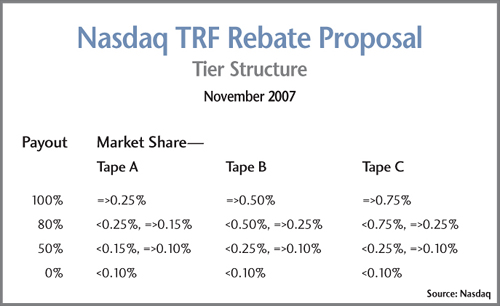
Broker-dealers that report their trades to Nasdaq’s TRF-mostly market makers and ECNs-would receive up to 100 percent of the revenues Nasdaq now receives for selling its quote and trade data. The brokers now only get half of the revenues.

Not all brokers would be entitled to 100 percent. The amount is dependent on how much volume they report to the TRF. Some brokers may receive no rebate at all under Nasdaq’s tiering scheme. Only the largest would receive 100 percent. Tiering levels depend on the type of security-Tape A, Tape B or Tape C (see table).

Nasdaq is not the only TRF operator feeling the heat from the NYSE. The National Stock Exchange, which launched the first TRF in 2006 to accommodate ECNs such as BATS Trading, is proposing to increase its data rebate from 50 to 75 percent.

The move toward higher rebates has drawn some criticism. The Securities Industry & Financial Markets Association told the SEC in a letter that the high rates imply broker-dealers are paying exchanges too much for market data. If exchanges such as the NYSE can give away all of the revenues they receive, they obviously don’t need the monies to cover regulatory costs, their expected use.

SIFMA also holds that the NYSE is engaging in predatory pricing that may squash smaller TRFs, such as the one run by the National.

All three proposals-NYSE’s, NSX’s and Nasdaq’s-require SEC approval.

(c) 2008 Traders Magazine and SourceMedia, Inc. All Rights Reserved.

http://www.tradersmagazine.com http://www.sourcemedia.com

Specialist Rules Eased at NYSE

The New York Stock Exchange, on the same day Lehman Brothers announced its takeover of Van der Moolen Specialists USA, won approval from the Securities and Exchange Commission to streamline its regulatory process for new specialists.

Behind the abrupt move, the NYSE said in a filing, was the abandonment of their stocks by two of the NYSE’s seven specialists, the possibility that others could do the same and the need to make it easier for certain newcomers to become specialists.

NYSE Regulation now has the authority to grant a broker-dealer a temporary exemption from rules requiring it to cordon off a new specialist organization from its other trading operations.

Under NYSE Rule 98, broker-dealers that operate upstairs trading or floor-broker operations must house their specialist units within a separate broker-dealer.

Rule 98 establishes barriers between specialists and their upstairs colleagues to prevent collusion between the two.

The NYSE claims the dictates of Rule 98 have the “potential to impede the approval process for a prospective specialist firm.” The exemption still requires the specialist to maintain an arm’s-length relationship with other related entities within the broker-dealer.

Late last year, two of the exchanges’ seven specialist firms-Van der Moolen and SIG Specialists-gave up their stocks. Van der Moolen traded 416 stocks. SIG, a unit of Susquehanna International Group, traded 147. The NYSE allocated SIG’s stocks to Kellogg Specialist Group.

On December 4, Lehman announced it would buy certain assets of Van der Moolen Holdings, allowing it to establish a market-making operation on the NYSE floor.

Lehman also runs a large upstairs trading operation.

(c) 2008 Traders Magazine and SourceMedia, Inc. All Rights Reserved.

http://www.tradersmagazine.com http://www.sourcemedia.com

Specialists’ Role Declines At NYSE Arca for Options

NYSE Arca, in the latest of a series of moves that diminish the stature of its options specialists, or lead market makers, proposes to reduce their quoting requirements. Under the proposal, which needs Securities and Exchange Commission approval, the exchange would require lead market makers to quote two-sided markets only 90 percent of the time. That is down from a current 99 percent.

At NYSE Arca, 11 lead market makers and 26 “regular” market makers support 2,100 options series. The 55 regular market makers are required to quote continuous two-sided markets 60 percent of the time.

Because there are so many market makers supplying liquidity, NYSE Arca argues it is not necessary for lead market makers to play as significant a role. The proposal by NYSE Arca, operator of a stock exchange as well as an options mart, echoes other recent changes it has made.

A year ago, with the start of penny trading in certain options, the exchange eliminated the lead market-maker assignment in the Quad-Q option. “The issue,” Jon Werts, head of NYSE Arca’s options operation told Traders Magazine at the time, was: “Would liquidity be adversely affected without the lead market maker? The answer is no.” NYSE Arca’s plan to make lead market maker support optional won SEC approval last summer. At the time, the exchange said: “Certain highly liquid, highly active options classes have sufficient participation…and do not need an LMM to foster liquidity.”

In November, the exchange eliminated the lead market-maker role in the trading of the very liquid option on the iShares Russell 2000 ETF (IWM). It became the second ETF option to trade on Arca without a lead market maker. Both the QQQQ and IWM options are traded in penny increments in accord with the ongoing penny pilot. The penny pilot itself has given NYSE Arca an opportunity to treat lead market makers much the way it does LMMs on its equities market, where they have less clout. For those LMMs assigned to options classes trading in the pilot, Arca now pays them a rebate for providing liquidity, rather than guarantee them a percentage of incoming orders.

(c) 2008 Traders Magazine and SourceMedia, Inc. All Rights Reserved.

http://www.tradersmagazine.com http://www.sourcemedia.com

Experts Recount ’87 Crash Horrors

Risk models used by traders today pose a problem and should be studied further to ensure their failure doesn’t trigger another crash, a former New York Stock Exchange executive recently said.

Former Big Board CEO John Phelan made that point for a Webcast that reviewed the 1987 stock market crash, when the market fell 22 percent. In response to a question on whether another crash could occur, Phelan stopped short of predicting one.

However, he said he is skeptical about the various value at risk (VAR) models employed by some brokerages.

“The great thing about VAR is that it always works when you don’t need it,” Phelan wrote in a statement published at the Securities and Exchange Commission historical Web site, where the Webcast took place.

There are still many shortcomings in risk management theories, he added. And they were recently exposed in the subprime mortgage blowup, he warned.

“The ability to value and assess risk in these illiquid and rarely traded instruments,” he said, “only points out the need for a great deal more work in assessing risk in these particular markets.”

Jim Leman, a principal with the consultant Westwater Corp., didn’t participate in the Webcast, but told Traders Magazine that he agreed that a crash was still possible-even though the trading environment is very different today. Fragmentation is why: With 40 dark pools and the dominance of electronic trading after Regulation NMS, liquidity is now more decentralized, he said, so there is the potential for greater volatility.

“You get a situation where there is a stampede,” Leman said. The LTCM crisis was an example of a potential “stampede.” But for the actions of the Federal Reserve, which bailed out investors, another crash could have occurred, he said.

“Anytime you have the same amount of leverage that was there and large amounts of over-the-counter securities, which don’t operate through a mark-to-market mechanism in a clearinghouse, you have the potential for a big problem,” said Leman, who was a vice president in charge of trading support for fixed income and equity traders for Salomon Brothers in 1987. What happens in such a scenario, Leman continued, is a problem with illiquid securities spreads.

What can be done to protect against another sudden selling flood? Phelan urged more transparency in markets. That’s because of the large amounts of money going into derivatives.

“The market for derivatives is so immense that one can imagine all kinds of horror stories,” he wrote. And horror stories there were aplenty on October 19 and 20, 1987.

Nasdaq dealers stopped answering their phones. Traders had few places to find liquidity as most trading was still done manually.

In 1987, the NYSE had far more specialists than the seven today. Firms then lacked capital and access to it. “To say we were frightened would be a mild exaggeration,” said William R. Johnston, a former senior managing director of LaBranche & Co.

Was this the beginning of a market that would destroy the NYSE? Should it close? Those were issues Big Board officials faced in those desperate hours.

On the afternoon of October 20, the market rallied with the support of the Federal Reserve, Phelan said. The crisis passed.

(c) 2008 Traders Magazine and SourceMedia, Inc. All Rights Reserved.

http://www.tradersmagazine.com http://www.sourcemedia.com

Looking for Action in IOIs

They’re no more than electronic messages at this point. But a growing number of trading executives argue that indications of interest should be looked at as firm quotes that can be automatically traded against by the buyside.

“The nirvana is executable IOIs,” says Robert Moitoso, head of the FIX division at NYFIX, an institutional broker and technology provider whose IOI dissemination product has been distributed via the NYFIX Marketplace network for more than two years. “The sellside can spend a lot of money distributing IOIs to their client base. They want to know if they’re getting bang for that buck–and executable IOIs would let them measure that.”

An executable or electronically actionable IOI is a message containing trade data that can be clicked and executed immediately by its buyside recipient. As such, it would take on some of the characteristics of a firm quote sitting on an exchange or ECN. In comparison, traditional IOIs are indications, or messages, from a broker to buyside firms that invite a telephone call and a negotiation. Demand for executable IOIs is coming from segments of both the brokerage and buyside community. On the buyside in particular, interest in clickable IOIs is part of traders’ need to source block liquidity more efficiently.

Moitoso, who spent two decades at AutEx, the granddaddy of IOI distributors, recognizes that what’s being asked for now is a tall order. “Actionable IOIs are an elusive target,” he notes. “No one really has their arms around how to execute on an actionable IOI.” He observes that an IOI is essentially “a message, a feeler that says, If you want to trade give me a call and we can probably do something, but we have to talk about it first.'”

Albert Lojko, head of institutional equities at Tradeweb, which owns AutEx, agrees that interest in making IOIs electronically actionable is flourishing. “That’s probably where the path will lead, because brokers then can better correlate their return on investment for a particular message,” he says. But he too doesn’t expect actionable IOIs to take over the world of block indications.

Some buysiders are ready to auto-execute on indications. “If the IOI delivery systems improve and IOIs are more specifically targeted and contain good actionable information, we’ll use them,” says Joan Stack, trading manager at the Ohio Public Employees Retirement System, an $84 billion pension and health-care fund.

“Actionable IOIs is where the IOI space is headed,” says Robert Shapiro, executive director of trading and execution analysis at Morgan Stanley Investment Management, which has $597 billion in assets, including $300 billion in equities. “Interacting with clean, strategically desirable IOIs will be a much more important part of our liquidity-sourcing endeavors in the future.”

Joe Cangemi, co-head of electronic trading sales at agency broker BNY ConvergEx Group, notes that some buyside traders are eager to auto-execute IOIs. “There is a segment of the population that’s moving toward electronic trafficking and execution,” he says. But it’s not the entire population. He adds: “Those executions will never supplant the broker-assisted block liquidity sourcing that is the mainstay of our agency business and necessary for many customers.”

Indicating Out

The IOI arena includes various types of electronic messages from brokers to their customers, ranging from IOIs with just the name of the stock and general size to more detailed IOIs with side, size and price information. At the top of the totem pole are natural IOIs-indications based on an agency order from a broker’s buyside customer.

Traditional IOIs represent big business. Large brokers can easily spend hundreds of thousands of dollars annually sending IOIs to their customers. AutEx was for years the only player of significance, but competition now reigns between AutEx, Bloomberg and Reuters–the three biggies–as well as a growing number of smaller or newer players. Many brokers also use the FIX protocol to route IOIs directly to their buyside customers.

According to research firm TABB Group, 93 percent of fundamental buyside traders surveyed for a recent U.S. institutional equities trading report said they use IOIs every day. Even among quantitative firms, that figure was 54 percent. The firm found that 88 percent of fundamental, quantitative and combined-style traders expect their use of IOIs to stay the same or increase over the next two years.

The number of trades based on an IOI is also significant in the current era of electronic trading. At fundamental shops, according to TABB, 16 percent of trades come off the back of an IOI, while quantitative firms say 8 percent of their executions are based on an IOI. Overall, almost 30 percent of the traders surveyed said what they would now most like to see are “electronically actionable” IOIs.

Getting Real

Actionable IOIs would make sourcing block liquidity more efficient. But for that to happen, brokers must be able to tier the IOIs they send customers more finely than is currently the case.

Chris Kelley, executive vice president for product marketing at Fidessa, a sellside order management system, notes that brokers must generate IOIs more intelligently,”directing IOIs tospecific recipients and sometimes using smart tiering systems to expose interest differently, and at different times, to different groups of targets.” Keeping IOIs current is also critical. Dynamic links between IOIs and a broker’s underlying customer order can ensure that this occurs automatically, he says.

Against the backdrop of increased electronic trading, IOIs with more details and information are also likely to be taken more seriously, even if they’re not clickable. “For some traders, what’s considered actionable could be a natural priced within certain parameters of the NBBO for a stock,” says NYFIX’s Moitoso. “They would pay attention to those IOIs, but they would still have to pick up the phone to negotiate the order.”

For some large brokers, the idea of actionable IOIs is moot. David Weisberger, head of global electronic market access at Citi, notes that traditional IOIs are likely to become more automated and more electronically actionable over time. But in terms of IOIs having firm prices, he says, the largest bulge-bracket firms are already there. “We on the sellside are held to a standard where IOIs are always actionable,” he says. “Almost every IOI is firm.”

If a big brokerage firm that commits capital sends an IOI and “doesn’t stand up to that IOI, that firm is going to have a serious business problem,” Weisberger says. However, “most IOIs are the starting point for a block trade negotiation,” he adds. “As a result, they tend to be a little away from the market and are therefore not often executed directly.”

What’s Lost

That manual, phone-based (or sometimes IM-based) negotiation process that results from IOIs is an important vetting opportunity for both brokers and institutions. Both sides want to know as much as possible about why the other side is trading. And for those IOIs that move into electronically actionable territory, that dialogue could be curtailed.

“Some customers that execute electronically want actionable IOIs,” says BNY ConvergEx’s Cangemi. “But for long-only asset managers looking to buy into or sell a significant piece of liquidity, a follow-up conversation to an IOI is almost mandatory for a prudent execution decision.” One size doesn’t fit all.

Some market participants observe that with sales trading desks being pared down, conversations that result from IOIs partly fill in the gap. IOI providers haven’t yet reprised the old AT&T slogan “Reach out and touch someone,” but IOIs essentially do just that. “As the market gets more electronic, we talk less to counterparties on the phone,” says Ohio’s Stack. “IOIs are an important way to keep current with information.” She adds that while her desk would use clickable IOIs, they wouldn’t be the default method of executing blocks.

Hit Size

The IOI message is also just the first step in opening up to the other side. Rarely will a broker ship out an IOI for the full size available. The broker may start with a piece of an order and, if the other side calls and is comfortable with a price, may then broach a larger-size discussion.

As a result, the ability to execute larger size than what’s sent out in an IOI message could fade with executable IOIs. “If the hit size is shown on a hittable IOI, the buyside could end up with residuals or smaller trades when ideally they want to do fewer trades but execute in larger blocks,” says Paul Scott, co-founder and a director at FIXCITY, a software vendor and IOI-services company based in London.

Buyside traders may also be choosy about what they auto-execute. NYFIX’s Moitoso notes that buyside traders may be happy to interact with IOIs electronically if the IOIs are for stocks with a lot of liquidity or if it’s the tail end of the buysider’s position. But in his view, that conservatism would run both ways. “Before brokers provide point-click-done functionality to institutions,” he says, “they would want to know who they’re dealing with, and they would want to understand the other side of the trade.”

Info Glut

The push to make IOIs more electronically actionable is occurring as IOIs continue to command buyside attention. IOIs are used and checked frequently because buyside traders need to source block liquidity. Decimalization, the decreasing average order size on exchanges and ECNs, and the fragmentation of liquidity have made the search for large natural liquidity more critical to reducing information leakage on big orders.

At the same time, the IOI world is riddled with useless messages. Buyside traders are deluged with IOIs. Many say the vast majority of them are irrelevant to their trading needs or are simply come-ons–the industry’s equivalent of spam. Worse, they can be fishing expeditions. Buyside traders frequently complain that when they pick up the phone in response to an IOI message, the broker doesn’t actually have the other side, or the size is too small. Alternately, the broker may have broadcast the message to attract business or test interest in a particular name.

Electronically actionable IOIs are seen as a partial solution to the problem of information glut and IOI fishing. Industry participants point out that making a segment of IOIs auto-executable would shrink the magnitude of the problem. If IOIs were hittable, brokers would have to be more cautious about the IOIs they send-and, more broadly, they would perhaps rethink their IOI habits once buyside traders expected to see more hittable IOIs.

In recent years, the level of complaint about IOI spam rose enough that NASD (now called FINRA) issued a memo to member firms in September 2006 reminding brokers of their “obligation to communicate accurate information when using services to communicate trading volume and trading interest to the marketplace.” The bulletin went on to specify that published information “must be truthful, accurate and not misleading.”

That may have tamped down some of the gross distortions relayed to buyside firms, but market participants and IOI publishers say IOIs remain a largely self-policing enterprise. According to TABB, almost 50 percent of buyside firms report that they avoid IOIs from brokers with whom they’ve had a bad experience in the past.

Other efforts are now under way to ensure that only IOIs likely to be deemed meaningful reach the buyside. IOI distributors and OMS or EMS (execution management system) vendors can filter IOIs for buyside traders by message type, security, broker and so on. Buysiders can limit the IOIs they see to naturals. They can also choose to see only IOIs with specific detailed information about orders they are working or with certain attributes that, effectively, establish a quality hurdle.

AutEx’s Lojko says IOI suppliers are working with buyside OMS vendors to integrate naturals into the blotter and “bring IOIs closer to the point of execution.” The benefit of this is that a trader looking at his blotter can see if there’s a natural in that name. This can be done via a column or row in the blotter, an alerting mechanism for names the trader is actively working, or a desktop application that commingles IOIs from multiple brokers, along with advertised trades for those names. A number of vendors have systems, repositories or other means of tracking IOIs and trade adverts.

This is not a small problem. A number of OMS and EMS vendors have a hard time taking in a large volume of IOI flow. Stack of OPERS notes that her desk uses IOIs from Bloomberg and Reuters, but had also received indications via FIX directly into its OMS, before the volume of messages overwhelmed the OMS. OPERS is transitioning to another OMS this year. “One consideration was that the system could handle IOIs without performance degradation,” Stack says.

IOI of the Beholder

More generally, the shift toward actionable IOIs is likely to change the industry in another way. As IOIs become more automated and executable, interest in quantifying their quality and usefulness is expected to increase. “The IOI message is becoming closer to a quote when we talk about it being actionable,” says FIXCITY’s Scott. “Once that happens, the buyside will want to measure the execution quality they’re getting.”

In Scott’s view, this is a natural progression. “If a broker has no responsibility for what’s in an IOI, then measuring the value of executions is of less value,” he says. “But if it’s hittable, the execution can be measured against the IOI.” He adds that this information can contribute to best-execution stastistics.

As IOIs become electronically actionable, their increased execution and information value could lead to further fine-tuning of the interaction between brokers and buyside firms. If brokers tier and segment their customers further to reflect better-quality IOIs, buyside firms will want to manage their IOI data by tracking how good the liquidity they’re seeing is and which brokers are showing it to them.

This shift could also compel the buyside to step up efforts to streamline the gush of incoming indications. “Some trading desks are quantitatively evaluating the level of success they have with each of their brokers from an IOI standpoint,” says BNY ConvergEx’s Cangemi. “Any excess information that’s clogging their ability to get to more relevant information is inefficient and at some point is going to be filtered out.”

Shapiro of Morgan Stanley Investment Management agrees that the IOI-related interaction between the sellside and buyside is likely to change. He summarizes the impetus: “Tiering is simple. Brokers decide that certain clients will get IOIs because they essentially are paying for the privilege of receiving them.” With IOIs becoming more valuable and actionable, that idea prompted MSIM’s desk, under the aegis of former sales trading exec Ray Tierney, to recast the way it looks at IOIs.

The desk is now tracking how it manages incoming IOIs to see if and when traders respond to them. IOIs are also being integrated into the desk’s OMS. As IOIs move toward becoming actionable, MSIM is considering whether to proactively pay for high-quality IOIs with agency trading flow. These metrics will help the desk decide how much to trade with certain brokers. “Electronically actionable IOIs are essentially binding invitations to trade,” Shapiro says. “Buyside firms will want to ensure they’re in touch with this type of liquidity.”

SIDEBARS TO MAIN STORY:

Sidebar #1: IOI Robots

Out of IOIS came crossing systems. Now, out of crossing systems will come IOIs. AutEx, launched in 1969, spawned a generation of products, from the FIX protocol (initially conceived as an alternative to AutEx’s communications network) to Liquidnet. These competitors tackled the idea of matching large natural interest in a security from different angles and altered the trading landscape.

While traditional IOIs are becoming more automated and potentially executable, a new crop of real-time, executable IOIs has already emerged. These are IOIs sent from some dark pools and crossing systems to the servers of participants, in an effort to suss out the other side of an order. The IOIs interact with machines, not humans.

FIXCITY’s Paul Scott notes that as dark liquidity becomes more prevalent and brokers internalize more flow, dark pools will become a bigger source of IOIs. This could happen in two ways, he says. Brokers could take the residual piece of orders from their dark pools onto their book and send out IOIs to find the other side, with the resulting order executed in the dark pool.

Alternately, Scott says, clients could “tag orders going into the dark pool if they’d like the broker to try to find the other side of the trade through automated IOIs.” In that case, IOIs would be generated automatically and sent to other users of the pool. “On the buyside, what [a person] would be shown is pure natural business, since it’s coming from a pool of liquidity,” Scott says. Any contra-side order would then be sent to the dark pool to execute.

Other IOI developments on the horizon are the ability of algorithms to automatically send out IOIs to a targeted list of a broker’s customers, and automated negotiations between an algorithm and a person or another algo, says David Weisberger of Citi. “That will take a while, but it will almost certainly happen,” he says. He notes that “most algos are time-dependent” and that IOIs could potentially effect executions more quickly.

by Nina Mehta


Sidebar #2: IOI Landscape

AutEx sends out about 1 million IOI messages every day, 15 to 20 percent of which are naturals, according to Tradeweb’s Albert Lojko. The average size of those naturals is 75,000 shares. BlockDATA, a communications service for post-trade advertisements, is AutEx’s industry-standard counterpart, used by buysiders to try to discern who has the ax in a name. Tradeweb now owns both services, along with the vast Tradeweb Routing Network.

Bloomberg and Reuters also send out tremendous quantities of IOIs and trade adverts. FIXCITY, a London-based, newer competitor in the IOI space, has gained a strong foothold in this space since it was established in 2002. NYFIX, which built its indications product on top of its routing infrastructure, sends out 100,000 IOI messages daily and is now building a trade-adverts product.

But what’s considered key to an IOI platform’s growth is the growth of the naturals, as opposed to general indications that a broker wants to trade a stock. “The buyside is looking for natural inventory,” Lojko says. He notes that AutEx has had “double-digit growth in the number of naturals coming into the system in the last couple of years.” Buyside traders, however, frequently complain that while AutEx established the industry 40 years ago, its message flow has become a bit of a grab bag.

IOI distributors nowadays have different strong suits. Some have vast order-routing networks of buyside and sellside firms. Some, like AutEx and Bloomberg, have become a core part of the industry’s communications fabric. Some tend to be more global, while others service more niche brokers.

These IOI distributors also have different payment systems, which can encourage a wider or narrower dissemination of messages. These range from per-message sellside charges to monthly per-destination fees for brokers, based on the number of buyside firms to which they connect. Unlike the others, Bloomberg doesn’t charge for IOIs, but its terminals are considered costly. The basic network idea is that the IOI provider must have a “community” of institutions and brokers looking to trade, says NYFIX’s Robert Moitoso. NYFIX Marketplace, he adds, includes 350 institutions and 400 brokers. The Tradeweb Routing Network has 400 institutions and 350 brokers using its network, according to Lojko.

by Nina Mehta


(c) 2008 Traders Magazine and SourceMedia, Inc. All Rights Reserved.

http://www.tradersmagazine.com http://www.sourcemedia.com
Dark Fight in Midst of Options Battle

Nasdaq’s plan to incorporate hidden orders in its proposed options exchange has enraged many of its competitors, who claim the idea will undermine the progress they have made in growing the business. Those exchange executives contend that by encouraging internalization, dark liquidity has hurt the equities market and shouldn’t be allowed across the threshold of the options industry.

The latest fracas over dark, or hidden, liquidity emerged in the run-up to Nasdaq’s planned December 7 launch of its Nasdaq Options Market, which was scheduled to include

various types of non-displayed liquidity. However, that launch was scuttled in early December, since the Securities and Exchange Commission had not approved Nasdaq’s proposal in time.

The industry “should not move wholesale toward a market structure that destroys something all of us have been working toward,” insisted David Krell, president and CEO of the International Securities Exchange, in November. In his view, dark liquidity undercuts price discovery and compromises the transparency that has contributed to the options industry’s tremendous growth over the last seven years.

Strong Reaction

Executives at the Chicago Board Options Exchange, Philadelphia Stock Exchange and American Stock Exchange also expressed strong reservations about dark liquidity at the Futures Industry Association Expo in late November. They spoke on a panel that included the heads of the seven options exchanges.

One of several controversial components of Nasdaq’s options exchange filing, which was submitted to the SEC a year ago and updated in April, was the introduction of what Nasdaq termed a “price-improving order” for options. That order type would enable a Nasdaq Options Market participant to submit a penny-priced order to the exchange for an option with a nickel-minimum increment. If the price were within the increment, the order would be held in Nasdaq’s book for potential matching against an incoming contra-side order, but would be displayed publicly at the allowable nickel increment.

Nasdaq’s filing included both hidden and reserve orders. Currently, only NYSE Arca Options allows reserve orders, although the ISE has asked the SEC to allow reserve orders in its market as well. No options exchange has hidden order types that allow participants to conceal their best prices or to execute automatically against existing liquidity within the quoted spread. The options industry also does not allow brokers to internalize orders, which is a common practice in equities trading. This has prevented crossing platforms, ECNs and broker-dealers from competing with the listed displayed markets at options exchanges.

Adam Nunes, head of the Nasdaq Options Market, said in December that Nasdaq’s proposed price-improvement process is “both fairer and faster” than existing mini-auction processes at other exchanges, which currently enable executions within the spread. “Nasdaq’s system allows for price improvement of all incoming orders and our system does not delay the execution of the incoming orders,” he added. Nunes said Nasdaq is confident its options exchange will be approved with its price-improving orders, and that the exchange will launch early this year.

Kevin Murphy, head of U.S. broker-dealer sales at Citi, observed that Nasdaq’s price-improving orders represent a big change from the current tools available on options exchanges. “If this gets approved, it will be a major change in market structure in the options industry,” he said in November.

The First Domino

Nasdaq’s price-improving orders could also be the beginning of a broader shift. Other exchanges would likely feel compelled to offer similar order types, to prevent Nasdaq from getting an edge over their markets, according to Joseph Sellitto, marketing director for listed options at Susquehanna International Group. The industry would be “encouraging people not to show their hand,” but to hide their quotes and liquidity, he said.

Anthony McCormick, vice president of equity options at Charles Schwab & Co., criticized Nasdaq’s plans. He said the potential of having a resting penny-priced order in a name restricted to a nickel increment would confuse customers. Customers who placed such orders on the Nasdaq Options Market wouldn’t understand why their better-priced orders weren’t filled if displayed orders elsewhere, priced at the increment, got executed instead, he explained.

At the November conference, Nunes pointed out that the options industry “really can’t have [automated] price improvement without dark liquidity” for options whose minimum spread is a nickel. Nasdaq’s price-improving orders, he said, provide a “tool for institutions to get size done” without showing their hand. “Even if we’re not the preferred destination,” Nunes said, institutions could check Nasdaq’s market for liquidity within the spread before routing to other exchanges.

Check Here First

The idea that customers seeking price improvement should route to Nasdaq first, when other markets are displaying orders at the national best bid or offer, didn’t sit well with the other exchange leaders. “We think that is absolutely the wrong way to go,” said the ISE’s Krell about using dark liquidity as an enticement to win order flow in the options market. “Now we’re moving backwards.”

In Krell’s view, Nasdaq’s argument reflects the comfort in the equities market with internalization, which is not allowed in options. He added: “We think, philosophically, that’s the wrong thing to do.” Unlike in equities, all options trading must take place on an exchange, with orders exposed to the crowd for price improvement. In options, Krell said, “everything is done not opaquely, but transparently.”

Michael Bickford, senior vice president in charge of options at Amex, added that “hidden liquidity opens up an opportunity for gaming.” He also feared that Nasdaq’s plan would encourage people to “send in IOCs [immediate-or-cancel orders] for no reason.” Those IOC orders would add to the rush of options message traffic, which exchanges are currently trying to limit.

Others were less sanguine about dark liquidity more generally. “Dark pools on either side–equities or options–are a train wreck waiting to happen,” said Meyer “Sandy” Frucher, CEO of the PHLX. He added that competition and technology push markets in that direction, but said the SEC should rethink what he called its “laissez-faire” attitude toward dark liquidity. So far, the SEC has not put significant limits on hidden liquidity in the equities market.

SEC Dialogue

Frucher recommended that the SEC have a “dialogue” with exchanges about dark liquidity. Bill Brodsky, CBOE’s chairman and chief executive, agreed. “The issue of dark pools hasn’t had a good vetting,” Brodsky said. “I would urge the SEC to take the dark pool issue as seriously as they’re taking the [penny] pilot.” Based on what has transpired in the equities world, he added, not having “a full vetting of the issues is absolutely irresponsible.” He also noted that in a regulatory system where an exchange’s every move requires a rule filing, “this issue shouldn’t evolve amorphously.”

Brodsky said this despite the fact that his exchange in April proposed a rule to allow “price-improvement” orders akin to those in Nasdaq’s proposal for options whose minimum spread is greater than a penny. The filing said market makers would be able to provide firm “indications of interest that are superior to their own [displayed] quotations in increments no smaller than 1 cent.” The CBOE’s filing, like Nasdaq’s, had not received a yea or nay from the SEC by mid-December.

(c) 2008 Traders Magazine and SourceMedia, Inc. All Rights Reserved.

http://www.tradersmagazine.com http://www.sourcemedia.com

Eight for ’08

As we sound the closing bell for 2007, below are eight predictions for the new year, followed by a review of last year’s list.

1. Equities Exchanges: Market Share Trench Warfare.

By summer, NYSE removes the last pro-Floor advantages from Hybrid, automating the open and close and rolling out reserve order functionality to all participants. As specialists are replaced with “designated market makers” who can take an unconstrained, Nasdaq-style approach to producing liquidity, the differences between the major exchanges-not to mention ECN competitors BATS and DirectEdge-drop from slim to none. Pricing remains as a competitive lever, and new NYSE management isn’t afraid to turn the dial. Witness the flurry of price changes in the waning days of 2007. Market share becomes harder to move, however, as all major marketplaces are willing to go the mattresses. In NYSE names, NYSE Group holds 50% share, with Arca accounting for more than half. Nasdaq’s NYSE-listed share grinds upward to 25%. (Nasdaq does better if NYSE makes the mistake of offering its new-breed specialists “parity” with the limit order book, thereby driving competing liquidity providers to fairer pastures.) In Nasdaq names, Nasdaq holds its current 45-50% share as the three-way race for second place intensifies. Market data revenue-rich Amex names emerge as a battleground, again with price as the primary weapon.

2. Volume and Volatility Persist.

As the past few years of easy credit recede further into memory, the equity market volatility of the last five months of 2007 proves the rule, not the exception, in 2008. While the herd is culled in some short volatility strategies, such as quantitative long-short, others pick up the torch. The heavy volumes of the last five months persist. In a “harder” market to trade, assumptions about execution workflow are questioned, leading to better order flow segmentation and more intelligent choices about how to use technology-driven tools. In a trading landscape evocative of the futuristic scenes in the first Terminator, the role of human judgment catches a small bid.

3. DirectEdge Graduates from ECN to Exchange, BATS Doesn’t.

After wiping the mat with the regional exchanges in the race to provide alternatives to the NYSE-Nasdaq “duopoly,” DirectEdge and BATS pursue different approaches to achieve exchange status-and therefore improved economics and independence. DirectEdge merges with an existing exchange: either CHX or NSX (dark horse Amex would be the bold stroke). BATS goes it alone with its application to create a new exchange. Although its market structure isn’t contentious, a three-commissioner SEC and stringent governance requirements keep BATS in the ECN bin for the time being.

4. NYSE Buys BIDS.

Similar to ECNs in 1999, dark pool hysteria yields to consolidation, with exchanges as catalysts. NYSE-home of substantial, if waning, latent liquidity-takes the lead by moving past its proposed JV to an outright purchase of BIDS Trading. The negotiation features of BIDS prove powerful in combination with NYSE’s neutrality and vast network, creating a “sellside Liquidnet” at a price point that’s tough to beat. Others pursue successful dark strategies-think Arca’s MPL order and Nasdaq’s continuous crossing, which launches in the first quarter-and further combinations are bandied about (Nasdaq for Pipeline?). But NYSE-BIDS spurs the rationalization of the dark pool tangle via consolidation by low-cost exchange providers. Tiring of complexity, the industry welcomes this trend.

5. Amex and Nymex Trade.

After much expectation, both Amex and Nymex are sold. The proximate cause for the first print is Nasdaq’s garish $652 million purchase of Phlx, and the protracted inability of Amex to execute on its own. With exchange licenses increasingly scarce and Amex bleeding options market share, it’s no longer viable as an independent, and its assets are interesting at the right price. Deal speculation has surrounded Nymex since it became a public company, but suitors have been dissuaded by valuation and the unresolved issue of trading-permit-holder claims on revenues post-electronification. NYSE is the logical acquirer-energy derivatives would further diversify its business, General Atlantic is an anchor investor in both companies, and it’s got floor space to spare-but the process takes longer than most expect.

6. Options and Equities Aren’t “Different.”

As the penny pilot expands to cover 50% of options volume (March) and Nasdaq launches a new marketplace featuring a “pennies everywhere” hidden order (late first quarter), the thesis that “options are different” (from equities) looks increasingly suspect. Markets with “maker-taker” pricing-rebates for adding and charges for removing liquidity-continue to grow, accounting for 40% of equity options volume at year’s end. High-frequency, quant-based market-making strategies contribute to this trend, as do institutional investors, who gain comfort with volatility as an investible asset. The SEC extends Rule 605-execution-quality disclosure-to options trading. Calls for an options TRF to facilitate dark pools and internalization are heard, but not answered. A schedule for permanent adoption of pennies for all options below $3 is established for 2009 implementation. But Nasdaq’s hidden orders serve to make pennies a competitive reality ahead of regulatory change.

7. Futures Exchanges: A Credit Beachhead in OTC Territory.

If 2007 was marked by a number of broker-led efforts to constrain exchanges-think DirectEdge, Projects Turquoise and Boat, and oddities such as single-broker private equity markets-2008 witnesses exchange pushback. With big banks reeling from write-downs, futures exchanges redouble efforts to bring sorely needed transparent pricing, anonymous trading, and multilateral clearing to credit markets. While the banks resist these incursions against the OTC market for obvious reasons, their hedge fund clients are more amenable. CME is a leader in this effort, along with ICE (which increasingly eyes financial futures opportunities) and Deutsche Borse (via ISE for U.S. products).

8. SEC-CFTC Merger Gets Push, But Stays on Docket.

With international regulatory cooperation in the air and an increasing sense that the U.S. should adopt a single, principles-based regulator for both equities and futures, the concept of a SEC-CFTC merger gains currency. While a good idea in principle (pun alert), the jurisdictional divide proves impossible to breach, as neither regulated constituency proves agreeable to changes in the status quo. Instead of working to resolve the issue before the election, the financial industry bears the political risks of kicking the question down the road.

2007 Scorecard.

As with 2006, we were right on five, wrong on two, and pushed on one. Clearly, listed and Nasdaq trading have converged and our exchange market share predictions came close (we did give Arca too much of NYSE Group’s 55% share). BATS and DirectEdge produced plenty of heartburn for incumbent exchanges, and two new independent dark pool launches-LeveL and BIDS-have introduced price pressure and close 2007 within striking range of the legacy pack. Reg NMS proved a non-event, except for the compliance costs and the industry bid a happy adieu to the tick test for short sales. Nasdaq announced plans to acquire both BSE and Phlx, including clearing assets at both, with which it can compete with NSCC.

We missed on both our merger calls, as neither a BATS/DirectEdge/NSX nor a CME/CBOT/CBOE trinity came to pass. (We don’t see BATS and DirectEdge together anytime soon, but we’ll defend our latter call as “early,” given CME’s August purchase of 12% of the CBOT member exercise rights into CBOE.) Given the ongoing contention over the success of the penny pilot in options, we’ll cop to a push. Spreads have narrowed substantially and ECNish models have taken share, but the volume evidence is mixed and payment for order flow is alive (if not entirely well).

Jamie Selway is a founder and a managing director of White Cap Trading in New York.

(c) 2008 Traders Magazine and SourceMedia, Inc. All Rights Reserved.

http://www.tradersmagazine.com http://www.sourcemedia.com