
NSCC Awaits SEC Ruling

0

The cost-cutting needs of brokers are clashing with the continuity demands of a utility. That is how the debate is shaping up over a National Securities Clearing Corp. trade-compression plan pending before the Securities and Exchange Commission. Brokerage officials charge the plan is arcane and would hurt them.

“This would be a substantial cost for everybody,” says Neil Fitzpatrick, head of retail executions at Chicago’s Citadel Investment Group, which aggregates high volumes of orders to execute for brokerage customers.

Trade compression happens when a broker-dealer aggregates hundreds and even thousands of orders to reduce clearing and settlement transactions. This is a critical cost-saving practice, say brokerage officials who are fighting the NSCC move. However, an NSCC spokesman says its trade-compression plan is vital. “We think this would be very good for the trading industry,” he says.

Revenue-Neutral

The NSCC trade-compression plan was initially filed in March 2006 along with proposed fee changes. The changes describe the vast number of uncompressed orders that would have to be processed. The large number is required to ensure that the NSCC plan remains neutral. NSCC is a subsidiary of the Depository Trust & Clearing Corp., which acts as a central settlement utility for equity trades.

In the filing, NSCC officials argued that the plan would reduce operational and systemic risk. And they argue today that risk results “from trade data not being submitted [in] real time.” Firms, NSCC officials add, sometimes “delay trade submission so as to pre-net their trade data.” This reduces clearance fees. However, NSCC officials also contend that their plan would give most brokers a break on fees.

The NSCC trade-compression changes, if approved, would have different effects on different kinds of brokers. For example, even though the proposal would dramatically increase the number of trades sent to the NSCC, clearing and self-clearing firms submitting those trades for settlement would see only modest increases in settlement fees under the NSCC’s proposed fee schedule.

The same cannot be said, however, for introducing brokerages compressing trades before sending them to their clearing firms. They levy higher fees that are enforced by multiyear contracts.

Those dynamics raise several issues that industry players and SEC staff and commissioners hashed out during meetings in October. Then, the regulators said they were keen on analyzing the underpinnings of the NSCC’s proposal and its ramifications for the industry before deciding whether to approve it.

Sources say some subsequent discussions between the parties have taken place. Still, any decisions on the issues, including the potentially prohibitive financial costs that could arise, should be made this year.

Len Amoruso, chief operating officer of Knight Capital Group, unofficially leads the group of 12 or so broker-dealers that participated in the October meetings. He notes that the combination of Regulation National Market System and new technology is continuing to squeeze brokerages’ margins and shrink order sizes. These factors mean compression is key in cutting costs.

For example, ECNs are highly efficient operations that have dramatically driven down overall trading costs. They are broker-dealers that tend to compress huge volumes of trades before sending them to their third-party clearing firms. Market center competition has squeezed their margins down to a fraction of a cent per trade. That’s a challenge faced by many in the electronic trading.

Cumbersome Changes

When we’re talking about businesses where margins are measured in basis points, anything done to increase costs could severely impact their ability to continue in that business,” Amoruso says.

Clearing contracts can be changed to adapt to a compressionless market. Still, some argue that a regulatory rule prompting cumbersome changes in commercial contracts is too intrusive. Eliminating the tool would require hundreds of clearing contracts to be renegotiated. Systems capacity would have to be re-evaluated to determine whether clearers can handle more volume.

Los Angeles-based Wedbush Morgan Securities and others filing comments have argued that the NSCC drastically underestimates the volume of trades being compressed.

Industry participants contacted by Traders Magazine heaped praise on the SEC for diligently analyzing the issue. Nevertheless, their tone could change if the regulator ends up siding with the NSCC. The self-regulatory organization has emphasized the importance of submitting individual trades in real time to reach the goal of same-day settlement. That improved settlement schedule would mitigate business continuity risk, NSCC officials believe.

Compressed trades are submitted at the end of the day, leaving broker-dealers vulnerable to disruptive or even catastrophic events during the trading day.

The brokerage industry argues that the industry’s new redundancy systems mitigate that risk. In addition, those firms say, the NSCC’s request for intraday trading data can be accomplished using existing infrastructure. These include drop copies of trades or even real-time submissions of trade data, without doing away with compression.

“The preference would certainly be to come forward with a solution that helps the NSCC to achieve its objectives and permits the industry to continue to realize the benefits and efficiencies related to compression,” Amoruso says.

(c) 2008 Traders Magazine and SourceMedia, Inc. All Rights Reserved.

http://www.tradersmagazine.com http://www.sourcemedia.com
Bravo, Bravo for High Touch

At a time when electronic trading has developed deep roots, Michael Crockett of Brazos Capital Management still favors picking up the phone and talking to his brokers.

And as the Dallas-based firm takes mostly a hands-on approach to trading growth stocks in the mid-, small- and micro-cap areas, that means Crockett works the phone quite a bit.

The man appreciates his broker relationships, but only to the extent that they add value to his firm. So by early 2006, Crockett realized it would be more efficient if he dealt with fewer of them. At that point he started slashing his list of trading brokers to the roughly 10 he has today. That’s down from nearly 200 brokers–an eye-popping number for a firm with a little more than $615 million in equities under management.

“There’s just no way to manage that many relationships,” he says. “Now it’s very efficient, very clean.” Brazos today maintains research relationships with another 10 brokers.

Crockett says his days as a sales trader with a small firm on the West Coast provided early insight into unbundling. Trade-cost analysis helped provide the performance gauge to determine his best brokers, while client commission arrangements helped with the chopping. He’s found CCAs to be a boon, but the truncated trading list isn’t the last word. Crockett’s hunt for best execution means he’ll trade with brokers bringing natural flow, even if they aren’t normal execution partners.

“It’s not that ties are completely cut, but there are firms that work for that order flow and traffic in those names,” he says. “Well, they make noise, and they see business.”

Agency brokers dominate Crockett’s list of trading partners. Mostly, though, he wants to be sure he trusts the guy on the other end of the phone. And he’s very selective about shopping his orders. “There are about five traders I trust completely,” he says.

For the trading itself, Crockett says three things are critical starting points for success with small- and micro-cap orders: know who trades the names, access dark pools efficiently and recognize the implicit trading costs.

“When you send an order, you have to be able to recognize that the market’s moving,” he says. “Is that the result of a sales trader shopping an order to the wrong counterparty and that person trading ahead of you? Is it that I’m spending too much time in the public market and opportunity costs are starting to weigh in?”

Even though he’s a high-touch guy, he makes a point to road test as many of the newest trading tools as he can. Crockett is on a perpetual search for trading technology-whether that’s systems or order types-to find the best fit for Brazos’ needs.

“The skill set in today’s environment-you have to be able to manage the entire process. And it’s not just a high-touch order anymore,” he says. “It’s not just throwing something into an algorithm. It’s a combination of utilizing all the different avenues.”

Brazos Capital Management

Equity AUM: $615 million

Desk: 2 traders

Broker List: 10 firms

Avg. Commission: About 2.5 cents

(c) 2008 Traders Magazine and SourceMedia, Inc. All Rights Reserved.

http://www.tradersmagazine.com http://www.sourcemedia.com

Turf Battle

0

There’s nothing like a good old-fashioned donnybrook to get the blood circulating on a cold January morning in the Northeast. Conflict makes great copy. This month, Traders Magazine brings the latest on the dark-liquidity debate between the options and equities exchanges.

Nasdaq, once known as the stock market for the next hundred years, wants its piece of the options market. This newcomer is proposing the introduction of dark orders that offer automated price improvement beyond minimum pricing increments-meaning that Nasdaq would allow investors to trade in pennies for an option series that trades in nickel increments only.

Quote-driven options exchanges-and market makers, for that matter-are livid. It’s bad enough that the equities exchanges are encroaching on their turf. What’s worse, the equities exchanges are looking to create new rules in their market. The equity people have already introduced marker-taker pricing to options. Now dark orders? This should get real interesting. You can read about this latest brouhaha in staffer Nina Mehta’s feature story this month.

I asked an upstairs options trader his thoughts on how this battle between the options and equities markets will pan out. He said the equities people have a lot of money behind them. But the options people are smarter. The more telling point he made, though, was about how intense this rivalry could get. The options traders are a tough lot and will dig in their heels for a good long fight, he said. They won’t give up easily, he said, adding, “They’d just as soon lose a dollar to see you lose a dime.” That’s a formidable opponent in anyone’s book.

The so-called convergence of the equities and options is also discussed in Jamie Selway’s guest Viewpoint this month-his third annual outlook here. Selway says there really isn’t a difference between the two markets in his piece-a bold predictions article for the 2008 exchange world.

Lastly, Traders Magazine’s Web site, www.tradersmagazine.com, was relaunched last month. The new site is more user-friendly and visually attractive than its predecessor. Give it a look and tell me what you think. It’s also got a powerful search engine.

Traders Magazine will continue to post each issue online. That won’t change. Readers will also be able sign up for regularly scheduled electronic newsletters. So if you’re not getting e-correspondence from us now and you’d like to, then go to our Web site and sign up. You will not be disappointed.

Michael Scotti

Editorial Director

(c) 2008 Traders Magazine and SourceMedia, Inc. All Rights Reserved.

http://www.tradersmagazine.com http://www.sourcemedia.com

NYSE Arca Targets Bigger Traders

NYSE Arca, faced with declining market share in Nasdaq-listed securities, took a page from its rival’s book on the pricing front.

The exchange restructured its pricing matrix by adding a new rebate tier for active customers providing liquidity in Nasdaq-listed, or Tape C, securities.

Those using Arca to trade a daily average of 30 million shares in Tape C securities, including 15 million shares in liquidity provided, can now qualify for a 24-cent-per-100-shares rebate for their Tape C volume. That’s 4 cents higher than Arca’s base rebate and a turnabout by NYSE Euronext execs, who recently cut Arca’s take rate for Tape C names but decided against a higher rebate. Arca’s new tier is 1 cent below Nasdaq’s best rebate rate.

The base pricing on Arca for Tape C securities is a 20-cent rebate and a 25-cent take fee. “Customers can increase their rebate from 20 cents to 24 cents and continue to capture the best take fee for Tape C,” said Colin Clark, vice president of strategic market analysis at NYSE Euronext. Arca did not tier its take fee, which is already lower than Nasdaq’s. Nasdaq’s Tape C take fee ranges from 26 cents to 30 cents, based on the customer’s tier. Its rebate ranges from 25 cents down to 20 cents.

Arca’s tiering gambit mirrors Nasdaq’s. At Nasdaq, the highest tier applies to those traders either adding 35 million shares per day and taking or routing 55 million, or adding 25 million shares and taking or routing 65 million, in securities across all three tapes.

The next-highest tier is 20 million added and 35 million removed or routed. The base tier, whose pricing is a 20-cent rebate and 30-cent take fee, applies to everyone else.

Clark noted that “firms that already reach Nasdaq’s highest tier can send their excess volume to us and pick up incremental economic benefits in our market.” The new rebate tier also gives active players a “net-1-cent rate” on Arca, which they didn’t previously have, Clark said. For some high-frequency traders, the spread between the take and rebate rates is important.

In addition, Arca’s new pricing targets mid-size firms. Those who can’t reach Nasdaq’s 90-million-share tier across the three tapes “may be able to reach Arca’s tier of 30 million for Tape C,” Clark said.

(c) 2008 Traders Magazine and SourceMedia, Inc. All Rights Reserved.

http://www.tradersmagazine.com http://www.sourcemedia.com

Equities Traders Take a Hit in Compensation

0

Wall Street mortgage bond desks aren’t doing trading pros in cash equities and equity derivatives any favors this bonus season.

In the wake of this summer’s credit crunch and lingering liquidity troubles, all eyes on the Street are firmly focused on this year’s bonuses.

And the verdict? One headhunter is upbeat. Another, not so. “Equity cash and equity derivatives salespersons, traders and structurers are set to earn 10 percent to 15 percent more on average in bonuses than they did in 2006,” reports New York-based Options Group in a recent global survey.

And that increase is on top of last year’s record setting distributions. But that rosy picture isn’t true across the board-at least not in New York. There, trading pros in equities and equity derivatives should expect a haircut of between 5 and 10 percent from last year’s record take-home, says Eric Moskowitz, head of the compensation consulting practice at Options Group.

Indeed, credit losses at brokerage firms are the culprit for smaller bonuses this year at the big houses, Moskowitz says. However, the New Yorkers’ European colleagues should expect to see a jump in their bonuses from 10 to 15 percent this year. Asian traders should see a slightly larger increase of between 15 and 20 percent.

The credit losses stem from the massive write downs taken by most of the big banks that were prompted by the summer’s collapse of the sub prime mortgage industry, and more recently, the evaporation of liquidity in even the high rated debt markets.

Peter Smith, client partner at Korn Ferry, is less optimistic, saying banks’ fixed income losses are going to make it “very difficult to pay people accordingly.”

Smith says equity-related bonuses at the “better houses,” including those in Europe and Asia will be up just five percent from last year. Yet, executives with strong ties to hedge funds and other asset mangers should fare well, he says. For at least one trading house, expectations are high. Lehman Brothers announced record net revenues and income for 2007. They were driven by its equities business and expansion overseas. However, Lehman’s expected larger bonus pool must be divvied up among a larger group. It has a 10 percent staff increase.

All the firms are likely to increase the stock-payout portions of their bonuses to as much as 75 percent, up from the typical 50 percent, recruiters say. Those payouts typically vest over three years.

One lesson for equity pros this year may be to consider trading overseas.

“There are big equity derivatives hubs in places like Singapore and Korea,” says Moskowitz, adding, “There’s global opportunity there for equity derivatives. Traders should think about that.”

(c) 2008 Traders Magazine and SourceMedia, Inc. All Rights Reserved.

http://www.tradersmagazine.com http://www.sourcemedia.com

Nasdaq Boosts NYSE-Stock Rebate

Two months after an aggressive pricing move by NYSE Arca in New York Stock Exchange-listed securities, Nasdaq goosed its rebate for Tape A securities.

In October, NYSE Arca increased its liquidity-provider rebate for NYSE-listed names to 25 cents per 100 shares, from 20 cents. That put its maker-taker pricing at 25/30, leaving it with a nickel spread, half of what it had been. The move came in a bid to chase Nasdaq, which has had great success in capturing NYSE-listed flow.

Nasdaq has now counterattacked. Starting this month, it will give its highest-tier customers a higher rebate for Tape A transactions. “The rebate is a key component in moving liquidity from one venue to another,” said Brian Hyndman, senior vice president for transaction services at Nasdaq. Those customers will now get a rebate of 27 cents per 100 shares for providing liquidity. That’s up from 25 cents. To maintain a 2-cent spread, Nasdaq will increase the take rate to 28 cents from 26 cents.

The 2-cent shift up the pricing scale makes Nasdaq’s 27-cent rebate for Tape A securities the second highest in the industry for some of the most active players. The National Stock Exchange 30-cent rebate, which applies to everyone, is the highest. (Shortly after Nasdaq announced its changes, DirectEdge ECN increased its rebate for trading Tape A securities to 27 cents on its primary EDGX platform.)

Arca’s rebate for Tape A is 25 cents for all comers-lower than Nasdaq’s new highest credit, but higher than Nasdaq’s rebate for those in its other volume-based tiers.

Nasdaq’s pricing change is intended to appeal to active Tape A liquidity providers whose trading decisions are rebate-sensitive. “For any market with a material amount of market share, we now have the highest rebate for Tape A,” Hyndman said. Nasdaq does not consider the take and route fees, both of which it increased, as vital as the rebate in influencing market share.

Nasdaq’s matched market share in Tape A securities hit an all-time high of 19.6 percent in November, up from 19.3 percent in August, before BATS offered participants an inverted fee schedule for Tape A securities.

That one-month special produced the biggest monthly percentage-point decline in Nasdaq’s matched Tape A market share. Since the beginning of 2006, Nasdaq’s matched Tape A market share has increased in all but three months.

(c) 2008 Traders Magazine and SourceMedia, Inc. All Rights Reserved.

http://www.tradersmagazine.com http://www.sourcemedia.com

IB Dives Into the Hedges With FutureTrade Buy

0

Interactive Brokers, best known as a discount retail shop, is making a big push into the prime brokerage business.

The drive started slowly last April with the establishment of a prime brokerage division to service hedge funds.

In November, IB bought one of the last independent direct-market-access providers, FutureTrade, for undisclosed terms.

In doing so it augmented quickly and significantly the prime brokerage services it can offer its hedge fund, and other, clients, the firm said. IB absorbed FutureTrade’s customer base of more than 200 institutions, its 40 software developers and its last five years’ worth of technology.

And IB intends to leverage all of these, said Steve Sanders, its senior vice president of marketing and product development.

“Given our mission of providing our customers with the best technology at the lowest possible cost,” he said, “we felt the prime broker business was a natural extension of our current business.”

For FutureTrade, the sale means sharing its large, established hedge fund client expertise with a company that is determined to expand its execution and prime brokerage offerings with those clients. And FutureTrade looks forward to what’s next, said Murray Finebaum, FutureTrade’s president and chief executive.

Some of FutureTrade’s DMA customers, such as Bear Stearns and Credit Suisse, are themselves prime broker competitors. But the purchase is not expected to affect any established FutureTrade relationship, according to Sanders and Finebaum. Instead, it should present those Bear Stearns or Credit Suisse customers with more prime broker service options. “Customers can continue to route to their current prime brokers, or they now have an alternative prime broker in IB that will provide a real-time portfolio margin system and low costs,” Sanders said. “We are taking nothing away.”

But Finebaum would not comment about whether FutureTrade’s prime broker DMA customers have said they would perpetuate their relationships, knowing that their DMA provider now doubles as a competing prime broker.

Thomas Peterffy, IB’s founder and CEO, expects to integrate the FutureTrade platformwith the IB platform within six months.

(c) 2008 Traders Magazine and SourceMedia, Inc. All Rights Reserved.

http://www.tradersmagazine.com http://www.sourcemedia.com

Track Looks For Lifeboat

Track Data, operator of the Track ECN, may sell all or a part of itself or merge with another firm.

The vendor and broker-dealer made the announcement after reporting a loss for the first nine months of the year, as well as a significant decline in revenues.

“The company has retained a financial adviser to explore strategic alternatives to enhance shareholder value,” the company said in a statement. Those alternatives include a sale, merger or divestiture.

The company reported a loss of $829,000 in the first three quarters. That compares with a profit of $1.8 million in the same period last year. Revenues dropped to $26 million from $33 million.

Behind this year’s poor financial showing is a drop in business at the Track ECN, the company says.

The market center stopped displaying its quotes on Nasdaq in September 2006, resulting in fewer transactions. Track now displays its orders on the National Stock Exchange.

Volume on a recent day was only about 5 million shares, down from a daily average of about 20 million shares last year.

Revenues from Track’s ECN declined by about $5 million in the first nine months. In 2006, the ECN business accounted for about one-third of its $42 million in total revenues.

(c) 2008 Traders Magazine and SourceMedia, Inc. All Rights Reserved.

http://www.tradersmagazine.com http://www.sourcemedia.com

Options Executives Sound Off

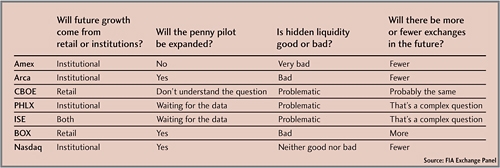
The heads of the seven U.S. options exchanges are an unruly bunch, but Anthony McCormick, vice president for equity options at Charles Schwab & Co., got quick answers out of them at the annual Futures Industry Association Expo in November. The panel speculated widely on the tremendous change and growth currently taking place in the options industry.

The questions were posed by McCormick, who moderated the panel in Chicago. The options execs in the line-up: Michael Bickford, American Stock Exchange; Edward Boyle, NYSE Arca Options; Bill Brodsky, Chicago Board Options Exchange; Sandy Frucher, Philadelphia Stock Exchange; David Krell, International Securities Exchange; Scott Morris, Boston Options Exchange; and Adam Nunes, Nasdaq Options Market.

(c) 2008 Traders Magazine and SourceMedia, Inc. All Rights Reserved.

http://www.tradersmagazine.com http://www.sourcemedia.com

On The Move

Christine Sandler joined NYSE Euronext as senior vice president, North American sales. Sandler will be responsible for all aspects of the company’s sales and marketing efforts to buyside and sellside customers. She will oversee client relationships, manage the sales team, plan and execute marketing activities, and lead cross-selling activities for the company’s full suite of equities, fixed income, derivatives and market information products throughout North America. Sandler will report to Larry Leibowitz, executive vice president and chief operating officer, U.S. products.

Sandler joins NYSE Euronext from BLOCKalert, a joint venture between Merrill Lynch and Investment Technology Group, where she led sales efforts for its block-trading indications system. Prior to joining BLOCKalert, Sandler was a managing director and head of U.S. electronic sales for Merrill Lynch. In this position, she led active cross-selling initiatives and was responsible for marketing global electronic products to U.S. institutional clients. Before joining Merrill Lynch, Sandler was head of sales at Wave Securities.


Bill Fallon joins GL Trade NY as senior vice president of the sales trading and connect unit. He’ll be responsible for selling GL’s suite of front-end, connectivity and value-added plug-in products for the buyside and sellside. GL products connect to 135 different markets, both domestic and international, as well as across asset classes that include cash equities, options, futures and derivatives. Fallon will be based in New York. He brings more than 20 years of financial services industry experience.

Prior to joining GL Trade, Fallon headed the OMS division of NYFIX, where his responsibilities included the launch of the Renaissance Market Making System, along with NYFIX Fusion. Before that, he was vice president of sales for SunGard Trading Systems’ BRASS.


Kay Lackey joined the Securities and Exchange Commission as associate regional director in the New York office. Lackey will oversee and manage the SEC’s enforcement program in the New York area. A 12-year SEC veteran, Lackey was previously an assistant regional director of enforcement in New York. Lackey replaces Helene Glotzer, who quit to join Bridgewater Associates of Westport, Conn.


Kristian West joins JPMorgan Asset Management as head of trading strategy within the firm’s European trading team. He will be responsible for finding optimal strategies to execute client account orders at the lowest transaction costs. Formerly, West was head of European execution at Barclays Capital, where he served the hedge fund community in equities, foreign exchange, ETFs and index futures. West is based in London and reports to Daemon Bear, head of trading.


Philip Adesso joined Dow Jones & Co. as a salesman for the firm’s quantitative news-based products. Adesso, a longtime market maker, was most recently a sales trader on the program trading desk at TradeTrek Securities.


Glenn Wilson joined Cogent Consulting last month at the firm’s new London office, where he will head the commission management firm’s sales effort in Europe. Wilson, who has marketed financial services products at various firms, is targeting both the buyside and sellside, due to the increased usage of commission-sharing arrangements.


Pyramis Global Advisors, the institutional arm of mutual fund giant Fidelity Investments, has added five people to its equity trading and operations team, which is run by Michael McCauley, head of trading.

Ian Baker joins from Wellington Management Co. as vice president of derivatives and risk management. Baker, a 20-year veteran, will oversee derivatives trading and monitor risk management and compliance.

Scott Lysko, a 15-year veteran, joins Pyramis as a senior trader. Lysko’s specialty is trading international equities. Lysko was previously a vice president at Boston-based MFS Investment Management, where he had managed a team of five international equity traders since 2005.

Eric Yi brings about 16 years of investment industry experience to his new role as senior trader. For the past six years, he served as a principal on Barclays Global Investors’ equity trading desk in San Francisco. Yi has focused on quantitative program trading and technology platform development.

Roseann McDermott joins Pyramis as a trader. For the past three years, she worked in Boston at CIBC World Markets as a sales trader and sales trading assistant.

Nichole Theroux, with Fidelity since 2001, joins as vice president, trading operations manager. Since 2005, she’s served as director of the firm’s investment strategy department.


Mark Esposito launched Esposito Securities, an institutional brokerage headquartered in Dallas that specializes in electronic and algorithmic trading. A 15-year veteran of the securities industry, Esposito held senior managerial and production roles with Fulcrum Global Securities and Southwest Securities prior to launching his firm. He began his career at JPMorgan in New York.


Esposito Securities hired Nancy O’Hearn as a trader. She will help the desk source liquidity for clients. Prior to joining ES, O’Hearn was a managing director of prime trading at Banc of America Securities. Before that, she was director of trading at McKinley Capital Management and spent six years as a portfolio manager with Navellier & Associates. She works at the Dallas office, reporting to CEO Mark Esposito.


Meridian Equity Partners hired an equities sales trader and an options sales trader. Mark Zifchak joined as a senior equity sales trader. Previously a floor broker with Capital Institutional Services, Zifchak will continue on the floor. Alex Xethalis joined as an equity and options sales trader. Xethalis, previously with Rochdale Securities, works at Meridian’s options desk in lower Manhattan. Both report to Jon Acquafredda, a senior managing partner. William “Bo” Vastine joined order-management-system vendor Advanced Financial Applications as director of sales. Vastine was most recently the Eastern regional sales director for DTI/Knight, responsible for the direct-market-access sales team for the buyside.


Daniel Petrie joined Perimeter Financial Corp.’s New York office as a vice president in business development. Petrie, a former managing director in the area of equity order flow at the American Stock Exchange, will be introducing Perimeter’s electronic platform to trade Canadian equities, options and futures to buyside and sellside clients in the U.S.


New York-based Rochdale Securities is opening a branch office in downtown Red Bank, N.J. next month. The trading desk will open with five senior sales traders currently with the firm, according to Kevin Cassidy, Rochdale’s chief operating officer. The desk has room to expand to 12 sales trading positions at the office-which overlooks the Navesink River. At launch, the trading desk will be manned by Richard Bennett, Matthew Ruane, Keith Arnott, Dave O’Neill and Stephen Langan.

(c) 2008 Traders Magazine and SourceMedia, Inc. All Rights Reserved.

http://www.tradersmagazine.com http://www.sourcemedia.com