
Buyside Ups the Ante in Program Trading

0

Program trading is booming, but the share of flow reaching the sellside is in decline. With business up so strong overall, though, brokers don’t seem to mind. Armed with increasingly sophisticated technology, the buyside is doing more trades in-house, rather than shipping them out to brokers.

The steady change over the past year or so has begun to alter the relationship between the buyside and their brokers. The trend has also changed how execution management system providers design the buyside’s trading tools.

And when the buyside does send its orders to the sellside, it is increasingly bypassing the program trading desk and using the firm’s algorithmic trading services. “The buyside has grown substantially as more money has flown into their investment vehicles,” says Andrew Silverman, Morgan Stanley’s head of sales and distribution for electronic trading. “In order to handle the flow, we see many traditional money managers now utilizing program trading strategies.”

Do-It-Yourself

The trend of more do-it-yourself trading of single stocks is now expanding into the program business. Seven or eight years ago, industry pros say, buyside traders directed 100 percent of their program trades to sellside desks. Today that figure stands at about 75 percent.

Data gathered between November 2006 and February 2007 for the latest Greenwich Associates portfolio trading study showed that the buyside will trade 25 percent of all program trading volume itself this year, compared with 21 percent in the same period a year earlier. Although the buyside increased its level of self-trading for programs by 4 percent in a year’s time, which might not seem like much, that still represents a 19 percent increase.

The increase occurred at a time of exploding program trading volume. According to the Greenwich study, the average buyside shop saw a 50 percent increase in the dollar amount of program trading it executed in 2007, compared to the previous year.

Marketwide, total portfolio trading volume jumped 52 percent to $2.1 trillion, from $1.38 trillion the previous year, the study reported. Greenwich attributes these enormous increases to cost, and how institutions viewed the program business as a way to lessen their average cost of trading, or “blended rate.”

And according to the 135 institutional equity buyside desks the Greenwich study surveyed, program trades represented roughly half of their total equity trading volume.

Million-Dollar Trade

Program, or portfolio, trades are defined as those involving 15 or more stocks valued at more than $1 million. There are two kinds: agency, where brokers work baskets for a commission, or the buyside handles the order itself; and principal, where a broker commits capital and takes on the client’s risk at a predetermined price. Agency trades are the most popular, constituting roughly 75 percent of all executed programs.

The buyside’s move to handle more of its own trading-whether single-stock or program-is happening for a number of reasons, says David Liles, global head of electronic trading at agency broker Sanford C. Bernstein.

For one, the quality of the trading technology the buyside has at its fingertips in some cases now rivals that of the sellside. Another reason is anonymity. “The buyside wants to avoid having anyone else know what they are doing, and algorithmic trading has definite advantages over other execution methods in this area,” Liles says. Third, the desire for more control over a trade drove the buyside to use algorithms themselves. Finally, trading talent has been moving from the sellside to the buyside, Liles notes, so a lot of buyside traders have sellside experience. “If a buyside trader has the right tools and the right experience, he’s in a good position to take greater control of his order flow,” Liles says. And of course, cost is always important, he says in agreement with Greenwich’s findings. If a buyside trader takes on the responsibility for a trade, it should cost less.

Jeff Galloway, CFA, head of derivative and program trading at Houston-based AIM Investments, says his firm’s agency business in three years has shifted from being 90 percent handled by the sellside to being 90 percent self-directed. Program trades account for roughly 20 percent of the firm’s overall flow.

“By sending a particular program or order to a broker-dealer, you don’t have the capabilities for real-time data,” he says. “A portfolio manager would ask, How are we doing on XYZ program? What percentage are we done on? How are we doing versus arrival price?’ You’d have to call a broker-dealer and gather that information. Now, that information and data are available real-time at my fingertips.”

But many of the types of agency program trades the buyside is executing itself are either the very regimented, such as trading volume-weighted-average price every day, or the very routine, such as market-on-close trades, says Brian Fagen, head of electronic trading and program trading sales at Lehman Brothers.

“You still don’t see a lot of buyside firms handling more complex program trading situations,” he says. “Those are the agency trades that tend to end up on the sellside desks.”

Do It My Way

When the buyside hands a trade over to a broker to execute electronically, he doesn’t do it perfunctorily, according to Vijay Kedia, president and chief executive of EMS provider FlexTrade, in Great Neck, N.Y.

“They’re still using all the broker algorithms, but they control the delivery of the orders to the brokers much more actively than they used to,” he says. “It’s a combination of the buyside using algorithms to define the trajectories of when they want a program’s stocks to be executed, but at the same time, leveraging the right broker algorithm for each chunk at different times of the day.”

Despite fewer trades being handed off to brokers, the sellside says it is fine with all of this. The program trading business is evolving, they say, and their desks are evolving along with it. Some brokerages even say they are still seeing increased program volume at their desks.

Technology Improvements

At Morgan Stanley, among the three largest program trading houses on the Street, combined risk and agency volume was up80 percent last year from 2006, says James Harris, the firm’s head of program trading. A proportion of that growth resulted from significant improvements to its trading technology. In addition, the firm has seen a similar increase in list trading going directly to the algos, according to Silverman. “The ratio of what we’re doing in program trading-electronically versus our overall number-has risen twofold,” he says.

Morgan Stanley is not alone. With increased buyside algo usage, much of the agency program business has been leaving program desks to become the algo business at sellside firms. As the buyside started using electronic tools and executing trades long ago, sellside firms everywhere adapted and provided algorithms for baskets.

For its part, AIM Investments will always need the sellside for some agency program trades, Galloway says-but mostly for technical support, not execution. Galloway chooses between several strategies and more than 70 algos to execute orders. He needs the sellside to ensure that AIM’s algorithms work properly, that he has a thorough understanding of what each algo does and that he knows what algos different firms offer. The relationship changes, he says, but doesn’t disappear.

“At the end of the day, from my perspective, it is still a relationship business,” Galloway says. “People still like to talk to people.”

Vendors Respond

EMS builders also note that the increase of program trading on the buyside is affecting their product development. Although they serve both sides of the Street, EMS firms have gone to great lengths to take the buyside’s needs into account, Kedia says.

At FlexTrade, the buyside now represents almost two-thirds of its client roster, according to Kedia. His firm’s EMS development is more focused on buyside-specific requirements-such as trade-cost analysis and the ability to design customized algorithms, as well as portfolio-level algorithms using various models.

“In terms of [FlexTrade’s] research efforts spending,” he adds, “it’s more on the buyside now, relative to the sellside.”

Buyside traders have been looking for advances in portfolio algorithms to take even more control of their orders. According to a 2007 TABB Group report on institutional equity trading, 65 percent of large-and 60 percent of midsize-buyside firms say they are using portfolio algorithms, either themselves or, more commonly, through their brokers.

Algorithms trace their origins to program and proprietary trading desks. Fittingly, a majority of bulge bracket and other large brokerages have been busy developing better portfolio algos-the next level in the algo space.

According to TABB, they are designed to execute “a strategy based upon selected correlations of multiple assets-assets relative to one another, to benchmarks or to hedging instruments.”

Portfolio algos that balance buys and sells or excel at maintaining specific neutralities, like balancing sectors, potentially could push more agency volume into the electronic camp, says Lehman’s Fagen. But because many portfolio algos are relatively difficult to use, he adds, complex agency orders will still reach sellside desks to tap their high-touch proficiency.

SIDEBAR to Main Story:

Joined at the Hip

Large brokerages have seen increased algorithm use in the portfolio business push their firms’ electronic and program trading desks into closer alignment. At those firms, the trend has led to gains in efficiency and reduced costs.

Programs and algorithms are closely intertwined on the electronic trading desk at Sanford C. Bernstein, says David Liles, its global head of electronic trading, a department which encompasses both. This two-pronged coverage has allowed his desk, which was formed almost five years ago, to integrate its pre-and post-trade analytics tightly with its algos and other quantitative trading tools.

“It’s a little more of an integrated effort than you’ll find at some other firms, and it works to our advantage,” Liles says. “It’s not two competing groups with different agendas trying to pull clients in multiple directions.” Both desks were growing in 2007, he notes. But Bernstein’s algo business has been growing noticeably faster than its program business.

Merrill Lynch has also seen the two desks grow together, says Bill Stush, a director within portfolio and electronic trading. The firm runs both a portfolio and an electronic desk, but considers them to be one functioning unit with the same product and sales management team. And when a program order comes to Merrill Lynch, there’s no fighting between the two for it. “The order and client direction should decide the execution venue, not a particular coverage group,” Stush says.

And algorithmic trading has been filtering down to the mid-size, lower-volume brokerages that do programs, because it’s proven more cost efficient, says Jay Bennett, Greenwich Associates’ managing director. Accordingly, he’s seen more mid-sized firms combine their program and electronic desks. By James Ramage

(c) 2008 Traders Magazine and SourceMedia, Inc. All Rights Reserved.

http://www.tradersmagazine.com http://www.sourcemedia.com

Aleri Tailors Market Analysis

The technology to aggregate multiple order books has gotten more powerful, according to one vendor. Complex event processing software provider Aleri designed its Market Liquidity Analysis engine to let firms analyze market depth in a new way to help them trade better.

Specifically, the tool consolidates multiple order book feeds from individual exchanges and ECNs to create a virtual market book. Brokers and traders can apply rules to the consolidation, such as price offsets to eliminate differences in trading costs or other behaviors of different venues, says Jeff Wootton, vice president of product strategy at Aleri.

Users can also apply algorithms to their virtual order book to better determine where, when and how to execute orders, Wootton says.

______________

(c) 2008 Traders Magazine and SourceMedia, Inc. All Rights Reserved.

http://www.tradersmagazine.com http://www.sourcemedia.com
Boosting Securities Lending at Quadriserv

0

Former Nasdaq and CIBC World Markets trading executive Bruce Turner was once part of the solution that helped over-the-counter equities become more efficient. Now he hopes to do the same for securities lending. Turner, a rabid Boston Red Sox rooter, likes underdogs who overachieve. His journey has taken him from one of the biggest trading houses, CIBC, to a relatively small securities lender, Quadriserv. He says he likes the challenge of serving a niche business at a small firm.

In an interview with Traders Magazine, Turner says he now has a chance “to remake a business.” Turner, who serves as managing director and chief operating officer at Quadriserv, thinks he will once again have a chance to make as dramatic a difference as he did with OTC.

Quadriserv was founded in 2001 by a group of prime brokerage veterans. It offers a broker-neutral securities lending platform.

Overpaying

So at a time when many securities lenders’ clients are calling for an electronic market place that will save them from paying dearly whenever they need an illiquid stock, Turner is attracted to securities lending because he thinks his firm will move the market toward more efficient electronic standards, he says. “Securities lending is exciting because it’s the convergence of a few different opportunities. These include improved technology, the creation of a tradable asset class and a general chance to improve the quality of markets for public investors.”

He says Quadriserv is offering services that will persuade hedge fund managers that securities lending isn’t a rigged game. Turner has a daunting task ahead of him. According to a recent report by the consulting Vodia Group, 27 percent of hedge fund managers believe they “are overcharged on securities lending rates by their prime brokers.” And 77 percent of poll participants say they want securities lending to become electronic at a time when much of the business is done by phone.

Some may be reminded of Nasdaq in the 1980s. That’s when Turner began his career with stints at Oppenheimer & Co. and Salomon Brothers. This is where Turner hopes his expertise, running trading desks and spending a year at Nasdaq overseeing SuperMontage, will be useful.

Turner says Quadriserv is seeking to connect lenders and borrowers “in more innovative ways.” Transparency, in and of itself, will not improve the securities lending business, he says. “Borrowers need a way to find the intrinsic value of a daily stock-lending rate and borrowers need to find the true cost of their shorts,” he says.

It’s Coming

Turner also acknowledges that many securities lenders expect that some form of electronic-screen-based trading is inevitable, a sentiment supported by the Vodia Group report.

“Most participants ultimately accept the ascendancy of electronic bid-ask markets but few custodians or brokers want to be the first to embrace them,” the report says. The report predicts that brokers will open up electronic markets to a range of hedge funds “very shortly.”

Quadriserv hopes to solve many of these problems with ProQure, its Web-based application service designed for both lenders and borrowers of securities. Those include hedge funds, long-only funds, 130/30 funds and custodians. The service also has historical data so that managers can see what has been happening in the stock loan rebate market.

Lenders pay an agreed-upon rebate rate on the cash collateral received in stock lending. An agreed upon rebate rate for transactions is based on the Federal Funds rate and is adjusted daily as the rate changes. This is important, Turner adds, in convincing hedge fund managers that they can receive fair value in securities lending.

“We want people to see what is happening in the loan rebate market for a security. You can see that the rate changes based on corporate action or the fundamentals of the stock, etc.,” Turner says.

This is not a complete screen-based-electronic lending service but it is a step in that direction, Turner points out.

Still, Turner says the industry shouldn’t make a fetish of screen-based, electronic lending. Instead, he says it should focus on ensuring that hedge fund managers and others using securities lending can understand how rates frequently move.

ProQure will help the client find the hard-to-borrow stock, increasing the number of transactions and creating volumes of scale, he predicts. Securities lending, Turner ultimately hopes, will follow the same path as Nasdaq trading.

Declining Costs

Turner says the Nasdaq issues saw transaction costs decline dramatically. “If more people come into a market because they have a better sense of execution capability and insight into it, then the market will grow,” Turner says. He hopes his extensive experience in trading OTC issues will help.

Turner, 43, developed an expertise in market structure during various stops in the trading big leagues, including Salomon Brothers/Citigroup, which went from a 25-person trading desk to 125 as the firm evolved into a unit of Citigroup.

By the time he left Citi, the desk was trading about 1,000 Nasdaq stocks. Besides running the desk, he was also responsible for the development of new trading products. At Salomon/Citigroup in the late 1990s, Turner was also investigating market structure technology issues in Nasdaq trading and looking at execution issues in general.

The late 1990s was a time of dramatic regulatory changes. It was the time of the order handling rules. Trading executives had to cope with massive technological change.

“I felt like I understood it and I had interesting thoughts and theories about how it should work,” Turner says.

So Turner, during his Citi stint, developed an expertise in how the OTC market would become electronic. He was put on Nasdaq’s Quality of Markets committee. The committee developed Nasdaq’s trading rules and technologies.

After that, he was recruited by the exchange to take over a high-profile project. At Nasdaq in 2001, Turner ran SuperMontage, which was supposed to be a next-generation trading system. It was designed to replace the Nasdaq Workstation II, by attracting more liquidity to the market. SuperMontage was an order display and execution system that was going to give traders the best, most up-to-date, information from multiple parties, including market makers and ECNs.

But Turner stepped into the middle of a debate over whether Nasdaq, which was in the process of separating from its regulator parent, the NASD, was using the SuperMontage to exert monopoly power. Nasdaq and its competitors waged regulatory war.

Some arguments were over “arcane” issues such as order delivery versus order execution for ECNs, Turner says. The debate resulted in an extensive amendment process at the Securities and Exchange Commission.

Placating

The reality is some of those amendments were probably filed to placate people,” Turner says. In the end, Nasdaq spent over $100 million to develop SuperMontage. It then scrapped the system when it got the Island ECN as part of its acquisition of Instinet.

But in the spring of 2002, Turner was recruited by CIBC to put his “thoughts and theories” into action.

Here was the chance to take much of the knowledge he had gained while working at Citi and put them it practice. In the spring of 2002, Turner began a four-year run with CIBC, running its U.S. equity and sales trading. There he supervised electronic trading, including program and direct- access trading. Yet after four years, Turner suddenly decided he needed to go back to school for an MBA “I wanted to expand my opportunities, and one of the ways was to further my education,” he says. He insists that he didn’t pursue his MBA because he believed his career path was blocked.

“I just wanted to round out my skills sets and get some other experience. This was a way of doing that,” he says. Now he hopes to combine his knowledge and education in an effort to help another underdog do what his beloved Red Sox have done over the past few years. And woe to those who walk away from his underdog.

Turner now uses his autographed jersey of Johnny Damon, who left the Sox to sign with the Yankees for big bucks, as a rag to wash his car.

(c) 2008 Traders Magazine and SourceMedia, Inc. All Rights Reserved.

http://www.tradersmagazine.com http://www.sourcemedia.com

GE Asset Looks to Close the Information Loop

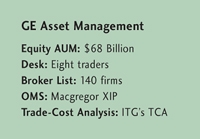
After 21 years at GE Asset Management, Damian Maroun has developed a good sense of what’s expected from the trading desk. The senior vice president of global equity trading says his desk must provide information that gives portfolio managers an edge in today’s marketplace.

To that end, his team of three domestic and five international traders-and one junior trader-created a system called IHub to better manage information flow and generate discussions between PMs and traders about the market. “We’re considered a part of the investment process,” Maroun says. “We really understand how a manager’s portfolio changes.”

The IHub system lets the desk share information with PMs about various global markets and specific stocks, as well as news that could affect their holdings.

“It’s a repository of data, with a front end that allows traders to input the information and a back end that allows us to aggregate that data in many different ways,” he says. “Now, we’re trying to get a PM or an analyst to put his spin on that information.” The next step is to share the PM’s thoughts with the rest of the stock-picking team.

Commissions and electronic trading are other areas that continue to evolve. GE benefits from client commission arrangements. It has been able to pare its list of 200 mostly research brokerage relationships down to about 140, with 70 brokers in the U.S. and another 70 abroad. But of those, it trades with only about 20 firms.

“Because we’re a large-cap-driven firm, we lean more toward the large-cap brokers,” Maroun says. Still, GE trades with a “core stable of specialty brokers.”

High-touch trading still lives at GE. The desk executes about 70 percent of its orders through traditional means via high-touch brokers. That means the other 30 percent are done electronically, but Maroun expects that to grow. “Electronic trading will become a bigger part of our business,” he says. That’s already a huge increase from the 5 percent it executed electronically five years ago.

He is particularly high on block trading’s electronic future-especially with BIDS Trading, the broker consortium that’s half-owned by NYSE Euronext. Maroun sees BIDS as one of a few key players going forward in the crossing space. “If (BIDS) provides liquidity in the process of being able to do larger blocks, with more anonymity,” he says, “I think it would be a positive thing.”

The GE trading desk has about 100 algorithms to choose from. About 10 percent of the list gets most of the business, Maroun says, particularly those algos that are adaptable, can react to the market and can aggregate displayed and non-displayed liquidity.

Maroun likes the desk’s new tools a lot. But whether he’s talking about his OMS or algos, all trading tools are fortified by experience. “In the old days, if you had 10 orders coming to your desk,” Maroun says, “your algorithm was a strong relationship with a broker.”


(c) 2008 Traders Magazine and SourceMedia, Inc. All Rights Reserved.

http://www.tradersmagazine.com http://www.sourcemedia.com

ECN Puts Canadian Spreads on a Diet

Spreads are too wide in Canada, according to one broker, so there’s money to be made from them. Perimeter Financial introduced a new ECN-like maker-taker marketplace there to help traders access them. The Toronto-based Perimeter launched Omega ATS to attract those hoping to narrow spreads for inter-listed securities-those Canadian stocks that are listed and trade in both the U.S. and Canada.

The plan echoes the U.S. Nasdaq market’s past. Overly wide spreads were a problem in the mid-’90s because of the actions of Nasdaq dealers. In Canada, their specialist equivalents-called registered traders-are expected to keep bid-offer spreads wide. Enter Perimeter’s Omega ATS.

“We saw an opportunity to allow people who wanted to narrow the bid-ask spread for business-and there are lots of those guys in the U.S.-to come up to the Canadian market and do the same thing here,” Doug Steiner, Perimeter’s chief executive, says. Omega ATS is the first ECN-type marketplace in Canada: Pure Trading, also in Toronto, offers a similar maker-taker model.

Omega supports securities listed on both the Toronto Stock Exchange and a U.S. exchange, and lets its customers trade at the Canadian best bid and offer. By the end of the month, Steiner says, it will support the full set of inter-listed symbols-just under 300.

Omega will use a liquidity rebate in Canada that is significantly above the liquidity taker fee in the U.S. to lure those interested in arbitraging maker-taker rates in the U.S. and Canada, according to Steiner.

“There’s a big business in people making sure that, given wherever the foreign exchange is, they can buy on one marketplace and sell on another and make a little bit of money,” he says.


(c) 2008 Traders Magazine and SourceMedia, Inc. All Rights Reserved.

http://www.tradersmagazine.com http://www.sourcemedia.com

FTEN Monitors Bad Behavior

0

As trading gets ever faster, compliance with new regulations can get tougher for prime brokerage and clearing firms. But application service provider and technology firm FTEN designed a new compliance surveillance system, named TradeXaminer, to help.

TradeXaminer enables prime brokers and clearing firms to monitor trading activity for suspicious behavior to ensure that it meets securities industry regulators’ existing and future compliance mandates. In doing so, TradeXaminer allows FTEN’s customers-large and medium-tier clearing and prime brokerage firms-to expand trading volume while they simultaneously observe trading activity either at the end of the trading day or in real time. The system watches for trades that fall under prohibited trading patterns, such as fictitious trading, wash orders or large groups of trades at the open or close of the markets, says Ted Myerson, president of the New York-based FTEN.

“TradeXaminer handles a criteria of reporting tools that the clearing firms use to be in compliance with FINRA,” Myerson says, “but also has a set of reporting tools to give them a finer level of data that’s same-day, rather than at some later time, and all in one place.”

Last month Penson Financial Services, the broker-dealer and clearing services subsidiary of Dallas-based Penson Worldwide, implemented TradeXaminer for its more than 250 broker-dealer customers.


(c) 2008 Traders Magazine and SourceMedia, Inc. All Rights Reserved.

http://www.tradersmagazine.com http://www.sourcemedia.com

The Big Boy Dilemma

0

In many ways, the SEC’s action against Steve Landzberg, a bond trader at Barclays, was a typical insider trading case. The SEC alleged, and Mr. Landzberg consented to judgment without admitting or denying the SEC’s allegations, that he traded distressed bonds while in possession of material nonpublic information received while a member of six creditors committees.

The case is nonetheless sending tremors through the securities bar. Some of the purchasers that Mr. Landzberg allegedly defrauded signed “big boy letters.”

In a big boy letter, a purchaser acknowledges that the seller has inside information that will not be disclosed, but states that it will nonetheless buy the security at the price offered, waiving any legal claims based on the information disparity. Big boy letters are not used to make retail sales; the name derives from the fact that these are trades among sophisticated institutional investors. Big boy letters are useful where, as in the Landzberg case, the seller has signed a confidentiality agreement with an issuer, but a willing institution wishes to purchase the securities without knowing the information that is blocked from disclosure by the agreement.

The disclosure of possible inside information in a big boy letter is intended to eliminate the reliance requirement that is essential to a Rule 10b-5 violation. When a purchaser is warned that the seller has inside information, and is sophisticated enough to understand the warning, it is difficult to argue that the purchaser relied on the information and was thus deceived by it. Nonetheless, the SEC appears to be taking the view that a big boy letter is not sufficient to overcome a 10b-5 violation.

In recent conferences, SEC staff members have suggested that their approach to big boy letters is based on a misappropriation theory. The idea would be that the seller, having agreed to keep the information confidential, would be misappropriating the information from the source of the information. And, it is true that the courts have held that, to find liability for insider trading, there must be proof that the trader had an obligation to someone not to misuse, and hence “misappropriated,” the information. However, this does not mean that misappropriation, by itself, is a violation of federal securities laws. Rule 10b-5 prohibits deception, not misappropriation.

The difficulty is that the information a seller has might not mean much to the buyer. The buyer of a 1929 Dusenberg probably doesn’t care about the seller’s knowledge that the odometer reads incorrectly. The purchase is based on other factors. Similarly, if the material nonpublic information known by the seller doesn’t make any difference to the buyer, what useful purpose is served by preventing the trade?

The preceding story was contributed by Stephen J. Nelson of The Nelson Law Firm LLC. To comment on the story, contact Stephen Nelson at sjnelson@nelsonlf.com.

Only Biggest Stocks May Be on the Table Under SEC’s Mutual Recognition Plan

0

The Securities and Exchange Commission should allow only foreign securities with a “broad market following” to be traded by U.S. investors under a mutual recognition regime, according to a top SEC official. The official said the minimum threshold should be companies with a global market capitalization of at least $700 million.

John W. White, director of the SEC’s Division of Corporate Finance, said last week in a speech in London that the SEC could use the market-cap definition of well-known seasoned issuers, or WKSIs, as the basis for deciding which foreign companies’ securities can be accessed directly by U.S. investors through foreign exchanges or brokers. The SEC defines WKSIs as large issuers with either $700 million in worldwide market cap or $1 billion in non-convertible securities issued in the last three years.

“Mutual recognition” is the SEC’s plan-in-progress to make U.S. investor access to foreign markets easier. According to current SEC discussions about mutual recognition arrangements, “foreign brokers and exchanges from selected jurisdictions would be allowed to operate in the U.S. without registration under certain circumstances,” White said on Wednesday in San Diego. Mutual recognition, he added, is “premised in large part on a determination that a foreign regulatory regime provides comparable protections and results to those afforded to U.S. investors under our securities laws.”

Currently, foreign securities offered in the U.S. to investors must be registered in the U.S. and traded on a registered U.S. exchange. Institutions are able to trade foreign securities abroad or through U.S. brokers with foreign affiliates, while retail customers can trade foreign securities primarily through foreign brokers. However, going through foreign intermediaries increases the cost of trading those stocks, according to the SEC.

White’s proposal doesn’t go as far as NYSE Euronext would like. In mid-2007, the exchange group suggested that the SEC allow all foreign securities traded on exchanges in jurisdictions approved for mutual recognition to be accessible to U.S. investors. “My short list would be we should go forward with mutual recognition of [companies’] registration statements,” said Catherine Kinney, president of NYSE Euronext, at an SEC-sponsored roundtable on mutual recognition last June. However, the SEC’s top corporate finance official appears disinclined to go that route.

White added that the SEC should also curtail U.S. investor access to new issues. “It would also seem appropriate, again at least initially, to limit access to those companies with an established track record of stock trading and public disclosure, such as those that have been public for at least a year or six months,” White said at last week’s Practicing Law Institute conference in London.

White noted that the SEC has so far focused on exchanges and brokers in its discussions about mutual recognition. Standards for issuers should also be part of the discussion, he said. In his view, there should be “comparability of issuer disclosure,” including annual disclosure documents. White also said the SEC should consider corporate governance and issuer standards, such as whether foreign companies–or the home country regulator or exchange–require foreign companies to treat U.S. investors “equally with home country investors, or equally with other foreign investors.”

SEC to Consider New Options Linkage Arrangement

A proposal to revamp the rules and systems that link the options exchanges is at the top of the Securities and Exchange Commission’s agenda.

Dan Gray, the market structure counsel in the SEC’s division of trading and markets, said recently a proposal from NYSE Arca and the International Securities Exchange to revamp the options market linkage plan to reflect Regulation NMS principles is “an important market structure issue on the Commission’s agenda for 2008.”

Speaking at the Security Traders Association of Chicago’s annual conference last month, Gray noted that the proposal was driven by the penny pilot now underway in the options market. The pilot, which permits quoting in penny increments, has exposed some weaknesses in the existing options plan, Gray said.

The ISE and NYSE Arca want to replace the existing plan with a new one, based on three principles of Reg NMS–trade-through protection, private linkages and intermarket sweep orders.

Unlike the equities markets, the current options linkage plan does not provide market participants with an effective means to trade in large size by efficiently sweeping multiple price levels at multiple exchanges, the exchanges argue.

“For institutional investors that need to trade in large sizes beyond what may be displayed at the NBBO in penny markets,” Gray noted, “the inability to obtain ready executions at multiple price levels could be a serious issue.”

Gray wouldn’t comment on the direction the SEC will take, but emphasized that there are differences between the structures of the equities and options markets. One cannot assume, Gray said, that what works in the equities market is applicable to the options world.

A Benevolent Deity?

0

I’m by no means a protectionist. I wasn’t the least bit concerned back in 2006 at the prospect of Dubai Ports World owning select U.S. docks, and I’m more inclined to yawn than blink at the billions being thrown around by the sovereign wealth funds of countries like China, Abu Dhabi and Singapore. In fact, I’d rather those countries bail out our banks than place it on the shoulders of Tommy and Tina Taxpayer.

With that said, I don’t understand why we’re making it so easy for them. Our addiction to rate cuts and our dependency on the Fed has undoubtedly spawned inflation (which I’ve discussed in previous posts), yet nobody wants to link it to the low interest rate.

Why would they? It would mean that we’re not quite as clever as we think. And this latest cut, a surprise move that chopped 75 basis points off of the federal funds rate, reeks of panic in my humble estimation.

On one hand, we had George Bush politicking in Saudi Arabia last week for cuts in oil prices, and on the other, we have the stock market celebrating Ben Bernanke’s best impression of Edward Scissorhands. (After a 460-point drop Tuesday morning, the stock market reversed course following the FOMC’s trimming.)

Wouldn’t the companies who make up the Dow Jones Industrial Average be better served by a stronger dollar that ultimately lowers commodity prices? How about a consumer who isn’t cutting their budget so they can afford milk for their cereal? I’d bet at least some of those savings would find their way to Sears, or other struggling retailers.

And didn’t Japan prove that low interest rates aren’t necessarily a long-term fix? The country’s central bank maintained a 0% interest rate for six long years.

We’ve just experienced a stretch of dipsomanic spending, fueled by a fabricated debt market, an intemperate housing boom and a government that maintains a budget no better than M.C. Hammer. Sorry people, but it’s not as if we deserve a free pass.

Rate cuts may stave off a downturn in the immediate term, but they’re weakening our dollar to the point that we make for an easy target. It’s the same way that Excedrin cures headaches, but it never helped ace an exam if the two previous evenings were spent engaged in beer die and flip-cup tournaments.

I’ve vouched before that I’m not an economist. However, I’d love to see the Fed hold the line and make us go cold turkey on this one. We’re capitalists. That used to mean something. And I’d still like to believe the market can take care of itself if left to its own devices…

… and, if I’m wrong, well, Fed Chairman Ben does seem like a benevolent kind of deity, doesn’t he?


The preceding story appeared in Wednesday’s issue of Merger Mogul, a weekly e-newsletter covering M&A. To sign up for this e-newsletter, please visit www.mergersunleashed.com and register. For editorial inquiries please contact Danielle Fugazy at danielle.fugazy@sourcemedia.com.