

Tradebot’s Cummings Says Large Trader Rule Ill Conceived

In response to the recent Traders Magazine article HFTs Give Thumbs Up to Proposal, Tradebot Systems’ Dave Cummings shared his thoughts on why the Large Trader rule proposal is a bad idea.


Dear Traders Magazine,

I’m sure there are people on both sides of the issue, but as one HFT I think creating a huge government database of confidential information is a horrible idea because:

They estimate it will cost $25 billion over 10 years ($4 billion startup, $2.1 billion per year for operations). This will somehow need to be paid for by investors.  

"Therefore, for all SROs and members, we estimate that the total one-time aggregate cost to implement the proposed Rule would be approximately $4 billion and the total ongoing aggregate annual costs would be approximately $2.1 billion." See page 48 from the SEC Rule Proposal.

This has ‘big brother’ written all over it.  How can we be sure the government will not conduct endless investigations of political enemies?  Even when there are legitimate trades, the legal bills to defend yourself will be huge. 

Some firms hire SEC employees for their knowledge (i.e. Elizabeth King goes to Getco).  Why should they have full access to our trading strategies across all markets, and then be allowed to join a competitor?

People are hesitant to publicly criticize the SEC proposal because they fear they will become a target for harassing investigations once the database is up and running.


Dave Cummings

Chairman of the Board

Tradebot Systems, Inc.

Commentary: The “Foreign-Cubed” Equation

Let me begin by calming the nerves of anyone who thinks "foreign-cubed" is a long-forgotten high school algebra equation. I promise there will be no math in this column. "Foreign-cubed" refers to a securities class action brought in the United States by (1) foreign investors, against (2) a foreign issuer, regarding securities purchased or sold on (3) a foreign exchange or a foreign securities market. Plaintiffs in foreign-cubed actions seek to bring their claims in the U.S. courts to take advantage of relatively liberal U.S. class action law and the potentially larger damage awards here than in their home countries. 

Foreign-cubed litigation gained notoriety earlier this year when the U.S. Supreme Court heard a prime example of such a case, Morrison v. National Australia Bank. The Morrison case highlights the myriad legal and public policy questions raised by foreign-cubed cases, and a surprising proposal made by the SEC may offer a workable solution. 

In Morrison, Australian investors sued the National Australia Bank (NAB) for losses suffered through trading on the ASX, an Australian exchange. The plaintiffs allege that fraudulent financial reporting by the bank artificially inflated its stock price, which later dropped when the fraud finally was revealed. The investors claim that the fraud took place in the United States, through intentionally misleading financial statements prepared by the bank’s Florida subsidiary, thereby implicating U.S. law. The bank argues that any potential wrongdoing took place in Australia, where the financial statements were compiled and reviewed, and that the case should be thrown out of the U.S. courts.

Like most foreign-cubed cases, the original Morrison plaintiff class included both U.S. and foreign investors. Courts generally agree with the common sense notion that claims by U.S. investors who purchased securities on a U.S. exchange should be subject to U.S. law, even though the defendant may be a non-U.S. resident. Courts often utilize something called the "effects test" to determine whether the United States has enough of an interest in a case for domestic law to apply–when the fraudulent activity has an effect on domestic investors purchasing securities on domestic exchanges, then the courts allow U.S. law to be used to protect U.S. citizens and markets. 

In Morrison, the named plaintiff was a U.S. investor who purchased the bank’s ADRs on the New York Stock Exchange. NAB never questioned U.S. jurisdiction over Morrison’s own case, but his claim was dismissed early in the proceedings on other grounds. That left only foreign plaintiffs complaining about losses on a foreign exchange. With no U.S. investors or exchanges any longer involved, the effects test did not apply. 

That left the courts with the job of determining whether the allegedly fraudulent conduct in Florida was significant enough to warrant the United States’ exercise of its jurisdiction. That determination is typically called the "conduct test," where courts evaluate how much of the conduct contributing to the fraud actually occurred in the United States. Nationally, judicial interpretations of the conduct test have been inconsistent. The two lower courts that heard Morrison interpreted the conduct test to mean that U.S. jurisdiction exists "if activities in this country were more than merely preparatory to a fraud and culpable acts or omissions occurring here directly caused losses to investors abroad." Not exactly a clear or easy standard for courts to follow. Both lower courts then concluded that the conduct in Florida was "merely preparatory" and ultimately was not the "direct" cause of the fraudulent activity. 

The Supreme Court must now evaluate the lower courts’ application of the conduct test and weigh the competing public policy concerns.  The Supreme Court will be asked to consider whether the conduct test was the proper standard, or whether the lower courts should have applied some other method of determining whether U.S. jurisdiction was warranted.  If the Court decides that the conduct test was the right test, then it will have to determine whether the lower courts properly interpreted and applied the conduct test.

Both sides believe they have strong public policy arguments in their favor, and both presented suitably eloquent legal arguments to the Supreme Court. Plaintiffs’ supporters asserted that when an issuer lists its securities on a U.S. exchange, subject to stringent U.S. disclosure requirements, investors have a heightened level of confidence that leads to an increase in the issuer’s stock price. Confidence that U.S. law protects shareholders attracts more investors to the U.S. markets, which in turn benefits the U.S. economy. Thus, they argued that if the Supreme Court rules that foreign-cubed claimants are not entitled to the protection of U.S. law, foreign investors may flee from our markets, taking much-needed capital with them. Moreover, the U.S. courts’ dismissing foreign-cubed cases would embolden international criminals to commit fraud in the United States, knowing that they likely will not be subject to U.S. legal action. 

NAB’s supporters countered that subjecting an issuer in a foreign-cubed case to potential U.S. securities liability will cause foreign companies to delist from U.S. exchanges and to cease their U.S. business operations, which could devastate the U.S. economy. They argued that United States involvement in foreign-cubed cases would frustrate foreign governments’ efforts to enforce their own securities laws, and would allow foreign plaintiffs to circumvent the laws of their home countries by forum-shopping for plaintiff-friendly regulatory regimes. Several nations filed briefs with the Supreme Court in support of NAB’s position, including Great Britain, France and, appropriately, Australia. 

The SEC, on behalf of the U.S. government, has also taken an active role in Morrison, but its position took a peculiar turn as the case worked its way to the Supreme Court. In the lower courts, the SEC supported the plaintiffs, arguing that the conduct in Florida was substantial enough to warrant U.S. jurisdiction. That viewpoint surprised no one, as the SEC would understandably wish to have jurisdiction to bring its own legal action against similar frauds in the future. 

At the Supreme Court, however, the SEC reversed its position and surprisingly supported NAB. The SEC’s new and more nuanced argument supports the dismissal of Morrison, while simultaneously advocating for SEC jurisdiction over similar cases in the future. The SEC reasoned that for private lawsuits, such as a class action by investors in a foreign-cubed case, something similar to the version of the conduct test used by the lower courts in Morrison should apply. Under that test, the SEC agreed with the courts below that the Morrison claim should not be tried in the United States because the plaintiffs cannot show that their losses were "directly" caused by any fraudulent activity that took place in Florida. 

However, the SEC also proposed a new, more relaxed version of the conduct test for determining whether the type of fraud alleged in Morrison violates Section 10(b) of the Exchange Act. The SEC believes that such fraud violates Section 10(b) if "significant conduct material to the fraud’s success occurs in the United States." The SEC’s test may be just as subjective and difficult to apply as the "more than merely preparatory" and "direct cause" interpretations used by the lower courts in Morrison, but it seems clear that the SEC’s "significant and material" standard would lower the bar in applying U.S. jurisdiction for enforcement actions by the SEC. 

The SEC maintained that the alleged fraudulent conduct by NAB in Florida meets the "significant and material" test, which would allow for an enforcement action against NAB. Moreover, the SEC argued that applying different standards to private lawsuits than to SEC enforcement actions would address the competing public policy concerns presented by the parties and their amicus curiae supporters. 

Addressing the concerns of those siding with the Morrison plaintiffs, the SEC argued that a more lenient jurisdictional standard for SEC enforcement actions would provide assurance to foreign investors that the SEC could protect against U.S.-based fraud. Thus reassured, foreign investors would continue to invest in foreign companies listed on U.S exchanges and in foreign companies with U.S. subsidiaries, saving the U.S. markets and U.S. economy from ill effects. The SEC’s solution also would tend to deter potential fraudsters from engaging in unsavory conduct in the United States, because they would fear the enforcement might of the SEC. 

On the other hand, Morrison’s dismissal also would ease the public policy concerns of NAB’s supporters. Secure that the United States would not grab jurisdiction over a foreign-cubed private class actions like Morrison, foreign issuers would continue to list securities on U.S. exchanges and to operate U.S. subsidiaries. Foreign investors could not circumvent issuer-friendly regulatory regimes in their home countries by bringing securities cases in the more investor-friendly environment of the United States. 

The SEC’s solution might just work, provided that the SEC actually is vigilant about enforcing U.S. laws against fraudulently activity that affects foreign investors. The policy in favor of private rights of action recognizes that the SEC can’t do it all: directly affected individuals can assist the government’s overall goal of compliance with the securities laws, and increase the total amount of resources applied to the prosecution of fraud claims, if they are allowed to bring their own suits against fraudsters at their own expense. However, forum-shopping is a problem, and the standards applicable to foreign-cubed claims have long been dangerously unclear. Parties to these litigations, including legitimately aggrieved plaintiffs, have spent countless legal dollars arguing over U.S. jurisdiction without ever getting to the merits of their cases. While not without its flaws, the SEC’s proposal in Morrison may be the most equitable solution put forth yet. The Supreme Court will soon provide its solution to the foreign-cubed equation.


Daniel Zinn is a principal of The Nelson Law Firm in White Plains, N.Y. He can be reached at dmzinn@nelsonlf.com 

The views represented in this commentary are those of its author and do not reflect the opinion of Traders Magazine or its staff. Traders Magazine welcomes reader feedback on this column and on all issues relevant to the institutional trading community. Please send your comments to Traderseditorial@sourcemedia.com 

NYSE Stands By Its LRPs

Despite criticism, the New York Stock Exchange has vowed to continue its program for trading pauses.

At the urging of the Securities and Exchange Commission, exchanges started to implement a marketwide, single-stock circuit breaker to cover names in the S&P 500 index on June 11. But the NYSE said it would continue to employ its own trading-pause program, called Liquidity Replenishment Points, in addition to the SEC-mandated circuit breaker.

LRP critics argue that the NYSE program intensifies, rather than moderates, volatility. They also say that LRPs contributed to the sudden disappearance of liquidity during the May 6 "flash crash."

The NYSE argues that LRPs are a beneficial component of the market structure. "We believe they add value, and that they’re complementary to the new volatility trading pauses," said NYSE spokesman Ray Pellecchia.

Trading halts have become popular conversation across the industry thanks to the events of May 6, when the markets gyrated dramatically over a 20-minute span. As trading exploded that afternoon, the NYSE’s LRPs were triggered many thousands of times.
But they were triggered to ill effect, according to Jose Marques, global head of electronic equity trading at Deutsche Bank.

The LRPs definitely contributed to the lack of liquidity on May 6, he said, because the NYSE took itself offline at a time when the market was under stress. Other venues were able to route around the NYSE when it switched to a manual mode and was no longer able to participate, he said.

"Having the NYSE with a separate, additional [circuit breaker] … is really not helpful," Marques said.

Others agree. One competitor of the NYSE who did not want to give his name said he understood why exchanges would want to have their own trading-halt mechanisms to limit volatility in the stocks they list. But he said there can be trouble whenever a halt is issued on one exchange and other markets continue trading. And furthermore, he added, with a marketwide circuit breaker in place, individual trading pause mechanisms aren’t necessary. "I think it’s difficult to pause one market and not all markets," he said.

Nomura Research Institute, an affiliate of giant Japanese bank Nomura Securities International, took a look at the repercussions of triggered LRPs on May 6 in its study of the flash crash. It concluded that the triggering of the LRPs coincided with the disappearance of high-frequency traders’ buy orders.

"NYSE LRPs are suspected of not only failing to fulfill their intended purpose of stabilizing the market," the NRI wrote, "but having the opposite effect by causing mass rerouting of sell orders to nearly bidless non-NYSE trading venues as high-frequency traders vanished from the market."

The SEC has said it wants to determine whether LRPs played a role on that day in the net loss of liquidity that produced the extreme volatility in prices. In its joint report with the Commodity Futures Trading Commission on the preliminary findings of May 6, it said that it would closely examine LRPs and other procedures exchanges use for handling or executing orders to establish whether they slow liquidity down unnecessarily.

If LRPs were responsible for ultimately exacerbating price volatility, the SEC and CFTC wrote, "it potentially could have caused some NYSE securities to decline further than the broad market decline."

But the report also noted how it’s possible that the LRPs actually reduced volatility on May 6 by assembling liquidity that absorbed some of the excess selling interest. Either way, the NYSE would not comment on the SEC’s intentions for LRPs.

Joseph Cangemi would. The head of equity sales and trading at ConvergEx’s global electronic trading unit likes LRPs. Cangemi traded for many years on the NYSE floor and is also the current vice chairman of the Security Traders Association. "The NYSE’s LRPs serve a good purpose," he said.

An LRP pauses automated trading on the Big Board when the price of an NYSE-listed stock rises or falls by roughly 2 to 4 percent, Pellecchia said. When an LRP is triggered, trading on the NYSE will halt for a time to allow additional liquidity to enter the market. Then, trading in the name on the NYSE reverts to manual auction-style, permitting new bids and offers. A market maker then tries to amass a large, price-discovering trade in an attempt to attract liquidity on the other side of the buy-sell equation, Pellecchia added. 

The average LRP process takes a few seconds. Typically, LRPs are triggered a couple hundred times a day, Pellecchia said. On May 6, that number was in the tens of thousands of times.

In NYSE-listed names, LRPs would be triggered prior to the new, industrywide circuit breaker. That circuit breaker would pause trading in S&P 500 stocks if the price moved 10 percent or more, up or down, in a five-minute period.


NYSE Amex to Begin Trading Nasdaq Stocks on July 12

The market for Nasdaq-listed securities is about to get more fragmented.

NYSE Euronext announced this week that it would begin trading Nasdaq stocks on its NYSE Amex platform on July 12. The Securities and Exchange Commission has not yet given its formal approval, but the proposal received no pushback when the regulator sought comment this spring.

NYSE Euronext says it expects to have "limited market share" with "lower volume and less liquidity" in Nasdaq stocks than its Amex-listed securities. Still, the addition of one more trading platform is expected to splinter trading in those names further. Thirteen of the 15 exchanges and ECNs currently trade Nasdaq stocks with only one–Nasdaq itself–having more than a 25 percent share. Most have less than 12 percent and much trading is done within brokerage houses off-board.

Amex will roll out selected Nasdaq securities in stages over several weeks with each security assigned to a single designated market maker, formerly known as a specialist. NYSE Amex expects designated market makers operating at sister exchange NYSE Classic to also sign on to trade Nasdaq stocks. They will be allowed to trade both NYSE and Nasdaq names at the same post, but must maintain separate staff for the trading of NYSE names.

(In the past, NYSE Euronext has said it will not trade Nasdaq stocks on its NYSE Classic platform as it wants to reserve trading for its listed companies.)

Trading in Nasdaq securities at NYSE Amex will be conducted much as trading in Amex securities, except there will be no opening or closing auctions. Nasdaq stocks will open at 9:30 am based on a quote from the designated market maker. The closing price will be based on the last sale.


Pragma Offers Overlays For Algos

0

Pragma Securities has released new functionality that allows traders to alter the behavior of algorithms to react to market changes as an order is being filled.

The new service called adaptive overlays allows a buyside trader to preprogram his algorithm to change its method of operation should market conditions or order parameters change. He can do this without canceling the order and creating a new one, saving time and money.

“Normally, algos are based on single discreet goal; our adaptive overlays allow for multiple trading goals–deviation from a single goal if market conditions present themselves,” said Pragma CEO Doug Rivelli. “Adaptive overlays allow for more complex strategy to be created by users, and the strategy can be much more intelligent.”

Configured directly through any standard order or execution management system, the overlays can be automatically triggered by specific market conditions or goals, such as changes in prices or percentage of a trade allocated to dark pools or crossing networks.

Rivelli said traders can simply set an order up with their parameters and forget it, letting the algorithm work on its own. And if market conditions change, traders can change the trading strategy via the overlays without canceling the existing order.

“Traders know what the algo will be doing in any given market condition,” Rivelli said. “The entire life cycle of order is monitored, and the client gets exactly what they wanted in the order.”

Three hundred clients are already using this technology, which Pragma charges for on a per-share and per-client basis.


(c) 2010 Traders Magazine and SourceMedia, Inc. All Rights Reserved.

http://www.tradersmagazine.com http://www.sourcemedia.com/

Linedata Adopts Touchscreen Trading

0

Some buyside traders can now send orders without clicking on a mouse or tapping on a keyboard.

Order management system vendor Linedata Services has made its products touchscreen-compliant. The new technology will function on its LongView OMS, execution management system and its compliance application. Linedata wrote a new graphical user interface to enable the touch experience.

The touchscreen feature functions exactly like a computer’s mouse and keyboard. So, everything LongView customers could do before with a mouse they can now do by touching the screen, said Gavin Little-Gill, executive vice president of front office operations in North America for Linedata.

“The data itself exists in the LongView trading system today,” he said. “All we’re doing is showing it in a graphically rich way that lets people interact with it.”

The touchscreen technology lets traders customize how they want to visually arrange their work process in a more efficient way. For example, Little-Gill said, it can drill down into the trading process on-screen with multiple dials, graphics or charts to show how many orders are currently outstanding, where a desk’s overall exposure is, the distribution of orders by desk or what the top orders are by market value.

The firm recently started to market the touchscreen functionality. It awaits its first users. About 40 percent of Linedata’s clients are already compatible, Little-Gill said.


(c) 2010 Traders Magazine and SourceMedia, Inc. All Rights Reserved.

http://www.tradersmagazine.com http://www.sourcemedia.com/

Stifel Beefs Up With Weisel Merger

"More" is the operative word these days at mid-market brokerage Stifel Nicolaus.

More companies covered by research and trading. More sales and position traders. More algorithms to offer. More products for Stifel customers, such as direct market access. And Stifel said this should translate into more trading revenue.

Since April 26, when Stifel Financial entered into an agreement to merge with Thomas Weisel Partners in an all-stock deal valued at more than $300 million, the Stifel Nicolaus brokerage subsidiary has taken on Weisel’s 80 research sales and trading pros, as well as its 32 senior research analysts. They’ve joined Stifel’s 159 research sales, sales and position traders, in addition to its 61 senior research analysts.

Stifel has also absorbed most of the 479 U.S. and Canadian companies covered under San Francisco-based Weisel’s research. This brings St. Louis-based Stifel’s total research coverage to a whopping 1,143 companies. And the firm intends to leverage this new research dreadnought to grab more broker votes and ascend institutions’ trading lists, said Ronald Kruszewski, chairman, president and chief executive of Stifel Financial Corp.

"We had virtually no overlap in research," he said. "And so we would like to think that, at a minimum, if Weisel was getting five votes and we were getting five votes, on a combined basis we’d have 10."

Both Stifel and Weisel have focused on program trading and building algorithms over the past two years. The merger will result in combining the operations on both fronts, Kruszewski said.

Stifel took time to identify the strengths both firms brought to the deal. At the Sandler O’Neill Global Exchange and Electronic Trading Conference earlier this month, Kruszewski touted the electronic trading products and services both firms offered.

"We’ve really developed our program trading, and Weisel has a DMA product," he said. "So, we’re going to combine the capabilities and have a robust algorithm-DMA-program trading product offering."

Stifel is also eagerly embracing some Weisel products and shelving others. For example, Stifel is offering customers Weisel’s DMA. But it is mothballing, for now, Weisel’s recent move to boost its market data center in order to pursue high-frequency trading clients, Kruszewski said.

Banking was the primary driver for the deal, said Devin Ryan, an associate director in equity research at Sandler O’Neill and Partners. Both firms now span the spectrum of sector coverage, he said. And Weisel strengthens industry growth areas Stifel might otherwise have taken years to develop, such as technology and health care.

Still, the merger positions Stifel’s sales and trading well for the future, Ryan added. The firm’s desks will benefit from having more products for sale.

"[The merger] provides a broader sector depth and breadth that rounds out Stifel’s platform," Ryan said.

One Stifel customer who trades in small- and mid-cap names said it was too early to say what advantages Weisel research and trading would bring. But the newer, broader Stifel is intriguing, he said.

"One would think that it should only improve what they could do for us on the trading end," the trader said.

Stifel breaks its institutional business down into global wealth management and capital markets–which further divide into investment banking, sales and trading. Equities trading at Stifel saw a 5 percent increase in the first quarter of 2010 over the same period last year. The firm made more than $38.6 million trading equities from January through March 2010. Compared to the fourth quarter of 2009, though, equities trading revenues were flat.

That should change going forward, Kruszewski said. Even though he wouldn’t offer any specifics on upcoming revenues projections, Kruszewski said he likes the overall forecast.

"I would think that on a combined basis, our sales and trading revenues are going to be up," he said. "I’d be disappointed if they weren’t."

In accordance with the merger’s specifics, Weisel will become a wholly-owned subsidiary of Stifel. Stifel expects the transaction to close around June 30.

CIO Harris Embraces Trading

New leadership often brings new approaches. Teachers Retirement System of Texas took a fresh look at trading three years ago, when T. Britton "Britt" Harris, a 25-year veteran, was hired as chief investment officer. Harris is the former chief executive of Bridgewater Associates and, prior to that, the chief investment officer at Verizon Investment Management. At TRS, he changed the structure and process of trading, said TRS senior director Claudia Williams, who oversees trading.

"Before Britt arrived, trading was not incentivized to change the status quo," Williams said. "After Britt arrived, every process, technology and method was reviewed and best practices implemented. We are continually encouraged to look at our processes to improve performance, reduce costs and improve efficiencies."

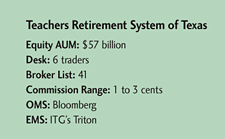
TRS is the eighth-largest public pension system in the U.S., with $57 billion in equities. What makes the pension fund’s charge daunting is that it is responsible for the retirement benefits of 1.27 million beneficiaries–or one of every 20 Texans. So every bit of additional saved trading costs adds up for these retirees.

Harris believes traders should add value to the entire investment process–not just handle and run with an order, but use the information they are privy to and help in the investment process.

"As full partners in the investment process, traders monitor active positions real-time, and identify hidden risks and opportunities to add value to the strategy," Williams said.

Traders, given their direct access to the markets, more actively assist portfolio managers by providing market color, as well as give updates on block trading flow, sudden credit default swap movements and other rapid market developments, she added. Technical analysis is employed on the trading desk, too.

The six-person desk is led by Bernie Bozzelli. The desk trades primarily on an agency basis, with about 30 percent of its trading volume done electronically. However, Bozzelli expects its electronic trading to increase because algorithmic trading offers more avenues for finding liquidity in fragmented markets.

The fund has gotten creative with its outside managers and held a best-execution meeting with them in April. TRS met with Morgan Stanley Investment Management, J.P. Morgan Asset Management, Neuberger Berman and BlackRock. The firms traded ideas and best-practices tips. TRS gained insight on topics such as market structure, leveraging current technology, dark pool usage and the effects of high-frequency trading.

According to Williams, these discussions sparked further conversations on trade-cost analysis–not only how to measure costs but also how to lessen them. As a result, TRS pared down its broker list to 41 firms. It once was a lofty 150 brokerages. More consideration is given to those firms that provide a greater contribution of services and lowering trading costs, she said.

Assessing the strategy, Williams said: "It’s better to have a few relationships that are a mile deep and an inch wide than many that are an inch deep and a mile wide."

Kansas City Securities Association

0

Commentary: The Investor’s Advocate

At the end of 2008, I wrote a column for Traders Magazine entitled "Regulatory Capture," which argued the need for an investor advocate. An investor advocate is necessary to ameliorate the problem of undue industry influence on regulatory decisions, a disease known as "regulatory capture" that afflicts many government agencies. I am pleased to report that there has been a great deal of progress since that time.

The problem of regulatory capture was described in detail in the 2008 column. In brief, to do its job, the SEC must obtain information from the broker-dealers, exchanges, issuers and investment advisers that it regulates. In turn, the business of these regulated entities will be directly affected by the decisions the SEC makes. As regulated entities feed information to the regulator, they gain access–the regulated have many opportunities to complain about "unnecessary" and "burdensome" regulations, request special rules and exceptions, and influence the course of rulemaking.

The industry’s influence over the SEC’s decision-making is exacerbated because the SEC, like most other government agencies, routinely hires staff from law and accounting firms. And many staffers expect that upon leaving government service, the most promising employment opportunities will be at law and accounting firms whose clients are regulated by the SEC.
 
I have the greatest respect for professionals who decide to take a severe cut in income to devote years of their career to government service. But it is also true that, while these professionals make every effort to represent their new government client wholeheartedly, their views and perspectives are influenced by their experiences representing regulated entities, and they tend to lean in favor of their former clients or employers, consciously or unconsciously. Similarly, I don’t think there is anything wrong with SEC staffers finding jobs in the securities industry. They need to support their families, like everyone else. But, these future employment prospects undoubtedly limit the zeal of staffers to provoke the industry’s ire by aggressive efforts to institute or enforce costly regulations.

Our culture and system of laws recognize that conflicts of interest will always be with us. Rather than trying to abolish them, we usually address conflicts of interest by providing a counterbalance. We try to expose the existence of the conflict of interest; then we try to make sure that there is an unbiased arbiter and, at the very least, provide an opportunity for each party to have an unbiased advocate who will tell their story in a light most favorable to their cause. The idea is that the truth lies somewhere in the middle.

Unfortunately, investors generally don’t hire advocates to represent their positions to the SEC. The big pension funds and other large institutional investors retain lawyers to advocate their views on a handful of issues, such as proxy voting. And retail investors sometimes call the SEC to complain about their brokers or some industry miscreant. But in the process of rulemaking, most rules that may have an enormous impact on investors are promulgated without any input from advocates for investor interests.

Of course, the SEC is charged with protecting the interests of investors, and I believe they try to consider these interests when rules are promulgated. However, the information used to make any particular regulatory decision is almost always generated by the securities industry. There has been no counterbalance on the investors’ side, until recently.

In 2009, the SEC organized an "Investor Advisory Committee." It is composed of people who represent a broad spectrum of investor interests, as well as some members of the securities industry. The Committee includes some law professors and representatives of organizations that advocate the interests of individual and institutional investors. Some members represent labor organizations, which have a great interest in seeing that the retirement funds of their members are invested properly. There are also some members who are employees of exchanges and broker-dealers. 

When this group was first assembled, I wondered whether it would actually try to accomplish any useful purpose, or whether its role would consist of simply applying lipstick to a pig. A recent Webcast of the Committee’s latest meeting left me guardedly optimistic.

The meeting began with a presentation by Dan Ariely, a behavioral economist and author of the best selling book "Predictably Irrational." Ariely challenged the most basic propositions of the securities laws. Disclosure, in his view, merely confuses investors and recent behavioral studies suggest that the person making disclosure feels liberated to make outrageous claims on the theory that the disclosure has sanctified the process. He also pointed to recent experiments showing that conflicts of interest cannot be cured by disclosure.

Ariely’s research takes aim at some highly venerated sacred cows that serve as the foundations of our securities laws. It will be interesting to see how far the Committee goes in its recommendations to the SEC. There seem to be some fairly simple alternative ways to protect investors that are suggested by Ariely’s research, and these may well find their way into the Committee’s recommendations to the SEC. Others of his suggestions would require us to abandon the notion that "sunlight is the best of disinfectants." An entirely new theory of investor protection would have to be developed to take its place.

Another panel got into a thorough and balanced discussion of the pros and cons of securities arbitration. My experience representing clients in securities arbitration has caused me to loathe the process. Nonetheless, I came away from the panel discussion thinking that doing away with it altogether would probably do more harm than good. A more nuanced approach that improves the fairness of the process is probably the most practical alternative.

The Committee’s discussion of money market funds was particularly interesting. The Committee is generally opposed to the SEC’s recent rule-making proposal, which, among other things, considers whether to do away with a stable net asset value. This proposal would cause the value of a share to vary each day, much like a traditional mutual fund. The Committee thoroughly grilled Robert Plaze from the Division of Investment Management, who provided a lot of information about the thinking of the President’s Working Group on this issue. This discussion demonstrated the Committee’s independence from the SEC and the current administration on a very controversial issue.

The SEC from time to time organizes "blue ribbon" commissions and other committees to focus on certain issues. They generally make some recommendations, which may lead to rulemaking, and then they go away.  In this case, however, it appears that we can be reasonably optimistic that the Investor Advisory Committee will be with us for the long haul. Both the Senate and House version of the recently passed financial service regulatory reform bills require the SEC to establish an Investor Advisory Committee. It would have to be funded and meet at least twice each year. The SEC would be required to consider the Committee’s recommendations, but would not be required to do anything about them.

The Senate bill would go one step further. It would establish an "Investor Advocate," who would be a member of the Investor Advisory Committee. This would be a paid position. The Investor Advocate also would be entitled to retain or employ independent counsel–that is, counsel who would not be part of the SEC Office of General Counsel–and its own research and service staff, as the Investor Advocate deems necessary to carry out the duties of the office.

The Senate bill’s Investor Advocate would have the duties of an ombudsman, assisting retail investors to resolve significant problems with the SEC or FINRA. It would identify areas where investors would benefit from rule changes and problems with financial service providers and investment products, and propose changes to rules and orders that would be helpful to investors. Most importantly, the Investor Advocate would be charged with analyzing the proposed impact on investors of proposed regulations, including changes in FINRA’s rules, and with suggesting changes to the SEC and Congress, including legislation, that would be appropriate to address adverse impact to investors. The SEC would be required to respond to the Investor Advocate’s suggestions. One would expect the "Investor Advocate’s Statement" to become an important part of rule-making proposals.

The Investor Advocate would also be required to make an annual report to Congress on its success in achieving its objectives. Among other things, this report would describe the quality of the SEC’s cooperation and would not be reviewed by the SEC prior to its submission. The Senate clearly intends for the Investor Advocate to be independent of the SEC and provide an independent assessment of the SEC’s effectiveness as a regulatory agency.

A lot depends on who gets appointed Investor Advocate and how seriously they take their responsibilities. But this proposal has a lot of potential. If it survives in conference and becomes law, and the Investor Advocate competently performs its assigned tasks–both very big ifs–the SEC’s decision-making process will never be the same. I would expect the Investor Advocate and the Investor Advisory Committee to provide a strong counterbalance to the influence of industry advocates. 

The days of regulatory capture are numbered.


Stephen J. Nelson is a principal of The Nelson Law Firm in White Plains, N.Y. Nelson is a weekly contributor and columnist to Traders Magazine’s online edition. He can be reached at sjnelson@nelsonlf.com 

The views represented in this commentary are those of its author and do not reflect the opinion of Traders Magazine or its staff. Traders Magazine welcomes reader feedback on this column and on all issues relevant to the institutional trading community. Please send your comments to Traderseditorial@sourcemedia.com