CIO Harris Embraces Trading

New leadership often brings new approaches. Teachers Retirement System of Texas took a fresh look at trading three years ago, when T. Britton "Britt" Harris, a 25-year veteran, was hired as chief investment officer. Harris is the former chief executive of Bridgewater Associates and, prior to that, the chief investment officer at Verizon Investment Management. At TRS, he changed the structure and process of trading, said TRS senior director Claudia Williams, who oversees trading.

"Before Britt arrived, trading was not incentivized to change the status quo," Williams said. "After Britt arrived, every process, technology and method was reviewed and best practices implemented. We are continually encouraged to look at our processes to improve performance, reduce costs and improve efficiencies."

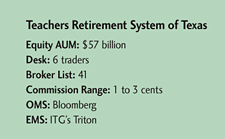
TRS is the eighth-largest public pension system in the U.S., with $57 billion in equities. What makes the pension fund’s charge daunting is that it is responsible for the retirement benefits of 1.27 million beneficiaries–or one of every 20 Texans.

Harris believes traders should add value to the entire investment process–not just handle and run with an order, but use the information they are privy to and help in the investment process.

"As full partners in the investment process, traders monitor active positions real-time, and identify hidden risks and opportunities to add value to the strategy," Williams said. Traders, given their direct access to the markets, more actively assist portfolio managers by providing market color, as well as give updates on block trading flow, sudden credit default swap movements and other rapid market developments, she added. Technical analysis is employed on the trading desk, too.

The six-person desk is led by Bernie Bozzelli. The desk trades primarily on an agency basis, with about 30 percent of its trading volume done electronically.

However, Bozzelli expects its electronic trading to increase because algorithmic trading offers more avenues for finding liquidity in fragmented markets.

The fund has gotten creative with its outside managers and held a best-execution meeting with them in April. TRS met with Morgan Stanley Investment Management, J.P. Morgan Asset Management, Neuberger Berman and BlackRock. The firms traded ideas and best-practices tips. TRS gained insight on topics such as market structure, dark pool usage and the effects of high-frequency trading.

According to Williams, these discussions sparked further conversations on trade-cost analysis–not only how to measure costs but also how to lessen them. As a result, TRS pared down its broker list to 41 firms. It once was a lofty 150 brokerages.

Assessing the strategy, Williams said: "It’s better to have a few relationships that are a mile deep and an inch wide than many that are an inch deep and a mile wide."


(c) 2010 Traders Magazine and SourceMedia, Inc. All Rights Reserved.

http://www.tradersmagazine.com http://www.sourcemedia.com/

This Year’s Model

Limit orders just sitting there, going unexecuted. It’s the same old story. It happened during the heyday of the Nasdaq dealer market. It happened on the floor of the fabled New York Stock Exchange, during the auction process. And it’s still happening in today’s sophisticated, hyper-speed market. The time, place and methods of trading may change, but the results are the same.

You can read about the latest rendition of this issue in this month’s story, "Some Traders Would Welcome a Trade-At Rule." The piece chronicles a prop trader who’s practically given up on posting limit orders because he can’t get filled. And he’s upset. Trades away from his order execute off-board in subpennies-right up to his limit. He now trades only one side of the market–the take–and consequently, executes about half as much as he used to. That is crimping his profitability. The SEC discusses the issue of "trade-at" in its recent Concept Release. Of course, the SEC would like to push more limit orders into the public market. That’s something the SEC’s landmark Reg NMS was supposed to accomplish, but did not. I think you’ll find the reporting by John D’Antona of great interest.

Separately, there’s been a huge shift in the options business. This month’s cover, "Reversal of Fortune," focuses on the options exchange fees and who is paying them. Customers are now bearing a larger portion of these since the introduction of penny pricing and the subsequent move to maker-taker pricing. Peter Chapman’s story takes a look at this evolution. And it is significant, he reports, as customers no longer trade for free.

"In the past, market makers were making enough money so they could afford to bear the costs," said Slade Winchester, a director in Citigroup’s U.S. equity derivatives division. "But markets have tightened up to a level where market makers can’t continue to bear the cost and make tight markets. So the costs are shifting." The good news is that spreads have narrowed as a result of penny pricing, so although customers might be shouldering a greater burden of the fees, they are also seeing a savings from the tighter spreads.

As I write this, half the year is nearly gone. There is still economic uncertainty from Europe. And many questions remain for the trading industry. Will commissions pick up in the second half? What will the SEC do regarding future rule-making for dark pools, high-frequency trading and other areas? At Traders Magazine, we plan to be there every step of the way, doing our best to keep you up to date on the developments coming from Washington, D.C. and on Wall Street in the trading community. We look forward to meeting that challenge.


(c) 2010 Traders Magazine and SourceMedia, Inc. All Rights Reserved.

http://www.tradersmagazine.com http://www.sourcemedia.com/

LeveL to Raise Profile With Brokers

The quest at LeveL ATS, the fifth-largest dark pool, is simple: Hook up more clients to achieve its goal for bigger prints.

The alternative liquidity provider is using a heavily client-centric model, looking to increase its sellside client base and grab market share, said LeveL chief executive Whit Conary.

"It is simply getting out and meeting customers and finding ways to meet their business needs. Our game plan is to capture as much liquidity as we can from smart routers or algos from the larger broker-dealers," Conary said, "and then offer this liquidity to each new customer."

The Boston-based alternative trading system thinks it is on the right path and is pleased with how things have gone since its inception four years ago. According to analysis from Rosenblatt Securities for April, LeveL was the fifth-largest dark pool, trading 81.2 million shares a day. (Rosenblatt single-counts trading volume, while dark pools double-count.) For April, LeveL sits behind industry leaders Credit Suisse’s Crossfinder (251 million shares daily), Knight Link (161 million shares daily), Goldman Sachs’ Sigma X (160 million shares daily) and GETCO (106.3 million shares daily.). After LeveL come four bulge bracket firms: Morgan Stanley, Barclays, UBS and Citi.

"I still think of us as fairly new and with a lot of customers we need to connect to," Conary said. "We are out there either with a grassroots sales-style marketing campaign or getting on a plane to see clients. I’ve got one salesman who is never in the office."

Average daily volume at LeveL in May was a record 175.1 million shares, compared to April’s 162.4 million shares and March’s 130.8 million shares–all double-counted.

For the first quarter, LeveL said it saw its piece of the trading pie rise 54 percent from 2009 to 2010. Its share of all trading volume was 0.74 percent in Q1 2010, compared to 0.48 percent in Q1 2009.

Despite LeveL being owned by a consortium of brokers–Citi, Credit Suisse, Bank of America Merrill Lynch, Fidelity Capital Markets and Barclays–their contribution to the amount of liquidity in LeveL is roughly only 25 percent.

Conary said there is a perception that the consortium makes up the majority of order flow, but that that is incorrect. He credited the sales staff–the entire firm is only eight people–for expanding the business through client meetings, typically discussing dark pool strategies and LeveL’s business model. As a result, Conary said even as the aggregate flow from the consortium has increased, its percentage of the traded volume in LeveL has dropped.

Still, Conary points out that there is still plenty of work ahead. Steve Miele, head of sales and product development at LeveL, spends most of his time in the field gathering suggestions from prospects and clients on how to improve the crossing network.

This approach has yielded new products, such as SmartBlock, LeveL’s order type designed to attract blocks from high-touch clients.

During client meetings, discussion usually centers on how to use LeveL’s minimum-size order types, or on ways clients might hike their match rate by modifying their resting time.

So far, the strategy appears to be working. On May 5, LeveL traded a record 214 million shares–double-counted. Growth on a year-over-year basis has been steady. Trading volume for the first quarter of 2010 was up 24 percent over Q4 2009.

Conary, a 31-trading veteran, began his career in 1979 as a clerk on the Boston Stock Exchange and then later worked as a sales trader there. At the age of 26, he founded Ward, Conary and Murphy, with two partners. That lasted 18 years.

Later, Conary sold his firm to Moors & Cabot Investments. But it was during his time on the floor at the Boston that he learned how to work large blocks of stock. There, he also learned the value of earning a client’s trust.

"Your word is your bond, and without integrity, you’ve got nothing," Conary said.

If clients trust him, Conary reasons, the business will follow. And so far it apparently has. LeveL’s client base has more than doubled in a year. It grew to 127 customers at the end of Q1 2010–that’s up from 59 clients in the same period in 2009. And he believes that more customers will help increase its average trade size from April’s 253 shares.

Conary declined to discuss LeveL’s profitability, but he did say it has been able to keep its costs low and attract a diverse pool of liquidity.

"Now that we are executing meaningful volume in the small- and mid-cap space as well as in larger trade sizes, we are building up our presence with the high-touch traders," Conary said. "We are reaching out to the high-touch sellside community with a clear and concise value proposition that is being received very well. Our growth speaks to that fact, and customer feedback has been very positive."

Sal Arnuk, co-founder and co-head of equity trading at Themis Trading LLC, said that when he does access dark liquidity, LeveL is among his top sources.

"We enjoy a higher trade size when we trade there," Arnuk said. "I like models where one can customize the type of flow they wish to interact with–pools where I can interact with more institutional flow versus other types of flow, I like."

And that’s music to Conary’s ears, as he points out that LeveL will continue to focus on developing order types and functionality that add value to the trading process.

"We want to become an independent low-cost source of liquidity to all," Conary said, "not just the consortium."


(c) 2010 Traders Magazine and SourceMedia, Inc. All Rights Reserved.

http://www.tradersmagazine.com http://www.sourcemedia.com/

Stifel Beefs Up With Weisel Merger

"More" is the operative word these days at mid-market brokerage Stifel Nicolaus.

More companies covered by research and trading. More sales and position traders. More algorithms to offer. More products for Stifel customers, such as direct market access. And Stifel said this should translate into more trading revenue.

Since April 26, when Stifel Financial entered into an agreement to merge with Thomas Weisel Partners in an all-stock deal valued at more than $300 million, the Stifel Nicolaus brokerage subsidiary has taken on Weisel’s 80 research sales and trading pros, as well as its 32 senior research analysts. They’ve joined Stifel’s 159 research sales, sales and position traders, in addition to its 61 senior research analysts.

Stifel has also absorbed most of the 479 U.S. and Canadian companies covered under San Francisco-based Weisel’s research group. This brings St. Louis-based Stifel’s total research coverage to 1,143 companies. And the firm intends to leverage this new research dreadnought to grab more broker votes and ascend institutions’ trading lists, said Ronald Kruszewski, chairman, president and chief executive of Stifel Financial Corp.

"We had virtually no overlap in research," he said. "And so we would like to think that, at a minimum, if Weisel was getting five votes and we were getting five votes, on a combined basis we’d have 10."

Both Stifel and Weisel have focused on program trading and building algorithms over the past two years. The merger will result in combining the operations on both fronts, Kruszewski said.

Stifel took time to identify the strengths both firms brought to the deal. At the Sandler O’Neill Global Exchange and Electronic Trading Conference earlier this month, Kruszewski touted the electronic trading products and services both firms offered.

"We’ve really developed our program trading, and Weisel has a DMA product," he said. "So, we’re going to combine the capabilities and have a robust algorithm-DMA-program trading product offering."

Stifel is also eagerly embracing some Weisel products and shelving others. For example, Stifel is offering customers Weisel’s DMA. But it is mothballing, for now, Weisel’s recent move to boost its market data center in order to pursue high-frequency trading clients, Kruszewski said.

Banking was the primary driver for the deal, said Devin Ryan, an associate director in equity research at Sandler O’Neill and Partners. Both firms now span the spectrum of sector coverage, he said. And Weisel strengthens industry growth areas Stifel might otherwise have taken years to develop, such as technology and health care.

Still, the merger positions Stifel’s sales and trading well for the future, Ryan added. The firm’s desks will benefit from having more products for sale.

"[The merger] provides a broader sector depth and breadth that rounds out Stifel’s platform," Ryan said.

One Stifel customer who trades in small- and mid-cap names said it was too early to say what advantages Weisel research and trading would bring. But the newer, broader Stifel is intriguing, he said.

"One would think that it should only improve what they could do for us on the trading end," the trader said.

Stifel breaks its institutional business down into global wealth management and capital markets–which further divide into investment banking, sales and trading. Equities trading at Stifel saw a 5 percent increase in the first quarter of 2010 over the same period last year. The firm made more than $38.6 million trading equities from January through March 2010. Compared to the fourth quarter of 2009, though, equities trading revenues were flat.

That should change going forward, Kruszewski said. Even though he wouldn’t offer any specifics on upcoming revenues projections, Kruszewski said he likes the overall forecast.

"I would think that on a combined basis, our sales and trading revenues are going to be up," he said. "I’d be disappointed if they weren’t."

In accordance with the merger’s specifics, Weisel will become a wholly-owned subsidiary of Stifel. Stifel expects the transaction to close around June 30.


(c) 2010 Traders Magazine and SourceMedia, Inc. All Rights Reserved.

http://www.tradersmagazine.com http://www.sourcemedia.com/  

Commissions Off–Pressure Remains

The Street saw a 13 percent drop in equity commissions last year, according to a Greenwich Associates study of buyside traders released June 7.


See Chart: Total Estimated Commissions Generated in U.S. Equities


Greenwich’s 2010 U.S. Equity Investors Study reports that brokerage commissions paid by U.S. institutions on domestic trades were $12.1 billion from Q1 2009 to Q1 2010. That’s down from the whopping $13.45 billion in commissions reported in the 2009 survey.

Although the recent survey showed commissions were down 13 percent year over year, the Greenwich report shows that commission levels for the 2010 study were on par with 2008’s–when they reached $12.19 billion.

John Feng, co-author of the study at Greenwich Associates, told Traders Magazine that falling commissions were the result of a tepid economy and an investor exodus from U.S. stock mutual funds.

Domestic funds saw an outflow of $39.52 billion for 2009, according to the Investment Company Institute. Conversely, foreign stock funds witnessed a $30.71 billion inflow.

"The buyside expected more of a recovery," Feng said.

Greenwich Associates interviewed 219 equity fund managers and 286 U.S. equity traders between December 2009 and February 2010.

The Greenwich study said U.S. institutions entered this year with great optimism–predicting that commission payments would surge in calendar year 2010 with a strong stock market. Buyside traders at long-onlys have projected a 15 percent increase in their commission pool for 2010. Hedge funds, meanwhile, predicted a 20 percent increase in commissions paid for U.S. equities.

But to date, those expectations have proven overly optimistic. "As we passed the midway point in the second quarter of 2010," wrote Jay Bennett, a Greenwich Associates consultant, "it becomes evident that, not only will equity commissions fail to reach those growth targets, but the commission pool might actually be contracting,"

The report also shows that commissions remain under pressure. The average "all-in" commission rate paid by U.S. institutions to brokers was 2.78 cents per share in the 2010 study–down from 2.90 cents from 2009’s study. The main culprit was the continued shift toward electronic trading, where rates are cheaper than "high-touch" executions, according to Greenwich.

U.S. institutions executed 37 percent of their volume for single-stock trades via the machines, Greenwich reported.


(c) 2010 Traders Magazine and SourceMedia, Inc. All Rights Reserved.

http://www.tradersmagazine.com http://www.sourcemedia.com/  

People On The Move

Dave Memmott joins International Strategy & Investment Group as a senior managing director and head of trading. Memmott, a 25-year veteran, previously spent 14 years with Morgan Stanley, where he held various roles in equity trading, including head of North American trading, head of the block desk and co-head of Nasdaq trading. Before joining Morgan, Memmott was a trader with Credit Suisse and Dillon, Read & Co. He oversees a desk of 21 traders and sales traders.


Andy Peer joins Instinet’s New York office as an executive director on the sales and trading desk. Peer, a 19-year veteran, spent the last 15 years at ITG. Prior to that, he was with the equity trading division at Lehman Brothers. Peer reports to Mark Turner, head of North America sales trading.


Needham & Co. hired three traders from GFI Group to establish an equity options sales and trading desk. The trio included Brett Marcus, previously head of trading for the CS Capital division of GFI; Sam Frankfort, who co-launched the CS Capital desk; and Marc Menachem, a derivatives sales trader at GFI.


Paul Sangimino is expected to join Nomura Securities International next month as co-head of U.S. cash sales and will oversee sales trading. A Lehman Brothers veteran from 1995 until 2008, he joins from Citi, where he headed U.S. equity trading. He is expected to serve as co-head with Pascal Bandelier, who oversees risk. Both report to Ciaran O’Kelly, who heads U.S. equities for the Americas.


Evercore Partners has brought on two trading executives to support its institutional equities operation, launched last month. Douglas DePietro is a managing director in charge of sales trading and trading execution. Scott Smith is a director in the group. Until March 2009, DePietro was a director in the U.S. equities division at Citigroup, where he served for 16 years. He was a position trader focusing primarily on the technology, media and entertainment sectors. Smith was a sales trader at DeMatteo Monness. Before that, he spent three years at Leerink Swann as a sales trader and four years at Morgan Stanley as a position trader.


Peter Battaglia joins the Vertical Group as an equities sales trader concentrating on Pink Sheets and Canadian orders. The 25-year professional was at Sterne Agee for three years as a sales trader and, prior to that, trading manager for broker-dealers at Tradition Asiel Securities. He reports to Mark Duncan.


Steve Panning joins KeyBanc Capital Markets as a sales trader in Chicago. Panning, a 15-year veteran, was previously with Banc America Securities/Merrill Lynch. He has been both a trader and sales trader in his career. Panning reports to Kevin Kruszenski, the firm’s director of equity trading.


Cheryl Gilberg joins Goldman Sachs as head of marketing for the firm’s securities division. The 20-year marketing veteran comes from Fox River Execution, where she was in charge of corporate communications and marketing for the past year. Prior to that, she was at Morgan Stanley and Citigroup.


Instinet Canada appointed Jeff Houslander and Andrew Hill as executive directors, electronic and program sales and trading, on its Canadian sales and trading desk in Toronto. Houslander and Hill both were in senior sales and trading positions with ITG Canada.


Linda Heuman joins Huntington National Bank as a senior trader in the firm’s private financial group trading equities, options and global securities. The 26-year veteran comes from National City Bank’s private client group, which is now part of PNC, where she worked for 12 years as a trader. She reports to William Doughty.


Public-relations veteran Marc Weinstein launched Spotlight Financial Marketing in New York. Weinstein, a onetime markets reporter at Knight Ridder Financial, was most recently with Spring O’Brien, where he spent 13 years running its financial services group.


Paul Viviano joins Jefferies & Co. as head of U.S. event driven sales. Viviano, a 17-year veteran, oversees the sales of U.S. equities for companies that are involved in transactions or restructurings. He joins from Morgan Stanley, where he spent four years as a sales trader and co-head of special situations. He reports to Jim Carmack.


Jamie DeSantis joins Knight Capital Group from Pali Capital. Before Pali, DeSantis was a vice president of equity trading and sales at Jefferies & Co.


Hudson Securities added a group of former Next Generation Equity Research employees in Chicago, including co-founders Timothy Fierce, a 30-year sales trading veteran, and Michael Boehm, a 20-year equity sales veteran. Sales traders Christopher Buti and Stephen Pocina join, as well as William Frayne Abernathy, an institutional salesman. Jerald Kallasjoins from Terra Nova Financial to focus on business development in Chicago.

Additionally, Hudson added a group of sales traders to its Jersey City, N.J. office. On the domestic side, Lawrence Sweetwood joins from Knight Equity Markets, David Noble from Domestic Securities and Edward Schmitz from Merc Partners. John Redmond joins the international desk from Macquarie Capital. Francis Fiolek joins the firm’s Norwalk, Conn. office after eight years at Cantor Fitzgerald.


Tim Dillon joined the New York office of Options IT, a provider of ultra-low-latency technology, market data and connectivity, as director of sales for North America. He will share North American sales oversight of several services related to the firm’s Options PIPE platform. Previously, Dillon oversaw electronic trading sales at JonesTrading.


Lida Preyma joins JitneyTrade as head of global direct market access. Preyma, a 15-year veteran, was director of business development and marketing at Pure Trading/CNSX for four years, where she helped build the first ECN in Canada. She reports to Francesco Pasin.


The Options Clearing Corp. appointed Craig Abruzzo and Valar Mihan to its board of directors. Abruzzo is head of Morgan Stanley’s listed derivatives business in the Americas, and Mihan is head of Americas equity-linked trading at BofAmerica Merrill Lynch.


Brian Pears joins RBC Capital Markets in Los Angeles as a director in electronic trading sales. Pears, a 19-year veteran who spent most of his career on the buyside, was previously with JonesTrading in Westlake Village, Calif., where he headed electronic trading initiatives at the firm. Pears reports to Brian Suth, who heads electronic trading sales in New York.


Paul Manelis joins WJB Capital as a sales trader in Chicago. Manellis, a 12-year veteran, was previously a managing director in sales trading for Soleil Securities in Chicago. Prior to Soleil, he spent two years at money manager NorthPointe Capital, where he launched the firm’s trading desk. A sellside veteran, Manelis also had stints as a sales trader at WR Hambrecht & Co. and Piper Jaffray, where he began his career.


(c) 2010 Traders Magazine and SourceMedia, Inc. All Rights Reserved.

http://www.tradersmagazine.com http://www.sourcemedia.com/  

Fee Cap Splits Options Exchanges

A Securities and Exchange Commission proposal requiring options exchanges to cap the fees they charge their members to access their markets is getting mixed reviews by exchange operators.

Operators of six of the nation’s eight options exchanges gave their views on the proposal at this year’s Sandler O’Neill + Partners’ "Global Exchange and Electronic Trading Conference."

Of them, Nasdaq OMX and NYSE Euronext shot down the proposal, while the International Securities Exchange and BATS Exchange voiced their support. Nasdaq and NYSE Euronext each operate two options exchanges.

"We are fully supportive and applaud what the Commission has done," Gary Katz, the ISE’s president and chief executive, told the assembled analysts and investors. "The fees that are 45 cents and higher are used to subsidize certain markets and ultimately the firms or the customers directly are paying for it. This has gone on for far too long."

Ed Boyle, an executive vice president at NYSE Euronext, disagreed. "I do think there is room for a fee cap of some kind," Boyle said, "but to put out some arbitrary number is the wrong way to do it."

The SEC has proposed that all options exchanges cap their access fees at 30 cents per contract. Boyle, whose Arca exchange charges 45 cents, told the crowd any fee should be a percentage of the minimum trading increment.

The SEC’s proposal is intended to prevent an exchange from abusing rules that require exchanges to route away any orders they can’t fill. The fear is that the recipient exchange will charge the routing exchange an exorbitant access fee.

The proposal is also intended to bring some uniformity to quotes across the eight exchanges as well as narrow any gap between the quoted price and the final price to the trader.

The proposed rule mirrors a similar rule in force in the equities market.

The rule has simmered on the SEC’s backburner for two years after Citadel Securities lobbied the regulator for a fee cap. The issue was pushed to the front of the SEC’s agenda late last year when the SEC proposed banning step-up orders on the exchanges.

Exchanges that employ step-ups argued they were necessary because the access fees at so-called maker-taker exchanges were too onerous. The step-up process allows exchanges to avoid routing out orders by giving members a last chance to step up and fill the order.

Nasdaq also dislikes the SEC proposal. "I think 30 cents is arbitrary," Tom Wittman, Nasdaq’s executive in charge of options, said. "There’s so much competition that the SEC probably shouldn’t try to put a cap on fees yet. But if they do cap them, the cap should be higher."

Wittman believes competition will drive down rebates and take fees at exchanges that employ maker-taker pricing. Exchanges will squeeze their spreads in a battle for order flow. "Competition will take care of it," Wittman argued.

Jeromee Johnson, in charge of BATS’ brand new options exchange, told conference-goers he supports a cap, but that the appropriate level might not be 30 cents. "There’s a lot of room to tighten things up and compete," he said, "whether that fee cap is 30 cents or 45 cents or 50 cents." BATS charges a 30-cent take, or access, fee.

The Chicago Board Options Exchange was not in attendance at the conference, but has stated publicly it objects to certain aspects of the proposal.

Because the proposed cap would take into account all fees, including licensing fees, it could severely damage CBOE’s index business. The exchange operator currently pays a license fee to Standard & Poors, for example, for every trade in the options based on the S&P 500 Index. To recoup that cost, the CBOE adds the royalty to its access fee.


(c) 2010 Traders Magazine and SourceMedia, Inc. All Rights Reserved.

http://www.tradersmagazine.com http://www.sourcemedia.com/

NYSE Stands By Its LRPs

Despite criticism, the New York Stock Exchange has vowed to continue its program for trading pauses.

At the urging of the Securities and Exchange Commission, exchanges started to implement a marketwide, single-stock circuit breaker to cover names in the S&P 500 index on June 11. But the NYSE said it would continue to employ its own trading-pause program, called Liquidity Replenishment Points, in addition to the SEC-mandated circuit breaker.

LRP critics argue that the NYSE program intensifies, rather than moderates, volatility. They also say that LRPs contributed to the sudden disappearance of liquidity during the May 6 "flash crash."

The NYSE argues that LRPs are a beneficial component of the market structure. "We believe they add value, and that they’re complementary to the new volatility trading pauses," said NYSE spokesman Ray Pellecchia.

Trading halts have become popular conversation across the industry thanks to the events of May 6, when the markets gyrated dramatically over a 20-minute span. As trading exploded that afternoon, the NYSE’s LRPs were triggered many thousands of times.

But they were triggered to ill effect, according to Jose Marques, global head of electronic equity trading at Deutsche Bank.

The LRPs definitely contributed to the lack of liquidity on May 6, he said, because the NYSE took itself offline at a time when the market was under stress. Other venues were able to route around the NYSE when it switched to a manual mode and was no longer able to participate, he said.

"Having the NYSE with a separate, additional [circuit breaker] … is really not helpful," Marques said.

Others agree. One competitor of the NYSE who did not want to give his name said he understood why exchanges would want to have their own trading-halt mechanisms to limit volatility in the stocks they list. But he said there can be trouble whenever a halt is issued on one exchange and other markets continue trading. And furthermore, he added, with a marketwide circuit breaker in place, individual trading pause mechanisms aren’t necessary.

"I think it’s difficult to pause one market and not all markets," he said.

Nomura Research Institute, an affiliate of giant Japanese bank Nomura Securities International, took a look at the repercussions of triggered LRPs on May 6 in its study of the flash crash. It concluded that the triggering of the LRPs coincided with the disappearance of high-frequency traders’ buy orders.

"NYSE LRPs are suspected of not only failing to fulfill their intended purpose of stabilizing the market," the NRI wrote, "but having the opposite effect by causing mass rerouting of sell orders to nearly bidless non-NYSE trading venues as high-frequency traders vanished from the market."

The SEC has said it wants to determine whether LRPs played a role on that day in the net loss of liquidity that produced the extreme volatility in prices. In its joint report with the Commodity Futures Trading Commission on the preliminary findings of May 6, it said that it would closely examine LRPs and other procedures exchanges use for handling or executing orders to establish whether they slow liquidity down unnecessarily.

If LRPs were responsible for ultimately exacerbating price volatility, the SEC and CFTC wrote, "it potentially could have caused some NYSE securities to decline further than the broad market decline."

But the report also noted how it’s possible that the LRPs actually reduced volatility on May 6 by assembling liquidity that absorbed some of the excess selling interest. Either way, the NYSE would not comment on the SEC’s intentions for LRPs.

Joseph Cangemi would. The head of equity sales and trading at ConvergEx’s global electronic trading unit likes LRPs. Cangemi traded for many years on the NYSE floor and is also the current vice chairman of the Security Traders Association.

"The NYSE’s LRPs serve a good purpose," he said.

An LRP pauses automated trading on the Big Board when the price of an NYSE-listed stock rises or falls by roughly 2 to 4 percent, Pellecchia said. When an LRP is triggered, trading on the NYSE will halt for a time to allow additional liquidity to enter the market.

Then, trading in the name on the NYSE reverts to manual auction-style, permitting new bids and offers. A market maker then tries to amass a large, price-discovering trade in an attempt to attract liquidity on the other side of the buy-sell equation, Pellecchia added. The average LRP process takes a few seconds. Typically, LRPs are triggered a couple hundred times a day, Pellecchia said. On May 6, that number was in the tens of thousands of times.

In NYSE-listed names, LRPs would be triggered prior to the new, industrywide circuit breaker. That circuit breaker would pause trading in S&P 500 stocks if the price moved 10 percent or more, up or down, in a five-minute period.


(c) 2010 Traders Magazine and SourceMedia, Inc. All Rights Reserved.

http://www.tradersmagazine.com http://www.sourcemedia.com/

New BofA Merrill Algos Pair Up

Buyside traders can now use Bank of America Merrill Lynch pairs-trading algorithms for equities. Pairs algos are often used to buy one security and sell another correlated security in a single trade, to take advantage of small price discrepancies.

The algos permit traders to set different levels of aggressiveness or passivity into the existing four strategies: Spread, Ratio, Inverse Spread and Inverse Ratio. This lets the buyside incorporate their market knowledge and experience into a trade, said Dan Nachtman, product manager and director of execution services at BofA Merrill.

"Pairs algos are a more straightforward way of clients taking on a position and then later unwinding it," Nachtman said.

A fifth pairs strategy, called "Outperformance," is being readied for release to the buyside as Traders Magazine goes to press. According to Lee Morakis, head of sales at BofA Merrill, this new algo trades when one selected asset outperforms another by a preset level.

For the past four months, the firm has been using the pairs-trading algos for its capital-commitment trades, Nachtman said. But as the buyside has increased its statistical arbitrage trading recently, he said, it makes sense to offer pairs to institutional accounts.

A handful of major brokers have developed algorithms that let traders quickly lock in prices in order to hedge positions or conduct arbitrage trades across markets.


(c) 2010 Traders Magazine and SourceMedia, Inc. All Rights Reserved.

http://www.tradersmagazine.com http://www.sourcemedia.com/  
Word For Word

Days after the "flash crash" on May 6, veteran high-frequency trader and exchange entrepreneur Dave Cummings sat down with Traders Magazine to discuss a bevy of issues facing the equities markets. Cummings started the HFT firm Tradebot Systems and launched the ECN BATS Trading.


On what makes for a strong marketplace–

Having thousands of different people playing for all kinds of different reasons and all kinds of different time frames and all kinds of different correlations and models–that’s what makes a robust market. Markets are all about transferring risk. And the more people you can pass that risk around to, the more value is created by the whole system. It’s more than just a big poker game.


On May 6 and circuit breakers–

The market definitely needs better circuit breakers. Anytime you break trades, that’s really bad. It’s bad for the markets and the public’s confidence in the markets. The answer is not to go back and break the trades where somebody after the fact on some committee–without any transparency–decided these must be errors and these must be good. The answer is to build logic into the matching engines that doesn’t let errant trades happen in the first place.


On a unified surveillance system–

The markets need good regulation. Sometimes, some competition among regulators gives more efficient solutions, too. Any time you have one system, it never seems to catch the one thing that the bad guys are doing, because they’ve designed what they’re doing to circumvent the one system out there.


On regulators monitoring individual trades–

You’ve got real issues of intellectual property leakage if you let different regulators or others start snooping through everybody’s trading styles. There are questions about what they are doing with that information, or what controls there are with that information. There’s clearly a revolving door between regulators and the industry. Is it fair to have a regulator look at a bunch of trades and then go take a job with a competitor? Whatever system is in place must have information barriers that don’t let that happen.


On sub-penny trading in the public markets–

I’m generally not a fan of sub-pennies. It lessens the public understanding of the market. It’s very natural to go into the stock market and see prices in dollars and cents. If you’re talking a 5-cent stock, then maybe it makes sense to have prices in fractions, but I just don’t think there’s the public outcry there.


On the value of manual intervention to slow markets down–

There’s no market participant that can hold up a trillion-dollar market. The high-frequency trading guys can’t. The specialist can’t. Slowing down [the market] gives the whole community time to react.


(c) 2010 Traders Magazine and SourceMedia, Inc. All Rights Reserved.

http://www.tradersmagazine.com http://www.sourcemedia.com/