
















Competition in the foreign exchange market has never been closer or more heated.
As activity in the $4.7 trillion dollar forex market heats up, firms will be spending more on technology and electronic trading systems to grab market share and be competitive, according to a new report from Aite Group. Also, more venues are likely to emerge, further pushing the market along, the group added.
New electronic trading platforms have emerged over the last 12 months, directly challenging the positions of incumbent platforms and foretelling a brutal battle. The battle for supremacy in electronic Forex trading is going to heat up, Aite said in its latest Impact Report.
Based on Aite Group interviews with leading banks, FX brokers, various client segments, FX vendors, and FX execution venues, Aite Group senior analysts Javier Paz and Howard Tai and managing partner Sang Lee chart focus and profile 18 forex trading venues, provide details and evaluate the strengths and weaknesses of each.
Aite said the growth in electronic trading and more changes stem from an industry-initiated effort to grow fx as an asset class for both the institutional and retail investor. Forex players, much like their equity cousins, have provided more trading transparency, reduced latency on trading platforms and have accepted high frequency traders as part of the landscape.
Click here for the report.
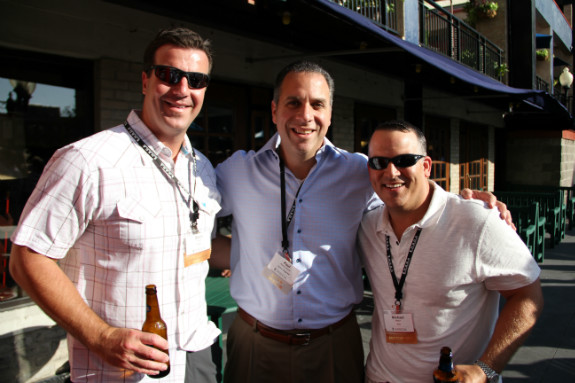
Midwest traders recently had a chance to get together and discuss the state of the equities industry just after the year’s half-way point.
Institutional investors, sales traders and vendors all met up at the recent Summer Conference of the Minnesota Security Dealers Association held July 18 – 19 at the W The Foshay, Minneapolis, Minnesota.
MSDA is a non-profit organization founded in 1991 and is comprised of approximately 150 members/security traders active in the greater Metropolitan area of Minneapolis and St. Paul. Through membership in MSDA we support the national Security Traders Association in its ongoing efforts to represent our interests in Washington D.C.
Click here for the slideshow of people who attended.
Technology vendor Pragma plans to introduce new foreign exchange trading algorithms in the fourth quarter.
Called Samba FX, the technology represents a new market for Pragma which is best known for its equity trading algorithms.
In an interview with FX Week, which first reported the news, Danielle Caravetta, Pragma’s director of institutional sales, said the firm was seeking to “fill a void” with the new offering.
Algos are not new in fx. Most are offered by banks, Caravetta explained.
Caravetta joined Pragma in June from Credit Suisse.
The new strategies will include volume- and time-weighted, liquidity sourcing, and opportunistic. Pragma is also rolling out transaction cost analysis for foreign exchange trading.

The technology revolution has had an incredible and indelible impact on the institutional investment landscape for the past 20 years. While most of Wall Street (and this magazine) usually focuses on how technology has revolutionized the execution process and how trading has become faster, cheaper and more efficient, what is often overlooked is its impact on back-office processing, which in turn has enabled an explosive accumulation of assets by the wealth management industry.
Up until about 10 years ago, clients of retail brokers, also known as wealth managers, were forced to maintain a separate account for each money manager that managed funds on behalf of their clients. This limited the customers’ investment alternatives, because a broker’s back office could not efficiently handle multiple accounts, thus limiting available investment alternatives.
However, the advent of the Unified Managed Account and model delivery system has enabled wealth advisors to create for their clients a diversified portfolio of stocks, bonds, ETFs and other vehicles by placing these assets into a single managed account, creating almost an unlimited choice of investment options for the average investor. Previously, if an investor chose to maintain a diversified portfolio of stocks, bonds and mutual funds, he or she needed to open separate accounts for each asset. The UMA removed this hurdle and combined all the assets into one account.
See Chart: UMA Growth
The introduction of the UMA platform, also known as a wrap account, has contributed to the massive asset growth by wirehouses, Registered Investment Advisors and other managers who predominately cater to individuals and high-net-worth financial investors. Today, a financial advisor can often choose from more than 100 different external managers, providing his or her client with a range of investment alternatives.
But what is often overlooked is how these portfolios are executed and where the trading is taking place. The UMA revolution has led to the creation of a group of trading desks that specialize in these large asset pools. Most of the major wirehouses now have dedicated trading desks to trade this outside manager flow. Where formerly the investment manager’s own trading desk would execute the order, today the trading responsibility is often outsourced to the actual owner of the assets. The largest of these desks resides in the Private Portfolio Group of Morgan Stanley Wealth Management.
To read the rest of this story, please click here for Traders Magazine.

When it’s time to build out an institutional trading desk, foreign exchange-centered firms turn to seasoned pros, just like in the equities universe.
R.J. O’Brien & Associates has hired Matthew Ardizzone, a 20-year veteran of the forex industry, as its new global head of FX sales. Ardizzone is charged with building the firm’s institutional trading business in New York. He is also tasked to grow the firm’s existing institutional FX presence, particularly among commodity trading advisors, hedge funds and FX portfolio managers.
After building out the New York desk, Ardizzone plans to expand the desk’s reach globally.
Ardizzone was most recently executive director in FX sales at Nomura Securities in New York. Previously he served for seven years as global head of FX sales at Jefferies Bache, formerly Prudential Bache, based in New York. Prior to Prudential, Ardizzone was founder and chief executive of Aurora Capital Management Ltd.
Earlier in his career, he was a senior FX sales/trader at Refco Capital Markets Bermuda. He started in the FX business as a trader at Banque Indosuez in Sydney.
He reports to Phillip Fondren, executive director and head of FX.
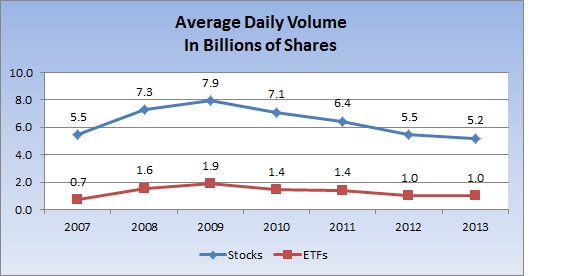
Average daily volume in listed stocks dropped by about 3 percent last month as compared to August 2012.
Over the same time frame, however, share volume in exchange-traded funds jumped by about 20 percent.
The data comes from a recent report from NYSE Euronext.
Average daily volume in stocks was about 4.4 billion shares last month. That was a 3 percent drop from 4.6 billion in August 2012.
For ETFs, 944 million shares traded every day, on average, last month. That was a 20 percent increase from 788 million shares in August 2012.
For the year, stock volume is down by about 5 percent while ETF volume is down about 1 percent, according to NYSE data.

Clearing and processing a trade typically takes too long. More trade processing should be real-time. Margining, profit and loss, and other vital information not only need to be collected on the day of the trade, but in one comprehensive step.
Such are some of the sentiments of Robert Victor, the managing member of clearing processor InteliClear. It is a relatively small trade processor with fewer than a dozen big clients. But it wants to take on the big boys of the business, such as Broadridge and SunGard.
A 30-year veteran of the business who came into the securities industry with an accounting education, he joined what would become InteliClear LLC. The firm’s leadership believed the financial services industry was investing billions of dollars in trading-related software solutions while essentially taking no action to improve the post-trade processing systems that still relied on batch-processed legacy solutions.
To accommodate the demands of the “new” Wall St., where trade volumes were higher, profit margins slimmer and regulatory and risk obligations constantly changing, InteliClear was formed.
Clearing and settlement takes three days now but the industry is mulling a move to T+2 or even T+1. Victor believes that is too long.
CQ&D: You have argued for quicker settlement cycles. In fact, you have asked why settlement cycles can’t be the same day, or T+0.
Victor: Yes.
CQ&D: Based on the recent Boston Consulting Study conducted for the Depository Trust & Clearing Corp., the industry seems ready to move to a T+2 or possibly even a T+1 standard. Do you see that happening soon?
Victor: Well, I think the people who will fight it will be the people who just can’t make dramatic changes in their systems.
CQ&D: You have some concerns about the regulatory issues of moving up to T+2 or T+1?
Victor: If the standard was changed because we see customer debits as a bad thing, then the customer will have to pay faster, because in the old days the risk was the customer not paying you.
CQ&D: And so…
Victor: I’m not sure what T+2 gains.
CQ&D: Here’s an argument for T+2: Everyone gets his or her money or securities faster. And by the way, the rest of the world is aiming for a T+2 standard, so the United States could fall behind the advanced markets if it doesn’t move to a faster settlement cycle.
Victor: That’s true. I know, for instance, the Tel Aviv stock market has a T+1 standard.
CQ&D: But you still have doubts?
Victor: Internally, I’m not sure if it speeds up the delivery process. If you don’t have the security, you still have to borrow it. I clearly see interest income savings and reduced risk in moving toward a short settlement cycle.
CQ&D: So you don’t see the benefits of the current proposal unless you do something more radical.
Victor: Yes, from my personal point of view as an accountant, years ago, we used to do accounting for the brokerage on a settlement date basis. And we used to make a notation what the trade date balance was as well. But from an accounting point of view, you really wanted to do your books and records on the trade date. Our margin system is trade date. We have certain things that are trade date, but the regulatory system is based on settlement date.
CQ&D: So you’re saying this movement to T+2 or T+1 doesn’t go far enough.
Victor: Right. If you’re going to go T+1, why not just go to T?
CQ&D: Why?
Victor: Because in any other business around the world, if you buy something today, you have the liability. In this business we say, “Oh, it’s two days or so before it is a liability.”
CQ&D: So your point is, if the industry continues to speed up trading, trading sometimes in micro-seconds, then why can’t clearing and settling also be done as quickly?
Victor: Absolutely. Why do we need to have anything beyond T+0 or T+1?
KCG Holdings, the new company formed by the merger of Knight Capital Group and Getco LLC, parted ways with the leaders of its listed derivatives unit.
In a regulatory filing, KCG announced that it made a decision to “end the employment” of the managers and take a severance charge of $15 million. A report by Reuters states the two parties were unable to reach an agreement on a new contract. KCG plans to replace the managers “in the near future,” according to the filing.
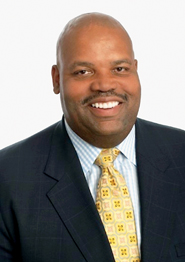
The company did not divulge the names of the departing executives, but Reuters stated they were Reggie Browne, Eric Lichtenstein and Darren Taube.
The three joined Knight in 2009 from Newedge, propelling Knight to become one of the large market makers in exchange-traded funds.
A KCG spokesperson told Reuters that Joe Mazzella and John Dibacco would oversee the ETF group on an interim basis.
Sept. 4 (Bloomberg) — For the second time in two weeks, a malfunction in a price feed overseen by Nasdaq OMX Group Inc. led to a trading halt of some of the companies it lists.
Nasdaq’s securities information processor had a “hardware memory failure” at 11:35 a.m. New York time today, the company said after a preliminary review. The issue was resolved six minutes later. Direct Edge Holdings LLC, another U.S. exchange operator, briefly stopped transactions for some Nasdaq-listed shares, according to a statement.
Nasdaq halted trading in thousands of its stocks for three hours on Aug. 22 out of concern a connectivity issue in the feed, known by its initials SIP, would cause uneven dissemination of prices in the market. The disruption underscored how quickly the integrity of the U.S. market can be subverted as orders to buy and sell shares are matched on more than 50 exchanges and alternative electronic venues.
“We are not inspired by the fact that this has become a recurring issue,” Peter Sorrentino, a senior vice president who helps manage about $15 billion at Huntington Asset Advisors, said by phone from Cincinnati. “This type of thing does an awful lot to kill investor confidence in the markets.”
Backup System
Last month’s market disruption snowballed when a software flaw prevented Nasdaq’s backup program from kicking in. This time, the affected system “successfully failed over,” according to the company.
“Any piece of software, even if it’s run for 100 percent for 10 years, there’s still flaws in it,” Nasdaq Chief Executive Officer Robert Greifeld said in an Aug. 29 interview with Bloomberg News. “Whatever you have, it’s a question of what unique set of circumstances happen to reveal that.”
The Aug. 22 flaw was revealed when NYSE Arca, one of the exchanges that sends price and trade data directly to the SIP, sent more than 20 “connect and disconnect sequences” and a stream of quotes for inaccurate stock symbols, according to a Nasdaq summary released Aug. 29. The amount of data “vastly exceeded” the capacity of the processor, Nasdaq said.
The SIP will manually block connection attempts the next time it’s deluged with data, according to a separate statement today based on a review by the 15-member committee that oversees the feed. The group also plans to review today’s issue.
Tape C
Nasdaq and the New York Stock Exchange, the venues where almost all U.S. companies go public, each operate SIPs that receive quotes and trades from around the country and disseminate them in three groups, known as tapes. NYSE operates Tapes A and B, and Nasdaq runs Tape C.
Today’s disruption affected Tape C stocks with symbols from “PC” to “SPZ,” Nasdaq said. The exchange operator’s shares briefly erased gains following the issue, declining as much as 0.9 percent, before rising 0.7 percent to $30 as of 4 p.m. New York time.
U.S. Securities and Exchange Commission Chairman Mary Jo White plans to meet Sept. 12 with the heads of exchanges and other self-regulatory organizations to discuss the Aug. 22 halt.
“As is our practice, we’re in contact with them and monitoring developments,” John Nester, an SEC spokesman, said regarding today’s Nasdaq outage.
