










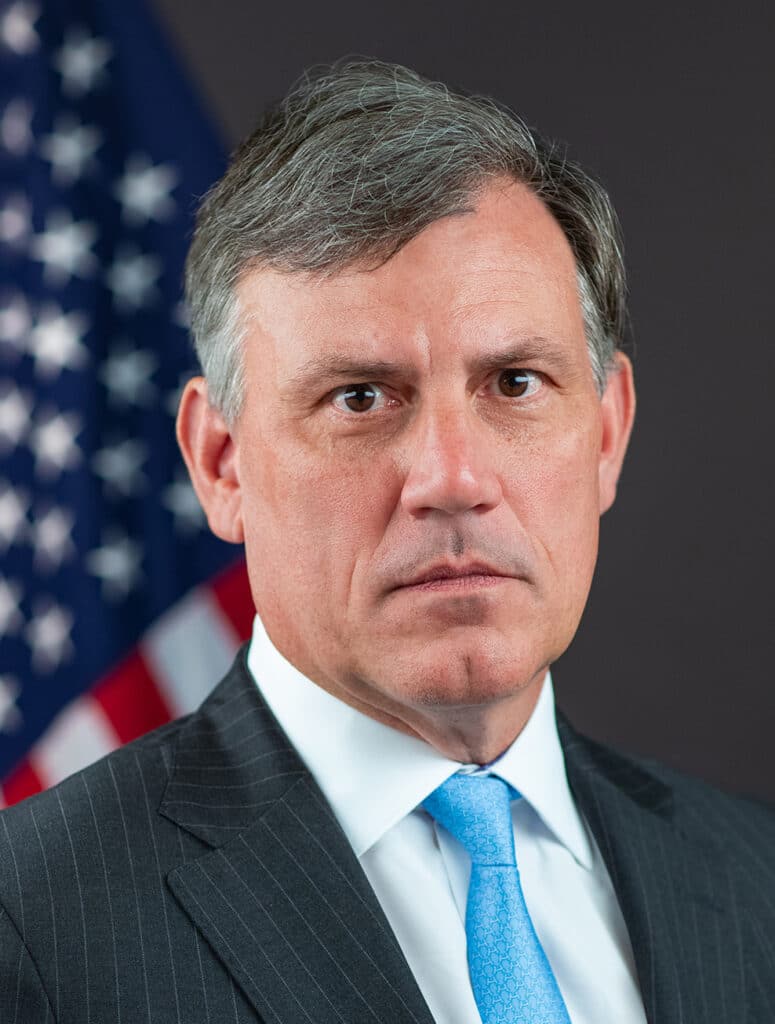
By Jamie Selway, Director, Division of Trading and Markets, SEC
Options Industry Conference: Palm Beach Gardens, Florida: May 5, 2026
Good afternoon. Steve [Luparello], thank you for that kind introduction. Given the incredible, persistent growth in the options markets over the past decade, it is only fitting to hold your annual conference in the great state of Florida, an anchor participant in our Nation’s “Boom Belt.” Congratulations on that growth. And thank you for the meaningful investor education work dutifully done by the Options Industry Council. Your dedication to the promise and power that options products deliver to investors is valuable and welcome.
And now, please accept my personal “ODD:” I speak today in my official capacity as the Commission’s Director of the Division of Trading and Markets. My remarks do not necessarily reflect the views of the Commission, the Commissioners, or members of the Division’s staff. I intend these remarks to be “American-style,” and trust this wise audience to advise at the end if they expire “out-of-the-money.”
Fischer Black was a giant of the options community. He rose to the top of both academia and industry, holding professorships at the University of Chicago and the Massachusetts Institute of Technology and a partnership at Goldman Sachs. Along with Myron Scholes, he is best known for the Black-Scholes options pricing model, published in 1973.[1] This model established the mathematical relationship between an option’s price and its key characteristics, foremost among these the volatility of the asset underlying the option. Along with volatility, a suite of derivatives of the Black-Scholes equation – the so-called “greeks,” such as delta, gamma, vega, and theta – created a language for the options marketplace. More efficient communication led to more efficient prices—which led to massive industry growth that continues today.
Fischer Black passed away in 1995. I never had the privilege of meeting him, but a graduate school classmate corresponded with him regularly on options problems in his final months. My friend describes Fischer Black’s responses to his inquiries as elegant, detailed, and—most of all—patient. When I interviewed for a derivatives job at Goldman Sachs in 1999, two of my thirty or so interrogators were Emanuel Derman and Bill Toy – along with Fischer Black, the authors of the Black-Derman-Toy model for interest rate derivatives.[2] My own mathematics were just so-so, but “Cool Hand Luke” proved to be a winning choice for favorite movie—at least to the trading desk. I joined a team led by Joanne Hill, an early index pioneer, and Sandy Rattray, co-inventor of the VIX. Joanne and Sandy themselves made foundational contributions to options market linguistics that drove efficiencies to the benefit of investors.
Given the centrality of communication to efficiency and progress, it may surprise this audience that the Commission has not made a formal study of options markets since 2004.[3] That’s not to say that the Division hasn’t been focusing on the options markets and listening to your concerns. I understand that at last year’s conference, a number of attendees suggested to Commissioner Peirce that FINRA’s Pattern Day Trading Rule was past its prime, and that the Options Regulatory Fee was in desperate need of reform. I am therefore pleased to report that the Commission approved FINRA’s rescission of “PDT” on April 14, and that industry-led “ORF” reform will take effect on July 1.
On April 16, the Commission held a roundtable on options market structure, which included a data presentation from the Division’s Office of Analytics and Research and three panel discussions.[4] Twenty-eight industry experts contributed to the panels, which focused on competition in a quote-driven market, the customer experience, and opportunities and challenges of growth. Chairman Atkins articulated the event’s purpose during his remarks:
“I should note that this roundtable is neither a prelude to, nor a harbinger of, any options rulemakings in the immediate term. Rather, today is a chance to celebrate the strength of our options markets and to recognize the important place that they have come to occupy in the broader financial ecosystem. Today’s panel discussions also offer an opportunity for leading experts and practitioners to examine what is working, to identify where closer attention is warranted, and to consider the opportunities and challenges that lie ahead.”[5]
The Division was pleased by the depth and breadth of discussions, which created a valuable record and contributed to the investing public’s understanding of relevant, but nuanced, questions. In addition, the Commission opened a public comment file – file number 4-887 – and the Division’s staff will evaluate all submissions received.
As this audience knows better than any, options are a growing business. The dynamic nature of the options marketplace was readily apparent from the staff presentation at the roundtable.[6] For example, between 2012 and 2025, the number of unique underliers grew by 144%, and the number of unique options series increased by 719%. In December 2025, the median OPRA message count was 131 billon – which is 3,275 times the daily average in 2000. Option activity on expiry, or “0DTEs,” has grown from nearly 20% of volume at the start of 2022 to 28% in 2025. On the other hand, the number of options market makers has dropped from 98 in 2012 to 51 in 2025. Yet market-wide payment-for-order-flow for options is now twice that of equities, illustrating the ever-growing interest in options from retail investors.
In terms of the roundtable panels, the Division discerned an emerging consensus on three marketplace improvements: execution quality disclosure, containment of strike proliferation, and cross-market efficiencies for “clearly erroneous” policies to break errant trades. In addition, the Division noted interest in replacing lifetime specialist appointments with periodic competitive selection, a review of auction processes, an expansion of penny classes, and enhanced risk management to support clearing capacity. We welcome feedback on these ideas—and any others you may have.
Beyond impressive growth, the options marketplace continues to innovate. Cboe has announced plans to offer binary options on the S&P 500 index, and last Thursday the Commission approved Nasdaq’s proposal to list and trade binaries on the Nasdaq-100 index. A core benefit of our harmonization work with the CFTC will be clear rules for new products, which drive innovation and investor choice—and I expect that the options marketplace will have an opportunity to play an important part in that process.
Whether a matter of mathematics, indices, or roundtables, efficient conveyance of relevant ideas and information creates value. Our options markets have no rival globally, and any improvements we make will serve to lengthen our lead over the competition. The Division has re-established the lines of communication with the options marketplace. Let’s speak early and often about ways to deliver benefits to the investors we serve.
Thank you for your time and attention. I look forward to your questions, feedback, and ideas.
[1] Black, Fischer and Scholes, Myron, “The Pricing of Options and Corporate Liabilities,” Journal of Political Economy, University of Chicago Press, vol. 81(3), pages 637-654, May-June 1973.
[2] Black, Fischer; Derman, Emanuel; and Toy, William, “A One-Factor Model of Interest Rates and Its Application to Treasury Bond Options,” Financial Analysts Journal, Association for Investment Management and Research, vol. 46(1), pages 33-39, Jan.-Feb. 1990.
[3] SEC.gov | Competitive Developments in the Options Markets.
[4] SEC.gov | Options Market Structure Roundtable.
[5] SEC.gov | Remarks at the Options Market Structure Roundtable.
[6] SEC.gov | Roundtable on Options Market Structure Supporting Data.
