










SpaceX options began as a classic post-IPO event trade: scarce float, fast index-inclusion demand, violent spot moves and a large earnings-and-lock-up calendar risk. By mid-August, that first event window had passed. The more striking development is that the options market did not calm down with it.
Public end-of-day option-chain snapshots compiled between 17 June and 11 August show a market that has become broader, deeper and still unusually active. The stock was lower than in the first options snapshot, with the underlying price moving from $185 to $139. But listed contracts expanded from 361 to more than 3,000, the number of expiries rose from three to 19, and total open interest increased from about 785,000 contracts to 4.16 million.
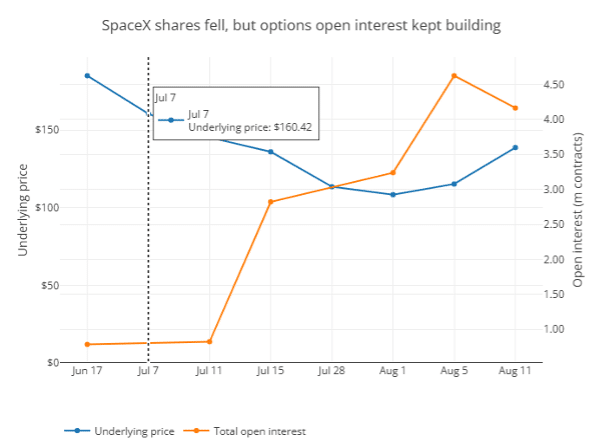
That distinction matters. SpaceX’s first options cycle was driven by a series of identifiable catalysts. Options started trading after a powerful post-IPO rally, passive index demand made upside exposure expensive, and the first earnings report and lock-up release created a concentrated volatility event. A lower share price might have suggested that the initial derivatives frenzy would fade once those catalysts passed. Instead, open interest continued to build.
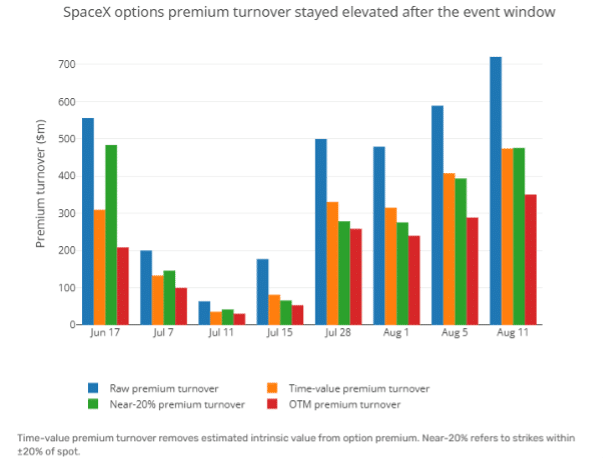
Contract volume alone gives only part of the picture. Total volume in the latest snapshot was 1.20 million contracts, down from 1.45 million in the first snapshot. But premium turnover moved the other way. Raw premium turnover rose from about $556 million to $720 million, while estimated time-value premium turnover rose from $309 million to $474 million. The time-value share of total premium turnover increased from about 56% to 66%, suggesting that the later market was not merely trading intrinsic value in already-in-the-money contracts. Traders were still paying substantial premium for volatility, time and convexity.
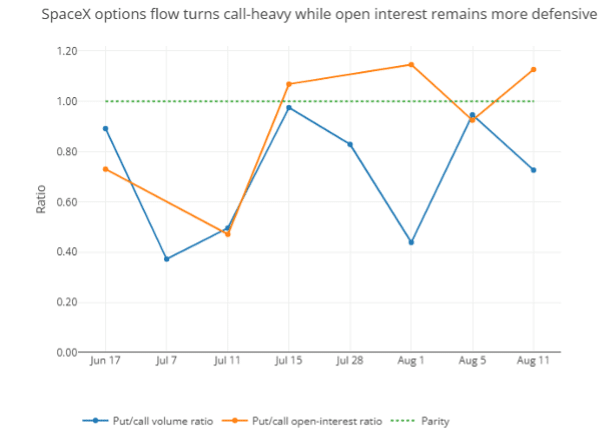
The put/call split also shows how the market evolved. The latest snapshot was call-heavy by volume, with put volume running at roughly 0.73 times call volume. That suggests fresh trading had moved back toward upside participation. Open interest told a more balanced, and slightly more defensive, story: put open interest stood at 1.13 times call open interest.
That divergence between flow and positioning is important for market participants. Daily volume captures the current trading impulse; open interest reflects positions that have accumulated over time. In SpaceX, the fresh flow appears to have turned speculative again, while the stock of existing positions still carries a larger downside or hedging component than the earliest snapshot.
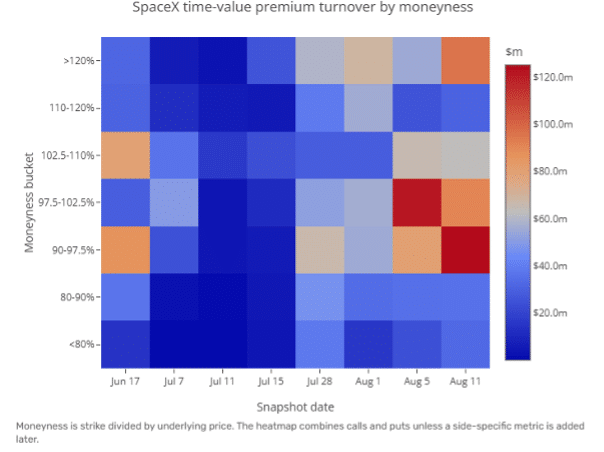
The moneyness distribution shows where the post-event activity was concentrated. By 11 August, premium turnover was not confined to far-out-of-the-money upside calls or deep downside protection. A visible cluster appeared around strikes close to spot, especially in the 90% to 97.5% moneyness bucket. That bucket includes strikes modestly below the prevailing share price, where activity can reflect both slightly in-the-money calls and out-of-the-money puts.
The point is not that the market had settled on a single directional view. Rather, the heatmap suggests that traders were paying for near-spot optionality after the event window, not simply expressing a one-way view on another IPO-style squeeze. That makes the later SpaceX options market look more like a continuing volatility venue than a one-catalyst trade.
The individual-contract view makes the same point more concrete. Ranking contracts by time-value premium turnover strips out much of the intrinsic-value effect that can dominate deep in-the-money options and highlights where traders are paying for optionality itself. In a young, fast-moving options market, that matters because aggregate turnover can still be driven by a relatively small number of strikes and expiries.
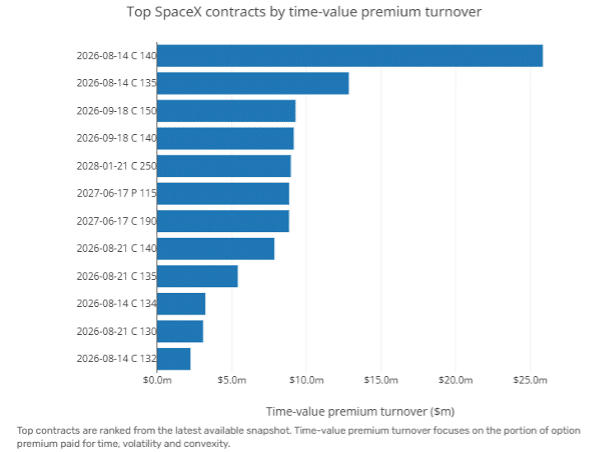
This analysis uses public option-chain snapshots rather than intraday quote-level data or a fitted volatility surface, so it should be read as a measure of listed activity, premium turnover and positioning rather than a reconstruction of dealer risk. Even with that caveat, the signal is clear. The first SpaceX options cycle was an event trade. By mid-August, it had become something more durable: a single-name volatility franchise with millions of contracts open, hundreds of millions of dollars of premium turnover and a market split between fresh upside trading and accumulated downside protection.
(VOL REPORT is a Traders Magazine – Cboe Global Markets content collaboration that covers volatility and its implications for market participants and operators.)
Featured image credit: depositphotos.
