




NEW YORK, April 21, 2026 – B. Riley Securities, Inc. (“B. Riley Securities” or “BRS”), a leading full-service and research-driven investment bank, today announced the return of Seamus O’Neill as Senior Sales Trader and the addition of TJ Bealko to Institutional Equity Sales, both joining the firm’s New York desk.
Together with the firm’s 2025 San Francisco expansion, these additions strengthen BRS’ bi-coastal institutional presence, deepening client coverage and enhancing distribution capabilities.
“Institutional clients rely on BRS to source differentiated ideas and deliver flawless execution,” said Andy Moore, CEO of B. Riley Securities. “The addition of TJ and Seamus is immediately accretive to our distribution platform, ensuring we continue to provide the actionable opportunities and high-touch service our clients expect as demand for research-driven coverage continues to grow.”
Seamus O’Neill returns to BRS as Senior Sales Trader, bringing more than 30 years of experience across institutional sell-side equity and options markets, most recently at Outset Global. He has built a reputation for execution and has long-standing relationships with institutional clients across the East Coast and Midwest. An alumnus of the College of Commerce in Dublin, Ireland, Mr. O’Neill brings his deep knowledge of complex securities trading and financial regulations to the New York desk.
TJ Bealko joins the firm’s Institutional Equity Sales team following nearly a decade of leadership at Bank of America and RBC Capital Markets. He brings extensive capital markets expertise and a strong track record of developing buy-side relationships, particularly within the hedge fund community. Mr. Bealko is highly regarded for his ability to source differentiated, high-conviction investment ideas, and driving meaningful, strategic engagement between corporate management teams and institutional investors. He earned his bachelor’s degree in finance and economics from Penn State University.
“We are strategically building our desk to navigate complex markets on behalf of our clients,” added Eric Rajewski, Senior Managing Director and Head of Institutional Sales at B. Riley Securities. “TJ and Seamus bring complementary strengths to our New York desk, anchoring our East Coast presence with elite relationship management and execution capabilities.”
For more information about B. Riley Securities’ institutional sales and trading, visit: https://www.brileysecurities.com/sales-trading.
About B. Riley Securities
B. Riley Securities is a leading full-service investment bank and capital markets provider serving companies, financial sponsors, and institutional investors across all industry verticals. Services include initial and follow-on offerings, debt and equity-linked solutions, institutional private placements, merger and acquisition (M&A) advisory, corporate restructuring, and liability management. Widely recognized for its thematic proprietary equity research, clients benefit from the firm’s extensive network, industry expertise, and proven execution capabilities through its end-to-end platform. For more information, visit www.brileysecurities.com. Follow us on LinkedIn.
B. Riley Securities Expands New York Institutional Sales & Trading Desk

HQLAX Announces Strategic Investments from Broadridge and Digital Asset
HQLAX Announces Strategic Investments from Broadridge and Digital Asset to Support its Next Phase of Growth on Canton
Luxembourg / New York, April 21st 2026 – HQLAX, a leading provider of digital collateral mobility solutions, today announced that it has secured strategic minority investments from global Fintech leader, Broadridge Financial Solutions, Inc., (NYSE: BR), and Digital Asset in its Series C‑1 funding round.
The investment will support HQLAX’s next phase of growth, including the continued evolution of its technology platform, collaboration with Broadridge’s Distributed Ledger Repo (DLR) platform, and a planned migration to the Canton Network. Together, these initiatives will leverage complementary capabilities to support regulated market use cases across the global securities finance and repo industry.
“This strategic investment marks a key milestone for HQLAX as we continue to build critical market infrastructure for collateral mobility,” said Guido Stroemer, CEO of HQLAX. “The backing from Broadridge and Digital Asset reflects growing industry momentum behind interoperable, privacy‑preserving blockchain solutions, with the Canton Network enabling connectivity across regulated capital markets.”
“We are pleased to support HQLAX in its next phase of growth as demand increases for scalable, interoperable digital infrastructure across global financial markets,” said Horacio Barakat, Global Head of Digital Innovation at Broadridge. “HQLAX has built a compelling solution that addresses critical inefficiencies in collateral mobility, and we see significant opportunity in combining its innovation with Broadridge’s deep expertise in market infrastructure and market-leading distributed ledger-enabled solutions. This investment reflects our commitment to accelerating the adoption of digital assets and collateral mobility to improve efficiency, resiliency, and capital optimization across the securities finance ecosystem.”
“Collateral mobility is a core requirement for modern market infrastructure, and HQLAX has demonstrated how to deliver it in a way that meets the needs of regulated institutions,” said Kelly Mathieson, Chief Business Development Officer at Digital Asset. “We’re excited to deepen our relationship with HQLAX as it enters its next chapter and to support its work alongside the Canton ecosystem to enable more connected, efficient, and scalable collateral and financing workflows across global markets.”
As part of the transaction, representatives from Broadridge and Digital Asset will join the HQLAX Board.
The planned Board appointments and the migration to the Canton Network are subject to regulatory approval from the Commission de Surveillance du Secteur Financier (CSSF).
The strategic investment builds on HQLAX’s broader ecosystem of partnerships across banks, market infrastructure providers, and technology firms, as the company continues to expand adoption of digital collateral mobility solutions across the broader securities finance ecosystem.
###
About HQLAX
HQLAX is an innovative financial technology firm that leverages Distributed Ledger Technology (DLT) to deliver efficiencies to the global securities finance and repo industry. Its platform enables banks and asset managers to achieve frictionless, precise, and real‑time collateral mobility. Learn more at: www.hqla-x.com
HQLAX Contacts:
Media: nick.short@hqla-x.com
About Broadridge
Broadridge Financial Solutions (NYSE: BR) is a global technology leader with trusted expertise and transformative technology, helping clients and the financial services industry operate, innovate, and grow. We power investing, governance, and communications for our clients – driving operational resiliency, elevating business performance, and transforming investor experiences.
Our technology and operations platforms process and generate over 7 billion communications annually and underpin the daily average trading of over $15 trillion in tokenized and traditional securities globally. A certified Great Place to Work®, Broadridge is part of the S&P 500® Index, employing over 15,000 associates in 21 countries.
For more information about us, please visit www.broadridge.com
About Broadridge’s Tokenization Solutions
Broadridge enables on-chain proxy voting and governance, digital asset post-trade infrastructure, and the scaling of digital asset capabilities across multiple asset classes. Through these innovations, Broadridge is helping financial institutions unlock the next era of digital assets investing.
Broadridge’s Distributed Ledger Repo (DLR) solution is the world’s largest institutional platform for settling tokenized real assets, tokenizing approximately $354 billion a day. As tokenization gains momentum across financial services, Broadridge is meeting the complexity of operating across traditional and digital ecosystems with established scale, critical market knowledge, and technological expertise.
For more information, please visit www.broadridge.com/hub/tokenization.
Broadridge Contacts:
Investors: broadridgeir@broadridge.com
Media: Gregg.Rosenberg@broadridge.com
About Digital Asset
Digital Asset is a leading innovator in blockchain technology, transforming traditional and digital financial markets with privacy-enabled solutions that improve capital flow and create a more efficient, fair, and resilient global system. As the creator of the Canton Network, the only public layer one blockchain with privacy, and a founding member of its Canton Foundation, Digital Asset has been a pioneer of this open, secure, and interoperable infrastructure. Founded in 2014, Digital Asset is committed to reshaping the future of finance by enabling real-time efficiencies, 24/7 global transactions, and unlocking the full potential of cryptocurrencies, digital assets, and the continued convergence of decentralized and traditional finance.
SEC Roundtable Reveals Divide Over Legacy Options Rules


Market participants disagreed sharply at a U.S. Securities and Exchange Commission roundtable on listed options market structure on April 16, with some calling legacy allocation rules anti-competitive while others said they remain necessary to support liquidity across a fragmented market.
The discussion was led by SEC Division of Trading and Markets Director Jamie Selway and Assistant Director Arun Manoharan.
Much of the debate centered on specialist programs and the so-called five-lot rule, which can give designated market makers priority on small customer orders.
Steve Crutchfield, formerly of Chicago Trading Company, argued that while U.S. options markets remain healthy, certain legacy incentives distort competition among liquidity providers.
“We’ve got very healthy markets. We’ve got an excellent customer experience,” Crutchfield said. But he added that “the competitive dynamics on the liquidity providing side have been skewed.”
He said such protections may once have been justified in less liquid products but are harder to defend in actively traded names.
John Kinahan, CEO of Group One Trading, agreed, saying guaranteed allocations likely reduce incentives for tighter or deeper displayed markets.
“If those market maker guarantees didn’t exist, we would make different markets,” Kinahan said. “My guess is they’d be tighter or deeper,” he added.
Meanwhile, Kevin Tyrrell, Head of Markets for NYSE Group, said specialist-style incentives remain important for smaller exchanges competing with larger rivals.
“The market may not need help on Apple, Tesla and Nvidia, but NYSE Amex might versus Cboe and Nasdaq,” Tyrrell said.
Ivan Brown, Head of Options, IEX, said the issue was one of balance: “Guaranteed allocations reduce the portion of order flow that’s broadly accessible to others. However … that serves a purpose.”
John Fischer, Market Structure & Business Development at Citadel Securities, rejected suggestions that liquid names no longer require specialist support: “Without a specialist, they wouldn’t have liquidity,” he said.
The panel then turned to retail price-improvement auctions, where participants broadly agreed the mechanisms benefit customers but differed over whether current rules favor firms that initiate orders.
Andrew Schultz, Head of Strategic Options Business Development at Susquehanna International Group, described auctions as an important source of competition and customer price improvement, particularly when quoted spreads widen beyond one cent.
“We are immense users of auctions,” Schultz said. “Competition … gets the best price for customers.”
“If spreads were always a penny, we wouldn’t have this discussion,” he added.
Kinahan said fee differences between initiating firms and competing responders can materially shape incentives: “This is an extremely competitive industry. Fractions of a cent count,” he said.
Brown called auctions “a critical tool” but said some fee structures may inhibit aggressive competition.
Crutchfield focused criticism on auto-match features that allow initiators to automatically match better competing prices during an auction: “It pretty obviously diminishes their incentives to provide the best price out of the gate,” he said.
Fischer added that initiating firms assume risk by committing capital before auctions conclude: “The initiating market maker is at a disadvantage.”
Schultz urged regulators to preserve the benefits customers currently receive: “Just don’t mess this up for the customers,” he said.
The future role of physical trading floors also drew debate.
Tyrrell said floors continue to serve an important purpose for large, complex and multi-leg trades where electronic execution may be less effective.
“What we generally see is that the floor is handling larger, more complicated orders where electronic execution either isn’t ideal or may not even be possible,” he said.
Schultz reiterated Susquehanna’s view that all trades should receive electronic exposure.
“Electronic exposure … will result in better and fairer executions for the end customer,” he said.
Crutchfield said floors appear to provide less value than in the past, particularly in multi-listed products. “What does not happen on floors is price discovery in multi-lists,” he said. “It’s just not happening.”
Costs, Fragmentation and Wide Quotes
The roundtable also examined exchange proliferation, protected quotes and why spreads remain wide in less liquid options.
According to Stewart Mayhew, Financial Economist at Cornerstone Research, trade-through protections still help customers by safeguarding displayed limit orders. “Trade-through protection in options markets feels to me to be very consistent with the goals of the national market system,” Mayhew said.
Tyrrell said regulators should also consider whether incentives for launching new exchanges continue to add fragmentation and industry costs. “There’s certainly an incentive to keep adding exchanges,” he said.
Schultz argued removing protected status from smaller exchanges likely would not materially harm customer execution quality, while warning that connectivity and infrastructure costs have become a major barrier to new entrants. “We don’t actually believe it would impact the prices that the customers achieve.”
“The connectivity, data center boxes, cross connects, all that are a real burden,” Schultz said.
Panelists also pointed to the explosion in listed strikes. Fischer said roughly half of nearly two million options strikes have no open interest. “There are nearly two million strikes, and half of them have no open interest,” Fischer said.
Steve Sosnick of Interactive Brokers said excessive listings dilute market-making resources: “If we still have 1 million out of 2 million strikes that have no open interest, I will argue we have too many strikes.”
Brown said strike rationalization has long been discussed but is difficult for exchanges to coordinate independently because of antitrust concerns: “This is an area where some direct initiative from the Commission … might be a very practical application.”
SEC, CFTC Jointly Propose Amendments to Reduce Private Fund Reporting Burdens

Washington D.C., April 20, 2026 —
The Securities and Exchange Commission (SEC) and the Commodity Futures Trading Commission (CFTC) jointly proposed amendments to reduce private fund reporting burdens while enabling the continued collection of necessary and appropriate information. The agencies proposed to amend Form PF, the confidential reporting form for certain SEC-registered investment advisers to private funds, including those that also are registered with the CFTC as commodity pool operators or commodity trading advisors. Form PF collects information designed to facilitate the Financial Stability Oversight Council’s (FSOC) monitoring of systemic risk in the financial markets. The SEC and CFTC use the information collected on Form PF in their investor protection efforts.
“A key pillar of my agenda is restoring balance to disclosure obligations and reducing the cost of compliance wherever possible,” said SEC Chairman Paul S. Atkins. “Prior amendments to Form PF have led to overly burdensome disclosure requirements for advisers, distracting them from their core investment functions, often without a commensurate benefit to regulators’ use of the collected data. These proposed changes would help to rationalize the scope of Form PF requirements to support its purpose and bring our overall disclosure regime back into alignment.”
“By raising the filing threshold and streamlining Form PF, we are taking steps to reduce the burdens associated with filing the form,” said CFTC Chairman Michael S. Selig. “I look forward to reading the public comments to ensure we get these changes right so that we eliminate unnecessary costs and burdens for filers.”
The proposed amendments would eliminate filing requirements for smaller advisers, who represent almost half of the advisers currently required to file Form PF, by raising the filing threshold from $150 million in private fund assets under management to $1 billion. The proposal would also raise the exposure reporting threshold for “large” hedge fund advisers from $1.5 billion in hedge fund assets under management to $10 billion. Form PF would continue to obtain information on over 90 percent of private fund gross assets and require detailed exposure information for funds managed by large hedge fund managers. In addition, the proposed amendments to Form PF would enable a method to identify funds that are active in the private credit market.
In addition to amending these thresholds, the proposal would eliminate or streamline many Form PF requirements, significantly reducing burdens for advisers required to file Form PF.
The proposal requests comments on all the proposed amendments.
The proposing release for the amendments will be published in the Federal Register, and the public comment period will remain open until 60 days after publication in the Federal Register.
Trading Technologies’ Nick Garrow Assumes New Role of Chief Strategy Officer; Josh Monroe Joins as Chief Revenue Officer

CHICAGO, April 20, 2026 – Trading Technologies International, Inc. (TT), a global capital markets technology platform services provider, announced that Nick Garrow, who has been serving as Chief Revenue Officer (CRO), has assumed the role of Chief Strategy Officer (CSO) – a new position within the firm – and Josh Monroe has joined TT as Chief Revenue Officer (CRO). Both executives have decades of experience in capital markets and technology leadership.
TT CEO Justin Llewellyn-Jones said: “Nick has done a truly fantastic job of driving the firm’s move into new asset classes, broadening our appeal to new segments, and leading our sales and marketing team through a period of exceptional revenue growth. He is ideally suited to the role of CSO, and his strategic thinking, vision and passion will continue to shape our future. Josh is a highly accomplished executive, who brings incredible experience and a great track record as a growth-focused CRO for capital markets fintech organizations. His drive and energy will be critical to our success, and I am absolutely delighted to welcome him to the team in this important leadership role.”
As CSO, Garrow will assume responsibility for driving accelerated sustainable growth across TT’s existing lines of business as well as identifying and evaluating new markets and product opportunities, ensuring TT’s strategy remains highly aligned with the rapidly changing landscape that is global capital markets. The role will include identifying and leveraging acquisition and partnership opportunities that support TT’s goals.
Monroe, based in New York, assumes responsibility for TT’s global sales, marketing and revenue operations activities. He previously served as CRO at Duco, a leading provider of AI-powered data automation to global financial institutions; and as CRO at Xceptor, a data automation platform for financial institutions. Previously, he served as Managing Director, Head of Americas for Itiviti, now part of Broadridge, with responsibility for revenue growth, client relationships and regional strategy. He also held multiple roles at SunGard and later FIS after its acquisition of the firm, ultimately as SVP & Head of Sales for Trading and Risk Solutions, Americas. Monroe earned a Bachelor of Science degree in Finance, Summa Cum Laude, from the University at Albany.
About Trading Technologies
Trading Technologies (www.tradingtechnologies.com) is a global capital markets platform services company providing market-leading technology for the end-to-end trading operations of Tier 1 banks, brokerages, money managers, hedge funds, proprietary traders, Commodity Trading Advisors (CTAs), commercial hedgers and risk managers. With its roots in listed derivatives, the Software-as-a-Service (SaaS) company delivers “multi-X” solutions, with “X” representing asset classes, functions, workflows and geographies. This multi-X approach features trade execution services across futures and options, fixed income, foreign exchange (FX) and cryptocurrencies augmented by solutions for data and analytics, including transaction cost analysis (TCA); quantitative trading; compliance and trade surveillance; clearing and post-trade allocation; and infrastructure services. The award-winning TT platform ecosystem also helps exchanges deliver innovative solutions to their market participants, and technology companies to distribute their complementary offerings to Trading Technologies’ clients.
ON THE MOVE: SIFMA Promotes Lucas West; Sahana Athreya to Barclays


SIFMA has promoted Lucas West to Executive Vice President and Head of Advocacy. In this role, Lucas will be SIFMA’s senior government affairs officer and will lead SIFMA’s federal advocacy efforts, according to a press release. Prior to joining SIFMA, Lucas served as senior policy advisor for U.S. Representative Blaine Luetkemeyer (R-MO), a leading member of the House Financial Services Committee (HFSC) who served as Chairman of the HFSC Subcommittee on Financial Institutions, and Chairman of the HFSC Subcommittee on National Security, Illicit Finance, and International Financial Institutions.
Barclays Research has appointed Sahana Athreya as Global Head of Data Science & Applied AI, based in New York. According to a press statement, Athreya will lead the firm’s data science, artificial intelligence and advanced analytics agenda across Research. Prior to joining Barclays, Athreya led data science and advanced machine learning initiatives at some of the world’s leading hedge funds, including Eisler Capital and Millennium Management.
Citi has appointed Lee Smallwood Chief Operating Officer of its Markets business, according to a source familiar with the matter. Lee has experience across Markets front-office roles, COO leadership, and work in innovation, data and AI. In his new role, Lee will partner with Markets leadership on the division’s operating model and strategic priorities. Most recently, as Markets Head of Innovation and Investments, he led global teams focused on data-driven platforms, AI initiatives and strategic investments.

Britni Ihle has joined BlackRock as Managing Director, the firm confirmed to Traders Magazine via email. Ihle joins from Citi, where she spent more than four years in senior trading roles. Most recently, she served as Head of Cross-Product Trading, Spread Products from November 2024, after previously serving as Head of Credit Quant Trading – North America from December 2021 to November 2024. Before Citi, Ihle spent more than a decade at Credit Suisse.
Daniel Mottram, Nicole Nesbitt, and Will Tsui have joined Brandes Investment Partners, according to a press release. Mottram serves as Director, Institutional Group at Brandes. He began his career as a portfolio specialist in alternatives and multi asset, before moving to institutional sales and consultant relations at J O Hambro Capital Management.Nesbitt joins Brandes as Director, Institutional Group. She most recently served as Global Head of Institutional Client Service at Brown Advisory. Tsui assumes the role of Director, Institutional Group. He joins Brandes from First Eagle, where he held a similar role, with previous experience at Causeway Capital and as a research analyst at Aon.
If you have a new job or promotion to report, let me know at alyudvig@marketsmedia.com
Charles Schwab Launches Spot Crypto Trading
Retail clients will have access to Schwab Crypto™ alongside the research, education, service and comprehensive investing, trading, wealth, and banking offers they already enjoy at Schwab
Charles Schwab announced Schwab Crypto™, a spot crypto trading offer that will begin a phased rollout to retail clients in the coming weeks. Schwab Crypto will provide direct access to bitcoin and ethereum trading, combined with educational content and experienced professional support all at a great value.
In a recent Schwab survey* of nearly 500 current and prospective cryptocurrency investors, respondents identified three key factors when choosing a firm for cryptocurrency trading: low, transparent pricing; brand familiarity and reputation; and confidence that assets will be kept secure.
“We know our clients want to conduct more of their financial lives at Schwab,” said Jonathan Craig, Head of Retail Investing at Charles Schwab. “With Schwab Crypto, clients who want direct access to the asset class can trade it alongside their other investments, while benefiting from the service, education, and research they expect from us.”
A holistic crypto investing experience
At launch, Schwab Crypto will include:
- Direct trading in bitcoin and ethereum, two of the most well-known and established cryptocurrencies, which together represent approximately three-quarters of the crypto market capitalization.
- In-depth digital assets education and resources, including insights and commentary from the Schwab Center for Financial Research and crypto-focused content through Schwab Coaching®, to help investors understand the digital assets market and how digital assets fit into a broader investing strategy.
- The ability to view and trade cryptocurrency and traditional investments side-by-side across Schwab.com, Schwab Mobile, and thinkorswim®, Schwab’s award-winning trading platform.
- Access to Schwab’s award-winning 24/7 support from thousands of tenured service professionals by phone or chat.
- Pricing among the lowest in the industry at 75 basis points on the dollar value of each trade.
Over time, Schwab plans to add additional cryptocurrencies to the platform, as well as transfer capabilities for both deposits and withdrawals, allowing clients with existing digital asset investments to bring them to Schwab alongside their other investments.
“With Schwab Crypto, investors can access familiar cryptocurrencies within an all‑in‑one investing and banking experience, backed by an ecosystem of education, tools, resources, and support so they can make informed decisions about how crypto might fit into their broader investing goals,” said Joe Vietri, Head of Digital Assets at Charles Schwab.
“Whether you’re new to crypto and looking for a firm you know and trust, or you already own digital assets, our goal is to be the destination of choice for retail investors who want to incorporate digital assets into their portfolios with confidence,” he added.
How Schwab Crypto works
Schwab clients will maintain a separate crypto account through Schwab Crypto, offered by Charles Schwab Premier Bank, SSB, (“CSPB”), linked directly to their brokerage accounts. CSPB will serve as the custodian of clients’ digital assets, responsible for safekeeping and record-keeping.
Paxos, a leading OCC-regulated blockchain infrastructure provider, will deliver sub-custody and trade execution services. Utilizing a federally overseen trust model and proven enterprise-grade technology, Paxos enables the world’s most sophisticated financial institutions to bring digital asset solutions to their customers.
“Paxos is a strong partner for blockchain infrastructure. Their regulatory standing and digital asset expertise will help us deliver the seamless, integrated experience our clients expect from Schwab,” said Vietri.
Schwab is already a leader in digital assets, with clients holding approximately 20% of spot crypto exchange‑traded products. The introduction of spot crypto trading builds on the many ways Schwab clients can already access digital asset investments including spot cryptocurrency Exchange-traded products (ETPs), crypto futures, options on spot crypto ETPs, crypto-related ETFs and mutual funds that invest in the broader digital asset ecosystem.
For an opportunity to gain early access to Schwab Crypto, and to receive insights and education about cryptocurrency, visit Schwab.com/cryptocurrency.
*An online survey of 460 cryptocurrency owners and intended owners aged 21 and over conducted July 31-September 1, 2025.
Source: Charles Schwab
Derivatives in Tokenized Commodities Begin to Emerge

FalconX said derivatives activity in tokenized commodities could be a $5bn market as the digital assets prime broker executed the first tokenized gold derivatives trade referencing the PAX Gold token. Each PAXG token is backed by one fine troy ounce of gold, stored in the London Bullion Market Association’s vaults in London.
The prime broker said in a statement on 14 April 2026 that the transaction marked an early step in the development of a derivatives market for tokenized commodities.

Josh Barkhordar, head of sales at FalconX, said in a statement that tokenized assets are at the center of convergence between traditional finance and digital assets. Onchain markets operate 24/7, allowing institutions to hedge and manage commodity exposure in real time, with faster settlement, greater transparency, and a more efficient use of collateral .
Trace Mayer, chief executive of family office Urim Capital, said in a statement that access to derivatives on assets like PAXG is an important step toward more integrated, continuous global markets that enable efficient management of macro exposure and extend monetary sovereignty. Mayers said: “Tokenized gold brings this ancient store of value and heavyweight of monetary sovereignty into 24/7 programmable markets.”
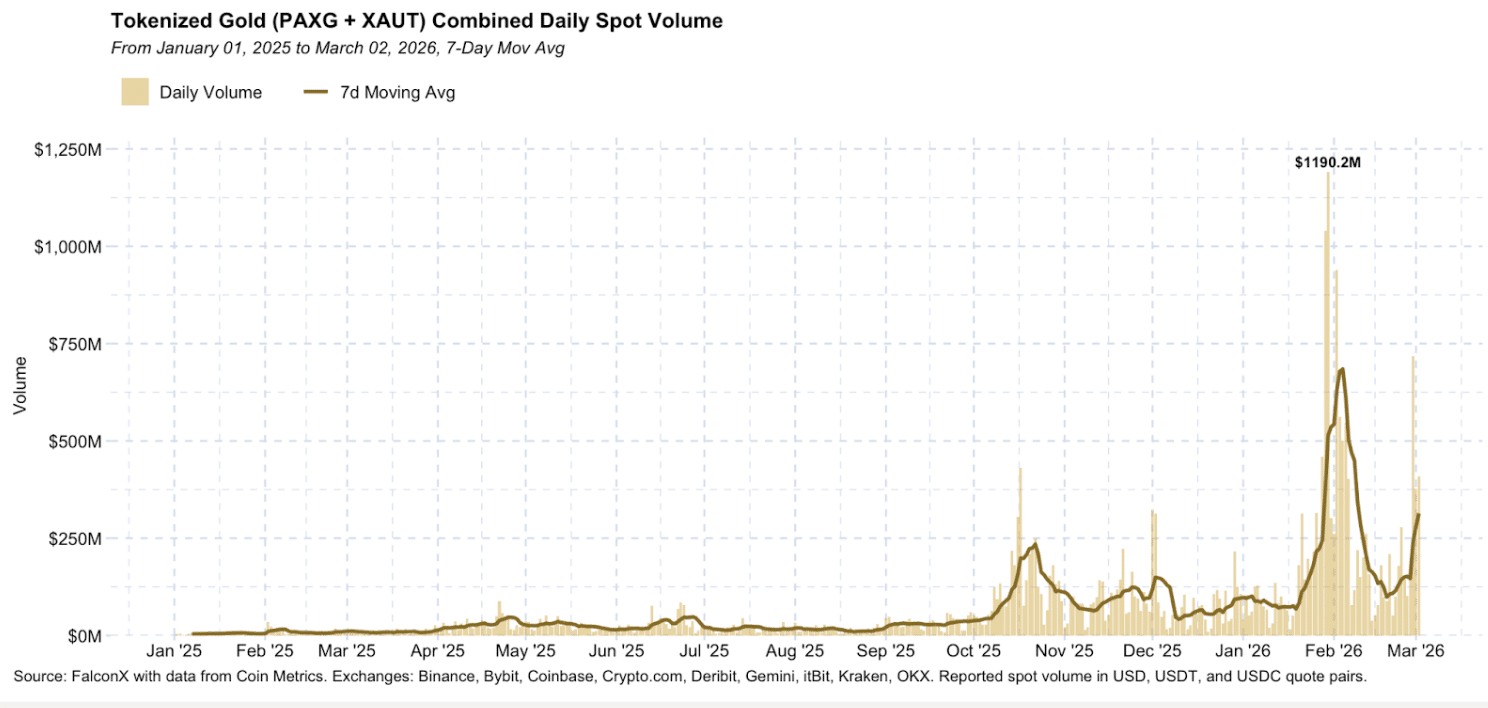
In March this year FalconX had launched support for tokenized gold products, enabling institutional clients to trade and settle PAXG and Tether Gold (XAUT). The market maker said in a statement that the launch reflected commodities increasingly integrating into blockchain-based market infrastructure, bringing 24/7 access and near real-time onchain settlement to traditional markets.
The market has coalesced around XAUT and PAXG, according to a blog from Martin Gaspar, senior crypto market strategist at FalconX, in March this year. He explained that Tether Gold is issued by the issuer of stablecoin USDT, while PAX Gold is from Paxos Trust Company, a crypto infrastructure provider and the third largest stablecoin issuer.

“XAUT has its gold kept in private Swiss vaults, while PAXG uses LBMA-approved vaults in London,” he added. “Liquidity is another consideration. As of Mar 3, 2026, XAUT has a market cap of nearly $2.9bn with daily trading volume of $1.1bn, which compares to PAXG’s market cap of $2.5bn and daily volume of $948m, according to data from CoinGecko.”
During that month the strikes on Iran by the U.S. and Israel led to increased activity in tokenized metals markets on crypto-native venues over the weekends when traditional exchanges were closed. Gaspar said that spot (LBMA) and gold futures (COMEX) only trade Sunday-Friday evening ET for nearly 24 hours each day, meaning that trading cannot respond to potentially market moving geopolitical developments over weekends.
Hyperliquid, a decentralized trading-focused blockchain, has brought traditional markets onchain and a significant portion of its activity has been driven by metals, specifically gold, according to Gaspar.
As of 3 March 2026, gold market open interest on Hyperliquid was $186m, approximately 3% of its total open interest. In contrast, Gaspar highlighted that traditional gold futures had open interest of $266bn as of 27 February 2026, according to the World Gold Council.
Another digital asset prime broker, Ripple Prime, extended its Hyperliquid integration to give institutional traders onchain perpetuals access to gold, silver and oil for the first time in March this year.
Michael Higgins, chef executive of Ripple Prime, said on X that institutions can now trade 24/7 commodity perpetuals through a single margin framework, consolidated risk management, and one counterparty relationship. He described this as traditional finance (TradFi) exposure on decentralized finance (DeFi) rails.
B2C2
On 18 March 2026 B2C2, the digital asset liquidity provider, said in a statement it had launched over-the-counter trading for tokenized gold, offering institutional clients spot and contract for difference (CFD) exposure to PAXG and XAUT, in response to client demand for access to the asset class outside traditional market hours. The two tokens represent approximately 97% of the tokenized gold market, which has grown to nearly $6bn in market capitalization, according to B2C2.
Clients can trade tokenized gold against selected cryptocurrencies, stablecoins and fiat currencies 24/7/365, subject to jurisdiction.
Thomas Restout, group chief executive at B2C2, said in a statement: “Gold has long been one of the most important macro hedges, but for most institutions the infrastructure used to access it still operates on traditional financial rails.”
World Gold Council
The World Gold Council said in a statement on 19 March 2026 that it had launched an initiative to build new market infrastructure for digital gold.
In a white paper, Digital Gold: The Case for a Shared Infrastructure, the World Gold Council and Boston Consulting Group (BCG) proposed Gold as a Service, a new open platform to support the issuance and operation of scalable, interoperable digital gold products. The platform would connect the physical custody of gold with the digital systems used to issue and manage gold-backed products to standardize and grow the market.
The white paper acknowledged that tokenized gold and digital gold accounts have already gained traction as they have clear adoption potential, driven by frictionless access and the prospect of everyday utility.
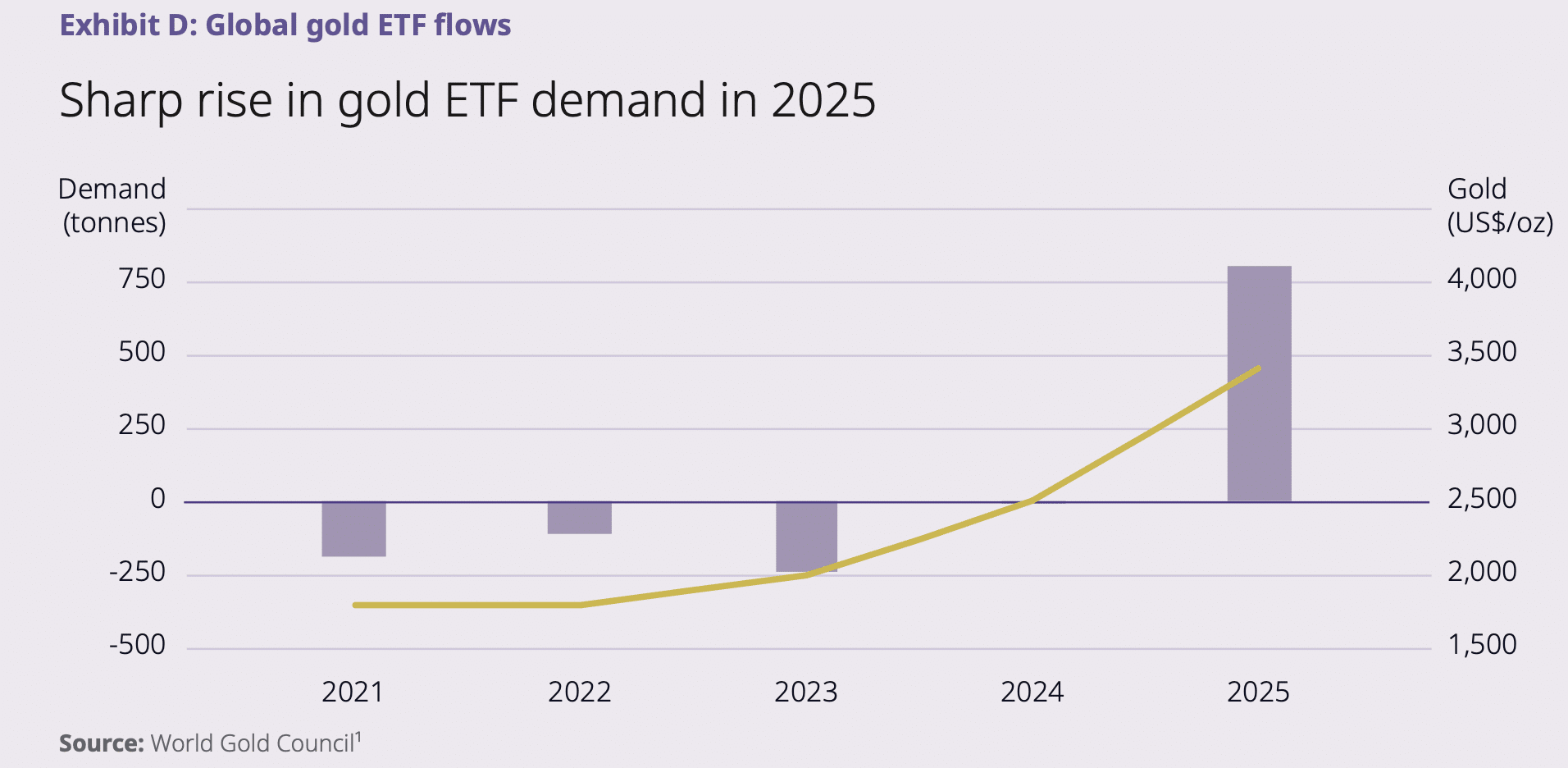
In addition, the paper highlighted that 2025 was a “breakout” year for gold ETFs and other digital gold products. The paper said; “They contributed 16% of annual gold demand and drew $89bn of inflows, lifting total assets under management to $559bn and holdings to 4,025 tonnes.¹”
However, the council said that launching and operating digital gold products remains complex, with limited standardization and reduced fungibility, restricting its ability to integrate with modern financial systems.
David Tait, chief executive of the World Gold Council, said in a statement: “Shared infrastructure can help gold become more accessible, more easily traded and fully integrated into modern financial systems – ensuring it remains as relevant tomorrow as it has been for millennia.”
Citi Appoints Lee Smallwood Chief Operating Officer of Markets

Citi has appointed Lee Smallwood Chief Operating Officer of its Markets business, according to a source familiar with the matter.
Lee has experience across Markets front-office roles, COO leadership, and work in innovation, data and AI.
In his new role, Lee will partner with Markets leadership on the division’s operating model and strategic priorities.
Most recently, as Markets Head of Innovation and Investments, he led global teams focused on data-driven platforms, AI initiatives and strategic investments.
Prior to this, he held multiple senior roles within Markets and, externally, as COO of a digital asset dedicated investment fund and co-founder of a FinTech startup.
The hire comes as Citi modernizes its Markets business through technology and operational improvements.
In its latest shareholder letter, the bank said Markets revenue rose 11% while it continued building scale in equities.
Consolidated Audit Trail Enters Perilous Curve

(FLASH FRIDAY is a weekly content series looking at the past, present and future of capital markets trading and technology. FLASH FRIDAY is sponsored by Instinet, a Nomura company.)
Is the Consolidated Audit Trail (CAT) the capital markets version of the California High-Speed Rail?
Well, not exactly. But there are some parallels.
The California High-Speed Rail (CAHSR) is widely cited as the biggest modern U.S. public project boondoggle, with costs ballooning to $126 billion, triple the original $45 billion that was approved by voters in 2008. Meant to connect Los Angeles and San Francisco, it has become known as the ‘train to nowhere’, and its start date was just recently postponed again, from 2032 to 2033.
The CAT was back in the news this week, when the US Securities and Exchange Commission issued a concept release soliciting public comment in support of a comprehensive review of the CAT and other audit trails and related data sources currently used in the regulation of U.S. securities markets. SEC Chairman Paul Atkins emphasized the need to reform the CAT by better balancing regulatory use, costs, funding, and security considerations.
To be sure, unlike the CAHSR, the CAT is up and running after a phased, four-year go-live period between June 2020 and May 2024. But the CAT has had a long and checkered history dating back to when it was first announced in 2012 as a way for regulators to better monitor and analyze trading activity.
An AI-generated summary notes that the Consolidated Audit Trail has faced a decade of delays, litigation, and massive cost overruns, with more than $500 million spent on development by late 2025. The CAT’s 2025 operating budget reached $272 million, more than five times the 2016 estimate.
Just last year, an appeals court struck down the CAT’s SEC-approved funding model from 2023, and the future of the CAT is further clouded by the ongoing review by the SEC, which has shown to be a decidedly ‘lite’ regulatory agency in the first year under Atkins.
One key criticism of CAT pertains to privacy and surveillance, as the database stores personal data including names, addresses, and full trading history. That effectively creates a ‘government registry’ that allows for the surveillance of everyday investors – not the kind of arrangement that a libertarian-leaning SEC Chairman would likely be a fan of.
Add it all up and just when CAT developers must have been breathing sighs of relief two years ago, the audit trail is again facing headwinds and is mired in controversy and uncertainty.
Can the CAT train make it through the perilous curve it’s now navigating?