BMLL Partners with SpiderRock to Expand Cross-Asset Market Analytics

  • SpiderRock US equity options print set data now available via BMLL Data Lab
  • New dataset availability will enable clients to combine SpiderRock US equity options trade level analytics with BMLL’s historical options and equity data to study cross-asset market structure
  • Joint white paper shows how combined SpiderRock and BMLL data can unlock new insight into volatility dynamics, hedging flows and intraday price behaviour

London, New York, 23 April 2026: BMLL, the leading independent provider of harmonised, historical Level 3, 2 and 1 data and analytics across global equities, ETFs, futures and US equity options, today announced that SpiderRock’s Options Print Set data is available through the BMLL Data Lab.

SpiderRock Options Analytics Now Available in BMLL Data Lab

The addition of SpiderRock’s Options Print Set data enhances BMLL’s cross-asset research environment, enabling clients to analyse the interaction between options markets and underlying cash equity behaviour within a single framework. By combining SpiderRock options print level analytics with BMLL’s high-quality historical equity data, users can explore how dealer positioning, hedging flows and volatility conditions influence intraday price formation and liquidity.

Through the BMLL Data Lab, clients will be able to access SpiderRock’s options print level implied volatility and Greeks data alongside BMLL’s historical equities, futures and options market data to support quantitative research, strategy development and market structure analysis. This provides a unified environment for studying how options hedging flows affect spot liquidity patterns, and how underlying market microstructure in turn affects options pricing and risk.

Joint White Paper Highlights the Power of Cross-Asset Research

The launch is supported by a joint white paper, which demonstrates how SpiderRock’s options analytics can be used alongside BMLL’s intraday equity data to estimate dealer gamma positioning and analyse resulting price dynamics in the underlying stock. The paper shows how net short-gamma positioning can amplify intraday momentum through delta-hedging activity, and how these dynamics can be studied systematically using an integrated data approach.

Elliot Banks, Chief Product Officer, BMLL, said: “At BMLL, we are focused on giving clients access to the data they need to answer increasingly complex cross-asset questions. Making SpiderRock’s options print analytics available in the BMLL Data Lab allows users to combine SpiderRock’s options analytics with detailed historical market data in one environment, helping them accelerate research and generate deeper insight into market dynamics.”

Craig Iseli, Chief Operating Officer at SpiderRock, added: “SpiderRock’s options analytics are designed to help market participants better understand volatility and risk. Making this data available through BMLL Data Lab extends that value further, enabling clients to connect options market signals with underlying equity behaviour and supporting more advanced quantitative and market structure research.”

The availability of SpiderRock data in BMLL Data Lab marks a further step in BMLL’s strategy to bring together high-value partner datasets with its own historical market data and analytics, helping clients accelerate research and unlock new trading and market intelligence use cases. The BMLL and SpiderRock partnership allows institutional clients to better understand, predict, and capitalise on the complex market interdependencies between equity spot and options markets.

**Ends**

About SpiderRock  

SpiderRock is a technology provider that creates and deploys advanced data analytics, algorithmic execution, and risk management solutions to volatility funds, hedge funds, bank trading desks, and proprietary trading firms worldwide.

SpiderRock’s Data and Analytics business provides institutional-grade options analytics and market data, including historical datasets, live proprietary analytics, and direct exchange feeds to support trading, research, and risk models. Coverage spans U.S. and European equity options, options on futures, and futures markets, with both end-of-day and intraday data available. 

SpiderRock also offers a high-performance, cloud-based trading platform that supports the construction, execution, and management of options strategies across both point-and-click and systematic workflows. 

To learn more about SpiderRock, visit www.spiderrock.net or contact datasales@spiderrock.net.  

About BMLL

BMLL Technologies is the leading, independent provider of harmonised, Level 3, 2 and 1 historical data and analytics to the world’s most sophisticated capital market participants, covering global equities, ETFs, futures and US equity options.

BMLL offers banks, brokers, asset managers, hedge funds, global exchange groups, academic institutions and regulators immediate and flexible access to the most granular Level 3, 2 and 1 T+1 order book data and advanced pre and post-trade analytics. BMLL gives users the ability to understand market behaviour, accelerate research, optimise trading strategies and generate alpha more predictably.

Founded in 2014 in the machine learning laboratories of the University of Cambridge, the platform enables researchers and quants across global financial services firms to apply complex statistical techniques to BMLL’s unique big-data sets with applications such as market impact, pre and post trade analytics, order book simulation and compliance. Users no longer need to buy, curate and harmonise data. With BMLL, they gain cost-effective, instant access to a cloud-native Data Science environment via a single web portal, with a long history of the most granular, full order book data across global equities, US equity options, futures and ETFs for back-testing and simulation, delivered directly into their workflows.

In October 2025, Nordic Capital acquired BMLL. The investment was made in close partnership with the management team of BMLL and minority shareholder Optiver, marking a joint commitment to accelerate the company’s next phase of growth. Before this, BMLL secured $21 million strategic investment in October 2024, led by Optiver; $26 million Series B investment in 2022/2023; and $36 million in Series A and seed funding rounds.

For more information, please explore our website and follow us on X (Twitter) and LinkedIn.

Fragmented Liquidity Raises Pressure on Buy-Side Trading Desks

As portfolio managers increasingly deploy leverage and extension strategies to enhance returns, trading desks are facing a new set of execution challenges. In an interview with Traders Magazine, Joel Feinberg, SVP and Head of Trading at Acadian Asset Management, explains where the hidden costs of leverage emerge, how desks are adapting to dispersed liquidity, and why technology’s biggest edge today lies in real-time adaptability rather than pure speed.

How are leverage and extension strategies reshaping execution on the desk?

Joel Feinberg

They’re fundamentally turning execution into a higher-stakes, more interconnected problem. Leverage increases gross exposure without increasing AUM, so you’re trading more dollars for the same portfolio, which means transaction costs and liquidity access have a much bigger impact on returns.

It also changes the nature of the trades themselves. You’re often executing paired or offsetting exposures, so timing and coordination matter; how you trade one leg directly affects the cost and risk of the other. And because you’re operating with higher exposure, market structure frictions like short sale constraints, crowding, and fragmented liquidity show up more quickly in execution outcomes.

In practice, it pushes desks to be more deliberate about where they consume liquidity, more focused on sourcing natural flow, and more disciplined in managing costs—all things that are already central to how we operate day to day.

Where do the hidden trading costs of leverage show up most in practice?

A lot of the hidden costs show up on the short side, particularly through market structure frictions. Things like short sale restrictions, uptick rules, and limited stock borrow availability all reduce the ability to express short positions precisely under normal market conditions, and especially when markets are under duress. 

When a name is under a short sale restriction or trades in a market with an uptick rule, for example, you’re effectively removing a class of natural sellers from the market in certain scenarios. That makes liquidity more one-sided and, as a short seller, forces more passive child order placement, limiting discretion around execution timing, which can increase slippage.

On top of that, constraints like limited locate availability or outright short-selling bans shrink the investable universe, altering the supply-demand balance and influences prices away from where they would otherwise clear in a more open market.

So in practice, the cost of leverage isn’t just financing—it’s the reduced flexibility and higher execution costs that come from operating in a constrained market, especially on the short side.

Is liquidity fragmentation making large-scale trades harder to execute?

It’s making them more complex rather than strictly harder. Liquidity is still there, but it’s dispersed across venues, counterparties, and time. That means you need to work harder to source it by improving volume prediction models, customizing algorithms, and being thoughtful about routing decisions. The challenge is that no single venue gives you a complete picture, so execution becomes more about stitching together smaller pockets of liquidity without signaling your full size.

How do you balance alpha with implementation shortfall in crowded trades?

It comes down to being explicit about the trade-off between timing risk and market impact. In crowded trades, moving too quickly can be costly because you’re competing for the same liquidity, but moving too slowly increases the risk of missing the alpha. The key is to adapt—being more patient when liquidity is thin or signaling risk is high, and more aggressive when there’s natural flow to trade against.

What real execution edge is technology delivering today?

The biggest edge is in adaptability and decision-making, not just speed. Technology is helping desks better estimate real-time liquidity, adjust execution strategies dynamically, and learn from past trades through more granular TCA. The advantage today comes from being able to respond to changing market conditions in real time, rather than relying on static execution approaches.

Institutional Investors Rapidly Expand Use of ETFs

0

New Cerulli research, in collaboration with Invesco, shows North American asset owners’ adoption of ETFs has doubled in five years, as investors seek liquidity, efficiency, and access to previously hard to reach strategies

Cerulli Associates and Invesco Ltd. announced the publication of a first‑of‑its‑kind research report into the exchange-traded fund (ETF) usage of institutional asset owners. The study, titled Inside Institutional ETF Adoption – How asset owners are broadening use cases, surveyed 31 institutional decision makers in North America with at least US$1B in assets under management (AUM) in 4Q 2025 and 1Q 2026. In addition, Cerulli developed a custom U.S.and Canadian institutional asset owner ETF market sizing to supplement its robust, proprietary institutional asset owner survey data set, combining quantitative market sizing with qualitative insights.

The research found that institutional asset owners – including public and corporate defined benefit plans, endowments, foundations, insurance general accounts, and health and hospital systems – have nearly doubled their ETF usage over the past five years, with assets reaching approximately $337B in 2025. More specifically, institutional asset owner ETF holdings grew at a 14.4% five‑year compound annual growth rate (CAGR) from 2020 to 2025, significantly outpacing the broader U.S. institutional market, which grew at a 5% CAGR over the same period.

Institutional asset owners are now allocating to ETFs as both a core portfolio holding and in an operational or tactical manner. According to the study, institutions expect to continue expanding ETF use across both strategic and operational applications. Nearly half of institutional ETF users expect to increase their ETF allocations over the next 24 months, while 16% of current non users plan to begin using ETFs during that period. Primary factors for increased adoption of ETFs as core portfolio tools include:

• Improved liquidity

• Operational efficiency

• An expanded menu of ETFs across asset classes

• Longer performance track records

• Ability to deploy capital quickly in one diverse product

• Lower fees

• Asset owners partnering with ETF issuers to bring new, innovative products to market

“As asset managers remain dedicated to developing new ETFs – most notably actively managed strategies and esoteric index exposures – it is important for asset owners to keep a pulse on the pace of innovation and how those new products can be used within portfolios.” says Brendan Powers, Director of Product Development Research at Cerulli. “We believe the use cases for ETFs institutional adoptionwill continue to grow especially for investment teams seeking to increase team capacity, address liquidity concerns, access unique investment strategies, and co-manufacture desired exposures,” he concludes.

Index tracking ETFs remain an important foundational vehicle, with most institutional asset owners allocating to index equity products such as market-cap weighted or equal-weighted core equity ETFs. While demand for these strategies remains strong, Cerulli research finds that more institutional asset allocators are broadening their ETF usage and are considering active ETFs – especially within active fixed-income – as products approach their three- and five-year track records. As institutional adoption of ETFs continues, the whitepaper highlights several other areas beyond active ETF usage that are poised to expand. ETFs that access unique areas of the market, such as cryptocurrency, bank loans, or emerging markets, offer an efficient way for institutions to gain exposure. The research also explores case studies where asset owners have partnered with an asset manager to develop and seed new ETFs.\

“Our research clearly shows that institutional investors are no longer experimenting with ETFs, they are utilizing them to build core positions and make strategic adjustments to their portfolios,” said Garrett Glawe, Head of Asset Owner & Consultant ETF Specialists at Invesco. “Our asset owner clients are using ETFs to gain turnkey exposure to different asset classes and geographies, address concentration concerns in the US equity market, and build public proxies for private markets.”

Inside Institutional ETF Adoption – How asset owners are broadening use cases is the only research of its kind focused exclusively on the U.S. and Canadian institutional ETF landscape, providing asset allocators, consultants, and market participants with a detailed roadmap for how institutional ETF use is evolving – and where it is headed next.

Source: Cerulli

SimCorp Introduces Agent Launchpad, Agentic AI Ecosystem for Investment Managers

Introducing Agent Launchpad: SimCorp’s Agentic AI ecosystem for investment managers

  • Agent Launchpad will enable clients to discover and deploy agentic AI with ease across front-to-back investment workflows directly within SimCorp One.
  • Orbit, a leading investment research platform, will be the first partner to make its financial intelligence agent available through Agent Launchpad.

Copenhagen — April 22, 2026 — SimCorp, a global leader in financial technology, today announced Agent Launchpad, an agentic AI ecosystem that allows investment managers to employ agents from SimCorp and curated partners securely and easily within the award‑winning SimCorp One platform.

Investment managers will be able to access a growing range of pre‑built AI agents from SimCorp and curated partners. These agents support key investment workflows such as portfolio management, corporate actions, risk analysis, and operational support. In addition, Agent Launchpad will allow clients to build their own agents, with controlled access to data from SimCorp One and approved third‑party providers.

Today, SimCorp One clients can use a portfolio management agent as a standalone solution. Building on SimCorp One’s unified data layer and platform capabilities; Agent Launchpad will enable multiple AI agents to work together across workflows within a common governance framework. By enabling specialized AI agents to collaborate, Agent Launchpad helps investment managers easily use agentic AI to automate operational workflows, accelerate market analytics, and support investment decision‑making — freeing their teams to focus on portfolio decisions and client service.

“Agent Launchpad provides the connective layer that allows AI agents — whether from SimCorp, a trusted partner, or built by the client — to collaborate across real investment workflows, safely, consistently, and at scale, while maintaining the controls and data integrity our clients require,” said Peter Sanderson, Chief Executive Officer at SimCorp. “Investment managers will get a higher return on their AI investments when their agents are orchestrated and working together — not operating in isolation.”

Every agent interaction generates a structured audit trail showing which data informed decisions, what constraints applied, and which agents participated — while humans remain accountable for final decisions. To support adoption, SimCorp will also introduce a prompt library to help clients get started with agentic AI more easily.

New partnership brings first ecosystem partner agent

In addition, Orbit, a fintech providing AI-driven research and intelligence capabilities for financial services, will become the first ecosystem partner to deliver an AI agent through Agent Launchpad.

Orbit’s agent embeds AI-powered insights across company fundamentals, markets, news, broker research and regulatory information directly into SimCorp One workflows.

“By partnering with SimCorp, we are bringing Orbit’s AI-powered research directly into the daily workflows of leading asset managers and asset owners,” said Da Wei, Founder and CEO of Orbit. “Together, we are making advanced AI insights accessible in a way that is aligned with institutional investment requirements.”

Agent Launchpad was unveiled at SimCorp Global Summit, the firm’s annual client conference, this year held in Copenhagen, April 22-24, and attended by 1,400 leaders from across the financial services industry. The first SimCorp One clients are expected to gain access this year.

About SimCorp 

SimCorp is a provider of industry-leading integrated investment management solutions for the global buy side.

Founded in 1971, with more than 3,500 employees across five continents, SimCorp is a truly global technology leader that empowers more than half of the world’s top 100 financial companies through its integrated platform, services, and partner ecosystem. 

SimCorp is a subsidiary of Deutsche Börse Group. 

For more information, please visit www.simcorp.com. 

About Orbit

Orbit is a sophisticated AI-powered financial services platform designed to empower informed, data-driven decision-making.

Founded in 2015, Orbit processes over 70 million documents annually across 150,000+ companies in 80 countries, delivering unmatched market intelligence and regulatory insights.

Our platform combines comprehensive data coverage with advanced AI capabilities to transform unstructured data into actionable intelligence for asset managers, hedge funds, data vendors, exchanges, and software platforms.

For more information, visit orbitfin.ai.

TMX Group Announces Agreement to Acquire Cboe Australia and Cboe Canada

Transaction will create a global powerhouse for mining finance and reduce complexity and costs for Canadian market participants 

Acquisition will strengthen TMX’s ability to serve clients across the capital markets  ecosystem, expands global presence, accelerates growth strategy 

Analyst webcast and conference call on Wednesday, April 22, 2026 at 8:00am EDT  to discuss 

April 22, 2026 (TORONTO) – TMX Group Limited (TMX Group) announced today an agreement  to acquire Middlebury Holdings Pty. Limited (Cboe Australia) and Cboe Canada Holdings, ULC  (Cboe Canada) from Cboe Global Markets, Inc. for US$300 million ($409 million*) in total  consideration, a transaction that will bolster TMX’s ability to serve clients across the capital  markets ecosystem, expand the company’s global presence, and accelerate the company’s  growth strategy, while reducing cost and complexity for Canadian market participants. 

“We are tremendously excited to announce the acquisition of Cboe Australia and Cboe  Canada, a deal that represents a unique opportunity to strengthen our domestic marketplace  for clients and the entire stakeholder ecosystem, while expanding the reach and impact of our  presence in a region of the world we know well,” said John McKenzie, Chief Executive Officer,  TMX Group. “We look forward to working with our industry partners to ensure a smooth  transition, and to exploring innovative ways to serve the needs of issuers and investors across  the Australian market, while continuing to seek out opportunities to accelerate our enterprise  growth strategy.”  

Cboe Australia and Cboe Canada offer equities trading venues, listing venues and market data  solutions. Cboe Australia is an innovative securities exchange offering companies strategic  tailored support for public market listings, including ETFs, as well as structured products and  warrants, and providing a trading venue for brokers and investors with efficient and cost 

effective access to local and global investment opportunities. Cboe Australia was also recently  granted a license for corporate listings. Cboe Canada includes MATCHNow, NEO-L, NEO-N, and NEO-D, as well as ETF, CDR and corporate listings. 

“The teams at Cboe Australia and Cboe Canada have delivered consistent performance and  built resilient, high-quality markets,” said Craig Donohue, Chief Executive Officer, Cboe Global  Markets. “These businesses are well positioned for their next chapter, and we will work closely  with TMX, our local regulators, and our clients to ensure a seamless transition.”

Transaction Highlights 

● TMX’s acquisition of Cboe Australia will bring together the world’s leading mining and  energy transition financing ecosystems, unlocking potential to innovate for a growing  global client base. 

● TMX’s acquisition of Cboe Canada enhances the quality of client experience across  domestic equities marketplaces: 

○ Increasing efficiency of access to capital and liquidity for Canadian issuers, and 

○ Reducing direct and indirect costs for participants, while improving execution  quality and resiliency.  

● Transaction expected to be accretive to adjusted earnings per share within the first 12  months of closing, excluding synergies. 

● Revenue growth expected to be in-line with TMX’s long-term financial objectives 

● Combined Cboe Canada and Cboe Australia businesses delivered revenue of  approximately $87 million in 2025, and adjusted EBITDA of approximately $25 million**. 

Further Transaction Details 

The purchase of each business is subject to regulatory approvals and customary closing  conditions in Australia and Canada. The two components of this acquisition, Cboe Australia  and Cboe Canada, are expected to close separately, each after required approvals have been  obtained. 

Canaccord Genuity and Macquarie Capital are acting as financial advisors to TMX Group. FGS  Longview is acting as strategic communications advisor to TMX Group.  

*Based on USD/CAD exchange rate of 1.3644 at April 21, 2026. Actual amounts in Canadian dollars are subject to  change. 

**Based on average AUD/CAD of 0.90 for 2025. Cboe Australia and Canada revenue and EBITDA are compilations  of financial information provided to us for the Cboe entities as of December 31, 2025. The Cboe financial information  is unaudited and prepared in accordance with IFRS (Cboe Canada) or Australian Accounting Standards (Cboe  Australia) for public companies. 

Teleconference / Audio Webcast 

TMX Group will host a teleconference / audio webcast to discuss the transaction.  Time: 8:00 a.m. – 9:00 a.m. ET on Wednesday, April 22, 2026  

Participants may access the conference call via the webcast link:  https://www.gowebcasting.com/14669.  

The audio webcast of the conference call and investor presentation will also be available on  TMX Group’s website at www.tmx.com, under Investor Relations.  

Alternatively, participants may join the live call by dialing 1-833-752-4317 or 1-647-846-2266. 

An audio replay of the conference call will be available at 1-855-669-9658 or 1-412-317-0088,  [access code 6830744]. 

Caution Regarding Forward-Looking Information 

This press release of TMX Group Limited (“TMX Group”, “us”, “we”, “our”) contains “forward looking information” (as defined in applicable Canadian securities legislation) that is based on  expectations, assumptions, estimates, projections and other factors that management believes  to be relevant as of the date of this press release. Often, but not always, such forward-looking  information can be identified by the use of forward-looking words such as “plans”, “expects”,  “projects”, “is expected”, “projected”, “budget”, “scheduled”, “targeted”, “estimates”,  “forecasts”, “intends”, “anticipates”, “believes”, or variations or the negatives of such words  and phrases or statements that certain actions, events or results “may”, “could”, “would”,  “might” or “will” be taken, occur or be achieved or not be taken, occur or be achieved.  Forward-looking information, by its nature, requires TMX Group to make assumptions and is  subject to significant risks and uncertainties which may give rise to the possibility that our  expectations or conclusions will not prove to be accurate and that our assumptions may not  be correct. Examples of forward-looking information in this press release include, but are not  limited to, the anticipated benefits of the transactions to TMX Group, Cboe Canada and Cboe  Australia; the expected impact on TMX Group’s earnings and Adjusted earnings per share;  expectations regarding the revenue growth of Cboe Canada and Cboe Australia; the ability to  integrate Cboe Canada and Cboe Australia into TMX Group and the potential synergies; the  expected impact on TMX’s long-term growth strategy and transformational objectives; the  potential for geographic expansion; the ability for TMX Group to accelerate Cboe Canada and  Cboe Australia’s growth; the timing and receipt of regulatory approval; and closing of the  transaction, each of which is subject to a number of significant risks and uncertainties. These  risks include, but are not limited to: competition from other exchanges or marketplaces,  including alternative trading systems and new technologies, on a national and international  basis; dependence on the economies of Canada, the United States and Australia; adverse  effects on our results caused by global economic conditions (including geopolitical events,  interest rate movements or threats of recession) or uncertainties including changes in business  cycles that impact our sector; failure to retain and attract qualified personnel; geopolitical and  other factors which could cause business interruption; dependence on information  technology; vulnerability of our networks and third party service providers to security risks,  including cyber attacks; failure to properly identify or implement our strategies; regulatory  constraints; constraints imposed by our level of indebtedness, risks of litigation or other  proceedings; dependence on adequate numbers of customers; failure to develop, market or  gain acceptance of new products; failure to close and effectively integrate acquisitions,  including the Cboe Canada and Cboe Australia acquisition, to achieve planned economics or  divest underperforming businesses; currency risk; adverse effect of new business activities;  adverse effects from business divestitures; not being able to meet cash requirements because  of our holding company structure and restrictions on paying inter-corporate dividends;  dependence on third party suppliers and service providers; dependence of trading operations  on a small number of clients; risks associated with our clearing operations; challenges related  to international expansion; restrictions on ownership of TMX Group common shares; inability  to protect our intellectual property; adverse effect of a systemic market event on certain of our  businesses; risks associated with the credit of customers; cost structures being largely fixed;  the failure to realize cost reductions in the amount or the time frame anticipated; dependence  on market activity that cannot be controlled; the regulatory constraints that apply to the  business of TMX Group and its regulated subsidiaries, costs of on exchange clearing and  depository services, trading volumes (which could be higher or lower than estimated) and the  resulting impact on revenues; future levels of revenues being lower than expected or costs  being higher than expected. 

Forward-looking information is based on a number of assumptions which may prove to be  incorrect, including, but not limited to, assumptions with respect to the impact of the cost of  acquisition financing on adjusted earnings per share; assumptions in connection with the  ability of TMX Group to successfully compete against global and regional marketplaces and  other venues; business and economic conditions generally; exchange rates (including  estimates of exchange rates from Canadian dollars to the U.S. dollar, British pound sterling, or  Australian dollar), commodities prices, the level of trading and activity on markets, and  particularly the level of trading in TMX Group’s key products; business development and  marketing and sales activity; the continued availability of financing on appropriate terms for  future projects; changes to interest rates and the timing thereof; productivity at TMX Group,  as well as that of TMX Group’s competitors; market competition; research and development  activities; the successful introduction and client acceptance of new products and services;  successful introduction of various technology assets and capabilities; the impact on TMX  Group and its customers of various regulations; TMX Group’s ongoing relations with its  employees; and the extent of any labour, equipment or other disruptions at any of its  operations of any significance other than any planned maintenance or similar shutdowns. 

In addition to the assumptions outlined above, forward looking information related to long term  revenue CAGR objectives, and long term adjusted earnings per share CAGR objectives are  based on assumptions that include, but not limited to: 

● TMX Group’s success in achieving growth initiatives and business objectives; 
● continued investment in growth businesses and in transformation initiatives including  next generation technology and systems; 

● no significant changes to our effective tax rate, and number of shares outstanding;
● organic and inorganic growth in recurring revenue 

● moderate levels of market volatility over the long term; 

● level of listings, trading, and clearing consistent with historical activity;
● economic growth consistent with historical activity;

● no significant changes in regulations; 

● continued disciplined expense management across our business; 

● continued re-prioritization of investment towards enterprise solutions and new  capabilities; 

● free cash flow generation consistent with historical run rate; and 

● a limited impact from inflation, rising interest rates and supply chain constraints on our  plans to grow our business over the long term including on the ability of our listed  issuers to raise capital. 

While we anticipate that subsequent events and developments may cause TMX Group’s views  to change, TMX Group has no intention to update this forward-looking information, except as  required by applicable securities law. This forward-looking information should not be relied  upon as representing TMX Group’s views as of any date subsequent to the date of this press  release. TMX Group has attempted to identify important factors that could cause actual  actions, events or results to differ materially from those current expectations described in  forward-looking information. However, there may be other factors that cause actions, events  or results not to be as anticipated, estimated or intended and that could cause actual actions,  events or results to differ materially from current expectations. There can be no assurance that  forward-looking information will prove to be accurate, as actual results and future events could  differ materially from those anticipated in such statements. Accordingly, readers should not  place undue reliance on forward-looking information. These factors are not intended to  represent a complete list of the factors that could affect TMX Group. Important additional  information identifying risks and uncertainties and other factors is contained in TMX Group’s  2025 Annual Report under the headings entitled “Caution Regarding Forward-Looking  Information” and “Enterprise Risk Management” which may be accessed at tmx.com in the  Investor Relations section under Regulatory Filings. 

Non-GAAP Financial Measures 

This press release includes references to financial measures that are not defined by GAAP.  Although such non-GAAP measures are calculated according to accepted industry practice,  such measures disclosed in this press release may be different from non-GAAP measures  used by other companies. This data is intended to provide additional information and should  not be considered in isolation or as a substitute for measures of performance prepared in  accordance with GAAP. While TMX Group believes these measures provide investors with  greater transparency and supplemental data relating to the transaction, readers are cautioned  that these non-GAAP measures are not alternatives to measures determined in accordance  with GAAP and should not, on their own, be construed as indicators of TMX Group’s or Cboe  Canada and Cboe Australia’s future performance or profitability. Readers should not rely on  any single financial measure when evaluating TMX Group’s business or that of Cboe Canada  and Cboe Australia. We use non-GAAP measures and non-GAAP ratios that do not have  standardized meanings prescribed by GAAP and are, therefore, unlikely to be comparable to similar measures presented by other companies. Management uses these measures, and  excludes certain items, because it believes doing so provides investors a more effective  analysis of underlying operating and financial performance, including, in some cases, our  ability to generate cash and our ability to repay debt. Management also uses these measures  to more effectively measure performance over time, and excluding these items increases  comparability across periods. The exclusion of certain items does not imply that they are non-recurring or not useful to investors. 

Adjusted earnings per share provided above is a non-GAAP ratio and does not have a  standardized meaning prescribed by GAAP and is therefore unlikely to be comparable to  similar measures presented by other companies. TMX Group presents Adjusted EPS and  excludes, among other things, acquisition, integration, and related items; amortization of  intangibles related to acquisitions; strategic re-alignment expenses; dispute, litigation and  related items; and other items as disclosed in TMX Group’s 2025 Annual Report. For more  information on Adjusted EPS, including definitions and explanations of how these measures  provide useful information, refer to Non-GAAP Measures in TMX Group‘s 2025 Annual Report. 

Adjusted EBITDA is calculated as net income excluding interest expense, income tax expense,  depreciation and amortization, acquisition, integration, and related costs, one-time income  (loss), and other significant items that are not reflective of the underlying business operations  of Cboe Canada and Cboe Australia. Cboe Canada and Cboe Australia Adjusted EBITDA is a  compilation of financial information provided to us for Cboe Canada and Cboe Australia entities  as of December 31, 2025. The Cboe Canada and Cboe Australia financial information is  unaudited and prepared in accordance with IFRS (Cboe Canada) or Australian Accounting  Standards (Cboe Australia) for public companies. Adjusted EBITDA for Cboe Canada and Cboe  Australia excludes certain items such as discontinued operations, transfer pricing, unrealized  gains / losses, and one-time employee costs. 

About TMX Group (TSX-X)  

TMX Group operates global markets, and builds digital communities and analytic solutions that  facilitate the funding, growth and success of businesses, traders and investors. TMX Group’s  key operations include Toronto Stock Exchange, TSX Venture Exchange, TSX Alpha  Exchange, The Canadian Depository for Securities, Montréal Exchange, Canadian Derivatives  Clearing Corporation, TSX Trust, TMX Trayport, TMX Datalinx, TMX VettaFi and TMX  Newsfile, which provide listing markets, trading markets, clearing facilities, depository  services, technology solutions, data products and other services to the global financial  community. TMX Group is headquartered in Toronto and operates offices across North  America (Montréal, Calgary, Vancouver and New York), as well as in key international markets  including London, Singapore, and Vienna. For more information about TMX Group, visit  www.tmx.com. Follow TMX Group on X: @TMXGroup. 

DERIVSOURCE: Derivatives Industry Cheers Fed’s Revised Capital Rules

There was a collective sigh of relief across the derivatives industry over the Federal Reserve’s revised capital proposals which are seen as the most significant adjustment to US banks’ capital framework since the post global financial crisis reforms.  

The central bank estimated that the relaxed new drafts of the Basel III and globally systematic important banks (GSIB) surcharge legislation would reduce capital levels at big US banks by around 4.8%. This was seen as a hard-won victory for the sector which vigorously lobbied to water ​down the central bank’s original 2023 plan that had envisaged 20% hikes.

The main concerns in derivatives circles were that proposal for bank capital rules would have forced them to hold excessive capital against client clearing exposures.

In fact, a January 2024 report by the Futures Industry Association (FIA) showed that the initial iteration would have translated into a $7.2 bn aggregate hit for the six largest US clearing banks. These include JPMorgan Chase, Goldman Sachs, Morgan Stanley, Citigroup, Bank of America and Wells Fargo.

The result would not only have been restricted liquidity but paradoxically increase systemic risk for the $846trn derivatives market. This would go against the grain of the central banks main objective to curtail contagion and make the derivatives markets safer and more secure.

Red flags were also being raised over capacity constraints and the potential threats posed by concentrating the clearing business in a handful of dealers. Industry figures show a shrinking field with the six largest US banks accounting for roughly 80% of OTC swaps clearing services.  

Over the years Deutsche Bank, Nomura, BNY Mellon, State Street and NatWest left the business which has become expensive and complicated. This was not only due to due to the regulatory capital, but also ongoing technological investment required.

Market participants believe that the new regulatory blueprint will make it easier for these players to stay in the clearing game. They include scrapping a requirement for these behemoths to hold 80% more capital against client exposures in their derivatives clearing units.

In addition, banks are exempt for client-facing derivatives clearing when calculating market risk scores that dictate how much regulatory capital US banks must hold. Moreover, they will be able to engage in cross-product netting of their risk exposures across derivatives and repo products, which should reduce the amount of capital they have to hold if positions across different products.

These widely expected changes are part of a broader capital overhaul marking the culmination of a years-long effort by Wall Street banks to ease rules introduced following the 2008 financial crisis, which they argue are stymying economic growth.

Data-Sharing Concerns Slow Sell-Side Limit Automation

Security concerns around internal data sharing are slowing efforts to automate client limit management across sell-side execution desks, according to Ross Lancaster, Head of research at Acuiti.

“When execution desks work with a third-party vendor, concern around data sharing can become a factor,” Lancaster told Traders Magazine.

Ross Lancaster

“Other departments in the bank can restrict the amount of data provided to a limits management platform out of security concerns, capping the effectiveness of any efficiency project,” he added.

His comments come alongside the latest Acuiti Sell-Side Execution Management Insight Report, produced in partnership with KRM22 and based on a survey of senior executives from banks and brokerages in Acuiti’s global sell-side network.

According to the report, more than half of sell-side execution desks focused on listed derivatives still rely on spreadsheets, email or chat tools to manage pre-trade risk limits. Only 46% of firms said they have automated processes for setting client limits, while 34% still use spreadsheets and 20% depend on email or chat-based workflows.

The report indicates that manual processes remain widely used for pre-trade risk limit management as firms evaluate automation initiatives.

“This quarter’s report reveals a divide across the sell-side between those firms that have invested in pre-trade risk and limit management automation and those that haven’t,” Lancaster said. He added that the gap is likely to widen as markets move closer to a 24/7 trading cycle.

Cross-asset consolidation also remains limited, according to the report. Just 29% of respondents said they have invested in consolidating limit management across asset classes, although nearly half said they plan to do so. Among firms that have already made that investment, all reported benefits, with one quarter citing significant efficiencies.

Operational silos continue to complicate decision-making, the report found. Only 37% of respondents said reviewing a client’s risk profile alongside a limits change request is simple enough to be handled by one employee, while more than half said the process still requires coordination across multiple desks.

Lancaster said that challenge reflects the broader complexity of integrating systems inside large financial institutions.

“A risk manager wanting information on pre-trade risk limits will often have to communicate with other departments and use spreadsheets and emails as a primary form of data management,” he said. “This is an inherently manual and time-consuming process, and its scale can be significant, with many thousands of accounts often forming part of the database.”

The report also found uneven progress on artificial intelligence. Just over half of firms said AI is being used in selected front-office production cases, while more than a quarter reported no meaningful adoption.

Still, Lancaster said firms are increasingly looking to AI to help clean up older operational processes, particularly around give-up agreements.

“There is excitement around the potential of AI to create efficiencies in these processes,” he said. “There is hope AI can help organize these sprawling databases and reduce the risk of long-forgotten agreements suddenly being used.”

Other operational pain points also remain, according to the report. Only 4% of respondents described exchange requests to test and validate client algorithms as straightforward, while a quarter said the process is either very challenging or impossible. Firms were also divided over Intercontinental Exchange updated ATS ID registration requirements, with 40% describing them as very complicated and 7% saying compliance is impossible.

Meanwhile, exchange fire drills continue to weigh on desk operations, according to the report. Nearly four in five respondents said such exercises are at least a minor inconvenience, while 35% called them a significant disruption.

Horizon Trading Solutions Launches FixConnect to Transform FIX Connectivity and Streamline Onboarding

Paris, April 22, 2026 – Horizon Trading Solutions, a global leader in electronic trading solutions and algorithmic technology for capital markets, today announces the launch of Horizon FixConnect, a new connectivity solution designed to accelerate client and broker onboarding while simplifying the management of FIX infrastructure.

In an environment where connectivity remains critical yet operationally complex, Horizon FixConnect introduces real-time, self-service configuration of FIX connections directly within the Horizon Trader Workspace. Built on the high-performance data infrastructure of Aeron, the solution removes traditional dependencies on IT and Operations teams.

With Horizon FixConnect, institutional and retail brokers can also significantly reduce onboarding timelines, moving from multi-day processes to near real-time deployment. It also enables more efficient deployment of FIX connection, eliminating the need for system restarts and reducing operational overhead. As a result, desks become more efficient and can adapt instantly to evolving trading requirements and respond faster to market opportunities while maintaining stability in live trading.

Designed for modern trading environments, FixConnect operates seamlessly in 24/7 trading environment. It enables real-time adaptation of connectivity without disruption, allowing brokers to effectively navigate continuous trading environments.

Yannick Martin, Head of Product Agency and OMS at Horizon Trading Solutions, said: “FixConnect represents a fundamental shift in how firms manage FIX connectivity. What has traditionally been a time-consuming and operations-heavy process is now fully streamlined. By giving control directly to traders, firms can configure, test, and deploy connections instantly, without disrupting live trading. As financial markets increasingly look towards round-the-clock trading, this functionality and the improvements it brings for time-to-market and overall agility are essential.”

The launch of FixConnect further strengthens Horizon’s modular and integrated trading platform, enabling clients to combine connectivity, execution, and algorithmic trading capabilities within a unified environment.

Sylvain Thieullent, CEO at Horizon Trading Solutions, added: “With FixConnect, we continue to remove friction from the trading lifecycle. Connectivity should not be a bottleneck; it should be an enabler. This new capability reinforces our commitment to delivering flexible, high-performance solutions that allow our clients to scale and adapt in increasingly complex markets.”

Nasdaq ‘Full Steam Ahead’ on Designing Equity Token 

Roland Chai, president of European markets and head of digital assets at Nasdaq, said the firm’s filing on the tokenization initiative from the Depository Trust & Clearing Corporation (DTCC), the U.S. post-trade infrastructure, was approved a few weeks ago and it is working on evolving the design of its equity token. Chai said: “That is very much full steam ahead.”

Roland Chai, Nasdaq
Roland Chai, Nasdaq

In March this year Nasdaq said it would support the tokenization of equities in a manner that preserves issuer control, existing regulatory frameworks, and the underlying rights associated with company shares. Nasdaq expects its equity tokens and related distributed ledger technology-based services to become operational in the first half of 2027.

Nasdaq filed a tokenization proposal with the U.S. Securities and Exchange Commission (SEC) in September 2025, in which Nasdaq proposed enabling equity securities to trade on its markets and to give clients the choice to settle in token form through the DTCC. The firm said its initiative is also consistent with the SEC’s 2026 staff statement on tokenized securities, which classifies tokenized equities the same under federal law as regular equity securities. 

Kraken’s xStocks

Payward also said in a statement in March that it had formed a partnership to combine Nasdaq’s regulated market infrastructure with Kraken’s xStocks framework to enable tokenized equities to move fluidly between permissioned institutional markets and permissionless decentralized finance (DeFi) ecosystems. Kraken/Payward will serve as the primary settlement layer for Nasdaq’s tokenized equities transactions in eligible jurisdictions, with Payward Services providing know your customer and anti-money laundering onboarding compliance.

Chai said Nasdaq will partner with DTCC and transfer agents to make sure issuers benefit from the engagement with investors, governance and all the integrity that is embedded in tokens. He added: “This is critically important as we felt the issuer’s voice has been less prominent in that debate.”

Quite a few issuer groups across all of Nasdaq-listed companies, including those on the Nasdaq 100, are discussing what they want in an equity token, according to Chai. He said that has been very well received, and Nasdaq is getting a number of queries from issuers on how they can get involved.

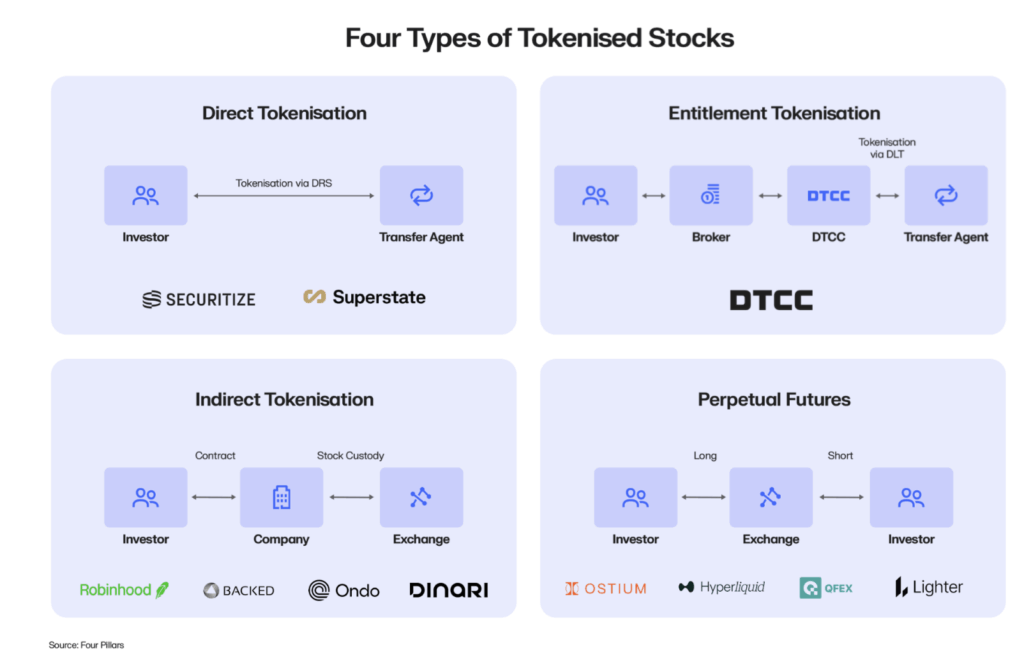
A report from crypto investment firm KeyRock and tokenization platform Securitize highlighted that there are four distinct models of tokenized equities, each implying different ownership structures, investor rights, and regulatory implications.

Source: KeyRock/Securitize

Direct tokenization means that onchain shares carry full ownership rights including voting, dividends, corporate actions, and direct registration on the shareholder record. Atomic settlement, immediate delivery versus payment, removes clearing risk and as the token is the share, there is no intermediary custody layer.

The report, The $400T Future of Tokenised Assets, said: “As direct tokenization scales through NYSE, Nasdaq, and transfer-agent rails, it unlocks something wrapper models cannot replicate for TradFi participants.”

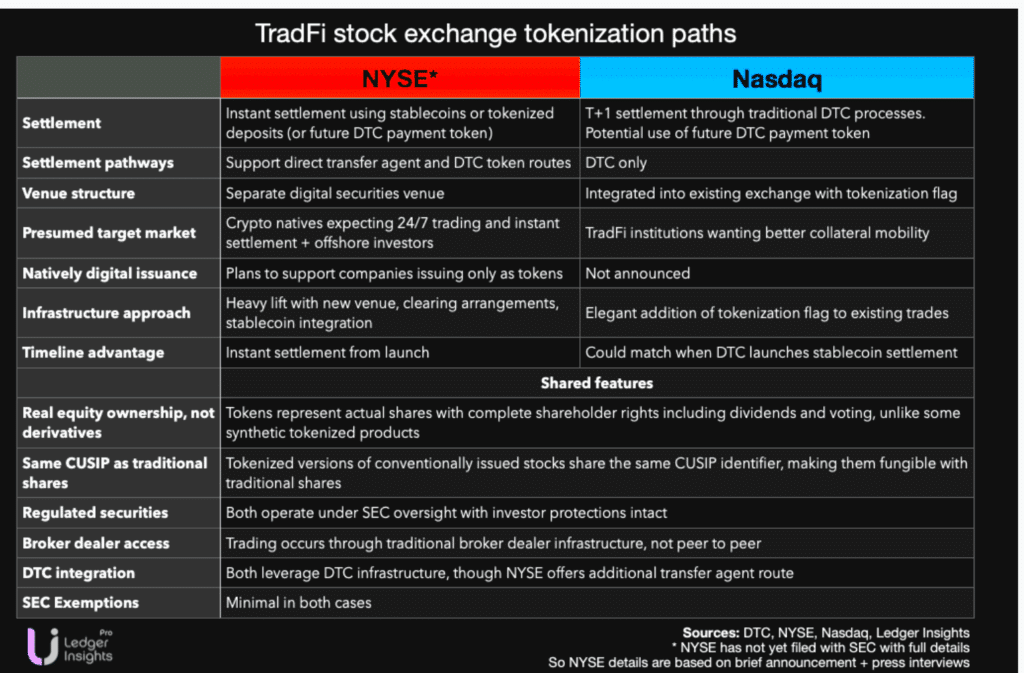
The New York Stock Exchange also plans to launch a dedicated venue for 24/7 tokenized equities and ETFs with instant settlement and stablecoin rails. In March this year ICE, the NYSE’s parent, said it a statement that it had invested in OKX, a blockchain technology and trading company, to evaluate joint initiatives. Star Xu, founder and chief executive of OKX, said in a statement that the two firms will build a more reliable market structure that bridges digital assets and equities and meet institutional standards for risk and compliance.”

Source: Blockworks Research

Arjun Sethi, co-chief executive of Payward and Kraken, said in a statement that the partnership with Nasdaq is important because tokenization alone does not create markets. 

“Markets require liquidity risk management and reliable infrastructure,” said Sethi. “By combining Nasdaq’s leadership in regulated equity markets with Payward’s digital asset infrastructure and Kraken’s global trading platform, we are helping build the liquidity layer risk engine and financial applications that allow tokenized equities to function within a more global, continuous and capital efficient financial system.”

Crypto markets can already trade onchain 24/7, 365 days a year. Chai argued that if traditional financial markets can go to 23×5 with the same guardrails, integrity, market surveillance, investor protection and deep and liquid markets, then that will be an extremely good foundation to go further. 

“Always-on markets are the future and the key thing is converging industrial-grade market architecture with digitally native networks,” said Chai. “We are well on our way to being ready, but the industry needs to continue thinking about how it’s going to adapt.”

Collateral 

Chai took on the additional role of head of digital assets at the start of the year. In addition to designing its equity token, Nasdaq is also focused on using tokenization to increase collateral mobility, eventually making collateral available 24/7 and to make collateral management workflows more efficient.

“Our tokens would be the same underlying security, have the same legal rights and ownership but allow owners to do more,” added Chai. “They can use the token as collateral, move it onto a shared ledger and leverage the programmability and the velocity so that it becomes an unlock on the capital side.”

In March this year Nasdaq said in a statement that it had partnered with Talos’ digital asset infrastructure in order to offer institutions the ability to  managing both onchain and offchain collateral workflows in an integrated environment.

Anton Katz, Talos

Anton Katz, chief executive and co-founder of Talos, said in a statement: “The evolution toward tokenized collateral is a natural progression for institutional capital markets.”

Chai described Talos as a “very strong” partner in the digital-native world. He added there was a natural synergy because Talos has risk solutions for crypto, but their customers also needed a risk solution for fixed income and other asset classes. In the opposite direction, traditional financial institutions use Nasdaq Calypso as their single source of truth, risk management and collateral management, and they want digital assets under the same framework to have a single operational risk lens. Nasdaq’s trade surveillance technology will also be integrated into Talos.

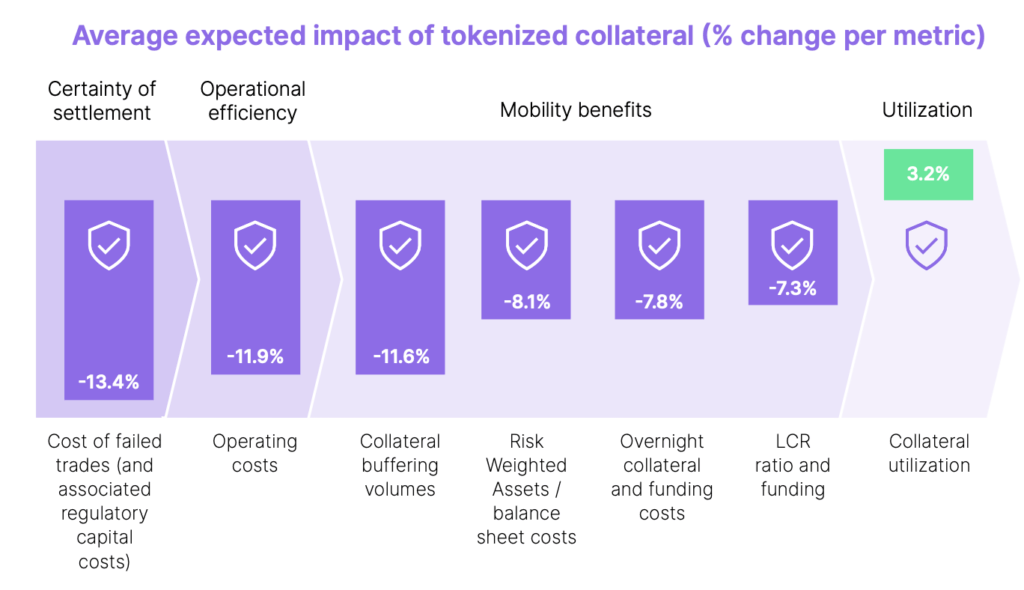
Over half, 52%, of global firms expect to manage live tokenized collateral by the end of 2026 according to study from Nasdaq with consultancy ValueExchange in February this year. The report, Making the Case for Tokenized Collateral, said tokenization could unlock more than $340m in annual interest benefits for each Tier 1 institution. 

Source: Nasdaq & ValueExchange

More than three quarters, 81%, of survey respondents expect tokenization to play a major role in facilitating instantaneous, delivery versus payment real-time settlement of loans, repos and/or collateral (and balance sheet savings). Tokenization is expected to reduce failed trades by 13.4% and improve bank risk-weighted asset efficiency by up to 8%, according to the study. 

In Europe Nasdaq has partnered Seturion, Boerse Stuttgart Group’s pan-European settlement platform for tokenized assets, to tokenize structured products and allow issuers to manage their assets more cost-effectively. 

Chai said: “We see a lot of traction in asset classes where tokenization can solve a pain point and simplify a complex process.”

He expects there will be a hybrid world for the next five to 10 years but there is an opportunity for a number of innovations to come to market. 

“We believe that we are uniquely positioned to help bridge on- and offchain market ecosystems and are focused on building solutions that prioritize issuers and provide the same industrial logic that we already have in our securities markets,” he added. 

Introducing Traders Magazine’s Digital Assets Channel

Crypto prices may be well below last year’s highs, but institutional adoption of the underlying blockchain technology shows no signs of slowing down. 

Institutions were encouraged by the increased regulatory clarity provided by the Genius Act, the first U.S. federal framework for stablecoins, and the administration is trying to pass the Clarity Act on crypto market structure. Traditional financial market infrastructures such as DTCC are aiming to tokenize trillions of dollars of real world assets, while exchanges have filed for regulatory approval to trade tokenized securities. 

Exchanges have also filed to follow the crypto world by extending their operating hours to 23×5. Meanwhile, the crypto world is learning from TradFi by realizing it needs to integrate into existing institutional workflows and improve capital efficiency. 

Amid this rapid market development, Traders Magazine is introducing a new content program: The Digital Assets Channel, produced with support from LMAX Group, which operates execution venues for FX and digital assets trading. The content will be produced independently by Markets Media Group editorial staff. 

The new channel won’t cover the ups and downs in prices, or new tokens. Instead, the focus will be on the development of digital assets markets and the intersection of TradFi infrastructure and the new ecosystem. 

There will be no shortage of topics to write about as the rails of the financial industry undergo a long-term transformation and market infrastructure operators ‘meet the moment’ by enabling their customers in their own digital assets journey.