








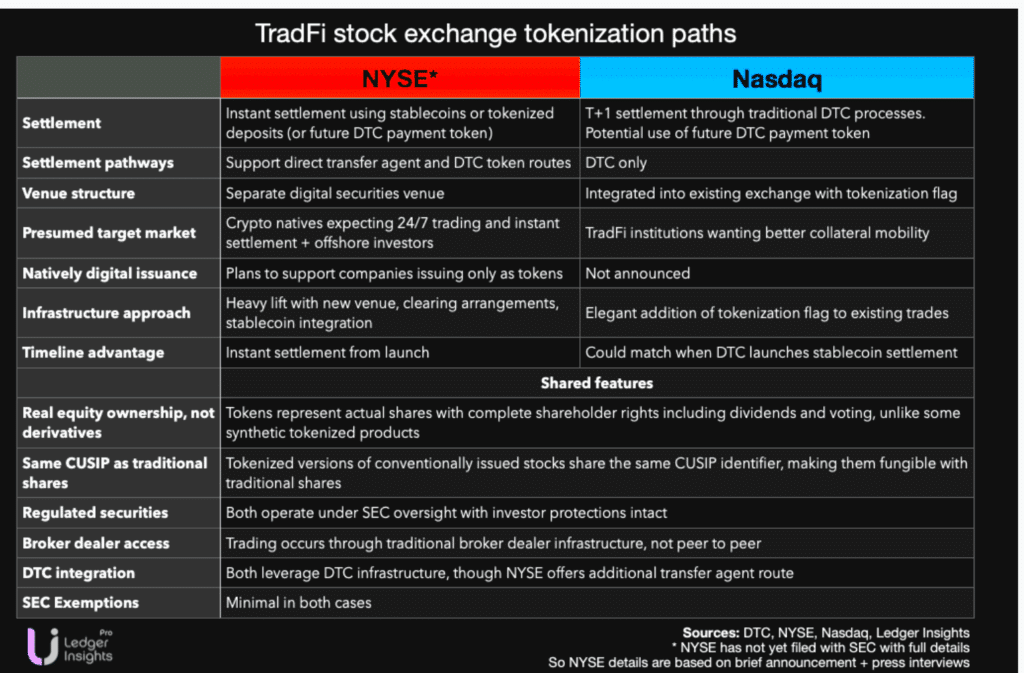
Roland Chai, president of European markets and head of digital assets at Nasdaq, said the firm’s filing on the tokenization initiative from the Depository Trust & Clearing Corporation (DTCC), the U.S. post-trade infrastructure, was approved a few weeks ago and it is working on evolving the design of its equity token. Chai said: “That is very much full steam ahead.”

In March this year Nasdaq said it would support the tokenization of equities in a manner that preserves issuer control, existing regulatory frameworks, and the underlying rights associated with company shares. Nasdaq expects its equity tokens and related distributed ledger technology-based services to become operational in the first half of 2027.
Nasdaq filed a tokenization proposal with the U.S. Securities and Exchange Commission (SEC) in September 2025, in which Nasdaq proposed enabling equity securities to trade on its markets and to give clients the choice to settle in token form through the DTCC. The firm said its initiative is also consistent with the SEC’s 2026 staff statement on tokenized securities, which classifies tokenized equities the same under federal law as regular equity securities.
Kraken’s xStocks
Payward also said in a statement in March that it had formed a partnership to combine Nasdaq’s regulated market infrastructure with Kraken’s xStocks framework to enable tokenized equities to move fluidly between permissioned institutional markets and permissionless decentralized finance (DeFi) ecosystems. Kraken/Payward will serve as the primary settlement layer for Nasdaq’s tokenized equities transactions in eligible jurisdictions, with Payward Services providing know your customer and anti-money laundering onboarding compliance.
Chai said Nasdaq will partner with DTCC and transfer agents to make sure issuers benefit from the engagement with investors, governance and all the integrity that is embedded in tokens. He added: “This is critically important as we felt the issuer’s voice has been less prominent in that debate.”
Quite a few issuer groups across all of Nasdaq-listed companies, including those on the Nasdaq 100, are discussing what they want in an equity token, according to Chai. He said that has been very well received, and Nasdaq is getting a number of queries from issuers on how they can get involved.
A report from crypto investment firm KeyRock and tokenization platform Securitize highlighted that there are four distinct models of tokenized equities, each implying different ownership structures, investor rights, and regulatory implications.
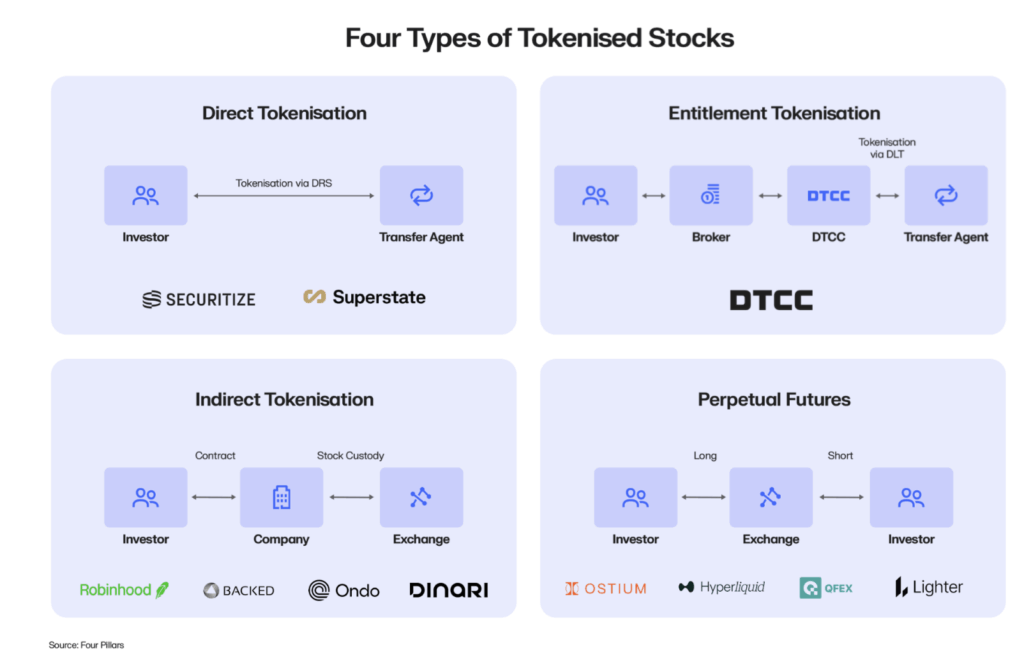
Direct tokenization means that onchain shares carry full ownership rights including voting, dividends, corporate actions, and direct registration on the shareholder record. Atomic settlement, immediate delivery versus payment, removes clearing risk and as the token is the share, there is no intermediary custody layer.
The report, The $400T Future of Tokenised Assets, said: “As direct tokenization scales through NYSE, Nasdaq, and transfer-agent rails, it unlocks something wrapper models cannot replicate for TradFi participants.”
The New York Stock Exchange also plans to launch a dedicated venue for 24/7 tokenized equities and ETFs with instant settlement and stablecoin rails. In March this year ICE, the NYSE’s parent, said it a statement that it had invested in OKX, a blockchain technology and trading company, to evaluate joint initiatives. Star Xu, founder and chief executive of OKX, said in a statement that the two firms will build a more reliable market structure that bridges digital assets and equities and meet institutional standards for risk and compliance.”
Arjun Sethi, co-chief executive of Payward and Kraken, said in a statement that the partnership with Nasdaq is important because tokenization alone does not create markets.
“Markets require liquidity risk management and reliable infrastructure,” said Sethi. “By combining Nasdaq’s leadership in regulated equity markets with Payward’s digital asset infrastructure and Kraken’s global trading platform, we are helping build the liquidity layer risk engine and financial applications that allow tokenized equities to function within a more global, continuous and capital efficient financial system.”
Crypto markets can already trade onchain 24/7, 365 days a year. Chai argued that if traditional financial markets can go to 23×5 with the same guardrails, integrity, market surveillance, investor protection and deep and liquid markets, then that will be an extremely good foundation to go further.
“Always-on markets are the future and the key thing is converging industrial-grade market architecture with digitally native networks,” said Chai. “We are well on our way to being ready, but the industry needs to continue thinking about how it’s going to adapt.”
Collateral
Chai took on the additional role of head of digital assets at the start of the year. In addition to designing its equity token, Nasdaq is also focused on using tokenization to increase collateral mobility, eventually making collateral available 24/7 and to make collateral management workflows more efficient.
“Our tokens would be the same underlying security, have the same legal rights and ownership but allow owners to do more,” added Chai. “They can use the token as collateral, move it onto a shared ledger and leverage the programmability and the velocity so that it becomes an unlock on the capital side.”
In March this year Nasdaq said in a statement that it had partnered with Talos’ digital asset infrastructure in order to offer institutions the ability to managing both onchain and offchain collateral workflows in an integrated environment.

Anton Katz, chief executive and co-founder of Talos, said in a statement: “The evolution toward tokenized collateral is a natural progression for institutional capital markets.”
Chai described Talos as a “very strong” partner in the digital-native world. He added there was a natural synergy because Talos has risk solutions for crypto, but their customers also needed a risk solution for fixed income and other asset classes. In the opposite direction, traditional financial institutions use Nasdaq Calypso as their single source of truth, risk management and collateral management, and they want digital assets under the same framework to have a single operational risk lens. Nasdaq’s trade surveillance technology will also be integrated into Talos.
Over half, 52%, of global firms expect to manage live tokenized collateral by the end of 2026 according to study from Nasdaq with consultancy ValueExchange in February this year. The report, Making the Case for Tokenized Collateral, said tokenization could unlock more than $340m in annual interest benefits for each Tier 1 institution.
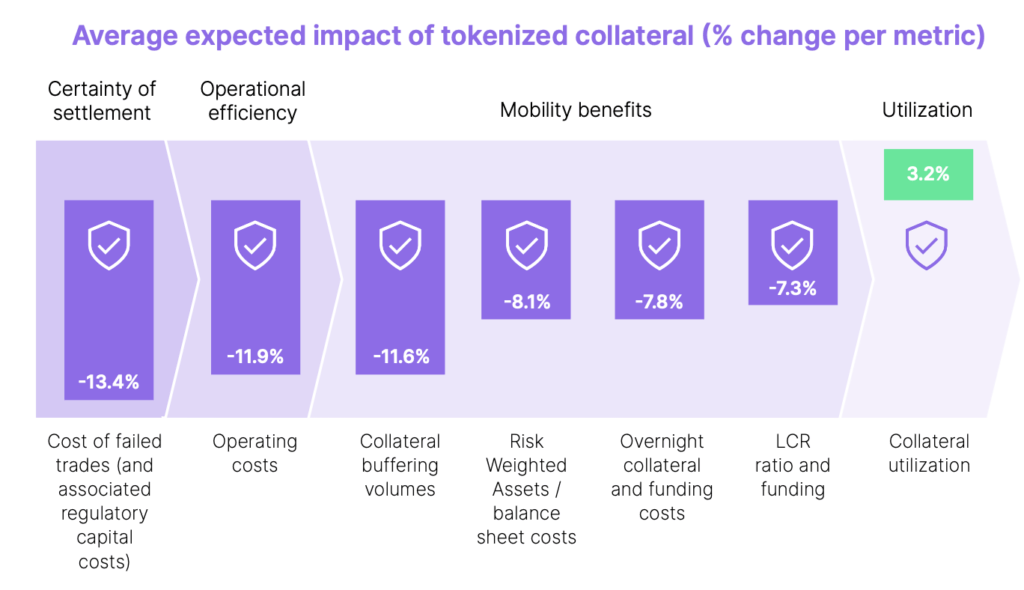
More than three quarters, 81%, of survey respondents expect tokenization to play a major role in facilitating instantaneous, delivery versus payment real-time settlement of loans, repos and/or collateral (and balance sheet savings). Tokenization is expected to reduce failed trades by 13.4% and improve bank risk-weighted asset efficiency by up to 8%, according to the study.
In Europe Nasdaq has partnered Seturion, Boerse Stuttgart Group’s pan-European settlement platform for tokenized assets, to tokenize structured products and allow issuers to manage their assets more cost-effectively.
Chai said: “We see a lot of traction in asset classes where tokenization can solve a pain point and simplify a complex process.”
He expects there will be a hybrid world for the next five to 10 years but there is an opportunity for a number of innovations to come to market.
“We believe that we are uniquely positioned to help bridge on- and offchain market ecosystems and are focused on building solutions that prioritize issuers and provide the same industrial logic that we already have in our securities markets,” he added.
