

Exegy Enhances Iceberg Order Detection Tool with Intraday Data

St. Louis, New York – February 29, 2024 – Exegy, a leading provider of market data and trading technology for the capital markets, today announces the addition of intraday signals to its AI-powered iceberg order detection offering, Liquidity Lamp. Quantitative traders can now have visibility on the volume of iceberg orders throughout the day using summary files delivered every ten minutes.

Liquidity Lamp offers a distinct perspective on US equities trading, effectively filtering out the ‘noise’ created by retail and high-frequency trading (HFT) activities. These summarized updates on iceberg trading activity are delivered as a CSV file via a cross-connect at the NY4 data center or to an AWS S3 bucket of your choice.

Institutional investors skillfully handle large volumes of trades by using exchange-native iceberg orders, and the ability to monitor these transactions can reveal hidden opportunities for alpha.

Until now, Liquidity Lamp offered firms the choice between real-time and end-of-day signals. With the introduction of intraday files, Liquidity Lamp enables quant traders to make data-driven decisions while the iceberg trades are occurring and ahead of market close, saving them significant time and allowing traders to react to opportunistic trades in real-time.

Andy Lee, Director of Quantitative Research at Exegy, explained: “Institutional iceberg orders can significantly influence prices, creating lucrative opportunities for adept traders.” He continued, “My team of quants published a whitepaper demonstrating Liquidity Lamp Intraday’s impact by highlighting how a well-known statistical arbitrage strategy can use iceberg order detection to significantly improve on itself and consistently beat the S&P 500 index (SPY).”

Read the whitepaper by clicking here.

Using data backdated to 2018, Exegy’s in-house quant team created an experimental model they called Nitro. This model used a mean reversion strategy to create a baseline alpha. After teasing out predictive features from the Liquidity Lamp Intraday data, their Nitro model outperformed the baseline alpha and the S&P 500 tracking ETF, SPY, by 10.5% and 31.8% over the final year of its out of sample testing. In addition, it consistently achieved low volatility returns.

David Taylor, CEO of Exegy, said “Liquidity Lamp Intraday is a novel dataset for systematic trading. Using this data, quantitative traders will be able to seize trading opportunities that conventional models might have missed or considered too risky.”

This intraday volume signal, which is derived using Exegy’s proprietary iceberg order detection algorithm based on US Equities market data from the Exegy Ticker Plant, enables traders to:

  • Uncover institutional order flows.
  • Reveal informed investor actions.
  • Provide insights into price impact dynamics.
  • Optimize portfolio positioning.
  • Respond promptly to unusual institutional volume.
  • Enhance predictive models and overall market responsiveness.

Providing Liquidity Lamp data at intraday intervals delivers cost-effective access to aggregation and counts of iceberg trades for every symbol traded in US equities, identifying unique insight into the presence of any active iceberg orders. Traders will be able to spot hidden liquidity to optimize their strategies and identify new trading opportunities that incorporate data that traditional models might not otherwise capture.

Taylor continued, “This dataset represents an opportunity for the quant trading community to elevate their strategies with a unique view on intraday institutional trading activity.  Its integrations into sophisticated models by early adopters is both intriguing and inspiring.” 

As the availability of AI and machine learning-driven trading signals increases, Exegy will continue to provide the trading community with invaluable, next-gen tools for alpha-generation.


Interactive Brokers Unveils IBKR Desktop

Interactive Brokers, an automated global electronic broker, has announced the launch of IBKR Desktop, the next-generation desktop trading application for Windows and Mac.

Steve Sanders

Steve Sanders, EVP of Marketing and Product Development at Interactive Brokers, said that the launch of IBKR Desktop directly responds to their clients’ requests for powerful trading tools in a user-friendly interface. 

“Many of our active trader and institutional investor clients appreciate the advanced technology available on Trader Workstation, our flagship desktop trading platform,” he said. 

“Rather than redesigning Trader Workstation, we decided to build IBKR Desktop from the ground up to include many of the same features as Trader Workstation, but in a user-friendly interface. Clients can choose which platform best suits their needs,” he explained.    

According to Sanders, like Trader Workstation, IBKR Desktop is a desktop trading platform. 

Both offer investors sophisticated trading tools and access to stocks, options, futures, currencies and more on over 150 markets worldwide, he said. 

However, what sets IBKR Desktop aside is its intuitive design and exclusive trading tools, such as Option Lattice and Screeners with MultiSort, Sanders added. 

“IBKR Desktop has the best of both worlds – a simple trading experience coupled with many advanced features,” he told Traders Magazine.

“At this time, we plan to keep all our platforms to give skilled traders and new investors access to a broad range of options to meet their trading objectives,” he added.

IBKR Desktop and all our other trading platforms are available to clients free of charge.

Sanders said that beginning investors looking for a platform that is easy to navigate and offers a simple way to trade stocks, options, and futures, as well as experienced traders seeking powerful trading tools, will benefit from IBKR Desktop. 

Using IBKR Desktop, clients can take advantage of many key trading features such as Rapid Order Entry with attached orders, Chart orders, Option Lattice or Order Presets, he said.

In addition, there are Research and Analytics services like Market Screeners with MultitSort, Watchlists with customizable columns, Option Analytics, Advanced Charts with Multi-chart mode and Fundamentals Explorer with worldwide fundamentals data for over 30,000 companies globally, he added.

Interactive Brokers is committed to continually updating IBKR Desktop, with plans to expand support for more products and integrate advanced tools that redefine what traders can expect from a trading platform.

“IBKR Desktop combines a straightforward interface with sophisticated tools to help clients navigate the complexities of today’s global markets to find investment opportunities across asset classes and regions worldwide,” Sanders said.

“We plan to continually update IBKR Desktop and add support for more products and tools. Currently planned for future releases are inline order modification, custom layouts and multi-window management, translations for local markets, Level II Market Data, and improved asset and search support,” he added.

To coincide with the launch, Interactive Brokers has developed the IBKR Desktop Trading Course, which features ten lessons, covering how traders can use the platform to submit options orders, view news and research, and customize charts, columns, and views, among other topics.

The free course is available through IBKR Campus: https://ibkrcampus.com/trading-course/ibkr-desktop/ 

Webinar: The Burden of the Buy Side

The burden of the buy-side – and what you can do about it…

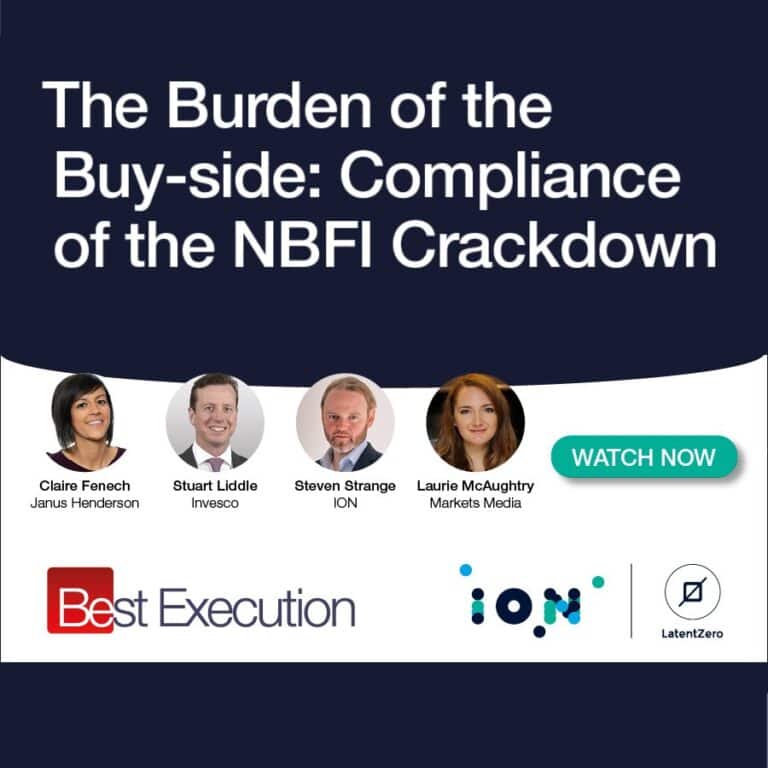
The regulatory burden is soaring for the buy-side as regulatory attention turns increasingly towards the regulation of the complex investment and funding markets that make up the area of non-banking finance intermediation (NBFI) – including asset managers, hedge funds and other players that make up much of our industry.

Not currently regulated by the frameworks that apply to licensed banks, the importance of these firms has grown to the point where they now represent around 50% of global financial assets. Unsurprisingly, therefore, regulators are raising concerns around their resilience – especially in today’s volatile post-Covid market conditions. Incidents such as the Archegos collapse, the London Metals Exchange nickel scandal and the LDI gilts crisis have shone a spotlight on the systemic risk this sector could potentially pose.

In the US, SEC chair Gary Gensler has been vocal in calling for increased oversight of hedge funds and other asset managers, and the US regulator recently passed new rules introducing significantly increased disclosure requirements for private funds (including the requirement to report risky events).

In Europe, the International Organization of Securities Commissions (IOSCO) and the Financial Stability Board (FSB) are also now working together, in a group co-chaired by the UK’s Financial Conduct Authority and the French Autorité des Marchés Financiers (AMF) to develop a set of concrete policy outcomes that could have serious implications for a wide variety of market participants: including asset managers, hedge funds, alternatives, and private markets in general. Added to the increasing complexity of ESG regulation and the challenges of data standardisation, the compliance burden for the buy-side is soaring.

But first – not everyone is aware of this new direction, and second, not everyone is prepared for it. With limited resources and significant existing requirements to meet, not every firm has the same ability to meet these increasingly onerous requirements. How can your controls function at as a gatekeeper, what are the biggest issues on the horizon, and how can you most efficiently meet them?

Join panelists including:

  • Claire Fenech, head of front office controls and governance at Janus Henderson Investors;
  • Stuart Liddle, senior manager, first line controls, Invesco; and
  • Steven Strange, head of product (asset management), ION Group.

Introducing the Mizuho Corporate Culture Award

Famed management guru Peter Drucker is reported to have once said “culture eats strategy for breakfast.” It wasn’t an assertion that strategy isn’t important, but an observation that without a business culture of engaged, valued, and motivated employees, the best laid plans can end up poorly executed. Culture counts. 

Once regarded as a nice-to-have, a focus on cohesion and collaboration has quicky emerged as a critical driver of organizational effectiveness and sustainability. 

Even the bellwether of business best practices, the Harvard Business Review, took up the culture cause with the 2021 article Company Culture is Everyone’s Responsibility. It noted that “culture has become a strategic priority with impact on the bottom line. It can’t just be delegated and compartmentalized anymore.”

At the 2023 Markets Choice Awards, Mizuho Americas received the first Best in Corporate Culture Award. It was recognition of its achievement in building one of the fastest-growing corporate and investment banks, while fostering a culture where employee satisfaction was a top priority.   

Paying tribute to its first recipient, Markets Media decided to rename the award to the Mizuho Corporate Culture Award with intention of recognizing firms or individuals in the capital markets industry that have demonstrated excellence in promoting a positive — and fun —company culture.

Debuting May 9th at Markets Media’s 2024 Markets Choice Awards, in New York’s Central Park Boathouse, Markets Media Group is pleased to introduce the Mizuho Corporate Culture Award. It will be awarded annually at both the Markets Choice and Women in Finance Awards.

Liz Ceisler, Chief Human Resources Officer at Mizuho Americas, accepted the Best in Corporate Culture Award on behalf of the firm in 2023 and spoke with Markets Media following the recognition. 

“Talking about culture isn’t lip service at Mizuho – our actions speak to our culture of accessibility and values,” Ceisler said. “A unified and positive corporate culture is critical to attracting and retaining top talent, and for motivating employees around a common goal,” she continued. “We’ve made tremendous progress in promoting our culture internally, and now we’re ready to share our values outwardly.”

As with all Markets Choice Awards, we rely on input from our readers as to which individuals or firms deserve consideration for the Mizuho Corporate Culture Award, so please nominate today! 

Virtu Financial Collaborates with ClearingBid 

Virtu Financial has announced a strategic collaboration with ClearingBid, the world’s first IPO investing network to expand ClearingBid’s Platform for primary share IPO investing.

All brokers and financial institutions that rely on Virtu’s connectivity will now be able to place orders for IPO shares using the same order entry systems as secondary market limit orders.

Steve Cavoli

“The combination of Virtu’s vast, FIX network and trading infrastructure with ClearingBid’s novel IPO offering, will expand access to the primary market to all investors and their brokers, expanding access to one of the most important parts of our capital markets,” said Steve Cavoli, EVP and Head of Global Execution Services at Virtu.

Under the terms of the agreement, ClearingBid’s IPO network will leverage Virtu ITG Net’s scaled connectivity platform.

Virtu’s intelligent, integrated network, ITG Net, enables clients to go well beyond the basics of connectivity.

In addition to providing reliable, 24/6 managed access to trade with over 700 brokers and market centers globally, ITG Net provides invaluable tools and transparency to enhance clients’ trading process before, during, and after the trade.

The combined capabilities of Virtu’s global FIX connectivity solutions and ClearingBid’s IPO network aims to make primary share IPO investing open to all brokers on the network and importantly their end investors.

ClearingBid’s price discovery platform, which allows issuing companies to optimize the IPO price while achieving the broadest potential investor participation, will be further enhanced by Virtu ITG Net’s connectivity with hundreds of broker-dealers who can now seamlessly onboard with ClearingBid’s primary market solution.

“Virtu is one of the industry’s largest trading providers with premier processing and fulfillment capabilities,” commented Matt Venturi, ClearingBid CEO and Founder.

“By providing investors with seamless order entry and accessibility, and having Virtu ITG Net serve as our preferred network service provider, ClearingBid moves one step closer in our mission to enhance an often inefficient and opaque IPO process,” he added.

Venturi said that the partnership with Virtu further supports ClearingBid’s ability to leverage today’s securities industry infrastructure and order entry protocols to meet the growing demand for access to IPO investing.

“The shared vision, to create a new IPO investing standard while driving further industry transparency, will help to expand investment opportunities for retail and institutional investors alike,” he said.

BNP Paribas, Citi Invest in United Fintech

BNP Paribas and Citi become the first institutional investors in United Fintech – the neutral Digital Transformation Platform, as part of a strategic investment round led by Citi. United Fintech is also in advanced talks with other leading strategic investors to join its transformative journey, signalling a broad industry shift towards collaborative fintech innovation.

Rotating board seats and quarterly industry roundtables

As part of the deal, two rotating board seats will go to BNP Paribas and Citi. The unique governance model allows institutional investors to contribute to the platform’s strategic direction. United Fintech has committed to host quarterly industry roundtables on shared challenges and innovation to facilitate industry dialogue and foster a collaborative ecosystem where pooling resources and ideas will enable financial institutions to accelerate their leap into the digital era.

“To BNP Paribas, it is all about trust in the validation of fintechs, ensuring they meet the highest standards of excellence and offering a robust ecosystem for innovation. Managing to combine the best of both worlds, we see this as the beginning of a new era where industry participants can grow together” says Junaid Baig, Head of Strategic Investments & Co-Head of Strategy with BNP Paribas Global Markets.

“Procuring specialist fintech firms is increasingly challenging for large institutions. United Fintech’s neutral Digital Transformation Platform fills gaps in the market, complements our overall offering, and drives market innovation through collective efforts,” says Ayesa Latif, Global Head of Foreign Exchange Products at Citi.

CEO: Investments demonstrate “forward-thinking leadership”

Founded in 2020 by CEO Christian Frahm, United Fintech has rapidly expanded to employ over 160 people across 8 countries. The investment round is a major milestone that United Fintech expects will facilitate further backing from strategic investors:

“More than a significant milestone for United Fintech, the backing of Citi and BNP Paribas is a testimony of forward-thinking leadership. As momentum builds, we project that more financial institutions will soon follow: Our vision of a neutral industry platform for digital transformation, to swiftly enable access to the world’s most innovative fintechs, is shared by every single C-level executive we’ve spoken with for the past four years, and their support energises our pursuit of a unified ecosystem”, ends United Fintech CEO Christian Frahm.

Source: United Fintech

Synergizing Data: Unveiling New Trading Tools in the Fast-Evolving Market Tapestry

Today’s data and trading tools have transformed how individual traders invest in markets. Traders are constantly looking for new ways to leverage different strategies to optimize portfolio positions, and to do so, they must efficiently navigate the data landscape and refine their ideas. Markets move fast, and so do data and the tools used to analyze data. 

Today, traders need access not only to data, but also to the right tools and research, and communities where they can share ideas and solicit feedback—the risk of not being prepared results in lackluster portfolio performance. 

Technology has changed how traders access market data. In the 1960s, stock prices were transmitted over telegraph lines. Today, some traders are looking at changes in prices that occur over a millisecond or nanosecond. How traders access and analyze data evolved rapidly with the introduction of computers and the Internet, which quickly gave more people both access to markets and the data behind those markets. 

How people traded also evolved. Electronic trading platforms were first used in the early 1990s. With improvements in latency and lower costs for computers came widespread adoption. Electronic platforms made data available to traders and the general public—these platforms enabled the development of new financial instruments like ETFs and new ways to analyze market data.

Even so, markets have changed in a way that traditional trading strategies don’t perform consistently. While holding both fixed income and equities is important for a balanced portfolio, determining the right percentage of each requires access to data, tools, and research, as well as a community to discuss different strategies. 

That means that traders need fundamental information more than ever as strategies change to address changing market conditions. Data that was once available to a few traders at a very high cost is now readily available to anyone with a computer and Internet connection. Also, there’s a universe of affordable platforms that help retail and smaller investors analyze data, conduct research, and execute different portfolio strategies.

Along with data, technical analysis has experienced a similar evolution in scale and affordability. Much of this analysis requires fundamental macro data as inputs, and the models provide a broad market analysis. Traders are looking for reliable technical analysis and technical aggregation of data so that they can create repeatable processes based on a mathematical view of the market. 

Understanding market dynamics is an integral part of refining a portfolio strategy. Different types of traders have different data and analysis needs. Technical traders focus on the short-term and conduct analysis that’s independent of macro events. Swing traders and long-term traders monitor macro trends as they consider which positions to hold and how different political or economic events can affect a position.

This dynamic of continued evolution creates an apex of opportunity. There’s untapped potential in how to match data with available tools to ascertain the best analysis. Marrying both macro and technical analysis is the sweet spot that traders are looking for, and they need to be able to access different tools as they develop different portfolio strategies.

Portfolio performance can vary, particularly in volatile markets—a real-world stress test. Data, technology, and research are costs to investing that ultimately lower yields, but as these become more accessible and cheaper, these lower costs create a deflationary effect. Everything that relies on technology becomes cheaper. Information asymmetry has changed; today, everyone has access whereas previously, access to data was limited and costly. 

The final piece that’s important to investing is a virtual trading floor, or community. Communities help traders flourish as that’s where traders can validate ideas and solicit feedback at no cost. While physical trading floors don’t exist in the same form, this online environment provides a platform for the conversations and exchanges that used to occur on the physical floor. 

The financial industry is pushed to continuously develop increasingly complex data and trading tools as markets evolve and the needs of traders at every level become more sophisticated. The financial world is at an inflection point where macro and technical analysis combine with growing virtual communities. 

As the data landscape changes, it’s important to use the right trading platform that combines data, research and communities in one place to enable the abilities and opportunities of real-time trading. This search helps fuel market evolution. 

Out of Harms Way

Lynn Strongin Dodds looks at what some firms are doing to help financial institutions stay on the sanctions roadmap

Navigating the world of sanctions is never easy and the financial services industry is no exception. However, a new handbook  – ‘Compliance: Guide to Sanctioned Securities, from BIGTXN, Dow Jones Risk & Compliance, Baker McKenzie, and the Association of Certified Sanctions Specialists (ACSS), aim to help it unravel the complexity.

A new handbook

The handbook addresses the specific challenges faced by financial institutions in ensuring regulatory compliance and is tailored to compliance professionals in investment banks, hedge funds, asset managers, and related sectors. Based on case studies and data, it offers actionable insights and a best practice guide.

The handbook also notes that although sanctions are far from new – the US has placed restrictions on Cuba and North Korea – for years, the ones against Russia are much more complex. This is because the country is more  closely integrated into the global economy with many Russian companies and individuals having close connections to western markets.

Government recommendations

It is not of course the only tool on the market and law firms have released a steady stream of information on the latest regulatory changes and recommendations on how to comply. Governments have also been busy and this month saw the US departments of state, treasury, commerce and labour issued advice for financial institutions as well as other businesses and individuals regarding the range of heightened risks such as sanctions associated with doing business in or engaging in transactions involving the Russian Federation or Russia-occupied territories of Ukraine. The government made it very clear that businesses across the board will face severe civil and criminal penalties if they circumvent or do not adhere to the rules.

The US as well as the UK and European Union imposed sanctions on Russia in the wake of its invasion of Ukraine in 2022. Last September, the UK watchdog, the Financial Conduct Authority (FCA) published a review from its assessment of the sanctions systems and controls in over 90 UK financial services firms across a range of sectors. The aim was to determine whether they were adequate and effective at not only addressing sanctions risk but also appropriately responding to any changes in the country’s regime system.  

On the positive side, the FCA identified three examples of good practice such as horizon scanning and scenario planning, sanctions screening systems and tool calibration. Most firms had incorporated “fuzzy logic” into their systems to assist in detecting name variations for sanctioned persons.

However, the list of areas that needed improvement was much longer. It ranged from senior management needing better oversight of sanctions risks to over reliance on third party tools as well as weak know your customer and customer due diligence. The review also uncovered substantial backlogs in the assessment, escalation, and reporting of alerts related to the sanctions screening of names and payments. In addition, some firms had not adequately tailored the calibration of their sanctions screening tools, resulting in the tools being too sensitive and returning high numbers of false positive hits.

Derivatives world

In the derivatives world, specifically, there were and have been different challenges. One of the main concerns in the wake of the sanctions in 2022, was the state of the credit default swap (CDS) market. There were fears that new Russian CDS trades would potentially become illegal while existing CDS trades might be unable to settle following a credit event. Figures from JP Morgan showed at the time, there were approximately $4.5 bn in CDS tied to Russian government debt and another $1.5 bn in derivative indices (https://www.proskauer.com/alert/russian-sanctions-how-will-they-impact-credit-default-swaps).

The initial step was to remove Russia from the CDX.EM index followed by the International Swaps and Derivatives Association (ISDA) publishing its 2022 Russian Sanctions Additional Provisions Protocol. This  enabled parties to amend the terms of their outstanding credit derivatives agreements, and exclude CDS contracts that reference sanctioned Russian entities as well as any index that includes the sanctioned Russian entities. It identified these entities as the Russian Federation, including any of its government ministries, agencies or instrumentalities, and Gazprom Public Joint Stock Company (Gazprom).

The trade group also prepared a list of frequently asked questions (FAQs) which covered the sanctions, the requirements, impact and how to assess if the firm or counterparty has been affected.

TECH TUESDAY: Introducing Nasdaq Compliance Hub

0

TECH TUESDAY is a weekly content series covering all aspects of capital markets technology. TECH TUESDAY is produced in collaboration with Nasdaq.

In Chile, the Securities Market Act and the Competition Act govern specific public offerings and promote competition in markets. In Singapore, The Securities and Futures Act governs the regulation of activities and institutions in the securities and derivatives industry. The German Securities Act contains requirements relating to the securities market including abusive conduct in on-exchange and OTC trading in financial instruments. 

In ever-evolving markets with increasing regulatory demands, compliance is a challenging function to stay on top of in just one jurisdiction. For global capital markets firms that operate in dozens of countries, that challenge becomes exponentially more difficult. 

Amid that backdrop, Nasdaq has introduced the Nasdaq Compliance Hub, a central resource where surveillance and compliance professionals can find the latest regulatory information pertaining to market abuse, and browse country-specific resources. The Nasdaq Compliance Hub has launched with 46 individual country pages, spanning the largest and most developed markets such as the US, UK, and Hong Kong, to smaller markets such as Finland, Nigeria and Slovakia.   

Tony Sio, Nasdaq
Tony Sio, Nasdaq

“We’re thrilled to launch the Nasdaq Compliance Hub,” said Tony Sio, Head of Regulatory Strategy and Innovation at Nasdaq. “The new digital destination will act as a valuable resource to compliance and surveillance professionals looking to get a holistic view of their regulatory obligations. We look forward to continuing to build the Nasdaq Compliance Hub out to include even more areas of compliance in the future.”  

Market regulation leveled up in the wake of the 2008-2009 global financial crisis, and 15 years later, the rate of change remains elevated. In a 2022 blog post, the International Monetary Fund said: “even after historic enhancements in recent years, countries still need to keep pushing to lower risks and strengthen the tools to manage future crises.”

This means financial institutions with a global client base – or at least global aspirations – need to stay abreast of an expanding list of country-specific regulations, and stitch that together in a cross-border compliance framework that requires regulatory guidance as well as compliance training and monitoring.

Key challenges to cross-border regulatory compliance include rapidly changing and diverse regulatory frameworks; language, cultural and ethical differences; data privacy and cybersecurity; and resource and supply chain constraints. 

Best practices include implementing a compliance risk management framework; deploying robust internal controls; monitoring local and international regulatory challenges; leveraging regulatory technology; and partnering with a managed service provider. 

Creating tomorrow’s markets today. Find out more about Nasdaq’s offerings to drive your business forward here.

‘No Real Progress’ on Consolidated Supervision of Crypto Intermediaries

The crypto industry continues to resist what it sees as improper or over-burdensome regulation and oversight, while jurisdictions continue to compete for crypto business, according to Acting Comptroller of the Currency Michael J. Hsu. 

Michael J. Hsu

“The risk with such competition is that it gives the industry leverage and forces regulators to accommodate and compromise,” he said.

In his remarks to the Financial Stability Board (FSB)’s Crypto Working Group on February 22, he said that the FSB’s global regulatory framework for crypto-asset activities lays out recommendations to promote comprehensive and consistent regulatory and supervisory approaches. 

“But implementation has been challenging, and no real progress has been made on consolidated supervision,” he noted.

Hsu shared his perspective on the importance of coordination and collaboration on the supervision of global institutions.

“Fortunately, collaboration and coordination among financial regulators can serve as an effective mitigant to the risk of over-accommodation,” he said.

Sharing information with peer agencies and seeking a common understanding of the risks and opportunities in the space can help ensure that regulatory standards remain high, he said, adding that the FSB’s efforts in this regard have been “extremely valuable”.

In July 2023, the FSB published its global regulatory framework for crypto-asset activities to promote the comprehensiveness and international consistency of regulatory and supervisory approaches.

The framework is based on the principle of ‘same activity, same risk, same regulation’ and provides a strong basis for ensuring that crypto-asset activities and so-called stablecoins are subject to consistent and comprehensive regulation, commensurate to the risks they pose, while supporting responsible innovations potentially brought by the technological change.

It consists of two distinct sets of recommendations:

High-level recommendations for the regulation, supervision and oversight of crypto-asset activities and markets;

Revised high-level recommendations for the regulation, supervision, and oversight of “global stablecoin” arrangements.

The recommendations focus on addressing risks to financial stability, and they do not comprehensively cover all specific risk categories related to crypto-asset activities.

They take account of lessons from events of the past year in crypto-asset markets, as well as feedback received during the public consultation of the FSB’s proposals.

“As students and practitioners of financial stability, we know that trust is fragile. Once lost, it is difficult to regain,” Hsu commented.

“Even though the underlying blockchain technology is supposedly trust-resistant, nearly all crypto activities operate through intermediaries, whom users must trust,” he said. 

“Put simply, there are no shortcuts, which is why the FSB principle of “same activity, same risk, same regulatory outcome” is so important as a guide to this work,” he added.