

Thursday, January 29, 2026
More
    More

      FIA Tech Adds Execution and Clearing Cost Analytics to Trade Data Network

      0

      London, 11 November 2025 – FIA Tech, a leading technology provider in the futures industry, today announced the launch of the third phase of its initiative to simplify fee and commission management in exchange traded derivatives, bringing clarity to the cost of trading and clearing including exchange fees, clearing commissions and execution brokerage.

      The execution and clearing cost analytics (XCA) are available to clients via a comprehensive dashboard as well as a high-performance API layer which can be integrated into execution and post-trade systems for clients on FIA Tech’s Trade Data Network (TDN).

      The integrated solution allows clients to identify and resolve fee and commission discrepancies on trade date, integrated into the allocation and confirmation workflows on TDN.

      This marks a further step in FIA Tech’s journey to allowing the buyside complete transparency into one of the biggest sources of operational frustration for the exchange traded derivatives industry.

      In February, FIA Tech announced TDN was live with real time fee and commission matching, reconciliation, and resolution, following the launch of FIA Tech’s Fee and Commission Repository which brought the central storage of golden source information on exchange and clearing fees, commissions and regulatory fees.

      Fee and commission breaks are the largest source of matching breaks in the ETD market and including them in TDN’s matching capabilities gives clients the ability to match in real time, depending on the capabilities of their brokers. Currently, managing these breaks takes up the bulk of ETD operations teams’ time.

      Nick Solinger

      Nick Solinger, President and CEO of FIA Tech, said: “T+0 processing gaps continue to impose substantial operational costs and risks, especially for buyside firms. The whole ETD industry still struggles to navigate the mess of exchange fees, commissions, brokerage, and regulatory charges across more than 80 global exchanges. TDN is the first post-trade solution to unify golden source data on brokerage, fees, and commissions in real time—connecting clients, clearing firms, brokers, and exchanges into a single, transparent ecosystem.”

      The ETD market struggles with a lack of transparency and high volumes of varied and inconsistent data, with multiple sources, formats, timings, and standards. TDN was created to integrate post-trade ETD data in real time from multiple sources, including executing brokers, CCPs, clearing brokers and clients, and offer matching services to create a single trade lineage in a common, secure, standards-based ledger.

      Funded by the market, TDN is already supported by over 20 banks/brokers and 40 investment managers/hedge funds with a total AUM of $34 trillion. It has comprehensive coverage of all exchanges and CCPs, with support of clearing and executing firms representing over 80% of the global futures volumes. TDN is one of the only global trade ledger initiatives to gain widespread adoption and production deployment at scale, processing millions of transactions in real time each day.

      Source: FIA

      Webull Launches AI-Powered Decision Partner for Smarter Investing

      Webull, an online investment platform, has introduced Vega, the next evolution of its AI-powered decision partner, with added features to enhance the investing experience.

      “Vega aims to simplify investing by turning complex market data into clear, personalized insights,” said Anthony Denier, Group President & US CEO of Webull.

      Anthony Denier

      “Its main goal is to make trading intelligence more intuitive and accessible for all users,” he told Traders Magazine.

      Integrated directly into Webull’s platform, Vega lets users ask questions in natural language to quickly get answers, whether it’s about account settings or options analysis—without switching between pages, Denier said.

      Overall, he said, it “enhances the investing experience by reducing friction, improving learning, and helping users make faster, more informed decisions”.

      Denier explained that unlike static tools that provide raw data or predefined reports, Vega adapts its responses to the user’s portfolio, trading style, and risk profile.

      “Rather than just displaying data, it helps traders interpret them. For example, when analyzing options activity, Vega uses AI-driven summaries to surface metrics like implied volatility, open interest changes, and call/put ratios, but goes a step further to explain what those numbers mean for the user’s specific strategy,” he said.

      “Its natural-language feedback and contextual prompts make data actionable, not just informational. Vega is on the forefront of the industry-wide shift from passive analytics dashboards into active, conversational trading partners,” he added.

      One of Vega’s most advanced features is the Options Statistics Strategist, which transforms complex options data into clear, actionable insights, Denier said.

      Instead of simply displaying raw metrics, Vega analyzes and interprets key indicators such as total volume, open interest, implied volatility, put-to-call ratios, and volume momentum relative to historical norms, he said.

      “It highlights where market activity stands out and explains what these conditions may indicate, such as strong call buying or defensive hedging,” Denier said.

      Vega also connects these insights to potential strategy considerations, helping users recognize when market conditions may favor premium-selling or volatility-driven strategies, while also identifying risks like implied volatility compression or accelerated time decay, he said.

      “By combining analysis, context, and practical guidance in one interface, the Options Statistics Strategist empowers traders to understand the data behind the market and make more confident, well-timed decisions,” he added.

      According to Denier, Vega advances Webull’s mission to make high quality and powerful investing tools accessible to everyone.

      “It breaks down barriers by bringing real-time analysis, educational insight, and personalized data to all users, not just professionals,” he said.

      “Integrated into the platform, Vega helps investors of all levels get a better understanding of the market, make informed decisions, and ultimately closes the gap between learning and action. It reinforces Webull’s goal of empowering users to be smarter and more confident investors,” he commented.

      Denier stressed that AI tools like Vega are valuable for research and analysis, but they “shouldn’t replace human judgment”.

      “Vega provides context and insights, not trading advice, with the goal of helping investors become more informed and self-sufficient. The best results come when users pair Vega’s analysis with their own due diligence and market understanding,” he said.

      Market Structure Evolution: Policy Shifts and Trading Dynamics

      0

      By Jeff O’Connor, Head of Market Structure and Sellside ATS Strategy, Americas at Liquidnet

      Jeff O’Connor

      Round Lot Redefinition: November 3rd Marked a Watershed Moment

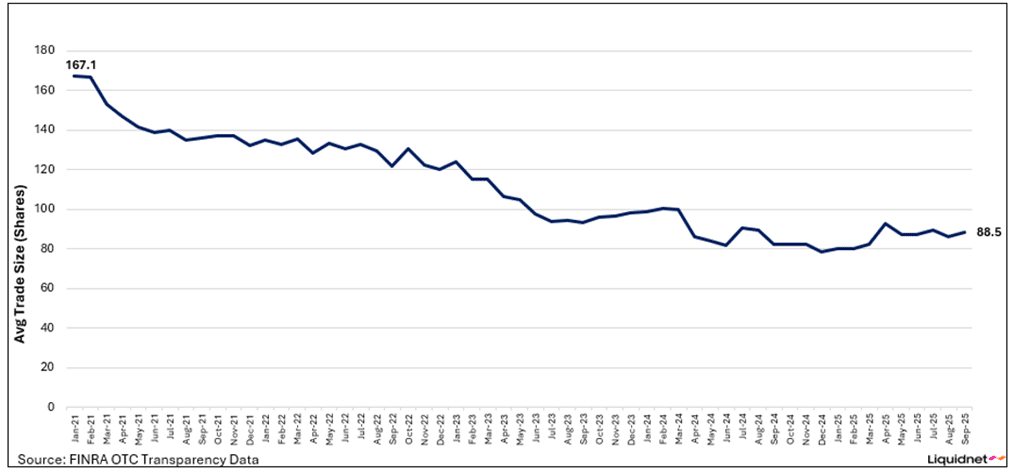
      The securities industry implemented a long-overdue modernization on November 3rd with adjusted round lot definitions. This semi-annual, symbol-by-symbol categorization based on average closing prices reflects a market reality that’s been building for years: average trade sizes have plummeted.

      Whether driven by macro conditions creating heightened risk variance and reduced block appetite (much of 2025’s story) or the more secular shift of volumes toward non-bank market makers and their unique flow management practices, odd lots have grown increasingly relevant. These smaller trades now regularly account for over 20% of total market volumes. More importantly, they can now constitute the NBBO and protected quotes—a fundamental shift with far-reaching implications for data feeds, spread calculations, and volume determinations.

      The New Framework

      Share PriceNew Lot Size
      $0–$250100
      $250.01–$1,00040
      $1,000–$10,00010
      $10,000.01+1

      ATS Trading: Preparing for Smaller Bites

      The Alternative Trading System space, historically synonymous with block trading, offers an interesting lens through which to view these changes. While large trades (10,000+ shares, depending on your definition) remain unaffected by lot size adjustments, small trades have become increasingly common on ATSs. Today’s average trade size consistently falls below the traditional 100-share threshold—and that’s despite many ATSs being unable to trade odd lots at all.

      Here’s where it gets interesting: venues that currently don’t support odd-lot trading will continue that practice, but they’ll now be able to print sub-100 share executions as legitimate round lots.

      A retrospective analysis of 2025 ATS trades under the new definitions reveals the scope of change ahead. A considerable volume of dark pool trading will now accommodate smaller sizes. For stocks previously requiring 10-share lots, volumes will increase by over 66x. The newly introduced 40-share lot category alone will account for nearly 5% of ATS volumes—roughly 100 million shares per day. While nothing is guaranteed, the door stands wide open for average trade sizes to shrink even further.

      2025 ATS Volumes Through September 26

      MetricLot Size: 1Lot Size: 10Lot Size: 40Lot Size: 100
      Old Definition: % of Total0.0%0.0%0.0%100.0%
      New Definition: % of Total0.0%0.1%4.7%95.2%
      Old Definition: Avg Daily Vol28418,33802.07Bn
      New Definition: Avg Daily Vol8811.24M99.73M2.01Bn
      Volume Delta+210%+6,684%New-2.6%

      Sources: FINRA OTC Transparency Data, Liquidnet internal data

      A New Regulatory Era Takes Shape

      The November 3rd adjustment signaled the beginning of what appears to be an increasingly active policy agenda from the SEC and related governing bodies. After the requisite settling-in period for new leadership, a distinct personality is emerging—one that became particularly evident at this year’s National STA conference in Washington, D.C.

      The odd lots redefinition represents one of the few surviving elements from Gary Gensler’s comprehensive Market Structure Overhaul Proposal, alongside Tick Size and Access Fee reforms. The prior four years were marked by debate, uncertainty, scrutiny, and eroding confidence, much of it centered on the overhaul’s sprawling ambitions. Now, with the D.C. Circuit Court denying the exchanges’ challenges to the Tick Size and Access Fee components, these rules are advancing toward implementation.

      Given the original 5-0 commission vote, some form of implementation seems certain. The key uncertainties now revolve around timing and potential modifications—stay tuned.

      STA Conference: A Shift in Tone and Substance

      Several key themes emerged from the STA conference, with optimism leading the list. There’s a renewed sense of competency and collaboration from the reconstituted SEC regime—one that values industry feedback and structured commentary panels as integral to the rulemaking process. SEC Chair Paul Atkins confirmed this approach personally (his attendance itself representing a refreshing change in behavior), supported by extensive paneling on what’s become the topic du jour: Order Protection Rule 611.

      The 611 Debate: Good Intentions, Unintended Consequences

      The discussion around Rule 611 was particularly lively across conference panels, building on September’s roundtable. There’s general agreement that 611 was well-intentioned and largely effective in practice, but its unintended consequences have been vast. Improvement is overdue.

      Key Consensus Points:

      • Market Fragmentation: Whether cause or correlation, Reg NMS marked the genesis of severe market fragmentation. Pre-NMS markets featured fewer exchanges and more market makers; post-NMS brought a proliferation of exchanges and venues alongside a consolidation of market makers. Every broker-dealer agrees: mandatory connectivity to exchanges is burdensome. The costs span onboarding, execution, clearing, testing, maintenance, upgrades, and surveillance. Layer on top of that data costs—which flow down through connectivity fees despite many exchanges carrying minimal volume percentages—and there’s no governor on what exchanges can charge. End clients and broker-dealers must pay because the exchange maintains a protected quote.
      • Slowing Proliferation: Eliminating the Order Protection Rule won’t necessarily solve existing fragmentation or complexity, but it would reduce the incentive for new exchange formation and slow the steady increase. A rewrite of SIP shared revenue fees could be another angle—perhaps establishing that venues below certain market share thresholds don’t participate in collected fees.
      • Threshold Questions: What should that market share threshold be? One percent of exchange volume? Two percent? Calculated on a per-name basis? These questions will be debated, but thresholds appear to be the direction this is heading based on panel commentaries and emerging lobby consensus.
      • Exchange Concerns vs. Market Realities: Exchanges argue that removing protection eliminates the incentive for innovation, raising the question: if displayed lit quotes aren’t protected, what happens to the NBBO? This concern carries particular weight given that liquidity has contracted far more dramatically than spreads—a situation that impacts institutions seeking to move size at the touch.
      • However, “best execution” in practice (distinct from FINRA or SEC rules) is already held to stringent standards. Sell-side firms connecting on behalf of buy-side clients both employ sophisticated quantitative performance measurement tools. Routing already utilizes dozens of non-protected venues alongside protected ones. Some autonomy in choosing the best-performing venues would help democratize the process.
      • The SIP and NBBO Reconsidered: While the SIP and NBBO need to exist in some capacity, questions around the “hows” and “whos” of contribution remain. Self-directed retail participants currently see high efficiency and typically achieve better execution than far quotes. But from the institutional perspective, liquidity has eroded. Rule 611 may have contributed to deteriorating displayed quote quality, and institutional investors find themselves beholden to prices as stop-gaps—unable to avoid quotes even when they have market-influencing size to move.
      • Is price necessarily the best barometer when an institution needs to execute meaningful size? Could fill quality matter more than price? And should a block exemption exist relative to exchange protected quotes?

      Other Notable Topics

      • 24-Hour Trading: Still an esoteric market corner, driven almost exclusively by Asian retail demand for U.S. markets (aided by a buoyant U.S. market). Volume remains small relative to the overall market, with four ATSs executing roughly 18 million shares daily. While DTCC doesn’t currently offer clearing services between 8 p.m. and 4 a.m. EST, platform changes due in mid-2026 should address this gap. Institutional interest has yet to materialize, but competitive opportunity is driving innovation and new providers. Still, institutional adoption will require better scale, legitimate spreads, and confidence that overnight price drift can be managed through liquid markets.
      • Reduced Corporate Reporting: This appears to be a major focus for the current administration. The reduction of quarterly earnings requirements will receive diligent assessment. This fits within the broader theme of deregulating the process by which private companies go public—a growing and problematic trend. Simplifying SEC requirements, depoliticizing corporate board processes, and litigation reform are among the discussed actions aimed at catalyzing private-to-public transitions. The overarching goal: reducing corporate governance burdens and costs.
      • Private Rooms: This topic continues to generate interest and debate, if not outright mystique. Some fund managers and ATS private room providers praise the model, particularly as another form of order and venue segmentation. Other participants point out apparent hypocrisies: lack of ATS-N regulation and fair access concerns. While volumes executed in private rooms remain nominal relative to accessible institutional flows, the absence of regulation suggests broker-dealers will continue utilizing this avenue in an era of growing fragmentation.
      • Tokenization: The adoption of blockchain as a ledger for equity markets seems to be a matter of when, not if. The possibilities are compelling: linking issuers directly with shareholders, providing safe and transparent immediate trade recording, enabling T+0 settlement to free up capital, and facilitating immediate DVP/RVP clearing to de-risk the market. As tokenization extends across asset classes, blockchain technology’s potential to bring transparency and efficiency to equity markets becomes increasingly tangible.
      • As we navigate these structural shifts, one thing is clear: the market structure landscape is evolving rapidly, and participants who stay alert to these changes will be best positioned for what’s ahead.

      Trading Technologies Closes Investment from Thoma Bravo

      0

      Trading Technologies International, Inc. (TT), a global capital markets technology platform services provider, today announced the close of the previously announced investment from Thoma Bravo, a leading software investment firm. Terms of the transaction, announced in late July, were not disclosed.

      Thoma Bravo now joins 7RIDGE, a specialized growth equity firm invested in transformative technologies for financial services, in ownership of TT, partnering for the next phase of TT’s growth. 7RIDGE acquired TT in December 2021.

      Justin Llewellyn-Jones

      “We are delighted to complete this transaction and enter our next phase of growth,” said Justin Llewellyn-Jones, CEO of TT.

      “Thoma Bravo’s and 7RIDGE’s support and expertise give us a powerful foundation for TT’s continued platform expansion and product innovation. We look forward to working closely together to achieve our ambitious goals, deliver exceptional value to our customers and unlock the full potential of TT as the operating system for the capital markets.”

      Houlihan Lokey acted as lead financial advisor and Barclays as financial advisor to TT. Proskauer served as TT’s legal advisor, and Oliver Wyman as TT’s market and commercial advisor. Ardea Partners LP served as financial advisor and Goodwin Procter LLP as legal advisor to Thoma Bravo.

      About Trading Technologies
      Trading Technologies (www.tradingtechnologies.com) is a global capital markets platform services company providing market-leading technology for the end-to-end trading operations of Tier 1 banks, brokerages, money managers, hedge funds, proprietary traders, Commodity Trading Advisors (CTAs), commercial hedgers and risk managers. With its roots in listed derivatives, the Software-as-a-Service (SaaS) company delivers “multi-X” solutions, with “X” representing asset classes, functions, workflows and geographies. This multi-X approach features trade execution services across futures and options, fixed income, foreign exchange (FX) and cryptocurrencies augmented by solutions for data and analytics, including transaction cost analysis (TCA); quantitative trading; compliance and trade surveillance; clearing and post-trade allocation; and infrastructure services. The award-winning TT platform ecosystem also helps exchanges deliver innovative solutions to their market participants, and technology companies to distribute their complementary offerings to Trading Technologies’ clients.

      About Thoma Bravo
      Thoma Bravo is one of the largest software-focused investors in the world, with approximately $181 billion in assets under management as of June 30, 2025. Through its private equity and credit strategies, the firm invests in growth-oriented, innovative companies operating in the software and technology sectors. Leveraging Thoma Bravo’s deep sector knowledge and strategic and operational expertise, the firm collaborates with its portfolio companies to implement operating best practices and drive growth initiatives. Over the past 20+ years, the firm has acquired or invested in approximately 555 companies representing approximately $285 billion in enterprise value (including control and non-control investments). The firm has offices in Chicago, Dallas, London, Miami, New York, and San Francisco. For more information, visit Thoma Bravo’s website at thomabravo.com.

      About 7RIDGE
      7RIDGE is a private markets asset manager invested in transformative technology for financial services to power the global economy. Visit: www.7ridge.com.

      Source: Trading Technologies International

      ON THE MOVE: DriveWealth Adds Barry Metzger; Matti Konsala to Citi

      DriveWealth, a financial technology platform providing Brokerage-as-a-Service, has expanded its executive leadership team with the introduction of Barry Metzger as Chief Brokerage Officer (CBO) and appointment of Emily Chardac as Chief People Officer (CPO), according to a company statement. Metzger brings decades of experience across leadership positions in financial services, including senior roles at Charles Schwab and as CEO of optionsXpress. Chardac brings extensive experience scaling fintech and financial services organizations, most recently as Chief People Officer at OnePay.

      Matti Konsala has joined Citi as an equities algo trader, based in London, Global Trading reported. Konsala has a decade of industry experience and joins Citi after more than seven years at Goldman Sachs. He was most recently vice president of equities algo strategies at the firm. Prior to this, he was an algorithmic trade support analyst at ITG.

      Sandra “Sandee” Buchanan

      Tradeweb Markets has appointed Sandra “Sandee” Buchanan as Chief People Officer and member of the Executive Committee. Buchanan joins Tradeweb with more than 25 years of experience in human resources and talent management. She most recently served as Chief Human Resources Officer at GCM Grosvenor, a global alternative asset manager. Previously, she was Global Head of Human Resources for Corporate & Investment Banking at Bank of America and held senior HR and talent roles at Goldman Sachs and JPMorgan Chase.

      Fenergo has appointed Hishaam Caramanli as President and Chief Operating Officer, according to a press release. Reporting to CEO Marc Murphy, Caramanli brings deep experience in product strategy and execution. He most recently served as Group Chief Product Officer at ION Markets, overseeing product strategy and delivery across a portfolio exceeding $1 billion in revenue. Earlier in his career, Caramanli served as Global Head of UBS Neo and Global Head of Morgan Stanley Matrix, two of the industry’s most acclaimed institutional trading platforms.

      Wilshire has appointed Todd Cassler as Chief Revenue Officer (CRO), according to a press release. Cassler joins Wilshire with more than 20 years of experience in financial services, building and leading businesses across wealth management, asset management, and institutional advisory. Before joining Wilshire, Todd served as Chief Growth Officer and Partner at Cerity Partners, where he was a member of the firm’s Leadership Team responsible for driving enterprise growth strategy, sales, and execution.

      Rimes, a provider of enterprise data management and investment intelligence solutions to the global investment community, has hired Bill Blythe as Global Head of Enterprise Data Management Sales. According to a press release, Blythe brings more than 25 years of leadership experience in financial technology and data management. Most recently, he served as Global Head of Sales, Enterprise Data Management at S&P Global Market Intelligence. In addition, Ross Allen has joined Rimes as Head of APAC.

      Octaura has announced Cristina Kim is joining as Chief Financial Officer and will be responsible for overseeing financial strategy and shaping the company’s growth agenda, according to a press release. Before Octaura, Kim served as Managing Director in the Strategic Investments Group at J.P. Morgan, where she led global investment activity for the Corporate & Investment Bank.

      If you have a new job or promotion to report, let me know at alyudvig@marketsmedia.com

      Reforming the SEC’s Waiver Process to Support Efficient and Fair Markets

      0

      By Saima Ahmed, Executive Vice President and General Counsel, SIFMA

      Saima Ahmed

      Federal securities laws impose disqualifications, or “collateral consequences,” that automatically attach following certain resolutions of enforcement actions. These disqualifications are often more significant to firms than the actual sanctions intended and imposed in a matter and can limit a firm’s ability to conduct ordinary business activities, such as serving as a well-known seasoned issuer (WKSI) or providing investment advice.

      Very often, the collateral consequences triggered are unrelated to the conduct at issue in the underlying enforcement action. Nevertheless, firms seeking a waiver must engage in a lengthy and cumbersome process, the resolution of which requires the expenditure of substantial firm and Commission resources. Existing guidance on waivers is also outdated and incomplete, leaving both firms and investors uncertain about the factors the staff consider in evaluating waiver requests.

      As we laid out in a recent letter to the SEC, SIFMA believes it is time for reform. This is not about reducing or limiting accountability but rather imposing it as intended. We are urging the Commission to adopt changes that will improve the efficiency, transparency, and fairness of the waiver process, while also restoring the intended application of certain exemptions.

      The Case for Reform

      As SEC Chairman Paul Atkins recently emphasized, regulation should be “smart, effective, and appropriately tailored.” Clear and well-designed rules benefit all market participants by reducing unnecessary friction that undermines capital formation.

      Consistent with these principles, SIFMA makes the following recommendations for reform:

      • Adopting a new regulation to govern the waiver process that sets forth the factors the Commission will consider in granting a waiver and provides for expedited consideration and presumptive waivers for certain requests.
      • Refocusing the scope of the WKSI disqualification (Securities Act Rule 405) by amending the definition of “ineligible issuer,” including to limit to only the named party in an enforcement action (and not subsidiaries).
      • Amending the Advisers Act Marketing Rule (Rule 206(4)-1) to provide more clarity as to the scope of its disqualification provisions by: (1) eliminating certain actions by regulators other than the SEC from even triggering the disqualification in the first place; and (2) clarifying the broker-dealer exception to the disqualification so it is sufficiently precise that broker-dealers can rely on that exception.

      These changes would ensure that firms can engage in a transparent and efficient process when seeking waivers. They would also reduce the number of unrelated matters that trigger disqualifications under the provisions, allowing the Commission to appropriately focus its resources on the small number of cases that may warrant collateral consequences.

      Looking Ahead

      We commend the SEC for resuming its policy of considering settlement offers and waiver requests simultaneously—a welcome step toward fairness and efficiency. But lasting reform is needed.

      By adopting a procedural framework to govern waiver requests and refining the scope of existing disqualification rules, the Commission can bring much-needed transparency and predictability to the waiver process, align collateral consequences with their intended purpose, and ensure that resources are focused where they matter most. This approach would also maintain full accountability—ensuring that bad actors face appropriate penalties while eliminating unnecessary and unintended barriers for firms acting in good faith.

      Clear, consistent, and efficient regulation strengthens confidence in our markets, supports capital formation, and benefits investors and firms alike.

      LSEG Launches MCP Server In Databricks Marketplace

      LSEG has announced the launch of the first phase of LSEG’s AI-ready content through MCP Server in Databricks Marketplace, a major milestone in the partnership between LSEG and Databricks, the data and AI company.

      The Databricks Marketplace is an open marketplace for data, analytics and AI, powered by Delta Sharing. Delta Sharing is Databricks’ open source approach that enables customers to share live data across platforms, clouds and regions with strong security and governance. This deployment allows customers, from within their agentic workflows (built using Agent Bricks), to access LSEG’s trusted financial datasets directly via the MCP Server, unlocking faster and scalable AI innovation.

      LSEG’s AI ready content will continue to roll out in phases through MCP, beginning with LSEG Financial Analytics. This follows the September announcement of the addition of LSEG’s Lipper Fund Data & Analytics and Historical Analytics on Databricks. With MCP in Databricks Marketplace, institutions can securely access LSEG’s remote MCP server from Agent Bricks, Databricks’ flagship AI product, unlocking real-time connectivity to trusted financial intelligence. 

      Emily Prince

      Emily Prince, Group Head of Analytics & AI at LSEG, said: “This is a pivotal moment in our journey to make high-quality financial data more accessible and actionable. By activating MCP connectivity on Databricks Marketplace and bringing our datasets natively to Agent Bricks, we’re helping institutions unlock new levels of intelligence, efficiency, and compliance.”

      Jay Bhankharia, Senior Director of Product Partnerships at Databricks, said: “Data intelligence is transforming how financial institutions operate, and these organisations are eager to accelerate their AI initiatives. With LSEG’s MCP server in Databricks Marketplace, finance teams gain instant access to high-quality, AI-ready data to build AI apps and agents that deliver real business impact.”

      By connecting LSEG’s trusted content with advanced AI capabilities, financial services professionals can benefit from intelligent tools that enhance decision-making and boost productivity.

      LSEG Everywhere: Trusted Data at Scale for Financial AI

      Today’s announcement builds on our ’LSEG Everywhere’, AI strategy which is delivering trusted licensed data to scale AI in financial services. The unparalleled depth, breadth, and quality of LSEG’s AI-ready content and taxonomies include datasets stretching back over decades and total more than 33 petabytes.

      Powering AI with Trusted Data

      LSEG AI-ready content aims to improve productivity with fewer bespoke builds, lower run-risk, faster time-to-answer, and audit-ready outputs – without locking into a single model or cloud. LSEG MCP server provides the consistency and traceability of the LSEG content across AI ecosystem.

      Empowering AI-Driven Investment Insight

      LSEG’s Lipper Fund Data & Analytics provides comprehensive, structured, and comparable information on funds globally, empowering financial professionals to enhance fund selection, benchmark performance, and optimize investment strategies using AI-driven models. Complementing this, Historical Analytics delivers decades of time-series and market data essential for backtesting, model training, and long-term market pattern analysis, enabling the development of predictive, explainable, and resilient AI systems built on trusted data.

      Source: LSEG

      Markets Never Sleep: LMAX David Mercer on Trading’s 24/7 Future

      The concept of a 24/7 capital market is moving from crypto experiment to financial reality. As assets become tokenized, collateral turns digital, and settlement becomes near-instant, markets won’t “close”, according to David Mercer, CEO of LMAX Group. In this conversation with Traders Magazine, Mercer explores why institutions are finally leaning into continuous markets, and how tokenization could blur the lines between asset classes for good.

      David Mercer

      What will a 24/7 capital market mean for equity trading as assets become tokenized and settlement becomes real-time?

      As assets become tokenized, we’ll move to true real-time exchange of ownership – seconds instead of days – the end of fragmented trading hours and batch processing for equities. It fundamentally changes the rhythm of markets and will inject a new level of continuous efficiency, collateral management, capital utility and liquidity into the market. The transformation is about speed, transparency and breaks down traditional asset classes. 

      We’ve seen this dynamic in crypto already; it’s a preview of what’s coming for equities. A 24/7 capital market across all asset classes means markets that never close – continuous price formation, constant liquidity and more efficient allocation of capital.

      How are institutional clients approaching the shift toward more continuous, around-the-clock markets?

      Institutional clients are progressing from cautious observation to active engagement, driven primarily by demand. They are currently focused on familiar plumbing—namely, credit intermediation, trusted custody solutions and regulated, institutional-grade execution venues to seamlessly integrate digital assets without having to completely overhaul their trading behaviours or infrastructure.

      Some are doing this directly; others through trusted partners using shared APIs and segregated accounts. The direction of travel is clear: 24/7 market access is moving from innovation to execution, clearing, custody and private wealth solutions in institutional finance.

      How do you interpret the SEC’s reported plans to allow blockchain-registered stocks on crypto exchanges?

      The move is a signal that regulators are seriously contemplating the fusion of traditional equities with digital asset market structure, lending crucial legitimacy and trust which will be a significant catalyst for further institutional participation and the ultimate mainstreaming of tokenized assets.

      It validates what we have said for years: tokenisation isn’t a fringe experiment; it’s the future of market infrastructure. All securities will be tokenised within a decade and new issues, well before then. Tokenisation will remove resource friction in capital markets. 

      In a world of tokenized equities and fungible collateral, what new liquidity dynamics do you expect to emerge?

      We expect a fundamental shift towards deeper, more resilient liquidity. The ability to use collateral fungibly across assets combined with instant settlement and yielding possibilities will unlock capital that is currently trapped in legacy T+2 or T+3 settlement cycles. We’ll see far greater fluidity as settlement risk and pre-funding requirements fall away, with stablecoins and tokenized money-market funds acting as the connective tissue between markets. Ultimately, leading to greater capital efficiency and a tighter, more active order books for tokenized assets. The result is higher trading volumes and more capital flowing across the global financial system, as the velocity of money, digitized and fiat, accelerates.

      As real-world assets become tokenized, what’s the future role of exchanges like LMAX in bridging institutional demand with on-chain infrastructure?

      Our role is to be the leading cross-asset marketplace to a tokenized future. As real-world assets move on-chain, we’ll continue to provide the trusted infrastructure that institutions expect – secure, seamless, low-latency and with deep liquidity pools – whether blockchain-based or fiat. The role of the exchange doesn’t disappear; it evolves to bridge traditional financial institutions with the new on-chain and tokenized infrastructure.

      What operational changes will institutions need to make to thrive in a 24/7 trading environment?

      It starts with mindset. Risk, treasury and settlement teams need to think in continuous rather than discrete cycles. Operationally, that means building round-the-clock collateral management, integrating trusted digital custody solutions, accepting stablecoins and other digital collateral, and ensuring AML/KYC processes run in real-time.

      We’ll also see new forms of digital prime brokerage emerge to manage liquidity and credit across venues. Those who can manage risk and liquidity continuously will capture the flows others can’t.

      From Execution to Insight: The New Frontier of Smart Trading Platforms

      0

      FLASH FRIDAY is a weekly content series looking at the past, present and future of capital markets trading and technology. FLASH FRIDAY is sponsored by Instinet, a Nomura company.

      Mark Speare, B2BROKER

      Automated decision making has always been a mixed bag. This year has signified a turning point in using AI and machine learning tools for the key execution processes. Not long ago, we perceived any kind of automation – electronic, algorithmic, self learning, etc. – as a helper, not as a front office instrument. 

      AI and ML: From Signal to Strategy

      In a recent episode as part of the risk management summit in London this summer, the event organizers offered a very unique experiment. They simulated some kind of economic stress scenario – a sort of black swan, so to speak – that would affect broad markets by catching the traders by surprise. The idea was to study the depth and speed of a human versus a machine operator’s reaction facing quick losses and overall instability of their investment portfolios. Ironically, that event was hosted by major European banks and some big tech companies. As part of that man-made experiment, the bot surprisingly managed to safeguard over 90% of the portfolio assets and even attained some modest gain. It acted quickly and boldly – unlike human managers, who seemed lost in assessing cross-asset impacts and other interdependencies – before they even realized it was too late to start bailing out the sagging portfolio.

      However, industry players get more and more grasped by what they perceive as the immense scale of AI’s applicability and usability. I tend to take a more cautious approach.

      According to one recent study by Bloomberg, European portfolio managers are reluctant to deeply integrate these technologies into decision-making. Only about 13% of them admitted the acceptability of outsourcing existentially important processes in their companies. I think the outcome of that poll makes a lot of sense. Also, beyond any doubt, although these technologies have made a huge forward leap recently, their structural and functional algorithms remain largely in limbo. The very fact that we don’t know how AI executes self learning, what exact historical inputs it uses, and how deeply any particular application is able to study such historical patterns – yes, I’m talking about the intricacies of backtesting – leads me to believe that we are still essentially at the experimental phase.

      Compliance in the Age of Complexity

      In terms of the regulatory and compliance impact of these new technologies, I see them mostly as an additional daily burden on a trading desk, forcing brokerage companies to appoint an independent actor whose only task would be to monitor and implement new directives and practices as they emerge and become new regulatory norms. That said, the regulatory and compliance practices are not uniform across the Atlantic. For example, in Europe, its recently introduced AI Act classified various systems of AI used in trading without further separation of them into particular categories – such as aiding routine processes, helping analyze big data, comparing patterns and number arrays from those directly involved in reporting and deduction making – labeling them ‘high risk factors’. That was intuitively understood, but, honestly, not entirely helpful.

      Beyond the Buzzwords

      Another emerging class, where AI and machine learning tools find more and more use, are crypto platforms. They obtained a huge momentum recently due to the rapid development of digital assets. Decentralized exchanges, along with various tokenized asset issues and smart contracts, are facing their own unique challenges, given complexities and the lack of uniformity of European and U.S. regulations. In the U.S., the Securities and Exchange Commission and CFTC remain stringent about the acceptance of various DeFi protocols. Furthermore, they require rigorous know your customer and anti-money laundering procedures, as well as enforced audits of smart contracts, stablecoins, their collaterals, and the necessary public disclosures.

      My biggest concerns about the applicability of these tools stem from a few questions that everyone is free to independently investigate. If we assign an AI to a particular task, sourcing of our queries may include broken or non-existent links and sources. In a situation where we can manually check all of the offered materials, that may not be a really big issue. What we usually do is discard the trash. However, if such a process becomes self-operated and self-controlled, then such zero output can create a real mess in the entire algorithm. 

      Another familiar example is the AI’s blindness towards the date stamps. It may address the inquiry irrespective of their historical time, which means once left unattended, the AI may give an inaccurate and outdated trading recommendation based on some conditions and factors, that now appear to be no longer valid.

      Mark Speare is Chief Customer Success Officer at B2BROKER.

      Schwab to Acquire Forge

      The Charles Schwab Corporation (Schwab) has entered into a definitive agreement to acquire Forge Global Holdings, in a transaction valued at approximately $660 million.

      Forge operates the premier private market platform and a leading trading marketplace through which investors have bought and sold more than $17 billion in private company shares1.

      Forge offers qualified investors a range of direct and indirect opportunities to participate in the private markets.

      Its combination of a direct marketplace, private company solutions, and proprietary data helps enhance private market access and transparency for qualified investors. The company also has forthcoming interval funds which are designed to broaden access to private market exposure with lower costs and reduced minimums.

      Rick Wurster

      “Our acquisition of Forge builds on more than half a century of Schwab innovating on behalf of individual investors, advisors and employers,” said Rick Wurster, president and chief executive officer of Charles Schwab.

      “Through Forge’s leading marketplace, we’re uniquely positioned to deepen liquidity, improve transparency, and further democratize access to this increasingly important source of wealth creation for investors. Schwab’s entry into this space also gives private‑share issuers more choice and liquidity for founders, employees, and early backers.”

      Combining Schwab’s Industry-Leading2 Reach across 46 million Accounts with Forge’s Expertise to Redefine Private Market Access

      This acquisition accelerates Schwab’s strategy to deliver private markets capabilities to retail and advisor clients, building on its expansive suite of wealth, advisory, and investment management solutions, to meet the complex needs of investors. Multi-decade industry trends and rising investor demand for broader diversification are driving sustained momentum in private markets and private wealth capital allocated to alternative asset classes is expected to grow from $4 trillion today to $13 trillion by 2032. The addition of direct access to private securities through Forge builds on our recent launch of Schwab Alternative Investments Select, a new alternative investments platform supported by a dedicated team of experts, which is now available to all eligible retail clients with more than $5 million in household assets at Schwab.

      Earlier this month, Schwab announced the launch of Schwab Private Issuer Equity Services, a complete equity management solution designed to support private companies in the late stages prior to IPO. Schwab Private Issuer Equity Services makes Schwab’s decades of experience managing equity programs for the world’s largest public companies available to private company administrators looking for a partner that can scale with them.

      Together, Schwab and Forge will unite private stock plan administration and liquidity access in a single, integrated ecosystem that benefits all participants. Through this acquisition, Schwab will build on Forge’s decade plus experience helping private companies deliver capital and liquidity solutions through a partnership model rooted in company approval and trusted collaboration.

      Kelly Rodriques, CEO of Forge said, “This combination will transform how the private market works. With Schwab’s reach and Forge’s solutions, private companies will gain access to liquidity and new growth options from an expanded market of qualified retail investors, while investors will gain new ways to invest in the innovation economy. Together, we’re making the private markets work better for everyone.”

      “Access to Schwab’s 46 million client accounts and $11.6 trillion in client assets creates a strong distribution platform for private securities,” said Wurster. “With the pool of private companies growing and remaining private for longer, a leading platform for individual investors to participate in private markets offers durable, strategic value. We expect meaningful growth in this space and believe our platform will become a go-to venue where retail investors discover new investment opportunities.”

      Transaction Details

      Under the terms of the agreement, Schwab will acquire all of Forge’s issued and outstanding common shares for $45 cash per Common Share. The transaction has been unanimously approved by the Boards of Directors of Schwab and Forge. The transaction is expected to close in the first half of 2026, subject to customary closing conditions, including approval by Forge’s stockholders and regulatory approvals. Forge’s two largest stockholders, Motive Capital and Deutsche Börse, have entered into agreements committing to support the transaction.

      J.P. Morgan Securities, LLC served as financial advisor and Wachtell, Lipton, Rosen & Katz acted as legal advisor to Schwab. Financial Technology Partners served as financial advisor and Morris, Nichols, Arsht & Tunnell LLP acted as legal advisor to a Special Committee of Forge’s Board of Directors. Sullivan & Cromwell LLP acted as legal advisor to Forge.

      ____________________
      1 Based on historical transaction data from inception through September 30, 2025.
      2 As disclosed by publicly-traded peers.
      3 Source: Bain & Co.

      Source: Charles Schwab Corporation