










By Jeff O’Connor, Head of Market Structure and Sellside ATS Strategy, Americas at Liquidnet

Round Lot Redefinition: November 3rd Marked a Watershed Moment
The securities industry implemented a long-overdue modernization on November 3rd with adjusted round lot definitions. This semi-annual, symbol-by-symbol categorization based on average closing prices reflects a market reality that’s been building for years: average trade sizes have plummeted.
Whether driven by macro conditions creating heightened risk variance and reduced block appetite (much of 2025’s story) or the more secular shift of volumes toward non-bank market makers and their unique flow management practices, odd lots have grown increasingly relevant. These smaller trades now regularly account for over 20% of total market volumes. More importantly, they can now constitute the NBBO and protected quotes—a fundamental shift with far-reaching implications for data feeds, spread calculations, and volume determinations.
The New Framework
| Share Price | New Lot Size |
| $0–$250 | 100 |
| $250.01–$1,000 | 40 |
| $1,000–$10,000 | 10 |
| $10,000.01+ | 1 |
ATS Trading: Preparing for Smaller Bites
The Alternative Trading System space, historically synonymous with block trading, offers an interesting lens through which to view these changes. While large trades (10,000+ shares, depending on your definition) remain unaffected by lot size adjustments, small trades have become increasingly common on ATSs. Today’s average trade size consistently falls below the traditional 100-share threshold—and that’s despite many ATSs being unable to trade odd lots at all.
Here’s where it gets interesting: venues that currently don’t support odd-lot trading will continue that practice, but they’ll now be able to print sub-100 share executions as legitimate round lots.
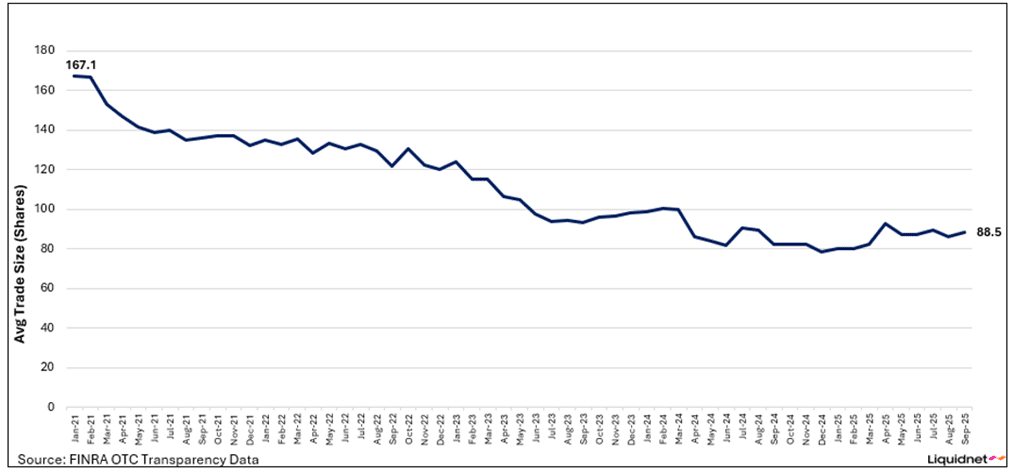
A retrospective analysis of 2025 ATS trades under the new definitions reveals the scope of change ahead. A considerable volume of dark pool trading will now accommodate smaller sizes. For stocks previously requiring 10-share lots, volumes will increase by over 66x. The newly introduced 40-share lot category alone will account for nearly 5% of ATS volumes—roughly 100 million shares per day. While nothing is guaranteed, the door stands wide open for average trade sizes to shrink even further.
2025 ATS Volumes Through September 26
| Metric | Lot Size: 1 | Lot Size: 10 | Lot Size: 40 | Lot Size: 100 |
| Old Definition: % of Total | 0.0% | 0.0% | 0.0% | 100.0% |
| New Definition: % of Total | 0.0% | 0.1% | 4.7% | 95.2% |
| Old Definition: Avg Daily Vol | 284 | 18,338 | 0 | 2.07Bn |
| New Definition: Avg Daily Vol | 881 | 1.24M | 99.73M | 2.01Bn |
| Volume Delta | +210% | +6,684% | New | -2.6% |
Sources: FINRA OTC Transparency Data, Liquidnet internal data
A New Regulatory Era Takes Shape
The November 3rd adjustment signaled the beginning of what appears to be an increasingly active policy agenda from the SEC and related governing bodies. After the requisite settling-in period for new leadership, a distinct personality is emerging—one that became particularly evident at this year’s National STA conference in Washington, D.C.
The odd lots redefinition represents one of the few surviving elements from Gary Gensler’s comprehensive Market Structure Overhaul Proposal, alongside Tick Size and Access Fee reforms. The prior four years were marked by debate, uncertainty, scrutiny, and eroding confidence, much of it centered on the overhaul’s sprawling ambitions. Now, with the D.C. Circuit Court denying the exchanges’ challenges to the Tick Size and Access Fee components, these rules are advancing toward implementation.
Given the original 5-0 commission vote, some form of implementation seems certain. The key uncertainties now revolve around timing and potential modifications—stay tuned.
STA Conference: A Shift in Tone and Substance
Several key themes emerged from the STA conference, with optimism leading the list. There’s a renewed sense of competency and collaboration from the reconstituted SEC regime—one that values industry feedback and structured commentary panels as integral to the rulemaking process. SEC Chair Paul Atkins confirmed this approach personally (his attendance itself representing a refreshing change in behavior), supported by extensive paneling on what’s become the topic du jour: Order Protection Rule 611.
The 611 Debate: Good Intentions, Unintended Consequences
The discussion around Rule 611 was particularly lively across conference panels, building on September’s roundtable. There’s general agreement that 611 was well-intentioned and largely effective in practice, but its unintended consequences have been vast. Improvement is overdue.
Key Consensus Points:
- Market Fragmentation: Whether cause or correlation, Reg NMS marked the genesis of severe market fragmentation. Pre-NMS markets featured fewer exchanges and more market makers; post-NMS brought a proliferation of exchanges and venues alongside a consolidation of market makers. Every broker-dealer agrees: mandatory connectivity to exchanges is burdensome. The costs span onboarding, execution, clearing, testing, maintenance, upgrades, and surveillance. Layer on top of that data costs—which flow down through connectivity fees despite many exchanges carrying minimal volume percentages—and there’s no governor on what exchanges can charge. End clients and broker-dealers must pay because the exchange maintains a protected quote.
- Slowing Proliferation: Eliminating the Order Protection Rule won’t necessarily solve existing fragmentation or complexity, but it would reduce the incentive for new exchange formation and slow the steady increase. A rewrite of SIP shared revenue fees could be another angle—perhaps establishing that venues below certain market share thresholds don’t participate in collected fees.
- Threshold Questions: What should that market share threshold be? One percent of exchange volume? Two percent? Calculated on a per-name basis? These questions will be debated, but thresholds appear to be the direction this is heading based on panel commentaries and emerging lobby consensus.
- Exchange Concerns vs. Market Realities: Exchanges argue that removing protection eliminates the incentive for innovation, raising the question: if displayed lit quotes aren’t protected, what happens to the NBBO? This concern carries particular weight given that liquidity has contracted far more dramatically than spreads—a situation that impacts institutions seeking to move size at the touch.
- However, “best execution” in practice (distinct from FINRA or SEC rules) is already held to stringent standards. Sell-side firms connecting on behalf of buy-side clients both employ sophisticated quantitative performance measurement tools. Routing already utilizes dozens of non-protected venues alongside protected ones. Some autonomy in choosing the best-performing venues would help democratize the process.
- The SIP and NBBO Reconsidered: While the SIP and NBBO need to exist in some capacity, questions around the “hows” and “whos” of contribution remain. Self-directed retail participants currently see high efficiency and typically achieve better execution than far quotes. But from the institutional perspective, liquidity has eroded. Rule 611 may have contributed to deteriorating displayed quote quality, and institutional investors find themselves beholden to prices as stop-gaps—unable to avoid quotes even when they have market-influencing size to move.
- Is price necessarily the best barometer when an institution needs to execute meaningful size? Could fill quality matter more than price? And should a block exemption exist relative to exchange protected quotes?
Other Notable Topics
- 24-Hour Trading: Still an esoteric market corner, driven almost exclusively by Asian retail demand for U.S. markets (aided by a buoyant U.S. market). Volume remains small relative to the overall market, with four ATSs executing roughly 18 million shares daily. While DTCC doesn’t currently offer clearing services between 8 p.m. and 4 a.m. EST, platform changes due in mid-2026 should address this gap. Institutional interest has yet to materialize, but competitive opportunity is driving innovation and new providers. Still, institutional adoption will require better scale, legitimate spreads, and confidence that overnight price drift can be managed through liquid markets.
- Reduced Corporate Reporting: This appears to be a major focus for the current administration. The reduction of quarterly earnings requirements will receive diligent assessment. This fits within the broader theme of deregulating the process by which private companies go public—a growing and problematic trend. Simplifying SEC requirements, depoliticizing corporate board processes, and litigation reform are among the discussed actions aimed at catalyzing private-to-public transitions. The overarching goal: reducing corporate governance burdens and costs.
- Private Rooms: This topic continues to generate interest and debate, if not outright mystique. Some fund managers and ATS private room providers praise the model, particularly as another form of order and venue segmentation. Other participants point out apparent hypocrisies: lack of ATS-N regulation and fair access concerns. While volumes executed in private rooms remain nominal relative to accessible institutional flows, the absence of regulation suggests broker-dealers will continue utilizing this avenue in an era of growing fragmentation.
- Tokenization: The adoption of blockchain as a ledger for equity markets seems to be a matter of when, not if. The possibilities are compelling: linking issuers directly with shareholders, providing safe and transparent immediate trade recording, enabling T+0 settlement to free up capital, and facilitating immediate DVP/RVP clearing to de-risk the market. As tokenization extends across asset classes, blockchain technology’s potential to bring transparency and efficiency to equity markets becomes increasingly tangible.
- As we navigate these structural shifts, one thing is clear: the market structure landscape is evolving rapidly, and participants who stay alert to these changes will be best positioned for what’s ahead.
