

Saturday, April 18, 2026
More
    More

      Buyside’s Underinvestment in IT “Unsustainable,” Celent Says

      Asset managers spend more than 80 percent of their technology dollars simply maintaining existing operations. Only 20 percent gets spent on developing new software and technology.

      With regulatory changes multiplying and trading spanning more types of assets, “the buy side has a situation of underinvestment which is unsustainable,’’ research firm Celent said.

      In particular, asset managers are facing broadening mandates from their customers and must carry out their trading over more venues and more types of assets than just stocks.

      In North America, asset managers can no longer just focus on stocks, Celent said in a report released Friday on “IT Trends and Spending Implications for the Securities and Investments Industry.”

      “Due to investor requests to be serviced with all investment choices, investment firms have and continue to diversify their own portfolio such that now they offer investments in all asset classes with a global mandate,’’ the firm’s securities and investments research team said. Compounding the problem: “Multiple and redundant systems from past mergers and acquisitions.”

      Also confronting the buyside: “a large portfolio of regulations,’’ from the 2010 Dodd-Frank Wall Street Reform Act, which is forcing the creation of a whole new set of electronic trading systems for trading in standardized forms of interest-rate and credit-default swaps, as well as the Basel III reforms, which are requiring firms to set aside more capital as buffers against market risks.

      That, Celent says, means “the next few years (is) a period where we will see dramatic change in the way firms handle all aspects of their IT business both internally and externally.’’

      That change will come, it said, as software suppliers consolidate and broker-dealers that handle transactions for the buyside cut back their operations, as they face margin pressures.

      Buyside firms, which already have been adopting order management systems, execution management systems, algorithms and smart order routing for foreign exchange and equities trading, will “naturally gravitate” to adopting such systems for fixed-income trading as well.

      Asset managers also will have to create new mechanisms for connecting to and interacting with swaps execution facilities in the United States, multilateral trading facilities in Europe and a host of other new types of trading systems, globally.

      The proliferation of regulatory reporting requirements, as well as asset classes and venues they must deal with, “will force buyside firms to spend increasing amounts of money to standardize data and create a seamless way of getting that data across the entire firm’s investment system,’’ Celent said.

      Celent did not quantify the amount of increase it expects buyside firms will have to put into its spending on information systems.
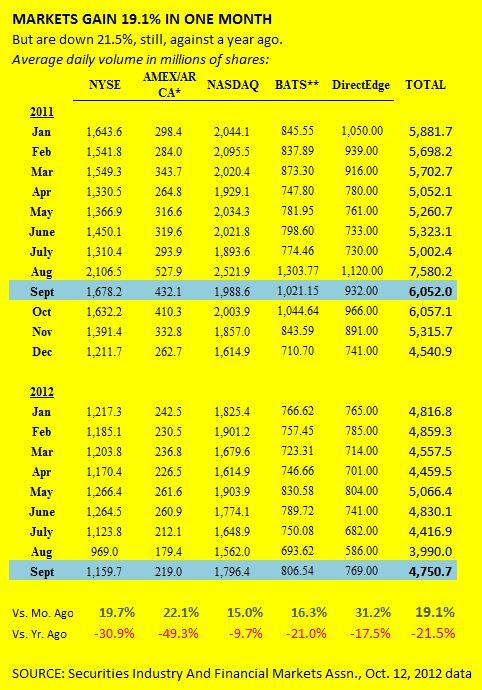

      Exchange Volume Picks Up 19.1%. And Drops 21.5%.

      Stock markets in September experienced their biggest gain in activity since May.

      Daily volume jumped 19.1% last month. The average number of shares traded reached 4.8 billion, up from 4.0 billion in August, according to statistics from Nasdaq, NYSE Euronext, Direct Edge and BATS Global Markets.

      But the stats, compiled by the Securities Industry and Financial Markets Association, showed volume still down 21.5% from a year ago. In September 2011, 6.1 billion shares were traded on an average day.

      The biggest prior one-month gain this year was in four months ago, when volume hit 5.1 billion shares a day in May, up 22.2% from 4.5 million in April.

      But, across the board, the exchanges are still seeing depressed activity.

      The New York Stock Exchange is off 30.9% from a year ago, at 1.2 billion shares. Its NYSE Arca and NYSE MKT exchanges are off 49.3%, to 219.0 million shares, according to SIFMA.

      Nasdaq is off 9.7%, to 1.8 billion shares, year over year. Direct Edge, which operates two exchanges, and BATS, which also operates two, are off about the general average.

      Year over year, BATS is down 21.0%, Direct Edge 17.5%.


      .


      Direct Edge Offers Anti-HFT Order Type

      Exchange operator Direct Edge will introduce a new order type aimed at customers who want to avoid interacting with professional traders.

      Called “Route Peg,” the order type was approved last week by the Securities and Exchange Commission. It will be available on both of Direct Edge’s exchanges on an as-yet undisclosed date.

      Route Peg is a hidden limit order priced at the market’s best bid or offer. It only executes against orders that are being routed out from EDGA or EDGX to another exchange.

      Those orders, according to Direct Edge’s regulatory filing, are unlikely to belong to professional, or high-frequency, traders. Typically, professional traders submit orders that fill immediately or are canceled. They don’t route out.

      The Route Peg has been crafted to interact with orders that enter one of Direct Edge’s exchanges, fail to execute and then are routed away. Just before it leaves Direct Edge, the order may match up with a Route Peg order.

      (c) 2012 Traders Magazine and SourceMedia, Inc. All Rights Reserved.
      http://www.tradersmagazine.com http://www.sourcemedia.com/

      FlexTrade Strikes VWAP Deal with NYSE Technologies

      FlexTrade Systems struck a deal with NYSE Technologies to redistribute a product that provides intraday volume predictions.

      Called FlexEdge, the service updates full day volume calculations every minute for traders using volume-weighted average price (VWAP) algorithms and other strategies. Traders using these algos need to be able to predict the distribution of volume throughout the day in order to achieve prices as close to final VWAP as possible, according to FlexTrade executive Max Palmer. FlexEdge continually updates its predictions using the current day’s data.

      “Users can feed a dynamically changing VWAP curve into their VWAP algorithms allowing them to reduce the variance of their execution with respect to actual market VWAP that day,” explained Palmer. FlexTrade has offered the technology to its own clients for many years.

      The deal with NYSE Technologies, a unit of exchange operator NYSE Euronext, is FlexTrade’s first effort at distributing through third parties. NYSE Technologies will offer FlexEdge through Superfeed, a low latency, market data vendor feed, according to Todd Watkins, an executive in NYSE Technologies’ market data group. FlexTrade’s content will be published through OpenMAMA middleware, an “open source” technology originally developed by NYSE Technologies.

      (c) 2012 Traders Magazine and SourceMedia, Inc. All Rights Reserved.
      http://www.tradersmagazine.com http://www.sourcemedia.com/

      Vanguard’s Sauter, Pt. IV: The Need for Market Structure Debate

      In the last of Traders Magazine’s four-part Q&A with Sauter, he explains why he became involved in industry debates.


      Traders Magazine: When the bid-rigging scandal broke in the 1990s, were you trying to work with the SEC and clean up that mess?
      Gus Sauter: That was what got me involved. It was the catalyst for getting me to work with various committee and get involved.

      Traders Magazine: You were interested because you feared people would lose confidence in markets
      Gus Sauter: Yes, and we realized how difficult it was to trade, especially in the over the counter market. So I became very involved.

      Traders Magazine: And you also became involved in the Reg NMS debate.
      Gus Sauter:  Yes.

      Traders Magazine: And in the midst of the debate some wanted to drop the trade-through rule. You believed that would have left the limit orders unprotected. And you were arguing for the rule and auto-execution on all exchanges. I assume you’re proud of what happened?
      Gus Sauter: Yes, very much so. Again, if your limit orders aren’t protected, then you are going to be disincentives to create limit orders. That means less liquidity on the book.

      Traders Magazine: And so…
      Gus Sauter: You have a much less liquid trading environment. I’m very glad that Reg NMS did happen

      Traders Magazine: One last thing, are you fearful about all these recent market events? And even with all these reforms that have come along, people are putting a lot less money into equity funds. Doesn’t that worry you that we could be going back to the 1990s?
      Gus Sauter: Well, I’m certainly disappointed every time you hear about a new event. But frankly I don’t think that is a result of a lack of confidence in equities. I think a good bull market would bring back all the confidence in the world in equities. We still have significant cash flow into our equity funds.

      Traders Magazine: So it’s a disappointment in the returns and not an uncomfortable feeling that markets are rigged against the little guy the way they were in 1990s.
      Gus Sauter: Yes, because if you look at cash flows into index funds, they’re still extremely strong.

      Traders Magazine: So the future of low expense funds, in your opinion, is bright.
      Gus Sauter: Yes, exactly, there are lots of studies that show low expense funds outperform high expense funds. And it is striking how conspicuous that is.

      Traders Magazine: How about the future of Gus Sauter? What do you plan to do after you leave Vanguard?
      Gus Sauter: I haven’t really figured that out. I’m sprinting toward the end of the year. I’m going to take the first quarter of 2013 off and just decompress. I’m kind of intrigued by the idea of teaching. I definitely want to get back to my golf game. I work about 60 hours or more now and only get to golf once or twice a year.

      Traders Magazine: Will you break a hundred?
      Gus Sauter: Hopefully I can do that.


      15 ‘Wall Street Women’ Recognized for Achievements

      Fifteen women and one firm are being honored in the second annual Wall Street Women: A Celebration of Excellence awards, organized by Traders Magazine.

      The program recognizes leaders that demonstrate how to skillfully and safely guide the securities trading industry to greater prosperity.

      This year’s honorees are being announced online today, profiled in the November print edition of Traders Magazine, and lauded in person at ceremonies to be held November 7, 2012, at the Waldorf Astoria Hotel in New York.

      “Women have had to overcome huge respect and wage gaps in securities trading,” said Tom Steinert-Threlkeld, Trader Magazine’s Editor-in-Chief. “These women have overcome all the obstacles they faced and emerged as true Wall Street leaders and role models for the next generation of securities traders.”

      Individuals were nominated in eight categories. Candidates were recommended by their peers in the trading community who submitted information on a variety of criteria, including responsibilities, financial results and organizational success, on each nominee.

      This year’s award-winners were selected from a field of more than 70 nominees by an independent advisory board comprised of seven established, female leaders from the industry.

      The honorees by category include:

      Excellence in Leadership:

      ♦ Sheri Kaiserman, Managing Director and Head of Equities, Wedbush Securities

      This award is presented to a woman who demonstrates exemplary leadership and exceptional performance throughout her career. This individual, selected by the Advisory Committee, is considered to be the standard bearer for women in the financial community.

      Industry Trailblazers:

      ♦ Janice McFadden; Managing Director; Goldman Sachs

      ♦ Donna Sims Wilson, Executive Vice President, Castle Oak Securities, L.P.

      These awards recognize women who broke the gender barrier in trading, advancing up the career ladder on the buy and sell sides of the business. These trailblazers forged the opportunity for other women to become traders, managers and successful financial professionals.

      Lifetime Achievement:

      ♦ Peggy Bowie, Trader for North American and Global Equities, MFC Global Investment Management

      ♦ Nancy D. McLaughlin, Managing Director | Sales & Business Development, ConvergEx Group

      These honors are given to women with more than two decades of senior management experience on Wall Street, and who have achieved the pinnacles of success and acted as role models to younger generations of women and men.

      Entrepreneurs of the Year:

      ♦ Dana Dakin, Founder, Dakin Partners, LLC

      ♦ Holly A. Stark, Managing Member, Efficient Frontiers LLC

      These are skilled, creative women who have pursued, and succeeded in new ventures or businesses in financial markets.

      Mentors of the Year:

      ♦ Renee DeGagne, Managing Director, RBC Capital Markets LLC

      ♦ Amy Ellis-Simon,Global Head of Specialist Sales and Americas Head of Corporate Access, Bank of America Merrill Lynch

      These are women who have shown dedication to the cause of furthering the careers of other women in financial services.

       (More)


      Charitable Works Awards:

      ♦ Cathy Wilson Rosen, Senior Trader, Zweig-DiMenna Associates

      ♦ Angela Sun, Chief of Staff to the President, Bloomberg L.P.

      These are presented to women who devote considerable resources and energy to philanthropic causes that benefit society as a whole.

      Crystal Ladder Awards:

      ♦ Kerry Byrne, Senior Vice President, First Eagle Investment Management

      ♦ Jennifer Litwin, Senior Director, Greenwich Associates

      These give recognition to women who began their careers in an entry-level job in a financial firm and climbed steadily through the ranks to reach senior management.

      Rising Stars Awards:

      ♦ Lisa Cavallari, Director, Fixed Income Derivatives, Russell Investments

      ♦ Christy Oeth, Director of Corporate Compliance, Knight Capital Group

      These are earned by professionals that have had significant and growing impact on their firms and the industry.

      Diversity Achievement Award:

      ♦ Goldman Sachs Group

      This award highlights the efforts as well as demonstrated quantitative and qualitative results produced by a firm in pursuit of gender diversity in the executive ranks.

      At the awards ceremony, the keynote speaker will be Stephanie Ruhle anchor for Bloomberg Television, based in New York.

      Ruhle is the host of “Market Makers,” which airs from 10 a.m. to noon on weekdays, and contributes to “Lunch Money,” Bloomberg Television’s noon-hour program covering news in equities, currencies, bonds and commodities.

      Prior to joining Bloomberg, Ruhle served as a Managing Director in Global Markets Senior Relationship Management at Deutsche Bank. She also plays an active role in women’s leadership and business leader development. She founded the Corporate Investment Bank (CIB) Women’s Network and co-chaired the Women on Wall Street (WOWS) steering committee.

      Since 1967 Traders Magazine has covered the industry, including the advancements of women in the business.

      “From the beginning, Traders has made a point of identifying women who have made substantial contributions to the development of markets and their firms,” said Traders Publisher Ken Heath. “We’ve reported on their achievements and these awards attest to the depth and breadth of what they accomplish, throughout their careers.’’

      Bisgay to Run Knight Capital’s Operations

      Knight Capital has consolidated its financial, technological and general operations under a single executive and moved its top technologist into a new role.

      Executive vice president and chief financial officer Steven Bisgay is now also chief operating officer.

      Executive vice president Steven Sadoff, who had been global head of operations and technology, is instead being charged with building Knight’s correspondent clearing, prime brokerage and futures businesses.

      The moves come in the wake of the August 1 trading debacle, in which a flood of erroneous orders that hit national exchanges were caused by a “large software bug” at Knight. The flood lasted for nearly 45 minutes and cost Knight $440 million.

      Sadoff led the build-out of Knight’s trading floor technology and networking infrastructure.

      Knight said it started an “internal and external search” for a chief technology officer that it will hire and have report to Bisgay. The firm also retained IBM to review the technical systems it has in place.

      Managing Director Brian Strauss also has been installed as the company’s newly-created Chief Risk Officer. He will manage the firm’s credit, market and operational risks.

      Bisgay will oversee the firm’s technology, operations, finance, accounting, risk management, business development, staff development and investor relations.

      “After careful consideration, we concluded it was best to consolidate responsibility for all financial, operational and technology risk under a single executive,” chief executive Tom Joyce said, in announcing the changes.

      Separately, Knight also named Brendan McCarthy as the new head of its Knight Direct algorithmic trading unit. He replaces Joe Wald, who has left the firm.

      McCarthy had been business manager and head of relationship management for Knight Direct. He will report to senior managing director David Lehmann, head of electronic execution services. 


      SIFMA Blasts Nasdaq’s Algo Plan

      The Securities Industry and Financial Markets Association is opposing a plan by Nasdaq OMX Group to offer algorithmic trading services to its members.

      In a letter to the Securities and Exchange Commission, SIFMA, which represents institutional brokers among others, told the regulator that it is concerned about a national securities exchange offering a service that competes with similar services provided by broker-dealers.

      Under its proposal, the Nasdaq Stock Market unit of the exchange operator would offer “benchmark orders” that simulate three common trading strategies. Entering such an order would spawn a series of “child” orders that would achieve a specified benchmark for the user.

      The initial benchmarks are designed to match the Volume-Weighted Average Price of a stock, the Time-Weighted Average Price or a defined Percent of Volume of trading in a stock.

      Institutional brokerages have been offering such benchmark algorithms for years.

      “The Commission should disapprove Nasdaq’s proposal” to offer such benchmark orders, SIFMA associate general counsel Theodore Lazo told the SEC.

      SIFMA contends that Nasdaq might get regulatory advantages over brokers that provide the same service. Specifically, the trade organization argued the proposal was flawed on two counts.

      First, it objects to Nasdaq characterizing the proposal as part of its regulatory functions and not part of its for-profit commercial operations. Such a characterization would allow Nasdaq to claim immunity from liability should some trade go awry, SIFMA said.

      That would give the exchange operator an unfair advantage over broker-dealers that have no such immunity. “It is clear that Nasdaq, in this instance, is acting as a market participant by providing a commercial offering,” Lazo told the SEC.

      Second, SIFMA contends that Nasdaq’s offering might not be subject to any risk controls. The group noted that Nasdaq is not subject to the SEC’s relatively new Market Access Rule, which requires brokers to run the orders of any customers they are providing direct electronic access to exchanges through pre-trade risk controls.

      That creates a “regulatory disparity” between Nasdaq and institutional brokers, SIFMA contends, which favors Nasdaq over the brokers.

      “We believe that it is inappropriate for an exchange to offer the Benchmark Order functionality, or any other type of algorithmic trading offering, when it is not subject to the Market Access Rule,” Lazo said.

      Nasdaq filed its algo proposal with the SEC in May. The regulator has some of the same concerns as SIFMA and has twice postponed action.

      Nasdaq would not comment for this article. However, Eric Noll, executive vice president for transaction services in the U.S., addressed the issue of exchanges, aka “self-regulatory organizations,” competing with brokerages at a conference last week in New York.

      “It’s an interesting debate as to what makes an SRO,” Noll said. “But I do think that one of things we do as an SRO, aside from being a trading venue, is to develop fair and transparent markets, to encourage price discovery, and to enhance the trading experience not only for investors and our member firms but also for our issuing companies.”

      SocGen Bolsters U.S. Equities Business

      0

      Societe Generale has hired two sales traders.

      Mario Arace joined the French firm’s trading business in August. He will spearhead the firm’s expansion in American cash equity and American Depositary Receipt trading, according to the company, working with U.S. clients.

      Arace joins from Citigroup, where he worked as a global equity sales trader for two years. Previously, he was a managing director of sales trading at HSBC, where he worked for six years. He also worked in equity arbitrage at J.P. Morgan for two. He reports to Sean Patrick Farrell, head of U.S. sales trading.

      Sunny Duggal come on board as a sales trader on the firm’s program trading desk, SocGen said.

      He joined in September from RBS, where he was a sales trader on that firm’s program trading desk. Previously, he worked at Goldman Sachs. Duggal has been involved in trading exchange-traded funds, futures, equity finance and corporate buy-backs.

      He will work with clients with products traded by SocGen’s Delta One desk. Duggal reports to Jenny Chen, head of U.S. program trading.

      FX Volume Slowing for First Time in Six Years

      Institutional interest in foreign exchange is tailing off around the world, except in the United States, according to research firm Celent.

      Growth is slowing down for the first time in six years, according to a report prepared by analyst Sreekrishna Sankar.

      Despite a widespread shift to electronic trading in the past decade and the emergence of technical platforms that cater to institutions, near-zero interest rates and fears of recession in many parts of world are causing banks and asset managers to pull back from foreign exchange trading. 

      The result: Volume is at $4.3 trillion a day this year, down from peak of $4.7 trillion in October, Celent says.

      This remains above 2010 levels. But the only country where volumes are up is the United States, which is showing what Celent calls a “minimal increase.” All other parts of the world are showing a drop in volume from 2011.

      Economic crises in Eurpe and elsewhere are slowing FX growth. The biggest drop is in spot markets, Celex said. That is where investors had begun to treat foreign currencies as a new asset class, representative of the strength of different economies.

      The biggest drops have been in what Celent calls the dealer-to-client (D2C) segment of the business, because of the pullback by banks and buyside institutions.

      The interdealer market also is not growing, Celent said. And the boost that high-frequency trading that has been a “key driver” of FX volume growth is not driving new peaks in 2012.

      The slowing growth comes, Celent says, as manual trading firms and those that use algorithms, but not in high-frequency fashion, struggle to compete in the high-speed trading that now characterizes the market.

      Celent said it expects an increase in competition in the dealer-to-client spot market and new platforms to serve institutions to emerge.

      It also expects growth in single-dealer platfroms, outside of the top three bank platforms. Technology costs are falling, it said, but sustained investment will be needed to continue growth.