Trading Technologies launches TT Broker Scorecard

0

Trading Technologies launches TT® Broker Scorecard

New monthly ranking of equity brokers provides independent proxy of institutional market

CHICAGO, Jan. 14, 2025 – Trading Technologies International, Inc. (TT), a global capital markets technology platform services provider, announced today it has launched TT Broker Scorecard, a first-of-its-kind monthly report ranking global and regional equity brokers by liquidity and execution quality. The report provides an independent proxy of the institutional market with rankings derived from the aggregated, anonymized trade data compiled by Abel Noser Solutions, which TT acquired in 2023.

TT Broker Scorecard is available through Trade Zoom, Abel Noser Solutions’ industry-leading transaction cost analysis (TCA) solution for investment managers, asset owners, consultants and brokers worldwide. Users of Trade Zoom’s post-trade application will have the ability to retrieve historical information from the platform, with the option to drill down and examine data in greater detail.

TT Broker Scorecard enables buy-side market participants to easily identify and vet brokerage firms that trade in specific market segments, then pinpoint broker liquidity, estimate costs before trade execution, and use Abel Noser Solutions’ TCA product suite to measure post-trade transaction efficacy against a peer universe. Sell-side firms can identify both their competitive strengths as well as areas for improvement, and then market to customers in regions or segments where they are the strongest.

Peter Weiler, EVP Managing Director, Data & Analytics at TT, said: “In today’s ultra-competitive environment, the buy side is increasingly trying to find liquidity in highly concentrated markets, while the sell side is seeking ways to protect and grow market share. TT Broker Scorecard will help firms on both sides uncover distinct business advantages by leveraging the massive universe of data that flows through our market-leading TCA platform. Our buy-side clients can find the counterparties that are most active in specific regions, countries, capitalizations, sectors and other segments. Sell-side brokers can identify and promote where they offer the most liquidity while establishing where they should focus on growing, leapfrogging competition or maintaining market share.”

The launch of TT Broker Scorecard builds on several significant TCA-related milestones the firm reached in recent months. In November, Abel Noser Solutions won the Editors’ Choice Award for TCA Provider of the Year in The TRADE’s inaugural Leaders in Trading New York Awards as well as the award for Best Buy-Side TCA Tool in WatersTechnology’s Buy-Side Technology Awards 2024. In June, TT introduced TT Futures TCA, a comprehensive new offering leveraging the industry’s largest collection of anonymized, microsecond-level futures market and trade data with a vast array of metrics and measures and an unprecedented level of granularity with real-world futures trading data.

Abel Noser Solutions is a leader and pioneer in helping buy-side and sell-side firms lower costs associated with trading and utilize analytics to govern their trading decisions. More than 350 global institutional clients subscribe to the firm’s multi-asset TCA and compliance products directly or through a network of resellers, distribution partners and strategic alliances. Abel Noser co-created the volume-weighted average price (VWAP) methodology – now one of the financial markets’ most ubiquitous trade cost methodologies. Abel Noser became a Trading Technologies company in August 2023, marking TT’s extension into the multi-asset data and analytics space.

About Trading Technologies

Trading Technologies (www.tradingtechnologies.com) is a Software-as-a-Service (SaaS) technology platform services provider to the global capital markets industry. The company’s award-winning TT® platform connects to the world’s major international exchanges and liquidity venues in listed derivatives alongside a growing number of asset classes, including fixed income, foreign exchange (FX) and cryptocurrencies. The TT platform delivers advanced tools for trade execution and order management, market data solutions, analytics, trade surveillance, risk management, clearing, post-trade allocation and infrastructure services to the world’s leading sell-side institutions, buy-side firms and exchanges. The company’s blue-chip client base includes the Tier 1 banks as well as brokers, money managers, hedge funds, proprietary traders, Commodity Trading Advisors (CTAs), commercial hedgers and risk managers. These firms rely on the TT ecosystem to manage their end-to-end trading operations. In addition, exchanges utilize TT’s technology to deliver innovative solutions to their market participants. TT also strategically partners with technology companies to make their complementary offerings available to Trading Technologies’ global client base through the TT ecosystem.

TECH TUESDAY: Top 10 Charts from 2024

TECH TUESDAY is a weekly content series covering all aspects of capital markets technology. TECH TUESDAY is produced in collaboration with Nasdaq.

Happy New Year to all our regular readers!

We’re kicking off 2025 with a countdown of what we think were the 10 most interesting charts from our blogs in 2024.

As you’ll see, we covered a lot of different topics – from introductions to options and short selling to latency to making markets better for issuers and investors.

We start our countdown at number 10:

10. Our first interns’ guide to options  

In 2024, we added to our suite of regular summer interns’ guides. In addition to introductions to market structure, how trading works and ETFs, we added a guide to options markets.

This included a lot of information, such as how option payoffs work, where the liquidity in U.S. options markets is, and when and how each option expires (Including a useful table showing what options expire in the open vs. the close, and which have physical delivery). 

But my favorite chart from the blog looked at the “moneyness” of options being traded. As the chart shows, the majority of options being traded when they are “out of the money.” That significantly reduces the premium costs (as the likelihood of exercise is lower) and the amount of hedging a market maker would need to do (as the delta is lower). It also means that adding up “options notional value traded” provides a meaningless comparison to liquidity in underlying stocks as the exposures and hedging are both well below 1-to-1.

Chart 10: Most options are trade when they are out of the money 

Most options are trade when they are out of the money

9. Short interest isn’t as scary as it seems

It’s fair to say that investors and companies both don’t like it when their stock prices fall. However, it’s usually wrong to focus blame on short sellers.

As we detailed in a blog in 2024, there is data available to help us understand some aspects of short selling.

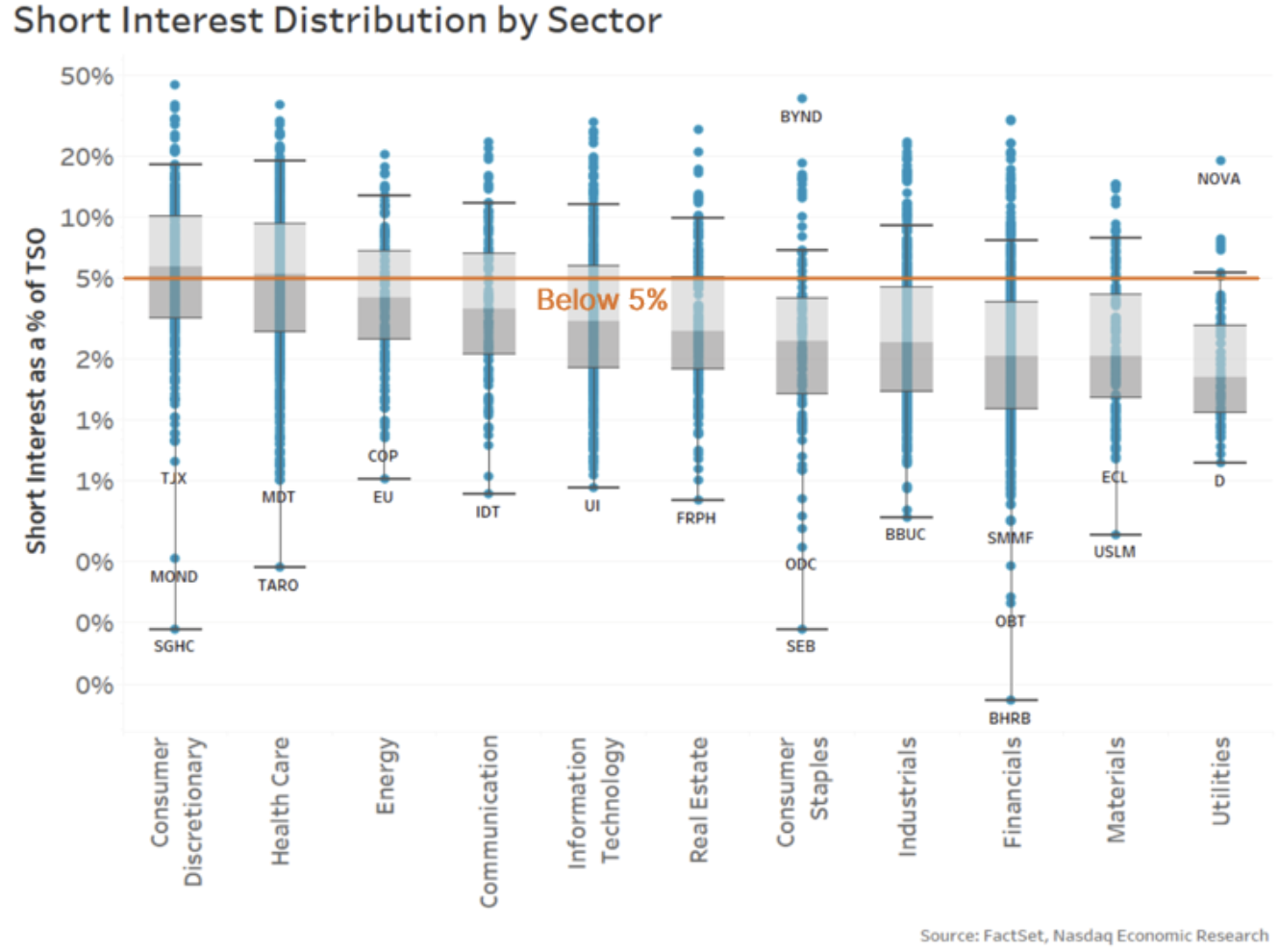
First, we saw that despite a very high proportion of trades having a “short sell” flag on them, the actual levels of short interest (or holdings) in the market tend to be much lower and stable. As the chart below shows, most stocks have 5% or less of their shares outstanding held short. That confirms that most short selling is done by “bona-fide market makers” who are required to sell and buy all day (to qualify as a market maker) and not adding to directional positions. 

We also cited rules that require stock to be borrowed before settlement. That’s so buyers can receive the stock they bought from a “short” seller – as without that, the trade would “fail.” And data shows that failing trades are relatively rare, and most fails are for exceptionally small (most likely retail) trades. 

Chart 9: Most stocks have below 5% of their shares outstanding shorted 

Most stocks have below 5% of their shares outstanding shorted

It’s also important to note that research consistently shows that short selling makes markets more efficient. It allows for hedging and cross-market arbitrage to occur, which helps keep Futures and ETF prices correct and stock spreads tight. 

8. What defines a small-cap stock depends on the index provider 

People frequently talk about large-, mid- and small-cap stocks – as if it is clear what companies are included in each group.

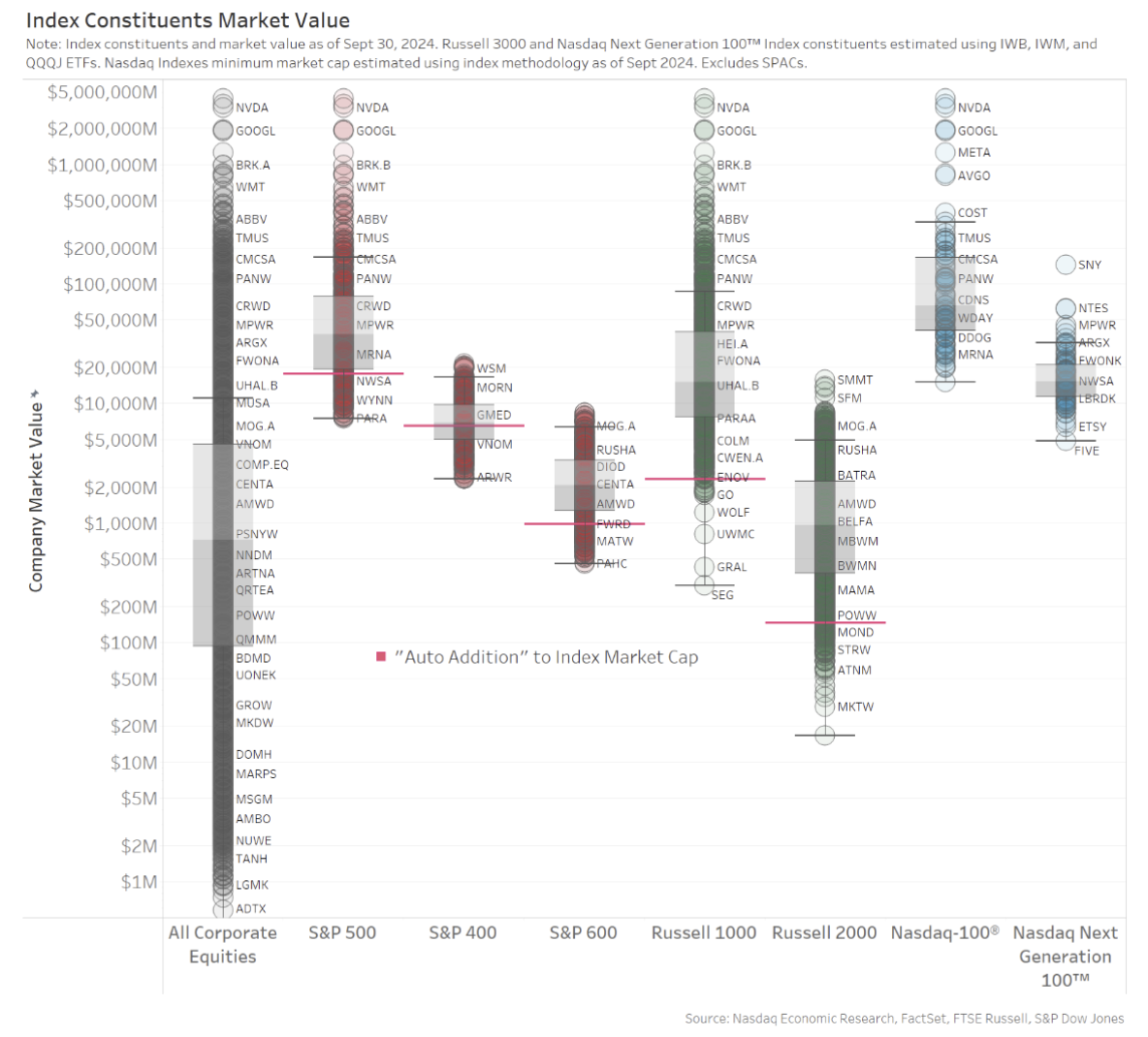
However, our favorite chart from that study shows that it can depend a lot on which index provider you are using.  In fact, the chart below shows that some small-cap stocks are larger than the smallest large-cap stocks. Although to be fair, that’s a result of price changes during the year as well as a conscious decision to reduce index turnover and trading cost for anyone running an index fund.

Chart 8: Stocks included in different market cap indexes by index provider 

Stocks included in different market cap indexes by index provider

7. Looking at index trades to estimate index tracking 

Index funds and ETFs are getting more and more popular

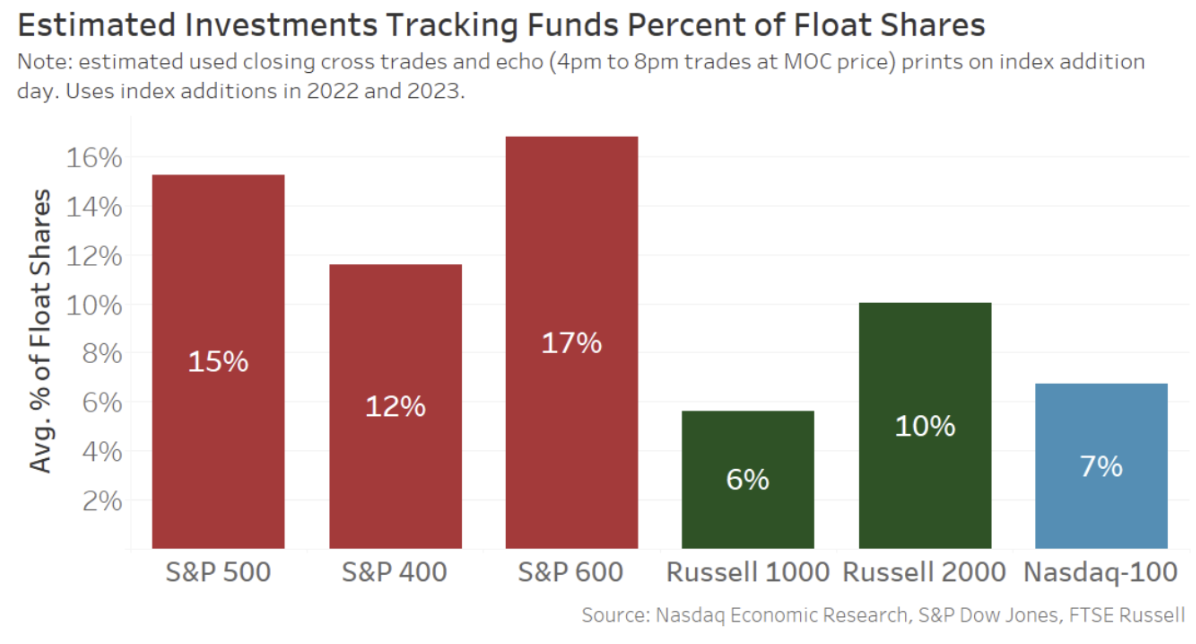
In another study, we looked at how much of a company’s available shares trade in the close on an index addition date.

The results were revealing, showing that the market can provide a huge amount of liquidity instantly as the market closes in order to satisfy indexer demand. That’s even more impressive given recent research shows the cost of that liquidity has been falling even as index funds continued to grow.

Chart 7: The MOC is able to absorb huge amounts of liquidity on index rebalance dates 

The MOC is able to absorb huge amounts of liquidity on index rebalance dates

6. Is the U.S. really the most liquid market in the world?

People frequently boast about how the U.S. is the cheapest, most liquid equity market to trade in the world. 

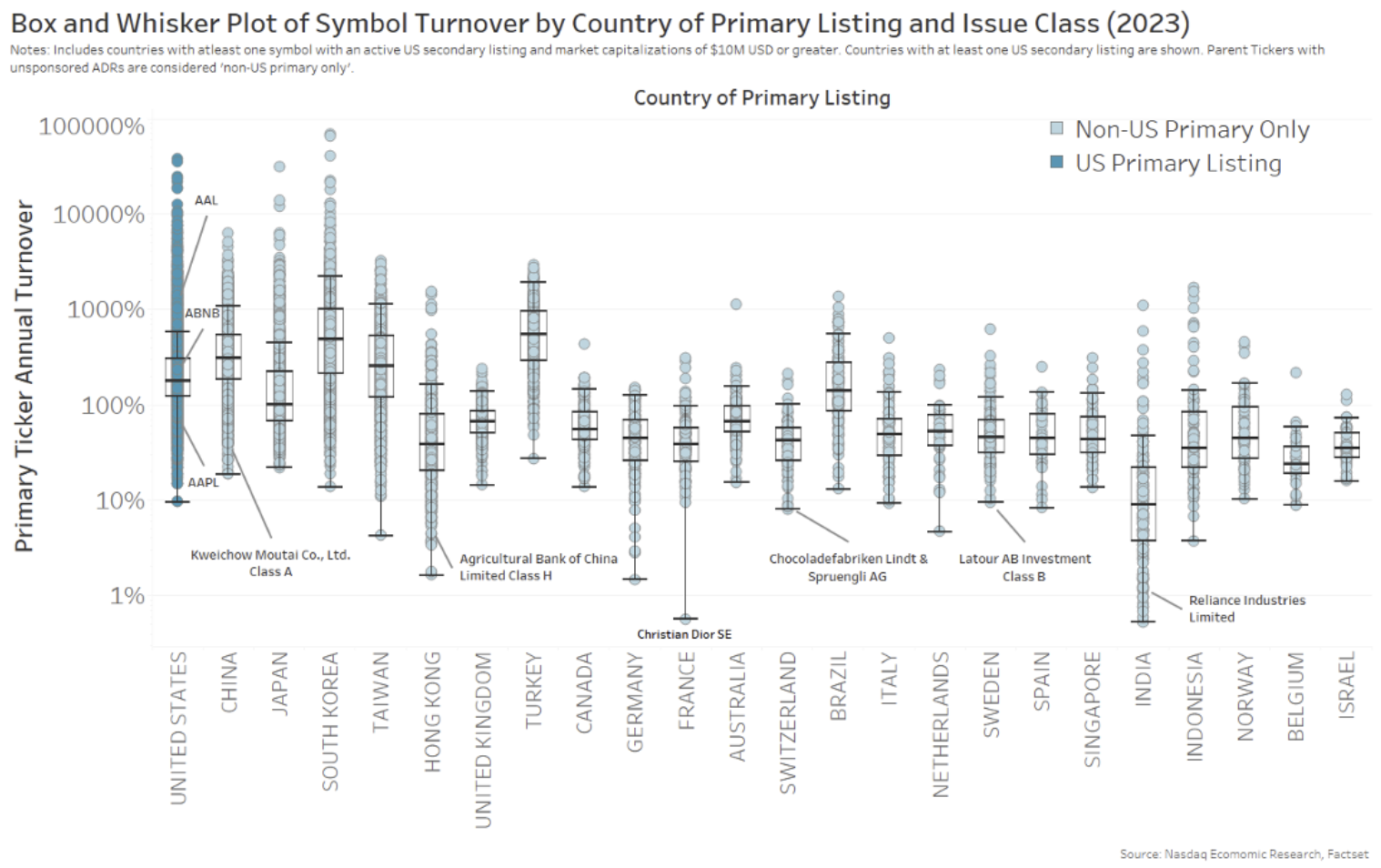
However, with roughly 6,000 companies listed in the U.S. versus less than 900 companies listed in France, is it even fair to compare trading in Apple to Total? 

It’s fairer if we compute the “market-cap turnover” of each company, which is measured as the times the total available shares trade each year. That accounts for different share prices and market caps around the world. 

The result (as we show in the chart below) was revealing. U.S. liquidity was good, but not the greatest. Notably, liquidity in a number of Asian countries – with generally strong retail markets – was, on average, even better. Although, as another chart in that study showed, Asia’s larger developed markets dragged the average for the whole region down below that of the U.S.

Chart 6: Annual market-cap turnover for each stock (by country)

Annual market-cap turnover for each stock (by country)

5. Exchanges fees work very differently to ATS’s

The U.S. Securities and Exchange Commission (SEC) was extremely busy in 2024, finalizing a multitude of new rules. A few targeted exchanges and their fee structures, including reducing access fees and eliminating volume discounts for lcustomers who trade and quote a lot. 

These rules only affected how exchange fees work, which was ironic, given that 2024 was also the year that off-exchange trading passed the 50% mark (more than once). That’s especially important as it’s a level considered a tipping point critical to market quality and having an NBBO that is meaningful to the market and actually protects investors. 

In short, by focusing on exchange fees, the SEC missed the increasingly competitive economics of the “other half” of the market.

We have said before that equal is not fair. That’s something that seems undeniably clear when you look at rates charged for the SIP (which include volume discounts) and how the SEC recoups its annual budget (which varies over time).

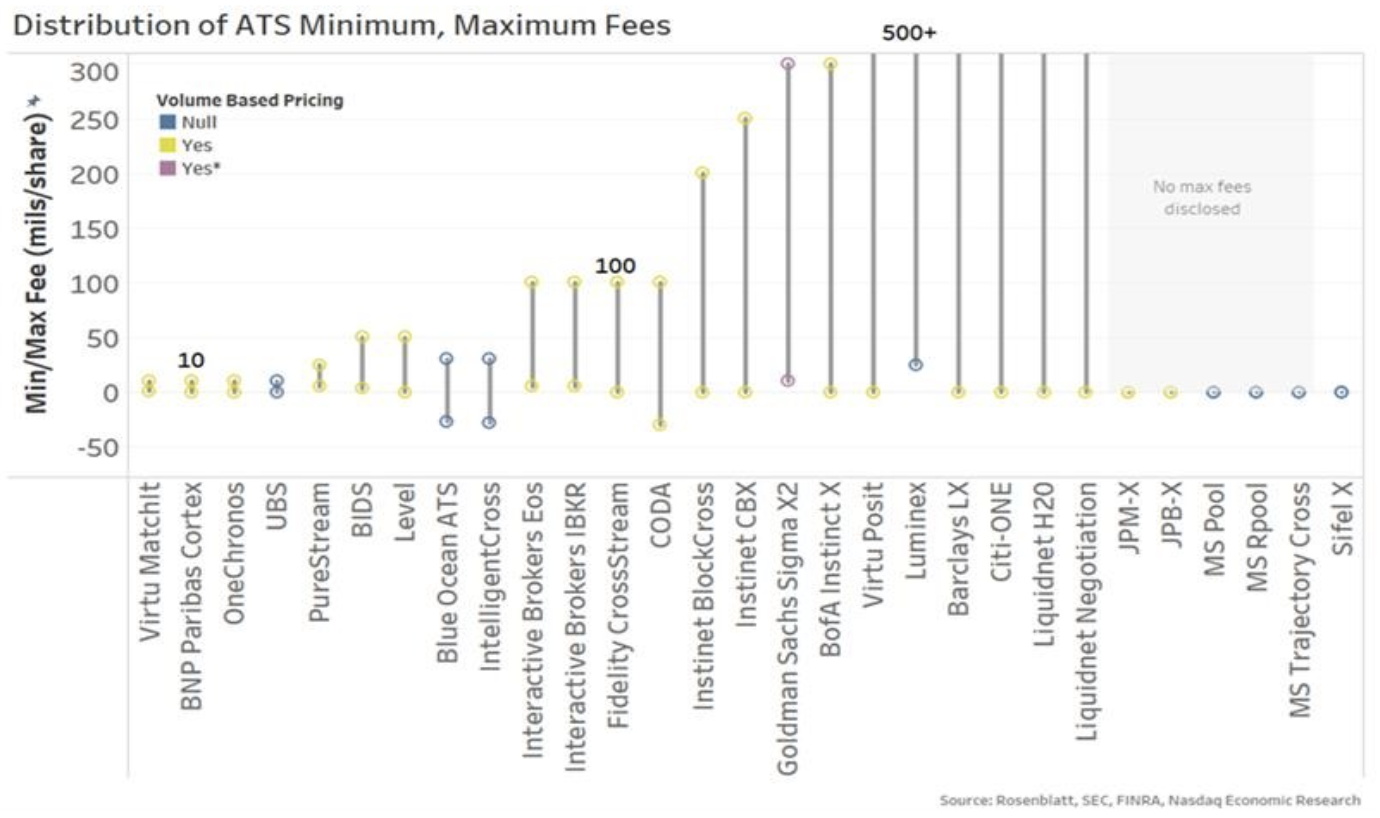
The economics of the “other half” of the market is very different. Rather than being fair access and equal (like the SEC wants for exchanges), it is bilateral and bundled, with customer quality tiers and segmentation that adds to spread capture (allowing fees to be higher). In fact, as the chart below from this blog highlighted, ATSs charge a wide range of fees – from “free” to much higher than the current exchange fee cap. 

Either way, “ten” is clearly not the norm, nor could it be said that other fees in the marketplace are “equal”.

Chart 5: Form ATS-N shows just how complicated market pricing is across (even off-exchange) venues

Form ATS-N shows just how complicated market pricing is across (even off-exchange) venues

4. One millisecond is only de minimis to a human

Years ago, the SEC created a new “de minimis” rule designed solely to approve IEX’s speed bump market (the same year they denied Cboe their own speed bump proposal, which was only fractionally slower). The SEC has since leaned on that rule to approve IEX’s D-limit (fade-able but protected) lit quotes. Ironically, the U.S. regulator declined to use it for determining an acceptable level of latency for the SIP.

All of that history is relevant to a study of trading latency we did in 2024. 

What we discussed in that blog was how, even at the speed of light, it takes time for a trade to travel around the U.S. marketplace for fills, which happen in real-time, fractions of a second apart, causing reverberations across the market. 

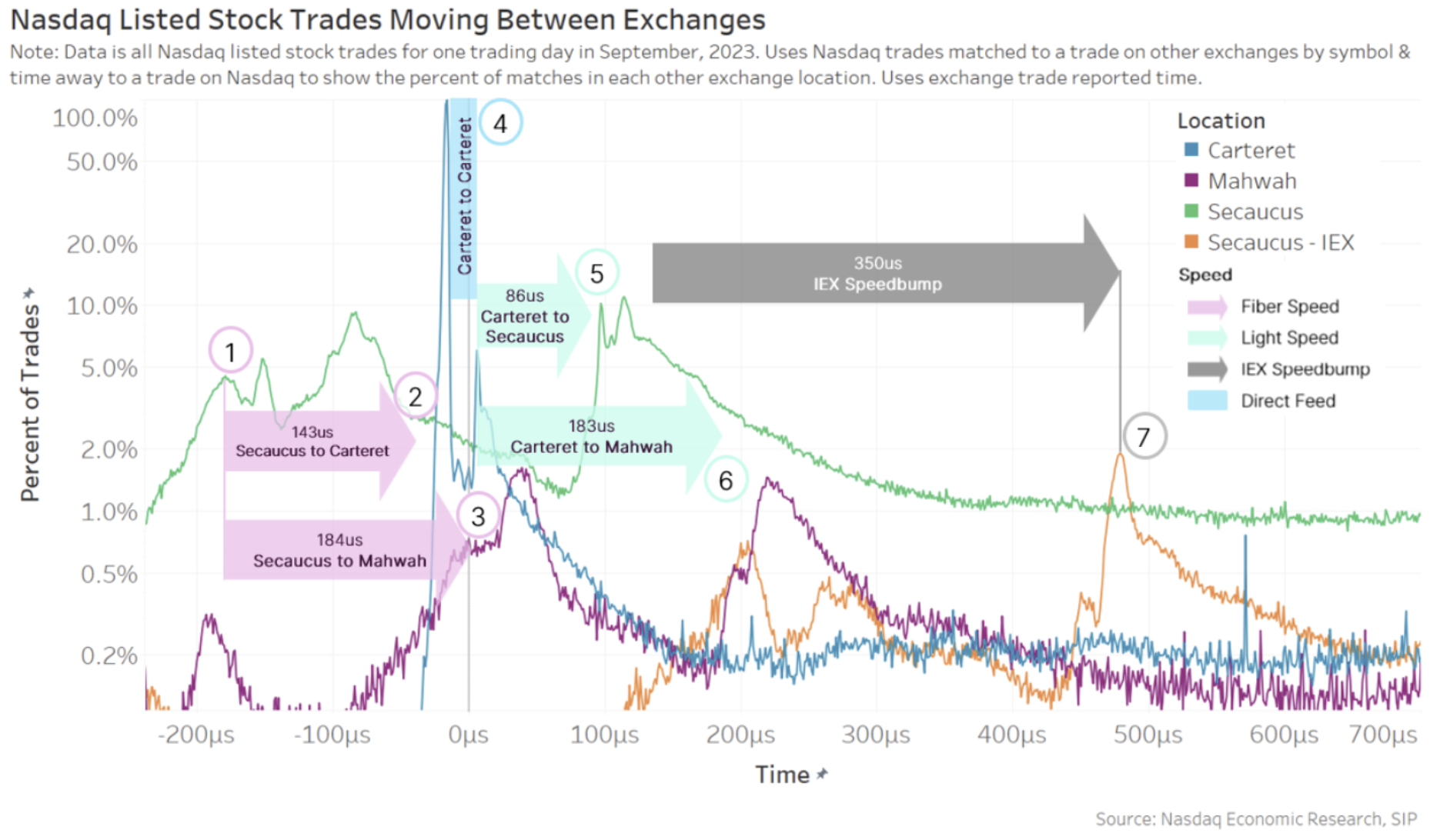
In fact, what our favorite chart from that blog showed, using microsecond timestamps (one-thousandth of a millisecond) is that we can see a lot of trades in the U.S. market initiate from Secaucus, where most broker algorithms are located. Initially, the orders from those algorithms travel at fiber speed around the U.S. market (pink arrows), then, as fills are seen at each venue, a reaction seems to occur at microwave speeds (green arrows) before finally passing through the IEX speed bump and trading there last, if any of their quotes have not, by then, been repriced.

Even with the IEX speed bump delaying trades occurring on their venue, from start to finish, this all happens in less than 1 millisecond.

Chart 4: Trades travel around the U.S. market and cause reactions that last less than one millisecond

Trades travel around the U.S. market and cause reactions that last less than one millisecond

3. Latency arbitrage detected in London dark pools

What we talk about in Chart 4 above is what leads people to talk about latency arbitrage. A new academic study showed how this can work in practice in dark pools in the United Kingdom.

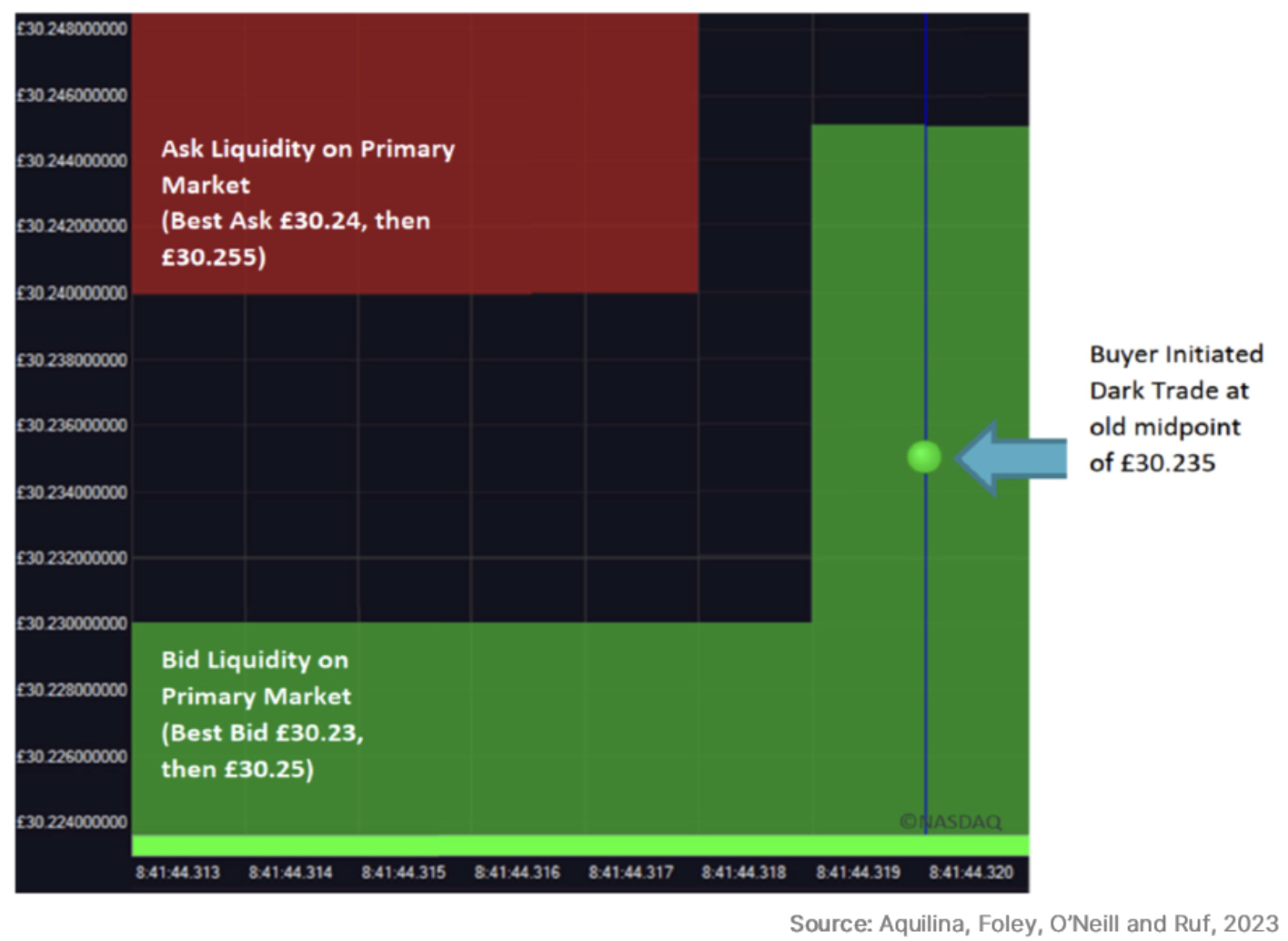
Dark pools, by design, peg orders to the quotes set by exchanges. The chart from that blog that most clearly showed what they found is below. It shows:

  • The bid on exchange increasing (green color).
  • Before a fill occurs in a dark pool at the “old midpoint.” 

This is possible because “fast” arbitrageurs can send a trade on microwave, while quotes travel on optic fiber (which has a slower speed of light but is more reliable).  

The study found that “a substantial amount of stale trading occurs [in dark pools].” They also found that arbitrageurs were on the winning side of the trade more than 96% of the time – buying at the stale midpoint while selling at the primary markets at a newer, higher price.

Chart 3: Dark fills occurring at old midpoints thanks to distance-created latency

Dark fills occurring at old midpoints thanks to distance-created latency

It has since been replicated across Europe, with research from Euronext, SIX Swiss and Deutsche Börse finding similar results.

This study has important implications for the consolidated tape debates occurring in Europe and elsewhere. 

As we’ve said before, all prices are delayed, and a consolidated tape will always be (even) slower. That’s why even our competitors say a consolidated tape should never be used for trading.

Said another way, a consolidated tape can never be pre-trade (it’s just physics). However, it could be used to quantify how much trading is occurring at these stale quotes. 

This has market structure implications, too. The fragmentation reduces the fill probability to dark pool customers (even if a buyer crossed the lit market spread) but also makes spread capture harder on the primary market harder (as spread crossers are mostly more aggressive trades). The result is worse economics for price setters and ultimately wider spreads and less depth.

2. Depth and spreads react to basic economics of supply and demand

Tick sizes have been studied in depth by us and academics. The findings are all pretty consistent, showing that the economics of spreads and depth are driven by simple supply and demand.

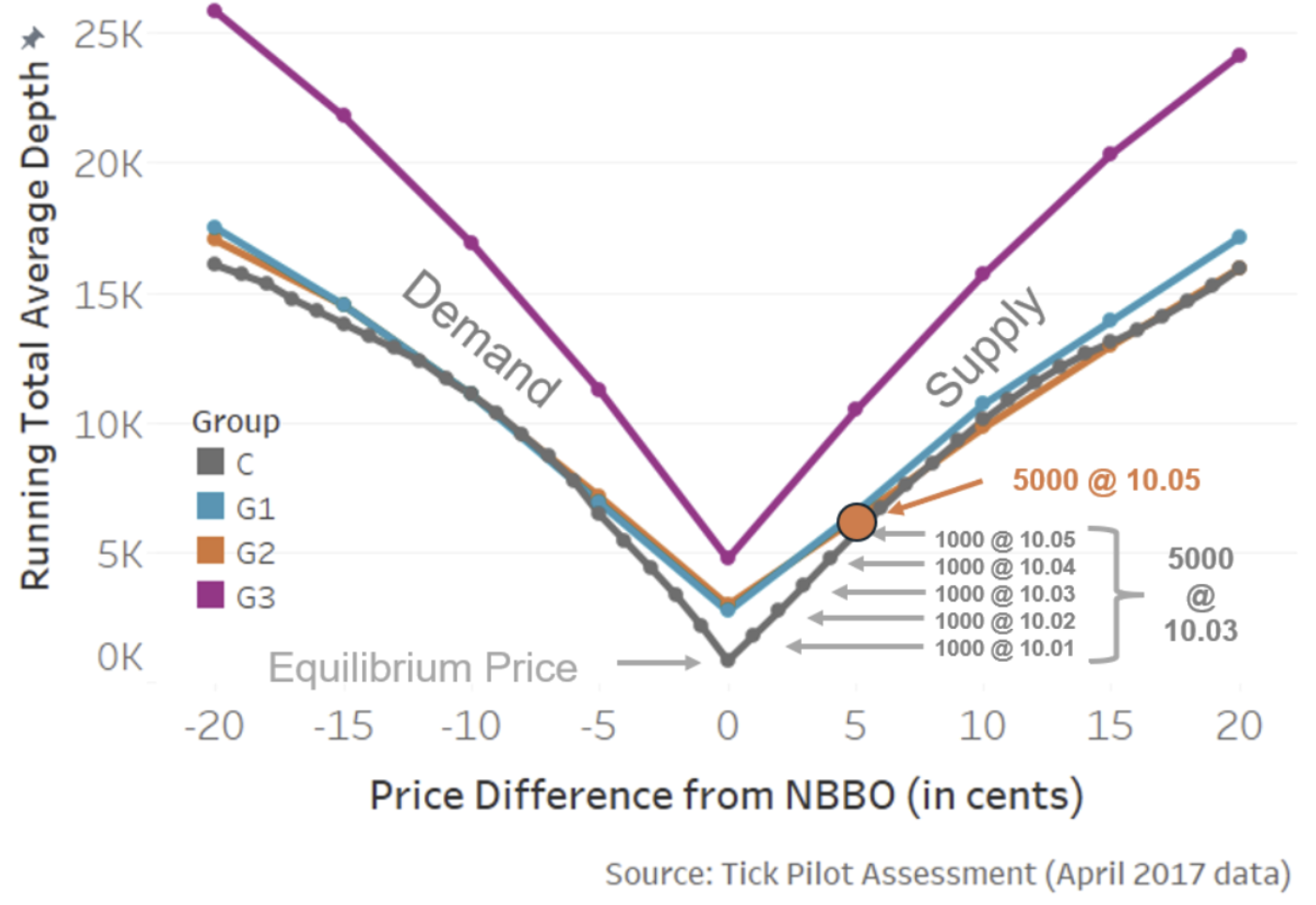
In the blog where we summarized these findings, the most relevant chart is the one below. It shows that: 

  • Supply and demand curves for stocks tend to be quite linear.
  • Reducing the tick (for tick-constrained stocks) helps to reduce not only the spread but also the depth. For investors, spreads and depth are a trade-off.

Based on all the studies, the only result that was able to improve both spreads and depth of the NBBO was the trade-at group in the Tick Pilot study (shown as G3 below). Interestingly, that’s what happens when the price setter gets to capture their own spread – rather than BBO being used to trade elsewhere like we see in chart 3 above.

Chart 2: Research shows improving spreads almost always worsens depth; it’s a trade-off without trade-at

Research shows improving spreads almost always worsens depth; it’s a trade-off without trade-at

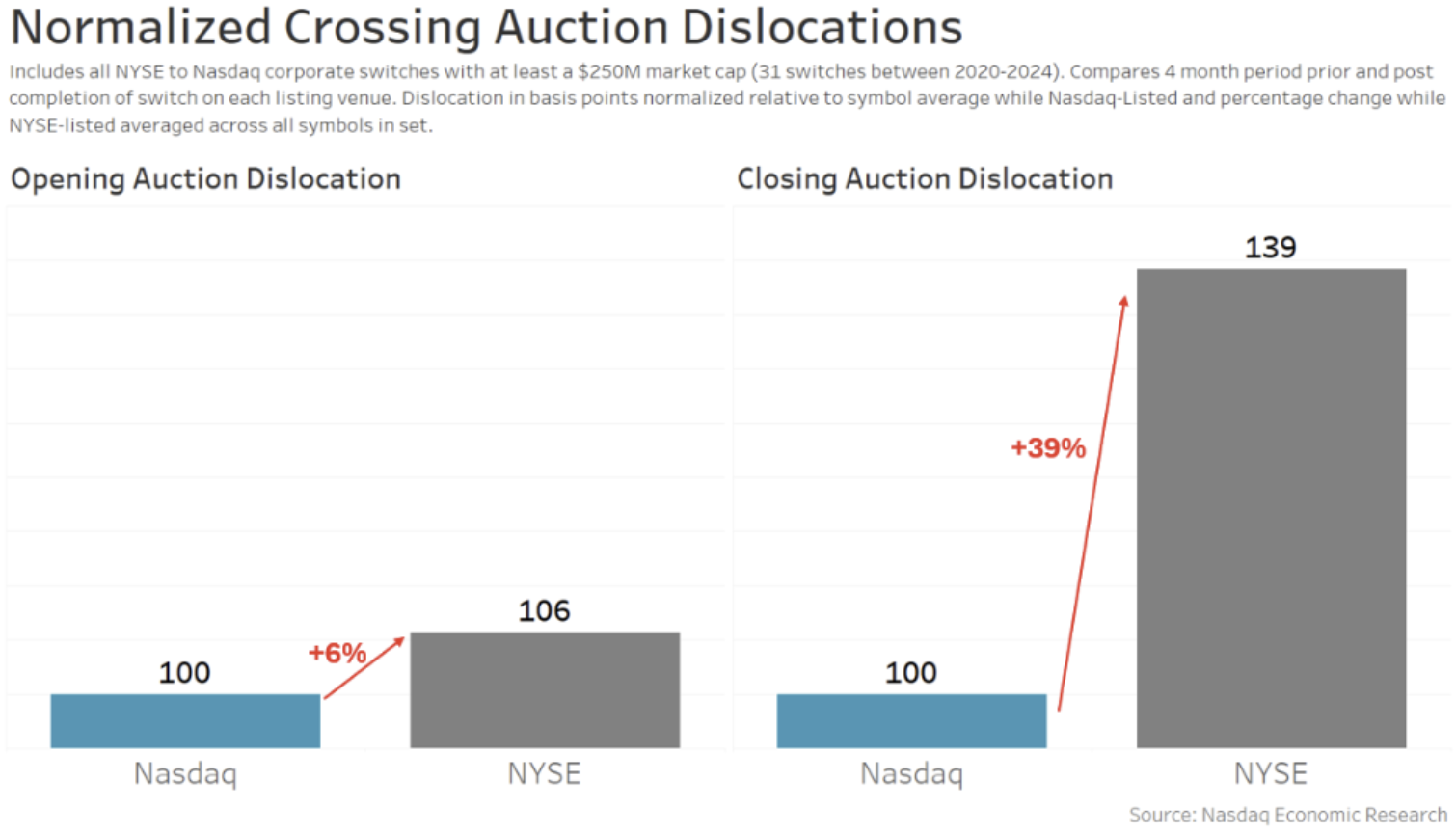
1. Nasdaq has better auctions for issuers 

During 2024, we saw the 500th company switch from NYSE to Nasdaq.

Obviously, we all trade in an NMS world (National Market System) with UTP (unlisted trading privileges) meaning stocks can trade anywhere – regardless of where they are listed. 

But when we look at the data, we see that Nasdaq market quality is still better for companies. 

Our favorite chart from that blog looked at the open and closing auctions. It shows that different auction rules can reduce a stock’s volatility. That’s important because research suggests that it can reduce a company’s cost of capital, which should lead to additional investments and returns for investors. This, in turn, is good for the U.S. economy.

Chart 1: Switches have lower auction volatility on Nasdaq  

Switches have lower auction volatility on Nasdaq

We hope everyone had a happy and healthy holiday season. We’re looking forward to bringing more new and interesting insights throughout 2025.

Creating tomorrow’s markets today. Find out more about Nasdaq’s offerings to drive your business forward here.

Pico, BMLL Partner on Data Integration

Pico and BMLL Forge Groundbreaking Partnership to Offer Enhanced Historical and Real-Time Data Integration Capabilities

Partnership offering clients the ability to integrate BMLL and Pico’s suite of products

NEW YORK, 14 January 2025 – Pico, a leading global provider of mission-critical technology services, software, data and analytics for the financial markets community, and BMLL, a leading independent provider of harmonized Level 3, 2 and 1 historical data and analytics, today announced a strategic partnership designed to uniquely address the growing need for access to real-time and historical data sets simultaneously to accelerate research, understand liquidity dynamics and optimize trading outcomes.

Central to the partnership, Pico’s raw real-time and historical data empowers BMLL’s Level 3, 2, and 1 offerings, enabling clients to gain granularity and actionable insights. In addition, Pico’s globally comprehensive infrastructure, market and broker connectivity, high-performance feed handler, and API for market data and order execution further enhance these capabilities. The combination of Pico and BMLL products and services provides a full-suite solution of historical data, backtesting, and live trading environments tailored for quantitative analysts, banks, and brokers to transition from research stages through to production while optimizing performance and reducing complexity – an unmatched combination in the industry.

This specialized end-to-end solution recently addressed the needs of a large European hedge fund expanding into U.S. equities. By leveraging the combined normalized raw historical and real-time data, it provided increased efficiency in market data functionality, performance, flexibility, and time to market.

Integrating Pico’s solutions with BMLL allows quants and high-performance traders to streamline their workflows with a unified set of technologies as they move through their journey from research to testing and into production,” said Jarrod Yuster, Chairman, Founder and CEO of Pico. “This solution directly addresses the growing demand for comprehensive front-office trading technology, streamlining the entire process with precision and efficiency.”

BMLL offers high-quality historical data derived from raw underlying exchange data; this data is harmonized into a consistent, lossless global format with nanosecond timestamp granularity to provide market participants with better insights and analytics. Clients can leverage BMLL’s granular Level 3 historical data feed alongside Pico’s low-latency real-time solution to seamlessly transition between scalable Level 3 research environments and low-latency production environments.

“We have seen increasing levels of demand for an offering that combines a lower latency real-time environment with high-quality historical data in a consistent data format,” said Paul Humphrey, Chief Executive Officer of BMLL. “This partnership with Pico addresses the very real pain points of many systematic traders who have dedicated far too many resources to migrating data between systems. Now, clients can spend 100% of their time gaining valuable insights rather than on unnecessary data cleansing. We are delighted to partner with Pico to advance this solution for the capital markets.”

Pico’s robust product suite, including 50+ global hosting facilities that provide direct exchange access and cloud connectivity, Redline’s ultra-low latency feed integration, and Corvil’s advanced network monitoring, complements BMLL’s historical data, ensuring seamless transitions from research to live trading environments. Pico and BMLL set a new standard for high-performance data integration capabilities for financial institutions seeking historical insights and real-time market data.


-ends-


About Pico

Pico is a leading global provider of technology services for the financial markets community. Pico’s technology and services power mission-critical systems for global banks, exchanges, electronic trading firms, quantitative hedge funds, and financial technology service providers. Pico provides a best-in-class portfolio of innovative, transparent, low-latency markets solutions coupled with an agile and expert service delivery model. Instant access to financial markets is provided via PicoNet™, a globally comprehensive network platform instrumented natively with Corvil to generate analytics and telemetry. Clients choose Pico when they want the freedom to move fast and create an operational edge in the fast-paced world of financial markets.

To learn more about Pico, please visit https://www.pico.net

About BMLL

BMLL Technologies is the leading, independent provider of harmonised, Level 3, 2, and 1 historical data and analytics to the world’s most sophisticated capital market participants, covering European and US equities and ETFs as well as global futures.

BMLL offers banks, brokers, asset managers, hedge funds, global exchange groups, academic institutions and regulators immediate and flexible access to the most granular Level 3, 2 and 1 T+1 order book data and advanced pre-and post-trade analytics. BMLL gives users the ability to understand market behaviour, accelerate research, optimise trading strategies and generate alpha more predictably.

To learn more about BMLL, please visit https://www.bmlltech.com

Wall Street Faces 200k Job Cuts as AI Transforms Workforce

Global banks are expected to cut up to 200,000 jobs over the next three to five years as Artificial Intelligence (AI) increasingly takes over tasks traditionally performed by human workers, according to a recent report by Bloomberg Intelligence (BI).

Tomasz Noetzel

The report, based on a survey of Chief Information and Technology Officers, reveals that, on average, banks are preparing to reduce 3% of their workforce.

The most vulnerable areas are likely to be back office, middle office, and operations, with customer service roles also at risk due to the rise of AI-powered bots.

Positions involving repetitive, routine tasks, such as know-your-customer (KYC) responsibilities, are also at risk, though Tomasz Noetzel, BI’s senior analyst who authored the report, emphasized that AI will not entirely eliminate these jobs.

Instead, the workforce will undergo a transformation, he said.

Nearly a quarter of the 93 respondents in the survey foresee a more significant reduction in headcount, with cuts ranging from 5% to 10%. This group includes major institutions such as Citigroup, JPMorgan Chase, and Goldman Sachs.

The findings suggest that these changes will reshape the industry and contribute to stronger financial performance. By 2027, banks could see pretax profits rise by 12% to 17%, adding up to $180 billion to their collective bottom line, driven by the productivity gains from AI, according to Bloomberg Intelligence. In fact, 80% of respondents believe generative AI will boost both productivity and revenue by at least 5% within the next three to five years.

Banks, which have spent years upgrading their IT systems to streamline processes and reduce costs in the aftermath of the financial crisis, are now embracing the latest AI technologies to further enhance productivity.

Citigroup’s June report highlighted that the banking sector is likely to experience more job displacement from AI than any other industry, with 54% of roles at risk of AI-led job displacement. Additionally, another 12% of banking jobs could potentially be augmented by AI.

Even though AI may replace certain roles within the industry, Citigroup pointed out that this doesn’t necessarily mean a reduction in overall headcount. Financial firms are expected to hire new positions, such as AI managers and AI-focused compliance officers, to oversee the technology’s implementation and ensure it complies with regulatory standards.

Over the past year, the world’s largest banks have been increasingly experimenting with AI, motivated by the promise of boosting staff productivity and cutting costs. The report suggests that AI could add $170 billion to the banking industry’s revenues by 2028.

JPMorgan CEO Jamie Dimon also discussed the broader impact of AI in a 2023 interview with Bloomberg Television. He expressed his belief that AI will significantly impact the workforce, potentially leading to shorter workweeks for future generations due to its ability to automate tasks and enhance productivity, while also acknowledging concerns about potential misuse of the technology by “bad people.”

Clearwater Analytics to Acquire Enfusion for $1.5 Billion

Clearwater Analytics to Acquire Enfusion for $1.5 Billion Expanding its Investment Management Platform with Front-to-Back Capabilities

Investor Conference Call Scheduled for Today at 8:30 a.m. ET

BOISE, Idaho and CHICAGO, Illinois – January 13, 2025  –  Clearwater Analytics (NYSE: CWAN) (“Clearwater”) and Enfusion, Inc. (NYSE: ENFN) (“Enfusion”) today announced their entry into a definitive merger agreement for Clearwater to acquire Enfusion, a leader in software-as-a-service (SaaS) solutions for the investment management and hedge fund industry. The purchase price is $11.25 per share, delivered in an approximately equal mix of cash and stock. Additionally, Clearwater will pay $30 million to terminate Enfusion’s tax receivable agreement (TRA). This equates to a purchase price of approximately $1.5 billion.

“Today’s announcement is about creating a future where our clients benefit from the synergy of two highly complementary, innovative software leaders, paving the way for a unified, cloud-native front-to-back platform that’s primed to serve institutional investors like never before. We expect to accelerate growth based on our increased right-to-win, higher back-to-base sales, greater presence across key geographies and increased Total Addressable Market (TAM). Coupled with our operating rigor and use of Generative AI, we have high confidence that we can drive meaningfully improved unit economics at Enfusion while also growing its emerging managed services business,” said Sandeep Sahai, CEO of Clearwater Analytics. “Most importantly, this acquisition enables seamless data management from the front office to the back office, unlocking powerful network effects that amplify client value.”

Strategic Rationale

The acquisition of Enfusion accelerates Clearwater’s vision of building the first cloud-native front-to-back platform for the entire investment management industry:

Front-to-Back Platform Leadership: Enfusion’s front-office capabilities—including IBOR, portfolio and order management—will be integrated with Clearwater’s middle and back-office solutions and client reporting capabilities to enable a unified, cloud-native platform that seamlessly integrates with other technologies. This will allow clients to avoid the error-prone data handoff that happens between the front, middle and back office, which in turn creates major reconciliation issues resulting in inefficiencies, inaccuracies and increased risk.

Enhanced Right to Win in Asset Management: Approximately two-thirds of Clearwater’s core TAM comes from the asset management industry, but the company derives only one-third of its revenue from it. Enfusion has developed a next-generation platform for asset managers, starting its innovation in the front office. Clearwater, on a parallel journey, has built a disruptive platform focused on the middle and back office, specifically in data ingestion, aggregation, accounting, compliance, regulatory reporting, and comprehensive client reporting. By combining both sets of solutions and engineering expertise, Clearwater aims to significantly enhance its right to win with asset managers across various segments, geographies, and sizes.

Expanded Capabilities for Clients: With very high levels of client satisfaction, as reflected in Clearwater’s high NPS score, the company has consistently been asked to do more in adjacent segments of its workflow. With this combination, Clearwater’s clients in the insurance, asset management, and asset allocator sectors—including corporations, governments, pensions, endowments, foundations and REITs— will, in due course, benefit from seamlessly integrating Enfusion’s IBOR and its portfolio and order management software with the Clearwater platform. We expect this to accelerate Clearwater’s journey from 1 basis point to 4 basis points (bps) journey and improve net revenue retention.

Increased TAM and Hedge Fund Leadership: The acquisition positions Clearwater to expand into the hedge fund industry. Enfusion has an outstanding track record and wide acceptance as the leading end-to-end platform for hedge funds and more broadly, liquid alternatives. By adding dedicated engineering, product, and client operations teams, Clearwater aims to accelerate growth and drive greater innovation within the industry. This expansion is expected to increase the company’s TAM by $1.9 billion.

Global Growth Opportunities: The international markets make up approximately 50% of Clearwater’s TAM but the company derives less than 18% of its revenue from outside the U.S. Enfusion’s strong international presence, with 38% of its revenue generated in Europe and Asia, is expected to accelerate Clearwater’s global adoption strategy. Having a significantly higher presence across these geographies will strengthen Clearwater’s ability to expand internationally.

Significant Synergy Opportunity: The combination presents significant synergy opportunities across multiple fronts. Clearwater believes it will help accelerate Enfusion’s growth based on the increased right-to-win, back-to-base sales, greater presence across geographies, and increased TAM.

Secondly, Clearwater has built a highly robust execution infrastructure across New Delhi, Edinburgh and Boise that operates effectively and at scale. Over the past few years, Clearwater’s operating rigor and its ability to harness Generative AI has allowed the company to aggressively improve gross margin while improving customer satisfaction. Clearwater expects to bring those skills to Enfusion and has very high confidence of driving meaningfully improved unit economics, while also growing their emerging managed services business.

And thirdly, Clearwater expects considerable efficiencies in general and administrative expenses, yielding about $20 million in cost savings, which we believe will be delivered over the first two and a half years after close. In the Enfusion business specifically, Clearwater expects to deliver 400 bps in Adjusted EBITDA margin expansion in the first year after close and an additional 400 bps in the second year after close.

“This transaction marks an exciting new chapter for all of Enfusion’s key stakeholders. Since our inception, we have proven that the versatility, scale, and depth of our solutions captures the hearts and minds of both traditional and alternative investment managers. Together with Clearwater, our shared passion for building innovative technologies and enriching every aspect of the client journey will now accelerate and enhance our combined ability to support our clients’ evolving needs–whether they are expanding into new strategies, asset classes, or geographies. That commitment will ensure our clients remain on the cutting edge of investment management technology,” said Oleg Movchan, CEO of Enfusion. 

Michael Spellacy, Chair of the Enfusion Board and a member of the Enfusion Special Committee, said, “Our agreement with Clearwater represents the culmination of a comprehensive process to determine the best path to maximizing value for all Enfusion shareholders. Our review of potential strategic alternatives for Enfusion was led by a Special Committee composed of independent directors and advised by independent legal and financial advisors. We are pleased to have reached an agreement that will both deliver significant and immediate value to Enfusion’s shareholders, and, together with Clearwater, provide our shareholders and employees with the opportunity to participate in meaningful potential upside.”

The merger agreement has been unanimously approved by a Special Committee of the Board of Directors of Enfusion, consisting of directors independent of Enfusion’s TRA holders, as well as by the Boards of Directors of both companies. Certain shareholders of Enfusion affiliated with FTV, ICONIQ and Mr. Movchan, collectively holding approximately 45% of Enfusion’s total voting power, have entered into voting and support agreements in favor of the transaction. The transaction is anticipated to close in Q2 of 2025, subject to approval by Enfusion shareholders, the receipt of required regulatory approvals, and customary closing conditions.

“Building on the momentum of our strong Q3 2024 results, we continue to see strong business momentum in Q4, and we are confident in our ability to meet and exceed the guidance provided for the fourth quarter and full year 2024. This outstanding ARR growth allows us to look ahead to 2025 with high confidence. These achievements reflect the durability of our business model and our disciplined approach to growth, which positions us to execute this transformative acquisition effectively. With Enfusion, we are taking a bold step forward, uniting two innovative platforms that will redefine investment management, deliver meaningful efficiencies, and expand our global reach,” said Jim Cox, CFO of Clearwater Analytics.

Enfusion management expects preliminary full year 2024 revenue of approximately $201-202 million, representing 15-16% year on year growth, and preliminary Annual Recurring Revenue (ARR) as of December 31, 2024, of approximately $210-211 million, representing 13-14% year on year growth.

Transaction Details

Under the terms of the merger agreement, Enfusion shareholders will receive consideration equal to $11.25 per share consisting of $5.85 per share in cash and $5.40 per share in Clearwater Class A Common Stock. This represents a 13% premium over the January 10, 2025, closing price of Enfusion Stock and a 32% premium over the undisturbed closing price of Enfusion Stock on September 19, 2024, the last trading day prior to media rumors about a potential sale of Enfusion.

The exchange ratio will be determined at close with reference to a 10% collar around a Clearwater Class A Common Stock price of $27.79. If the volume weighted average price of Clearwater Class A Common Stock for the 10-trading day period ending on the second to last trading day prior to the closing date (the “Final Parent Stock Price”) is below $25.01, then Enfusion shareholders will receive 0.2159 shares of Clearwater Class A Common Stock per share of Enfusion Stock. If the Final Parent Stock Price is above

$30.57, then Enfusion shareholders will receive 0.1766 shares of Clearwater Class A Common Stock per share of Enfusion Class A Common Stock. If the Final Parent Stock Price is greater than or equal to $25.01, but less than or equal to $30.57, then Enfusion shareholders will receive a number of shares of Clearwater Class A Common Stock determined by dividing $5.40 by the Final Parent Stock Price.

Enfusion shareholders will be able to elect to receive the mixed cash/stock consideration described above, or all-cash or all-stock consideration, subject to proration to the extent cash or stock is oversubscribed. Regardless of the mix elected, the value per share will be equalized ahead of closing, such that the value of each election choice will be substantially the same.

Clearwater is expected to pay a total of approximately $760 million in cash and issue between approximately 23 million and 28 million new shares to Enfusion shareholders.

In connection with the transaction, an additional $30 million will be paid to retire Enfusion’s TRA. This payment represents an approximately 78% reduction to the contractual early termination obligation otherwise due under the TRA in connection with a change of control, representing an approximately $105 million benefit to Enfusion’s shareholders.

Clearwater has obtained committed financing to support the transaction, which is expected to be funded, together with cash on hand, with a $800 million Term Loan B to fund the transaction and refinance certain existing debt. Clearwater has also secured commitments for a $200 million revolving line of credit. Gross leverage at closing is expected to be approximately 3.7 times adjusted pro forma EBITDA.

Advisors

J.P. Morgan Securities LLC is serving as financial advisor to Clearwater Analytics. Committed financing for the transaction has been provided by JPMorgan Chase Bank, N.A. Kirkland & Ellis LLP is serving as legal advisor to Clearwater Analytics. Goldman, Sachs & Co. LLC is serving as exclusive financial advisor to Enfusion’s Special Committee. Dechert LLP is serving as legal advisor to Enfusion’s Special Committee, while Goodwin Procter LLP is serving as legal advisor to Enfusion.

Conference Call and Webcast

Clearwater Analytics will host an investor conference call to discuss the transaction on January 13, 2025, at 8:30 a.m. ET. A live webcast of the call will be accessible via Clearwater’s Investor Relations website at investors.clearwateranalytics.com. A replay of the webcast will also be available on Clearwater’s Investor Relations website shortly after the call.

About Clearwater Analytics

Clearwater Analytics (NYSE: CWAN), a global, industry-leading SaaS solution, automates the entire investment lifecycle. With a single instance, multi-tenant architecture, Clearwater offers award-winning investment portfolio planning, performance reporting, data aggregation, reconciliation, accounting, compliance, risk, and order management. Each day, leading insurers, asset managers, corporations, and governments use Clearwater’s trusted data to drive efficient, scalable investing on more than $7.3 trillion in assets spanning traditional and alternative asset types. Additional information about Clearwater can be found at clearwateranalytics.com.

About Enfusion

Enfusion’s investment management software-as-a-service platform removes traditional information boundaries, uniting front-, middle- and back-office teams on one system. Through its software, analytics, and middle/back-office managed services, Enfusion creates enterprise-wide cultures of real-time, data-driven intelligence and collaboration boosting agility and powering growth. Enfusion partners with over 850 investment managers from 9 global offices spanning four continents. For more information, please visit www.enfusion.com.

Enfusion’s ARR

Enfusion calculates Annual Recurring Revenue (ARR) by annualizing platform subscriptions and managed services revenues recognized in the last month of the measurement period. Enfusion believes ARR provides important information about its future revenue potential, its ability to acquire new clients and its ability to maintain and expand its relationship with existing clients. ARR is included in a set of metrics Enfusion calculates monthly to review with management as well as periodically with its board of directors.

Forward-Looking Statements

This press release contains “forward-looking statements” within the meaning of the safe harbor provisions of the Private Securities Litigation Reform Act of 1995. These forward-looking statements are based on the beliefs and assumptions of Clearwater’s and Enfusion’s management and on information currently available to them. Forward-looking statements include information concerning the following factors in reference to Clearwater and/or Enfusion: the timing of the consummation of the acquisition and the ability to satisfy closing conditions, possible or assumed future results of operations, possible or assumed performance, business strategies, technology developments, financing and investment plans, competitive position, industry, economic and regulatory environment, potential growth opportunities and the effects of competition. Forward-looking statements include statements that are not historical facts and can be identified by terms such as “anticipate,” “believe,” “could,” “estimate,” “expect,” “intend,” “aim,” “may,” “plan,” “potential,” “predict,” “project,” “seek,” “should,” “will,” “would” or similar expressions and the negatives of those terms, but are not the exclusive means of identifying such statements.

Forward-looking statements involve known and unknown risks, uncertainties, and other factors, many of which are beyond Clearwater’s and Enfusion’s control, that may cause their actual results, performance, or achievements to be materially different from any future results, performance or achievements expressed or implied by the forward-looking statements. These risks and uncertainties include, but are not limited to, the ability to successfully close the acquisition, Clearwater’s ability to successfully integrate the operations and technology of Enfusion with those of Clearwater, retain and incentivize the employees of Enfusion following the close of the acquisition, retain Enfusion’s clients, repay debt to be incurred in connection with the Enfusion acquisition and meet financial covenants to be imposed in connection with such debt, risks that cost savings, synergies and growth from the acquisition may not be fully realized or may take longer to realize than expected, the finalization and audit of Enfusion’s 2024 fiscal year financial results which could potentially result in changes or adjustments to the preliminary financial results presented herein, as well as other risks and uncertainties discussed under “Risk Factors” in Clearwater’s Annual Report on Form 10-K for the year ended December 31, 2023 filed with the US Securities and Exchange Commission (the “SEC”) on February 29, 2024 and in Enfusion’s Annual Report on Form 10-K for the year ended December 31, 2023 filed with the SEC on March 12, 2024, as well as in other periodic reports filed by Clearwater and Enfusion with the SEC. These filings are available at www.sec.gov and on Clearwater’s website, investors.clearwateranalytics.com, and Enfusion’s website, ir.enfusion.com. Given these uncertainties, you should not place undue reliance on forward-looking statements. Also, forward-looking statements represent management’s beliefs and assumptions only as of the date of this press release and should not be relied upon as representing Clearwater’s or Enfusion’s expectations or beliefs as of any date subsequent to the time they are made. Each of Clearwater and Enfusion does not undertake to and specifically declines any obligation to update any forward-looking statements that may be made from time to time by or on behalf of Clearwater or Enfusion.

Enfusion’s financial results for and as of the year ended December 31, 2024, presented in this press release are preliminary, unaudited, and based on currently available information. Enfusion has provided estimated ranges because financial closing procedures for the quarter are not yet completed and final results may therefore vary from these estimates. These preliminary estimates have not been audited by Enfusion’s independent registered public accounting firm.

No Offer or Solicitation

This press release is not intended to and shall not constitute an offer to buy or sell or the solicitation of an offer to buy or sell any securities, or a solicitation of any vote or approval, nor shall there be any sale of securities in any jurisdiction in which such offer, solicitation or sale would be unlawful prior to registration or qualification under the securities laws of any such jurisdiction. No offer of securities shall be made except by means of a prospectus meeting the requirements of Section 10 of the Securities Act of 1933, as amended (the “Securities Act”).

Additional Information and Where to Find It

In connection with the acquisition, Clearwater will file with the SEC a Registration Statement on Form S-4 (the “Registration Statement”) to register the shares of Clearwater’s common stock to be issued pursuant to the acquisition, which will include a prospectus of Clearwater and a proxy statement of Enfusion (the “proxy statement/prospectus”). Each of Clearwater and Enfusion may also file other documents with the SEC regarding the acquisition. This press release is not a substitute for the Registration Statement, proxy statement/prospectus or any other document which Clearwater or Enfusion may file with the SEC in connection with the acquisition. BEFORE MAKING ANY VOTING DECISION, INVESTORS AND SECURITY HOLDERS ARE URGED TO READ THE REGISTRATION STATEMENT, PROXY STATEMENT/PROSPECTUS AND ANY OTHER RELEVANT DOCUMENTS THAT MAY BE FILED WITH THE SEC, AS WELL AS ANY AMENDMENTS OR SUPPLEMENTS TO THESE DOCUMENTS, CAREFULLY AND IN THEIR ENTIRETY IF AND WHEN THEY BECOME AVAILABLE BECAUSE THEY CONTAIN OR WILL CONTAIN IMPORTANT INFORMATION ABOUT THE TRANSACTION, THE RISKS RELATED THERETO, AND RELATED MATTERS. After the Registration Statement has been declared effective, the definitive proxy statement/prospectus (if and when available) will be mailed to Enfusion’s security holders. Investors and security holders will be able to obtain free copies of the Registration Statement and proxy statement/prospectus, as each may be amended or supplemented from time to time, and other relevant documents filed by Clearwater and Enfusion with the SEC (if and when available) through the website maintained by the SEC at www.sec.gov. Copies of documents filed with the SEC by Clearwater, including the proxy statement/prospectus (when available) will be available free of charge from Clearwater’s website at investors.clearwateranalytics.com/overview. Copies of documents filed with the SEC by Enfusion, including the proxy statement/prospectus (when available) will be available free of charge from Enfusion’s website at ir.enfusion.com.

Participants in the Solicitation

Clearwater, Enfusion and certain of their respective directors and executive officers may be deemed to be participants in the solicitation of proxies in respect of the Transaction. Information about Clearwater’s directors and executive officers is available in Clearwater’s Annual Report on Form 10-K for the year ended December 31, 2023 filed with the SEC on February 29, 2024, its definitive proxy statement for its 2024 annual meeting of stockholders, which was filed with the SEC on April 29, 2024, and in the proxy statement/prospectus (when available). Information about the directors and executive officers of Enfusion is available in its Annual Report on Form 10-K for the year ended December 31, 2023 filed with the SEC on March 12, 2024, its definitive proxy statement for its 2024 annual meeting of stockholders, which was filed with the SEC on April 26, 2024, and in the proxy statement/prospectus (when available). Other information regarding the participants in the solicitations and a description of their direct and indirect interests, by security holdings or otherwise, will be contained in the Registration Statement, the proxy statement/prospectus and other relevant materials to be filed with the SEC regarding the Transaction when they become available. Investors should read the proxy statement/prospectus carefully when it becomes available before making any voting or investment decisions. Copies of the documents filed with the SEC by Clearwater and Enfusion will be available free of charge through the website maintained by the SEC at www.sec.gov. Additionally, copies of documents filed with the SEC by Clearwater, including the proxy statement/prospectus (when available) will be available free of charge from Clearwater’s website at investors.clearwateranalytics.com/overview and copies of documents filed with the SEC by Enfusion, including the proxy statement/prospectus (when available) will be available free of charge from Enfusion’s website at ir.enfusion.com.

Trading Technologies: ‘All Engines Firing’ for 2025

Keith Todd, Trading Technologies
Keith Todd

Trading Technologies, a SaaS provider to the global capital markets industry, has had a busy past few years, with multiple acquisitions, expansion into new markets, and strong organic growth.

Traders Magazine caught up with Trading Technologies CEO Keith Todd to learn more about where the firm stands heading into 2025. 

How would you describe Trading Technologies as the firm stands today?

We’ve described ourselves as a technology platform services provider that aims to become the operating system of the capital markets. But it’s important to look at this question through the eyes of our customers. We’re in the business of facilitating successful and compliant trading. That spans EMS, OMS, algos, surveillance, data, and analytics, all to improve the profitability of trading. So customers engage with us because we help them with successful and compliant trading.

What would you cite as primary recent accomplishments of the firm? 

Over the past three years we’ve established a company with a vibrant, dynamic and an empowered culture. This has allowed us to drive significant growth, and through organic growth and acquisitions, the company has doubled revenue from three years ago. 

If we focus strictly on 2024 accomplishments, it’s easy to alight upon our acquisition of ATEO SAS, which is an important step in the completion of our exchange-traded derivatives offering. But I think the key has been the establishment of the six businesses, six engines on the TT plane, and significantly broadening our offerings to our customers across FX, fixed income, data and analytics, compliance, algos, and obviously futures and options.

How much have acquisitions driven Trading Technologies’ growth, and what is the M&A plan going forward?

In my opinion, the primary responsibility of an executive team in any business is to create an organic growth engine, and Trading Technologies has generated compound organic growth of 17% annually. That’s our primary responsibility. But acquisitions play a material role two ways:  filling functional gaps, and accelerating our growth. We’ve certainly seen the benefit of acquisitions as a complement to the other activities that we’ve been driving.

What are the challenges associated with Trading Technologies being a much larger firm?

It’s a legitimate question, but we first need to cite the law of relativity here, as we’re still a minnow compared to Broadridge, FIS, and some others. 

When one brings new companies into an organization, and when one brings an organization that really only worked in one field – futures and options – into a wider base of capital markets, culture is critically important.  

One mantra we operate by is, “business is a team game.” We are not in silos. We’re all playing the game together. For example, in our fixed income offering, it’s not just about the RFQ engine or the connectivity to the market – it’s also about the hedging of interest rates, the FX, the data analytics, and the surveillance. So it’s really important that one has a clear vision of the company, but it’s also important for the team to be aligned in the way they think and operate. That’s when success comes. 

Personally, I believe that the success we’ve had over the last three years is based on the reinvention of the culture, which was about building on the old TT family culture, and injecting a degree of pace, energy, focus, and ambition. We have a powerful group of 450 empowered, energetic, and knowledgeable employees, and we have delivered great results.

What is Trading Technologies’ 2025 focus?

The headline answer is growth across all our businesses. 

We laid the foundation for our new businesses in 2024. We had to simplify organizational complexity and also help customers understand these new offerings. And now we have one line of business with very significant market share and the other five at the foothills of their opportunity. We are expecting double-digit growth in these businesses, which some are already seeing. 

When I look at 2025, I say with good confidence that we’re going to see record organic growth, because all engines will be firing and operating effectively. 

How would you describe your own role at Trading Technologies? 

I’m well-informed because I’m very connected to what’s going on. I motivate and empower, but I also have very clear guardrails that are about protecting from the downside.

And personally, I can’t remember a time when I’ve had so much fun in the business. 

ON THE MOVE: Northern Trust Names Melanie Pickett; Rostin Behnam to Leave CFTC

Melanie Pickett

Melanie Pickett has been named Head of Asset Servicing, Americas, Northern Trust. Pickett, who has been Head of Asset Owners Americas since 2022, will continue to oversee product and service delivery to asset owner clients, including pensions, foundations, endowments, insurance companies and corporations, and assume responsibility for the business unit’s asset manager clients. She will continue to report to Teresa Parker, President of Asset Servicing. Pickett brings more than 20 years of experience in senior operations and technology roles. She joined Northern Trust in 2017 to spearhead the development of Front Office Solutions, a new business line that focuses on the portfolio management and technology needs of complex asset allocators worldwide. Before joining Northern Trust, she was the Chief Operating Officer at Emory Investment Management.

Rostin Behnam

Rostin Behnam has announced his departure from the U.S. Commodity Futures Trading Commission. He will be stepping down from his position as Chairman on January 20. His last day at the Commission will be Friday, February 7. As Chairman, he led the agency with a focus on identifying, assessing, and addressing risks within our regulated markets. Additionally, he took actions anchored in building consensus – strictly within the bounds of the law, and towards establishing appropriate guardrails to minimize disruption, maintain a level playing field for all stakeholders, and fulfill our mission and purpose. In addition, CFTC announced that Division of Enforcement Director Ian McGinley will depart the agency on January 17. McGinley has served as Director of Enforcement since February 2023. 

Lisa McGeough

HSBC has appointed Lisa McGeough as President and Chief Executive Officer for the United States. She will be joining as Director of HSBC North America Management Board, and as Chair of the HSBC Bank USA Management Board. McGeough joined HSBC in 2021 and has more than 35 years of experience in the banking industry. She most recently served as the Co-Head of Global Banking Coverage, with regional responsibility for Global Banking Europe. Before joining HSBC, McGeough was at Wells Fargo where she served most recently as Executive Vice President and Head of International.

Insight Investment has appointed Raman Srivastava as Chief Executive Officer designate, reporting to Jose Minaya, Global Head of BNY Investments and Wealth. After more than 20 years at Insight, including 17 years as Chief Executive Officer, Abdallah Nauphal has made the decision to retire from Insight in the first half of 2025. Raman brings over 25 years of extensive experience in the investment industry. Most recently, he served as Executive Vice-President and Global Chief Investment Officer at Great-West Lifeco.

The Federal Reserve Board has announced that Michael S. Barr will step down from his position as Federal Reserve Board Vice Chair for Supervision, effective February 28, 2025, or such earlier time as a successor is confirmed. Barr will continue to serve as a member of the Federal Reserve Board of Governors. Barr, who has served as vice chair for supervision since July 19, 2022, submitted his letter of resignation to President Joseph R. Biden.

The Goldman Sachs Group has announced the appointment of Alex Golten as Chief Risk Officer of the firm. He also joined the Management Committee. With over 27 years of experience at Goldman Sachs serving in a number of risk management leadership positions, Golten most recently served as head of Market Risk and Finance Risk. He has also been the firm’s chief credit risk officer, head of Enterprise Risk and co-head of Credit Risk for EMEA. He joined Goldman Sachs in 1997 as an analyst, was named managing director in 2008 and partner in 2014.

If you have a new job or promotion to report, let me know at alyudvig@marketsmedia.com

Sentiment Rose Across Derivatives Markets in Q4 2024

Sentiment across the global derivatives market rose in Q4 2024 as the industry looks to invest ahead of what is expected to be a busy 2025, according to the SGX Global Market Sentiment Index, a barometer of sentiment from across the global derivatives market.

The Sentiment Index is produced by Acuiti and based on a quarterly poll of Acuiti’s Expert Networks, comprising senior, derivatives-focused executives from hedge funds, asset managers, proprietary trading firms and the sell-side. Each quarter, Acuiti surveys Expert Network members on their outlook for the next three months to compile the index.

This quarter, the index rose to 72 from 68 in Q3 2024. This increase was driven by growing optimism among hedge funds, asset managers and sell-side execution desks. However, sentiment among senior executives overseeing sell-side derivatives clearing businesses and senior proprietary trading executives declined slightly on the previous quarter.

“Q4 2024 saw a meaningful increase in sentiment across the derivatives market,” says Will Mitting, founder of Acuiti. “This was driven in part by volatility in the run up to the US election but also by strengthening confidence in Asia as the market recovered.

“Data for this quarter’s report was collected between 23 September and 15 November, meaning that the results of the US election were only reflected in small sample of the data.

“However, we did see an uptick in sentiment after the election as fears over a disputed election did not come to bear. We will see the full impact of the market’s response to the results of the US election in the Q1 2025 Index report.”

Pol de Win, Head of Global Sales & Origination at SGX Group, said: “Derivatives volumes hit record highs last year as global investors managed risk more efficiently in volatile markets. In 2025, investors will chase higher returns, seeking innovative investments and ways to optimise their portfolios.”

The latest SGX Global Market Sentiment Index Report also looks at investment budgets for 2025 and found that all company types included in the survey, with the exception of asset managers, are planning above average investment in 2025.

Proprietary trading firms were the most likely to have significantly higher investment budgets and were targeting investment in improving latency, market data and algorithmic trading.

Sell-side clearing firms were also planning big technology investments with repo clearing functionality the most common area of investment being planned ahead of the introduction of the SEC’s mandate to clear repo and Treasuries from the end of 2025.

Hedge funds were planning investment in market data, connectivity to new exchanges and risk management. Sell-side execution desks were looking to boost risk management, algo offerings and invest in trading screens.

The next SGX Global Market Sentiment Index Report will be released in March 2025.

To download the full report, please visit https://www.acuiti.io/the-sgx-global-market-sentiment-report-q4-2024/

Source: Acuiti

Bridging the Liquidity Divide: A Path to Smarter Options Trading

By Gino Stella, Sales and Trading Manager, TradingBlock

Liquidity is the lifeblood of financial markets, yet its fragmentation across 18 option exchanges presents a daunting challenge for traders, asset managers and hedge funds. Overcoming this fragmentation and integrating efficient liquidity management into everyday trading strategies has never been more critical. In 2024, options and futures contract volumes rose significantly relative to 2023, with total options volume up 10.6% to a record 12.2 billion contracts, according to the Options Clearing Corporation.

Today, the world of trading demands precision and flexibility. Enter customized algorithmic order routing, a powerful solution that allows traders to execute orders with unparalleled efficiency across exchanges. These tailored algorithms are a marked improvement over generic, off-the-shelf tools, empowering traders to design execution strategies for options trades that align precisely with their goals. The results? Optimized trade performance tailored to the trader’s intentions, reduced costs through desired destination targeting, and a greater ability to tackle fragmented liquidity head-on.

Fragmented Liquidity Matters in Options Trading

Imagine trying to purchase a particular stock option, only to find its liquidity scattered across multiple exchanges. This fragmentation increases the risk of failed trades, delayed execution, or inflated costs. For active traders, asset managers, and hedge funds employing sophisticated strategies, such inefficiencies can mean missed opportunities or underperformance relative to benchmarks.

Customizable routing algorithms address this by dynamically scanning for and aggregating liquidity across venues. Traders no longer need to manually route orders or limit their activity to a specific exchange; instead, a single, optimized order can target multiple exchanges simultaneously. This is liquidity efficiency in action – maximizing access to liquidity while reducing execution complexity.

Broker-neutral solutions allow traders to remain agile. Whether it’s integrating new exchanges swiftly, building redundancies to ensure reliability, or tailoring routes for specific conditions – a broker-neutral platform gives traders the tools they need to succeed. This level of customization sets a new standard in the options market, surpassing competitors where such tools are scarce and unattainable through a single executing broker relationship. Overall, customized algorithms can enhance the efficiency of trade execution by optimizing factors such as speed, cost, and likelihood of execution. They can dynamically adjust based on real-time market data.

A Game-Changer for Asset Managers and Hedge Funds

Active asset managers and hedge funds – especially those executing high-frequency strategies – are prime beneficiaries of this innovation. For these institutional players, liquidity fragmentation is not just a technical headache; it can undermine performance and profitability. A routing system that dynamically adjusts to liquidity changes, prioritizes execution speed, and reduces cost is a game-changer.

Take, for example, a fund manager executing large orders. Previously, directing those orders to one or two exchanges might have limited their access to liquidity or driven up market impact. With customized routing algorithms, the order can be dispersed intelligently across multiple exchanges to minimize slippage, optimize fill rates, and reduce fees – the costs associated with trading.

Even for “priority customer traders,” who are often very active and enjoy better pricing and rebates (incentives offered by the exchange for adding or taking liquidity) than professional traders, such systems enable smart decision-making by factoring in each exchange’s specific conditions. Traders can prioritize routes based on fees, rebates, or even venue reliability – enhancing execution quality while maximizing savings. Traders can engage multiple exchanges with just one order, effectively managing order counts.

The Future of Trading

The concept of liquidity efficiency is not new, but its systematic application in the options market is groundbreaking. As liquidity continues to fragment and markets evolve, the ability to adapt via customized routing strategies will separate the leaders from the laggards.

For traders, hedge funds, and asset managers, the message is clear: overcoming liquidity fragmentation through tailored solutions is no longer optional; it is essential. This approach unlocks new possibilities, enabling smarter, faster, and more cost-effective execution. As we usher in this new era of efficiency, one thing is certain: those who embrace liquidity optimization will lead the increasingly volatile markets of tomorrow.

TradingBlock is a member of FINRASIPC. For more information, visit tradingblock.com. Options involve substantial risk and are not suitable for all investors. Please read Characteristics and Risks of Standardized Options prior to trading.

FLASH FRIDAY: 2.5 Stars for Dumb Money 

0

FLASH FRIDAY is a weekly content series looking at the past, present and future of capital markets trading and technology. FLASH FRIDAY is sponsored by Instinet, a Nomura company.

Four years on from the infamous GameStop short squeeze, your friendly neighborhood Traders Magazine editor finally got around to watching Dumb Money over the holidays.

The 2023 biographical comedy-drama chronicled the whole affair through the eyes of ‘Roaring Kitty’, aka individual investor and social media influencer Keith Gill, plus a number of regular folks who made and/or lost vast sums of money on the rise and fall of $GME stock and options in early 2021. 

From the description: “Dumb Money is the ultimate David vs. Goliath tale, based on the insane true story of everyday people who flipped the script on Wall Street and got rich by turning GameStop (yes, the mall videogame store) into the world’s hottest company. In the middle of everything is regular guy Keith Gill (Paul Dano), who starts it all by sinking his life savings into the stock and posting about it. When his social posts start blowing up, so does his life and the lives of everyone following him. As a stock tip becomes a movement, everyone gets rich — until the billionaires fight back, and both sides find their worlds turned upside down.”

Dumb Money was a commercial failure, as Sony Pictures spent $30 million to make the movie and it made only $8 million at the box office, according to ScreenRant.

Critic reviews aggregated by Rotten Tomatoes are a surprisingly high 84% positive, or “Certified Fresh” rating on its Tomatometer. We would have expected a certified-fresh number more in the 60s or thereabouts. But at the same time, most of the positive reviews were only tepidly positive, ScreenRant noted, with few reviewers pounding the table that the movie is a must-see.     

Traders Magazine gives Dumb Money two and a half stars. (That’s based on the late Roger Ebert’s four-star rating system, where two and a half was for films he liked in certain aspects but overall would not recommend.) 

Dumb Money was okay – it had its moments of fun and it was entertaining enough in Hollywood’s schmaltzy, formulaic and predictable way. But overall it was, well, dumb in ways, as the underdog-wins theme was overplayed to the point of being tiresome, and character development was thin. Traders Magazine does not recommend investing one hour and forty five minutes to watch it — the film doesn’t hold a candle to earlier-era business movies such as Wall Street, Glengarry Glen Ross, or even the underrated 1990s drama Boiler Room

One mildly positive Rotten Tomatoes review that resonated read as follows: “There’s something about this story — maybe it’s too simplistic, maybe it’s the fact that the actual events are so recent that the film can’t comment meaningfully on their potential future implications — that makes its populist bent feel contrived.”

Nailed it.