Implied volatilities were mixed across major asset classes last week as hotter-than-expected September CPI and PPI reports revived Fed rate-hike fears and collided with mounting worries about debt-funded AI spending. Despite hotter-than-expected readings in core CPI and headline PPI, interest-rate volatility held steady. The MOVE Index hovered in a tight 99–102 range (92nd–94th percentile) all week, a sign the rates market had already priced in this scenario. The 10-year Treasury yield briefly jumped to 5.33% after the CPI release, then reversed on safe-haven demand to finish the week down 15 bp at 5.10%.
Credit volatility rose last week (VIXHY & VIXIG climbed in tandem from 75th to 86th percentile highs) as investors repriced the debt-funded AI buildout not only for CoreWeave and other high-yield AI firms, but also for investment-grade borrowers such as Oracle and the capex-intensive hyperscalers.
The VIX® Index rose 5 pts w/w to 20, outpacing the move implied by skew by 3.5 pts; driven primarily by demand for downside convexity. The strong demand for downside protection steepened 1M S&P-500 Index 30-delta skew from 15th percentile lows to 82nd percentile highs. The overall demand for optionality accelerated into the weekend: Friday’s SPX and XSP options volume was the 4th- and 5th-highest on record.
Starting today, traders will get an extra 130 minutes per day to trade options on 29 large-cap stocks and ETFs, including SPY, QQQ, IWM, NVDA, TSLA, AAPL,INTC, MU,META, AMZN, AMD, MSFT, GOOGL, and more. For full list, see here. This new session runs from 730AM ET until 925AM, with trading extended an additional 15 minutes at the end of the day for the non-ETF symbols.
Chart: VIX Higher w/w on Demand for Tail Convexity & Core Hedges
CHICAGO, October 19, 2026 – Cboe Global Markets, Inc. (Cboe: CBOE), a leading global markets operator and pioneer in equity and index derivatives, today announced select multi-listed equity and exchange-traded fund (ETF) options are available to trade during extended pre-market and post-market sessions on its Cboe Options Exchange (C1). C1 is currently the only U.S. options exchange offering pre- and post-market index options sessions and is now expanding trading hours for select U.S. equity single-stock and ETF options.
Trading of select single-stock and ETF options is now available during a pre-market session from 7:30 a.m. to 9:25 a.m. ET and a post-market session from 4:00 p.m. to 4:15 p.m. ET, Monday to Friday, covering some of the most actively traded and liquid symbols, including the Magnificent 10 stocks and other widely followed U.S.-listed names plus major ETFs. The full list of underlying symbols is: AAPL, AMD, AMZN, AVGO, BABA, BAC, F, GLD, GOOG, GOOGL, HOOD, INTC, IWM, META, MRVL, MSFT, MU, NFLX, NOK, NVDA, ORCL, PFE, PLTR, QQQ, SNDK, SPY, TSLA, TSM, XLF.
Through September, options on these names accounted for approximately 53% of average daily U.S.-listed options volume in 2026.
Rob Hocking
“Building on our 53-year history of innovation and our expertise in offering expanded hours for our flagship index options, Cboe led this important initiative with extensive input from retail and institutional participants including our U.S. and non-U.S. broker partners, whose insights were critical to a successful launch today,” said Rob Hocking, Global Head of Derivatives at Cboe. “The shift to 24×5 trading across asset classes is only accelerating, and that’s been apparent in the demand for Cboe’s index options during non-traditional hours, particularly leading up to the U.S. market open when economic data and corporate announcements are commonly released. Now, with the addition of extended trading hours for options on single stocks and ETFs, global investors will be able to manage positions and risk with more flexibility in many of the names that drive today’s market.”
Several brokers globally are offering or plan to offer access to the sessions.
Josh Krugman, SVP, brokerage at Fidelity Investments, said: “Options have long been an important tool for Fidelity investors seeking to manage risk and pursue market opportunities. Cboe’s extended trading hours represent a meaningful evolution for the options market, giving investors greater flexibility and choice in how and when they engage with these strategies.”
Milan Galik, Chief Executive Officer of Interactive Brokers, said: “Markets move around the clock, but trading hours for US equity options have remained limited. We welcome Cboe’s initiative to narrow that gap, giving investors around the world more flexibility to trade and manage risk outside regular US market hours.”
Neil McDonald, CEO of Moomoo US, said: “We’re proud to partner with Cboe to offer our customers access to extended trading hours for select equity options from day one. Earnings announcements and economic developments don’t follow the market’s trading schedule. This expansion gives retail investors more flexibility to manage their positions and respond to market-moving news before the opening bell and after the close.”
Abhishek Fatehpuria, VP of Product Management at Robinhood, said: “Many of our customers are early risers who want to catch up on the news and look for market signals before the opening bell. With Cboe’s new extended hours options trading, we’re making it easier for customers to trade on their own schedule, both before or after the bell. This is just another example of our commitment to making Robinhood the best place for active traders.”
Ian Leong, Chief Executive Officer, Tiger Brokers Singapore, said: “For investors in Singapore, the U.S. pre-market falls in our evening, when much of the news that moves U.S. stocks is released. Our clients have long told us they want greater flexibility to manage their positions around these events, and our partnership with Cboe enables us to deliver on that need. Extending access to selected U.S. equity options is another step in our commitment to innovation and giving clients more choice in how they trade, alongside the education and risk controls needed for trading outside regular hours.”
John Bartleman, President and Chief Executive Officer of TradeStation Group, Inc., said: “Cboe’s expansion of options trading hours gives traders greater flexibility to respond to market-moving events as they happen. We believe traders deserve access to the markets when opportunity strikes, which is why TradeStation Securities is making extended-hours options trading available to its clients at launch. Clients will be able to act on their strategies in select options before the open and after the close, using the same integrated tools, education, and support they rely on every day across our trading ecosystem.”
Peter Laptewicz, CPO, Tradier, said: “Markets don’t wait for the opening bell, and neither should our clients. Cboe’s GTH equities options session will give Tradier clients the flexibility to react to market-moving events in real time, rather than having to wait for regular trading hours. We’re proud to support Cboe in expanding access and opportunity for active traders.”
Cboe currently offers near 24×5 trading of several of its proprietary index options in its Global Trading Hours (GTH) (8:15 p.m. ET to 9:25 a.m. ET) and Curb Trading Hours (4:15 p.m. ET to 5:00 p.m. ET) sessions. GTH trading achieved record monthly and quarterly average daily volume in September and the third quarter of 2026.
Cboe’s U.S. equities business currently operates trading from 4 a.m. ET to 8 p.m. ET, Monday through Friday, on two of its exchanges, and plans to launch trading 23 hours a day, 5 days a week on its Cboe BZX Exchange on December 6, subject to industry readiness. Cboe will not open a class of options if the underlying security has not opened and will generally halt an options class if its associated underlying security halts.
Standard Chartered has appointed Ying Ying Tan as Global Head of Securities Services and Global Head of Digital Assets. According to a press release, Tan succeeds Margaret Harwood-Jones who has taken on the role of CEO, UK & Europe at Standard Chartered. Since joining Standard Chartered in 2017, Tan has held a number of senior leadership roles and most recently served as Global Head of Securities Services Product Management and Chief Operating Officer for the business. Prior to joining Standard Chartered, she held several regional and global leadership positions at Deutsche Bank across securities services, product management and transaction banking.
Christopher Smith has joined Morgan Stanley as Vice President, FX Options Trader, according to a LinkedIn post. Smith joins from Societe Generale Corporate and Investment Banking, where he spent three years in FX options trading in London. Most recently, he served as Vice President, FX Options Trader, a position he assumed in February 2026, having previously worked as an FX Options Trader since October 2023. Prior to Societe Generale, Smith spent six years at Credit Suisse.
Evan L. Russo
CRB Group, the parent company of Cross River Bank, has appointed Evan L. Russo as President, according to a press release. He previously served as CEO of Lazard Asset Management and CFO of Lazard and has served as Cross River’s Lead Independent Director since April 2026. Russo will report to Cross River Founder, CEO and Chairman, Gilles Gade, and will continue on the Board of Directors while relinquishing his role as Lead Independent Director. Shimshon Gross, who has served on the Board since Cross River’s inception in 2008, has been appointed Lead Independent Director.
Catherine Grover will join Cboe Global Markets as Executive Vice President and Chief Human Resources Officer (CHRO), effective November 16, 2026. According to a press release, she joins Cboe from PNC Financial Services Group, where she spent more than 29 years in a variety of HR leadership and business roles. Most recently, she was Executive Vice President, Human Resources.
State Street Corporation has elected Alexander Vollert to its Board of Directors, according to a press release. Vollert brings more than two decades of leadership experience across global financial services, with deep expertise in technology, operations, and large-scale transformation. Most recently, Vollert served as Group Chief Operating Officer of AXA and Chief Executive Officer of AXA Group Operations. He previously served as Chief Executive Officer of AXA Germany and held senior leadership roles at Allianz, including Chief Executive Officer of its German property and casualty business.
Rimes has hired Tigran Khrimian as Chief Technology Officer, according to a press release. Before joining Rimes, Khrimian spent over 20 years at FINRA, where he most recently served as Chief Technology Engineering Officer. In that role, he guided technology strategy, engineering modernization and AI-driven transformation across FINRA’s digital and data platforms, while helping establish governance and capability frameworks for responsible generative AI adoption.
If you have a new job or promotion to report, let me know at alyudvig@marketsmedia.com
By Jon Glass, Partner, Financial Crimes Advisory, SolomonEdwards
Jon Glass
As digital assets become further ingrained in the financial mainstream, banks are facing a visibility gap when funds leave traditional payment rails. Many underlying financial crimes are familiar, but digital assets have changed the speed, channels and methods used to move and obscure funds. Clearer regulation alone won’t close this gap in data and oversight.
The core BSA/AML framework still applies. What’s changed is the information available to investigators and the speed and reach of the transactions they assess. The onus is on banks to identify digital-asset exposure, connect customer and payment information with on-chain activity and determine risk ownership in multi-party transactions.
The visibility problem
Traditional AML programs are built around information a bank can see, such as customer profiles, account activity, counterparties, and payment data. A bank may see a wire sent to a digital-asset exchange but have little insight into where the funds move, who interacts with them or what they ultimately become.
Adding rules, lowering thresholds, or generating more alerts doesn’t solve this if the underlying data is still incomplete. Banks need to connect their knowledge of the customer and traditional transactions with blockchain analytics and wallet information. Rather than creating more output from existing monitoring scenarios, establishing this connection gives investigators a fuller view of the activity and something they can act on.
Old risks, new channels
The extent of the visibility gap depends on how a bank interacts with digital assets. Direct exposure is easier to identify because the institution knows it exists and can build controls around it from the outset. Directly offering a digital-asset product allows a bank to establish customer requirements, determine what activity to permit and put controls in place before launch.
Indirect exposure is where challenges arise. Customers might send money to exchanges or transact with companies involved in digital assets even when the bank doesn’t offer those products itself. Those relationships may only be visible through payment and counterparty data. If monitoring only captures the fiat leg of a transaction, the bank misses the broader context of where the funds originated and where they went.
Investigators may encounter funds moving rapidly between fiat and crypto, transactions spanning multiple exchanges or wallets, and activity involving mixers or other methods of
obscuring transactions. They also need to assess wallet and counterparty risk and identify potential sanctions exposure, scams and fraud. These risks can overlap, with the same activity raising AML, fraud and sanctions concerns while the relevant data and investigators sit in different parts of the bank.
The existing AML processes still apply, but investigators need monitoring designed to recognize digital-asset indicators and provide them with the information needed to track the activity. A bank can’t assess or control exposure that hasn’t been identified. So while regulatory clarity may define which rules apply to which businesses, it doesn’t remove that responsibility from financial institutions.
What regulatory clarity does and doesn’t change
Clearer rules can help banks answer three practical questions: which regulator oversees an activity, which digital-asset businesses are covered by the BSA and what information needs to accompany a digital-asset transfer. Those answers help institutions understand exchange and custodian obligations, determine what regulatory history to examine, and establish what information to make available for monitoring.
However, clearer rules don’t necessarily diminish financial-crime risk. A license or registration might show which requirements apply to a company, but it doesn’t demonstrate that its AML controls remain effective. Banks still need to perform their own due diligence and determine whether a counterparty’s controls are appropriate for the risk.
The good news is that despite ongoing regulatory uncertainty, much of this work doesn’t require a finalized legislative framework. Banks can still identify their digital-asset exposure, determine whether their risk assessments cover it, address data gaps, and train investigators to recognize and escalate relevant activity. Regulatory developments might change which requirements apply, but they don’t remove the current need for effective controls.
Closing the gap is organizational
I worked with a bank that believed its digital-asset exposure was minimal because it didn’t offer crypto products. Upon closer look, the payment data told a different story, showing regular volume moving to and from exchanges and crypto fintechs. The activity was monitored, but the bank hadn’t examined it in a way that fully captured its exposure.
Closing that gap takes more than adding blockchain analytics. A blockchain analytics team might see wallet activity with no access to a customer’s banking history, while an investigator might see that history without visibility into the chain. Customer, payment, counterparty, and on-chain information need to reach the same investigator in the same case file.
Institutions also need answers when a digital-asset indicator appears. Many of the programs I see implement the tools without deciding what happens next. Would an investigator recognize the activity and know how to follow it? Could the bank create a list of customers and counterparties with digital-asset exposure? Do its risk models distinguish between different businesses like a stablecoin processor or a retail exchange?
Then comes the ownership question. Risks may be split across AML, fraud, sanctions, cyber and the business line, but someone needs to be responsible for the whole picture. Banks don’t need to wait for the regulatory framework to be finalized. They can identify their exposure now, understand what investigators can and can’t see, address the gaps and establish clear ownership of the risk.
Ultimately, effective oversight depends on whether a bank’s data, procedures and accountability enable investigators to recognize and act on suspicious activity.
Statement on the Commission’s Approval of a Proposed Rule Change to Permit the Listing of Binary Options Overlying Key Performance Indicators
Paul S. Atkins, Chairman
The Commission voted to approve a security exchange’s proposed rule change to allow the listing of binary options overlying specified key performance indicators (“KPIs”) reported by certain issuers of stock. I appreciate the Staff’s hard work in developing the approval order.
Paul S. Atkins
As described in the approval order, the binary KPI options would be listed and traded on a securities exchange as cash-settled, European-style, standardized options that are NMS securities subject to the protections afforded by the securities laws. These options would be subject to the rules of a securities exchange and would be listed and traded in a substantially similar manner as existing, standardized, non-binary options that already trade on securities exchanges. These binary KPI options would be subject to securities exchange rules governing customer accounts; margin requirements; trading halt procedures; auction mechanisms; market-maker appointments and quoting obligations; order types; times-in-force; and order instructions. As the approval order states, this context helps to provide core investor protections under the securities laws.
As the order emphasizes, the order speaks solely to the trading of these specific binary options contracts on a securities exchange that lists and trades standardized options on securities in compliance with the securities laws. The order does not address what may be similar products with the same underlying KPIs as the binary options described in the order structured in different ways. The SEC’s approval order does not address—and does not foreclose—CFTC jurisdiction over KPI contracts based on the same underlying KPIs as those contemplated in the approval order structured to fall under the CFTC’s jurisdiction.
For decades, jurisdictional “turf wars” between the SEC and the CFTC have frustrated innovation and left a void of unrealized financial products in their wake. The approval order, however, reflects a new spirit of harmonization, innovation, and investor choice, removing unnecessary obstacles to the lawful introduction of novel financial instruments within our markets.
Nasdaq (Nasdaq: NDAQ) has announced the completion of its acquisition of LeveL Markets, LLC, a leading off-exchange equity execution venue and operator of one of the largest Alternative Trading Systems (ATSs) in the United States. This acquisition marks a key milestone in Nasdaq’s strategy to advance always-on markets infrastructure, as investors increasingly expect seamless access to market services across venues and asset classes.
Roland Chai, Nasdaq
LeveL Markets provides institutional investors with a scaled, deeply connected execution platform that processes hundreds of millions of shares each day across more than 7,000 symbols. The venue reaches more than 2,500 clients through more than 15 order and execution management system integrations, and its average daily volume grew 56 percent year-over-year in 2025 — making it the third-largest ATS in the United States by trading volume.
“We are pleased to welcome LeveL Markets’ clients to Nasdaq and look forward to supporting a seamless transition,” said Roland Chai, Head of Nasdaq’s Digital Liquidity Networks. “LeveL Markets advances our vision for more connected, always-on markets by adding a scaled off-exchange liquidity platform and execution expertise to Nasdaq’s technology, market capabilities, and client relationships. We will continue to develop LeveL Markets’ strong platform and client communities to drive long-term growth and innovation.”
LeveL Markets will continue to operate as a registered ATS subject to FINRA oversight, with its own dedicated management team under Nasdaq’s Digital Liquidity Networks organization. Nasdaq intends to operate LeveL Markets with the strong execution quality clients expect, while investing in LeveL Markets’ technology and capabilities to accelerate long-term growth.
Nasdaq first acquired a minority stake in LeveL Markets in August 2021, as part of a broader always-on strategy, to establish a presence in off-exchange equities and to build an overall capability in alternative market structures.
Options, retail and buy side are among perennials. Prediction markets is decidedly a newcomer, but from what was said on the Thursday morning panel, it will become a perennial.
The STA panel, entitled Regulating the Future: Prediction Markets in a Modern Market Structure featured speakers from Robinhood, DraftKings, and Kalshi.
A backdrop was presented at the outset: prediction markets sit at the intersection of finance, technology, and how people ingest and process information. The premise of prediction markets is that everyone has a prediction, and markets enable prices to be put on that prediction. As for trends, prediction markets volume has scaled rapidly and platforms are innovating with new products, but institutional adoption remains elusive.
Prediction markets can be dismissed for their perceived connection to sports betting, but that perception is misplaced, according to platform operators. Some products on prediction markets are based on sports, but otherwise there is no direct intersection with sports betting, which has a single-dealer market structure entirely different from that of prediction markets.
Prediction markets are likened to sports betting because of their speculative element, but it was noted that speculation is considered healthy and necessary in financial markets, and financial products such as insurance, credit default swaps and some options contracts also have binary payouts.
Retail demand has driven the growth of prediction markets so far, as the nascent markets meet the demand for always-on trading in a wide variety of categories. The STA panel noted that institutions already have the ability to hedge and speculate in a bespoke way through their sell-side banks, and prediction markets’ liquidity, product standardization, and margin capacity aren’t up to institutional standards yet.
It was said that many institutions are interested in prediction markets, but they are waiting for others to get involved first. Once that happens and there are more safeguards and education, market operators say liquidity will beget liquidity and prediction markets will grow more rapidly.
To the question of what the next one to three years holds in store for prediction markets, it was said that sports will grow as an absolute number, but will be a lower percentage of overall prediction markets volume. There will be more product development, legal durability, and international expansion, and progress will be made toward institutional participation.
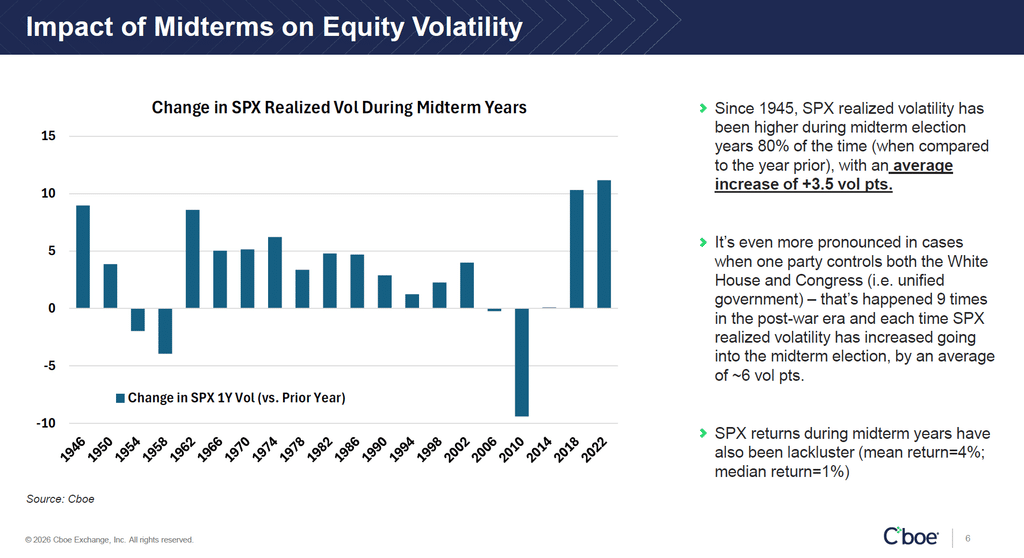
The upcoming midterm elections in the US are being closely watched for potentially consequential political implications, but their impact on financial markets is shaping up as muted.
That’s because the broad vote expectation – Democrats winning the House of Representatives and possibly the Senate, with a Republican White House – is for a divided government, which would make expansive new laws, sweeping tax overhauls, or major legislative shifts unlikely for 2027 and 2028.
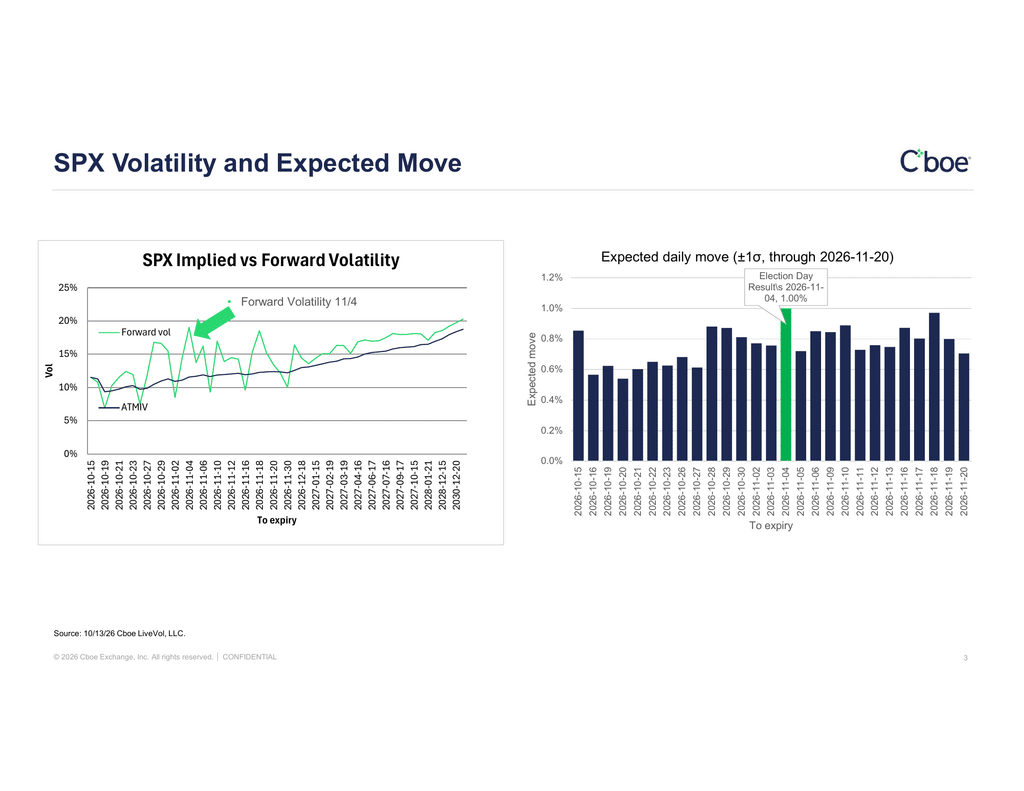
Forward volatility is expected to increase slightly more than 1% on Wednesday, November 4, the day after Election Day, according to Cboe Global Markets data, compared with the historical average closer to 4%. The next-day increase after presidential elections averages about 7%.
“The ultimate conclusion is that we’re going to see gridlock,” said Ed Tom, Senior Director of Derivatives Market Intelligence at Cboe. “That’s why markets aren’t pricing in much of a change for the midterms.”
State Street Investment Management previewed market reaction to the midterms in a recent research note. “While voters loathe gridlock, capital markets often prefer it,” the note stated. “Fewer legislative surprises can allow fundamentals, rather than politics, to play a larger role in driving returns.”
Equity investors have climbed a “wall of worry” in 2026, staying resilient through tariffs, Fed independence, war with Iran, oil prices, inflation, rising bond yields, and AI skepticism. Looking ahead to 2027, “the year after the election has historically delivered strong returns,” State Street noted. “The S&P 500 has not declined in the 12 months following a midterm election since 1930.”
The Cboe Volatility Index has illustrated the market’s resilience in 2026. The VIX, a leading barometer of investor sentiment and market volatility, increased in March and April to briefly top 30 but has otherwise mostly fluctuated between 15 and 20.
The VIX has increased this week amid renewed concern about the AI trade, retesting market resolve. But so far this year, “When faced with a 1.5 percent one-day market decline, VIX traders have been basically buying the dip — they buy upside calls and sell downside puts,” Tom said. That is the sign of a resilient market.”
(The VOL REPORT is a Traders Magazine – Cboe Global Markets content collaboration that covers volatility and its implications for market participants and operators.)
Laurence Fink, chairman and chief executive of BlackRock, said the need to create a new financing vehicle for compute is imperative for the U.S. to build out to the necessary scale.
Fink said on the third quarter results call on 14 October 2026 that the asset manager has long-standing relationships with hyperscalers – large-scale cloud providers or data center operators – sovereign wealth funds, pension funds and corporate clients which underpin some of the largest financing engagements in the market.
BlackRock has a strategy built around an integrated public and private market platform, underpinned by Aladdin, its investment technology platform. Fink highlighted that this is the first time that BlackRock has been operating for a full year with Preqin, a private markets data provider, Global Infrastructure Partners (GIP), and private credit manager HPS Investment Partners.
Source: BlackRock
The acquisition of Preqin was completed in March 2025 to serve clients’ whole portfolios across public and private markets by combining investment, technology, and data solutions in one platform. BlackRock completed its acquisition of GIP in 2024 and of HPS on 1 July 2025.
“This quarter is the clearest view yet of the earnings power of our integrated platform,” said Fink.
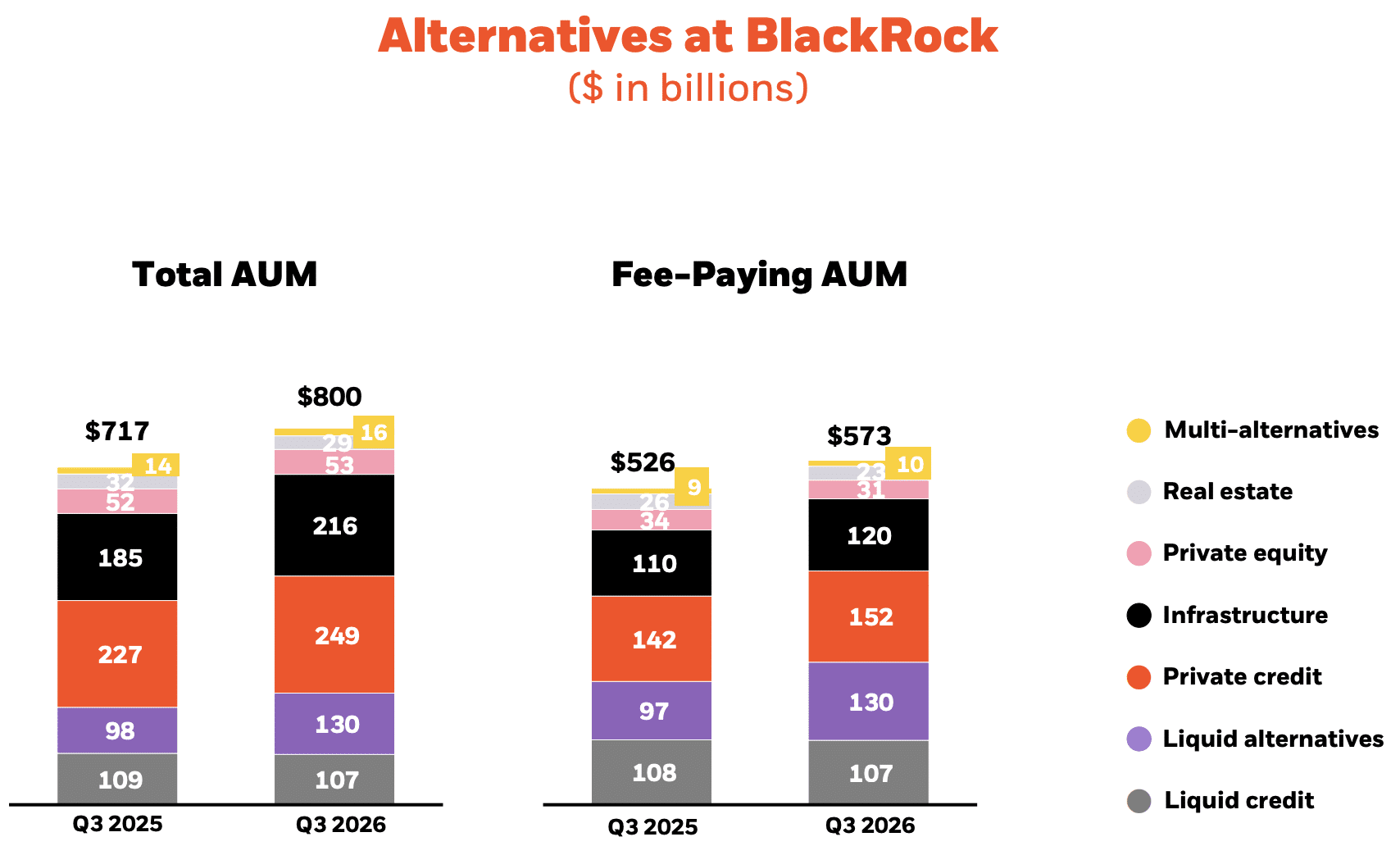
Private markets had $15bn of net inflows in the third quarter, mainly from deployment across infrastructure and private credit, and the onboarding of a real estate mandate. BlackRock has raised $68bn in private markets over the last twelve months, and the firm’s AI infrastructure partnership made its first deployment in the third quarter.
The manager raised $25bn in private credit in its first full year with HPS. The firm is seeing strong traction with insurance companies rotating or adding to high-grade solutions, according to Fink.
He said that for the first time in his career of more than 50 years, he is seeing genuine shortages of capital as governments run historically large deficits while needing financing for infrastructure, companies need to fund a “generational” AI buildout, and individuals need better ways to invest and retire.
For example, BlackRock partnered with Meta on financing its planned $14bn data center in Texas, bringing together infrastructure investments from GIP and private financing capabilities from HPS.
“We are also working alongside leading technology companies to create dedicated pools of financing for their customers to expand compute capabilities and capacity in the near term,” added Fink. “These can supply private placements into high-grade insurance mandates, but over time, there’s an even larger opportunity to securitize them into tradable structures for a much broader set of clients.”
In the early 1980s Fink and Rob Kapito, president of BlackRock, were at the beginning of the mortgage-backed securities (MBS) market and he expects compute capacity to follow a similar path. Fink highlighted that mortgages only became tradable once data, years of performance history, and an understanding of how performance would move with interest rates and the broader economy became available.
“Once investors had a trusted time series of data, issuers had a standard to build against, and the market opened up for a much bigger group of investors,” he added. “That combination took the MBS market from a few billion dollars when I started to the trillions of dollars it is today.”
He claimed that BlackRock is particularly well positioned to help develop this market because the firm combines capital formation, technology, data and scale. As compute capacity emerges as an asset class the markets will need trusted data, standardized performance metrics, and a common framework for risk analytics. Fink said these are capabilities that BlackRock has been building for decades.
Larry Fink, BlackRock
He expects it will take time to put the data and analytics in place for this new market, amnd for ratings agencies to provide opinions but said compute is a “huge priority.”
“It is a large opportunity for GPU financing for our HPS team,” said Fink. “It is a large opportunity for our GIP team in terms of the building out data centers.”
As private markets become a larger part of client portfolios, the need for transparency, risk management, and portfolio analytics can only increase according to Fink. He said: “That’s a natural extension of Aladdin’s role as an operating system for entire portfolios for investors worldwide.”
Performance fees of $630m in the third quarter increased 22% from a year ago, which BlackRock said primarily reflects higher revenue from alternatives, including $110m of performance fees from HPS.
ETFs
iShares, BlackRock’s ETF franchise, generated $135bn of net inflows in the third quarter. Index bond ETFs led the way with $61bn of net inflows as investors shifted into the long and short end of the curve.
There was also strong demand for AI-linked exposures, said Fink, as the semiconductor and South Korea ETFs were among the products with the highest inflows. Digital asset ETPs raised $8bn in the third quarter.
iShares is leading the industry with $60bn of active ETF inflows in 2026, including a record $22bn in the third quarter, according to Fink. He continued that IShare’s active assets under management have doubled in the last year to more than $160bn. Active ETFs are already tracking ahead of the $500m in added revenue that was set as a target in the 2030 strategy.
Martin Small, chief financial officer at BlackRock, said on the call: “Our ETFs have now delivered a sixth consecutive quarter of double-digit organic base fee growth, powered by higher-value ETF categories such as active and precision.”
Source: BlackRock
Financials
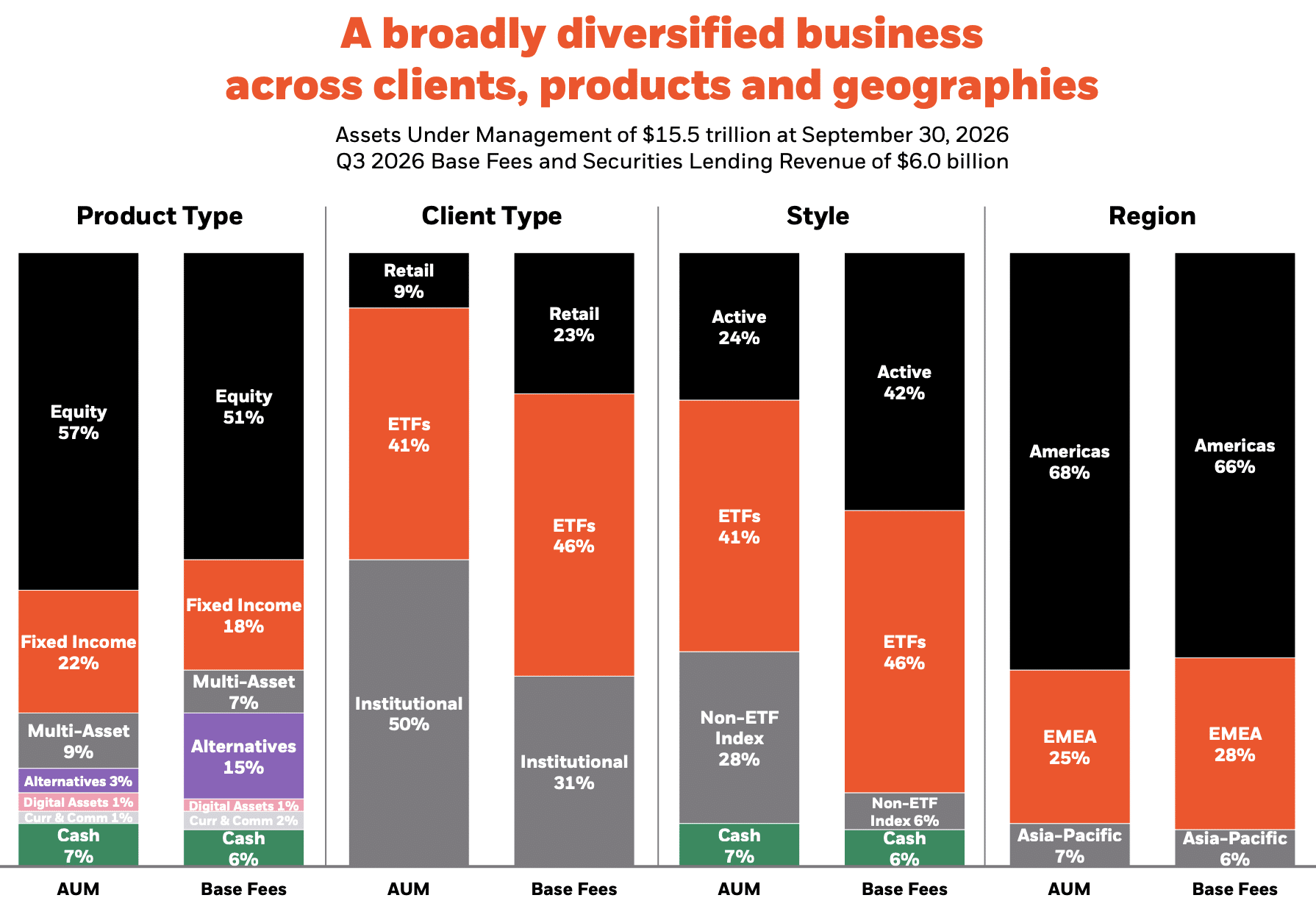
BlackRock reported $15.5 trillion in assets under management as at 30 September 2026. This followed $869bn of net inflows over the last twelve months, which represented 10% organic base fee growth.
In the third quarter of this year, BlackRock had $205bn of net inflows and 11% annualized organic base fee growth. The firm said this reflected broad-based strength across iShares ETFs, systematic active equities, private markets, and cash.
Fink said: “We generated net inflows across every asset class, every client type, every region and across both active and index.”
Martin Small, BlackRock
Small added that the firm’s 2030 plan at last year’s Investor Day set a strategy to drive growth in higher value, higher base fee rate categories. Growth broadened across active ETFs, private markets, systematic SMAs (separately managed accounts), digital assets, and technology.
He does not believe that the investment environment can be described as risk-on or risk-off as the new environment is about capital allocation acumen.
“Our industry is being reshaped by the blending of public and private markets and growing demand for technology and data to secure success in client portfolios,” Small added. “These conditions play directly to BlackRock’s strengths.”
BlackRock delivered double-digit growth in revenue, operating income, and earnings per share, with all three measures reaching new records. There was a 19% year-over-year increase in third quarter revenue to $7.8bn.
Fink continued that foreign investment is moving into U.S. equities and funds in record amounts, with a third of BlackRock’s long-term net inflows coming from clients outside the United States. Fink said this is even more pronounced in systematic equity, where more than 70% of the net inflows are coming from international clients.
“BlackRock’s results demonstrate the value of our integrated platform, as clients increasingly choose us as a partner across investing, financing, and technology,” added Fink. “That client trust is translating into higher earnings power, with shareholders benefiting from a more than 35% increase in adjusted earnings per share year-over-year, a 47.8% adjusted operating margin, and 11% annualized organic base fee growth in the third quarter.”
By Simone Cortese, Chief Product Officer for Fnality International
Simone Cortese
Stablecoins are opening up more efficient ways to move money and transact on-chain. But large-value wholesale transactions have more complex requirements, raising questions about the respective roles of stablecoins, tokenised deposits and central bank money in the new digital money ecosystem.
Key Takeaways
Stablecoins have become a powerful innovation for payments, but they may need to be supplemented by additional types of settlement in wholesale markets.
Central bank money should remain part of the critical architecture for large-value wholesale transactions.
Rather than inventing new constructs, the market can build on the established roles of commercial and central bank money and further support the coexistence of different settlement rails for different use cases.
Digital money is entering a new phase as activity moves beyond experimentation into real-world financial activity. Stablecoins are proving fast, programmable and useful across markets and borders. Tokenised deposits are also gathering momentum as commercial bank liabilities move onto new rails.
The harder question is what role these instruments can play when large-value wholesale transactions have to be settled. Moving value faster is not the same as having a sufficiently high-quality settlement asset. For regulated institutions, international supervisory guidelines state that settlement must close out an obligation without simply replacing one risk with another, achieving true settlement finality.
Stablecoins clearly have a role to play in settling obligations within institutional markets, with total supply already exceeding $300 billion. But being a useful global payment instrument is different from providing the common asset in which large institutions ultimately settle their obligations at the core of the financial system, where exposures can run to trillions of dollars.
What wholesale markets require
Wholesale settlement is not simply retail or institutional payment at a larger scale. There are three things that must be supported for it to work: finality, settlement-asset quality and interoperability. In other words, the obligation must be formally, and finally, extinguished with complete certainty; the settlement asset should not add unnecessary private credit risk; and different forms of digital money must be able to work across banks, issuers, ledgers and jurisdictions.
Stablecoins have obvious strengths, such as the ability to store value between crypto trades and support cross-border and corporate payments. However, users are likely to manage stablecoin balances actively, moving funds into yield-bearing assets when they are not required for payments. This may limit their velocity and reinforces the importance of considering the specific use case.
Additionally, there are challenges in using stablecoins as a means of payment when their value is based on underlying assets whose prices may vary. If stablecoin reserves are not legally ring-fenced, for example, the holder ultimately has a claim on the issuer. If they are ring-fenced, the claim is on a pool of assets. That can provide stronger protection, but it is still not the same as holding central bank money, which does not introduce asset, credit or operational risk from the stablecoin issuer, collateral originator or custodian, respectively.
Stablecoin reserves may contain cash, Treasury bills or other high-quality liquid assets (HQLA). But securities must be marked to market and may have to be financed or sold to meet redemptions during market stress events. As wholesale-market veteran Olaf Ransome, the self-described Bankers’ Plumber, puts it: “Always start with who has a claim on what.”
History shows why this matters. A Bank for International Settlements (BIS) study of 68 stablecoins found that not one maintained its peg absolutely in all scenarios. A promise of par is not the same as settlement at par. As stablecoin volumes continue to grow, repeatedly accepting privately issued money might create exposure elsewhere in that chain that ultimately needs to be cleared. Global systemically important banks (GSIBs) cannot continue building those exposures indefinitely, and BIS guidelines suggest that the “clarity and certainty of settlement finality is critical for mitigating settlement risk, which if not properly managed, could lead to systemic risk.”
Another issue is who will accept stablecoins on what terms. A dealer receiving $200 of one stablecoin and $300 of another does not necessarily have $500 that its next counterparty will accept. Different issuers can also mean different claims, liquidity and risks, so the dealer may have to redeem, exchange or clear them first. Even if stablecoins are backed by HQLA, their full value may not always be immediately available in cash, particularly during periods of market stress. Where banks are involved, the movement of cash and assets between affiliates and entities can present additional challenges, especially when different risk limits apply to each. Frequently addressing those risk limits with proper settlement of the relevant exposures is how banks can avoid ramping up risk or creating bottlenecks. None of this diminishes what stablecoins can do. It explains why they can work extremely well in bilateral or closed payment flows without automatically becoming the universal answer for wholesale settlement. A corporation paying suppliers in the same stablecoin has a compelling use case. A bank closing out obligations across repurchase agreements, derivatives or securities exposures with multiple counterparties is solving a different problem.
Tokenised deposits also have an important role to play in the emerging digital money ecosystem. They are programmable commercial bank money in digital form, well suited to supporting client activity, including treasury activities, cross-border payments and tokenised securities transactions. They should therefore be viewed as complementary to, rather than a replacement for, settlement in central bank money.
When used for large-value wholesale settlement, the underlying credit exposure remains. If Bank A accepts Bank B’s tokenised deposit, Bank A has exposure to Bank B, so the risk is transferred rather than extinguished. Connecting tokenised deposits with regulated wholesale payment infrastructure can preserve programmability across the transaction lifecycle, while enabling the underlying interbank obligation to be settled in central bank money balances. Tokenised deposits can put commercial bank money onto programmable infrastructure. Tokenised funds can mobilise collateral. But wholesale markets also need a neutral point at which material private exposures between GSIBs can finally end. The emerging model is therefore not about choosing a single form of digital money. It is about enabling stablecoins, tokenised deposits and tokenised assets to interact with a trusted settlement layer in central bank money.
In a world moving towards 24/7 global flows, we need architecture that can support settlement not just in one jurisdiction, but across jurisdictions in a harmonised way, enabling regulated flows of money.
The settlement layer beneath
The case for retaining central bank money at the heart of wholesale settlement, rather than anything less safe, is not just a matter of wholesale convention; it is also supported by recent statements from market authorities. In a new research paper for the Federal Reserve’s Jackson Hole symposium, Stanford University finance professor Darrell Duffie argues that stablecoins and tokenised commercial bank deposits are not sufficiently safe for multi-trillion-dollar applications between GSIBs. “Systemic financial-market infrastructure should rely for settlement on the literal unit of account, which only central banks can provide,” Duffie writes.
European Central Bank Executive Board member Isabel Schnabel reached a similar conclusion in her response to Duffie’s paper. “Stablecoins cannot be a substitute for central bank money in settlement,” she wrote. Schnabel goes on to argue that a safe settlement asset must not only avoid credit, liquidity and redemption risk; its supply must also be able to expand when liquidity demand surges. Central banks can provide liquidity elastically in times of stress; stablecoin issuers cannot.
That does not diminish the role of stablecoins. Schnabel herself says they can complement central bank money and broaden the range of payment instruments. It points instead towards a division of labour: stablecoins can extend the reach and functionality of digital money, tokenised deposits can bring commercial bank money onto programmable rails, and central bank money can provide the trusted settlement foundation beneath large-value wholesale activity.
As the ecosystem develops, clearer supervisory expectations around which settlement assets are best suited to which use cases could help these forms of money scale alongside one another, while retaining central bank money for large-value wholesale transactions where settlement risk matters most.
Interoperability is key to this future state. Issuers cannot sensibly integrate separately with every ledger, domestic payment system and central bank initiative. Specialised networks and different forms of money need to interact, while preserving access to a common settlement foundation.
As more value moves across stablecoins, tokenised deposits and tokenised assets, the need for this sort of common settlement foundation becomes increasingly important. Private forms of money can move value quickly and programmably, but large obligations still need somewhere they can be extinguished without adding another layer of private credit risk.
The stablecoin era does not lessen the need for central bank money in wholesale markets. It makes the settlement layer beneath it more important.