Consolidated Audit Trail Enters Perilous Curve

(FLASH FRIDAY is a weekly content series looking at the past, present and future of capital markets trading and technology. FLASH FRIDAY is sponsored by Instinet, a Nomura company.)

Is the Consolidated Audit Trail (CAT) the capital markets version of the California High-Speed Rail?

Well, not exactly. But there are some parallels.

The California High-Speed Rail (CAHSR) is widely cited as the biggest modern U.S. public project boondoggle, with costs ballooning to $126 billion, triple the original $45 billion that was approved by voters in 2008. Meant to connect Los Angeles and San Francisco, it has become known as the ‘train to nowhere’, and its start date was just recently postponed again, from 2032 to 2033.

The CAT was back in the news this week, when the US Securities and Exchange Commission issued a concept release soliciting public comment in support of a comprehensive review of the CAT and other audit trails and related data sources currently used in the regulation of U.S. securities markets. SEC Chairman Paul Atkins emphasized the need to reform the CAT by better balancing regulatory use, costs, funding, and security considerations.

To be sure, unlike the CAHSR, the CAT is up and running after a phased, four-year go-live  period between June 2020 and May 2024. But the CAT has had a long and checkered history dating back to when it was first announced in 2012 as a way for regulators to better monitor and analyze trading activity.  

An AI-generated summary notes that the Consolidated Audit Trail has faced a decade of delays, litigation, and massive cost overruns, with more than $500 million spent on development by late 2025. The CAT’s 2025 operating budget reached $272 million, more than five times the 2016 estimate.  

Just last year, an appeals court struck down the CAT’s SEC-approved funding model from 2023, and the future of the CAT is further clouded by the ongoing review by the SEC, which has shown to be a decidedly ‘lite’ regulatory agency in the first year under Atkins.

One key criticism of CAT pertains to privacy and surveillance, as the database stores personal data including names, addresses, and full trading history. That effectively creates a ‘government registry’ that allows for the surveillance of everyday investors – not the kind of arrangement that a libertarian-leaning SEC Chairman would likely be a fan of.

Add it all up and just when CAT developers must have been breathing sighs of relief two years ago, the audit trail is again facing headwinds and is mired in controversy and uncertainty.   

Can the CAT train make it through the perilous curve it’s now navigating?

Cboe Reports Record Daily Proprietary Index Options Volume

Cboe Global Markets, Inc. announced trading in its proprietary index options set a new single-day record on April 14, 2026, surpassing the previous record set on April 4, 2025.

“We saw investors actively positioning for risk beyond the front end of the curve,” said Meaghan Dugan, Cboe’s Head of U.S. Derivatives. “On April 14, total trading in our proprietary index options reached a new high of 8.96 million contracts, with elevated SPX and VIX options volumes on the trading floor driven by contracts with more than one month to expiration. It’s a clear signal of how market participants are using index options to manage exposure across different time horizons.”

Highlights include:

  • S&P 500 (SPX) options: 6.28 million contracts traded (4th highest on record)
    • SPX 0DTE: 3.12 million (~49.7% of total volume)
    • SPX >0DTE: 3.16 million (~50.3% of total volume)
    • Open outcry: 1.48 million contracts (23.49% of total SPX volume vs. Q1 average of 16.23%)
  • Cboe Volatility Index (VIX) options: 2.38 million contracts traded (highest trading day since April 4, 2025)
    • Open outcry: 1.28 million contracts (53.73% of total VIX volume vs. Q1 average of 39.31%)

Source: Cboe

Britni Ihle Joins BlackRock to Lead Trading Transformation in AI Push

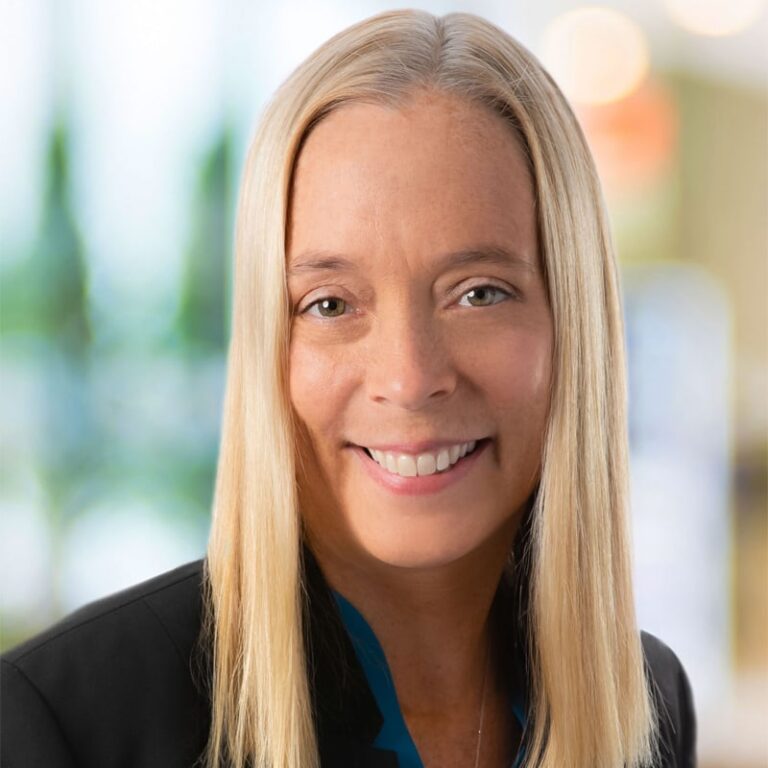
Britni Ihle has joined BlackRock as Managing Director, the firm confirmed to Traders Magazine via email.

“She is a senior member of the Blackrock Global Markets Artificial Intelligence team, with a current focus on leading Trading Transformation,” BlackRock said.

Britni Ihle

Ihle joins from Citi, where she spent more than four years in senior trading roles.

Most recently, she served as Head of Cross-Product Trading, Spread Products from November 2024, after previously serving as Head of Credit Quant Trading – North America from December 2021 to November 2024.

Before Citi, Ihle spent more than a decade at Credit Suisse.

Her roles there included Head of Systematic Credit Trading from July 2018 to December 2021, Head of Short-end Interest Rate Derivatives from June 2013 to July 2018, and a role focused on Multi-Asset Algorithmic Trading Platforms from July 2011 to June 2013.

The hire comes as BlackRock continues to expand across technology, private markets, and ETFs.

The firm entered 2026 with record flows, nearly $14 trillion in assets under management, and ambitious plans to grow revenue through private markets and technology by 2030.

In his latest annual letter, CEO Larry Fink said: “Technology is central to how we scale globally and deliver durable growth.”

SIFMA Welcomes SEC’s Comprehensive Review of the CAT

Washington, D.C., April 16, 2026 – SIFMA today issued the following statement from Kenneth E. Bentsen, Jr., SIFMA president and CEO, on the concept release issued by the Securities and Exchange Commission soliciting public comment in support of a comprehensive review of the Consolidated Audit Trail (CAT):

“SIFMA welcomes the concept release the Securities and Exchange Commission (SEC) published today soliciting public input to assist the SEC’s comprehensive review of the Consolidated Audit Trail (CAT).  We have long called for a public review of the CAT which would address, among other topics, the costs of the CAT, its governance and funding, and the scope and security of the data held within the CAT.  SIFMA has previously made in-depth recommendations which would lead to a more efficient and cost-effective CAT without compromising its intended regulatory purpose, and we look forward to further commenting on today’s concept release and engaging further with the SEC on this issue.”

SIFMA is the leading trade association for broker-dealers, investment banks and asset managers operating in the U.S. and global capital markets. On behalf of our industry’s one million employees, we advocate on legislation, regulation and business policy affecting retail and institutional investors, equity and fixed income markets and related products and services. We serve as an industry coordinating body to promote fair and orderly markets, informed regulatory compliance, and efficient market operations and resiliency. We also provide a forum for industry policy and professional development.  SIFMA, with offices in New York and Washington, D.C., is the U.S. regional member of the Global Financial Markets Association (GFMA).

BofA Trading Jumps 12% as Equities Deliver Record Quarter

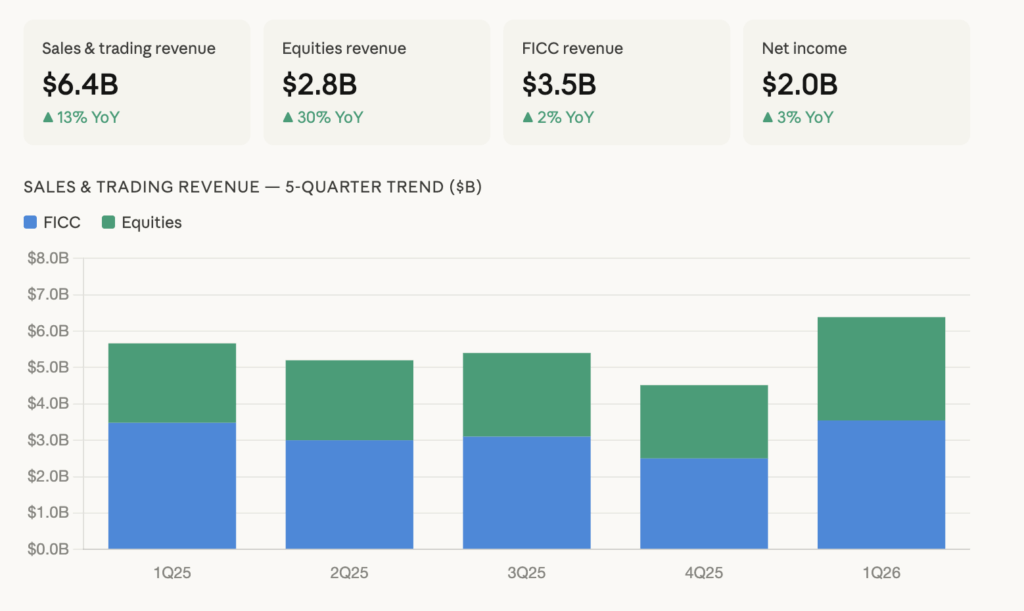
Bank of America reported its first quarter 2026 financial results on April 15, with its Global Markets division posting its strongest sales and trading performance in a decade. Equities delivered what CFO Alastair Borthwick called the desk’s “best quarter ever”.

Sales and trading revenue excluding DVA came in at $6.3 billion, up 12% year-over-year, within total Global Markets revenue ex-DVA of $7.0 billion, up 7% year-over-year.

The quarter marks the 16th consecutive period of year-over-year sales and trading revenue growth for the division.

Alastair Borthwick

Equities led at $2.8 billion, up 30% year-over-year. On the earnings call, Borthwick said the gain reflected “increased client activity and capital extended to the business for growth,” driven by “client financing activity, particularly in Asia, as well as strong trading performance in derivatives.”

FICC came in at $3.5 billion, with Borthwick describing results as “modestly higher,” with strength in commodities “partially offset by lower revenue in FX and interest rate products.”

Despite what Borthwick called “a volatile trading environment heightened by geopolitical uncertainty,” the desk recorded no trading loss days during the quarter.

Average VaR fell to $47 million from $50 million in Q4 2025 and well below the $91 million posted in Q1 2025, a decline in measured risk alongside higher revenue. Average assets grew 14% year-over-year to $1.1 trillion, which Borthwick said reflected “higher inventory levels and strong client balances”.

Source: Bank of America

Speaking on the earnings call, CEO Brian Moynihan said the performance was broad-based: “Markets, wealth and investment banking all show good momentum. Client activity remained healthy,” with revenues across those businesses growing at double-digit rates compared to Q1 2025.

He described the quarter as one driven by “balanced results across our businesses,” with every segment growing revenue, earnings, loans and deposits year-over-year.

Net income for Global Markets was $2.0 billion, up modestly from Q1 2025, though Borthwick noted the prior-year quarter included “roughly $230 million in gains related to leveraged finance positions” that did not repeat. Return on allocated capital was 15%.

On expenses, Global Markets non-interest expense rose 15% year-over-year to $4.4 billion. Borthwick said on the call the increase reflected “higher activity levels, increased people costs and our continued investment in this business.” The segment efficiency ratio recovered sharply to 61% from 74% in Q4 2025 from a previous quarter.

The investment banking component within Global Markets contributed $0.8 billion in fees. Across the broader franchise, total Corporation investment banking fees excluding self-led deals reached $1.8 billion, up 21% year-over-year, led by M&A with equity capital markets also contributing. Borthwick noted the year-over-year comparison was “particularly notable” given Q1 2025 had included gains on leveraged finance positions that did not recur.

On the balance sheet, Borthwick said the firm maintains “one of the lowest cost funding profiles among the large US banks”, supported by deposit mix and pricing discipline, with the total rate paid on deposits declining 16 basis points to 1.47% in the quarter. Firm-wide liquidity stood at over $960 billion, “well above regulatory requirements”, providing the capacity to support trading inventory and client facilitation activity.

On regulation, Borthwick said on the call that proposed changes to the GSIB surcharge are expected to “more than offset the Basel III endgame impact,” adding that if both frameworks are adopted as proposed, “Bank of America is likely to see some reduction in overall capital requirements relative to the current regime in future periods”.

The Real Edge in Investing Isn’t Complexity. It’s Client Stewardship.

0

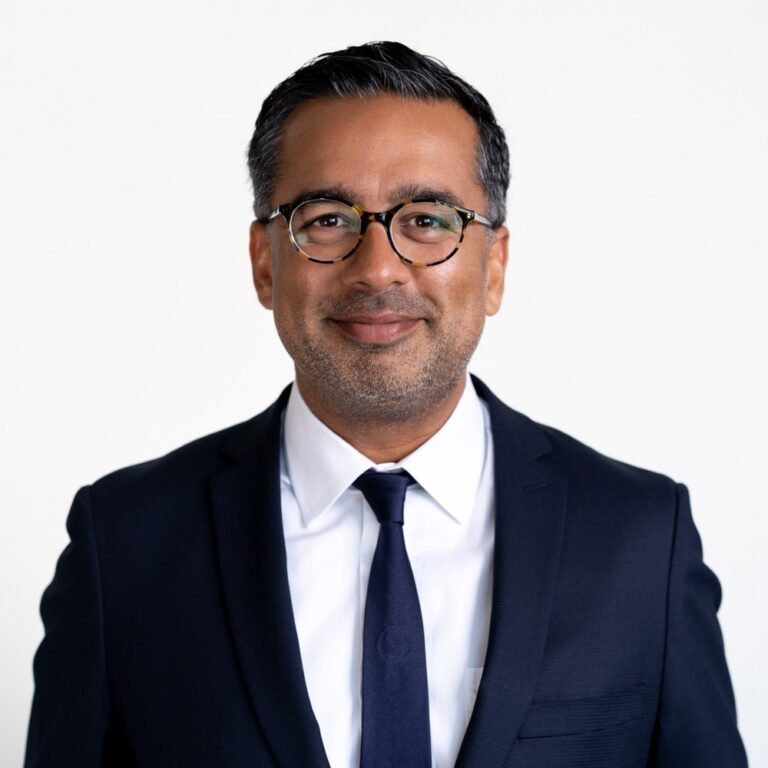
By Samir Dhrolia, Senior Managing Director, Derivatives, Trading & Indexing, British Columbia Investment Management Corporation (BCI)

In institutional investing, people often spend too much time talking about derivative instruments and not enough time talking about client stewardship and the systems built around them.

That is backwards.

The real question is not whether an asset owner uses complex derivatives, securities financing, indexing, or liquidity tools. It is how those tools are governed, designed, and deployed to responsibly serve clients over decades. For institutions entrusted with long-term capital like BCI, that distinction matters enormously.

This is a conviction shaped by more than 25 years of experience in derivatives markets — and a perspective I recently shared on Traders Magazine’s Open Order Podcast. Simply put: centralized infrastructure and institutional discipline anchored by purpose create enduring edge and advantages.

Today’s markets are more complex, more connected, and more global than ever before. For asset owners, that means investing cannot be reduced to isolated trades or siloed decisions.

Exposure management, liquidity, securities financing, collateral management, portfolio implementation, and execution all interact. Treating them separately may satisfy internal structures, but it rarely produces the best outcome for clients over time. Modern investment platforms must see the whole picture.

That is why centralization matters.

At BCI, this philosophy comes to life through our ‘One Wallet’ approach. Bringing everything together within a single implementation framework creates something essential: alignment. It improves governance, sharpens execution, and increases transparency around how capital is deployed. Most importantly, it ensures decisions are made in the collective interest of clients, rather than optimized within individual pockets of the organization.

Done well, centralization is additive — a meaningful advantage. When an institution sees its exposures holistically, mobilizes liquidity efficiently, coordinates implementation centrally, and avoids friction between teams, it makes better decisions. Better decisions, executed more consistently and at lower cost, compound over time.

This compounding effect is especially important for long-horizon institutions. For BCI, the capital we manage belongs to real people – pensioners, public servants, communities — who depend on us to deliver over the long term. That reality shapes the design of the platform, the culture of the team, and the quality of decision-making.

It also underpins how we think about derivative instruments — not as complex financial engineering, but as practical tools in service of client outcomes.

Derivatives are useful because they are efficient. They allow institutions to manage exposure without constantly moving physical assets, maintain liquidity, rebalance portfolios with precision, and reduce unnecessary frictional costs. When used inside a centralized framework, they are simply part of a better operating model.

Derivatives, however, do not create good outcomes on their own. The outcomes depend on how they are documented, governed, collateralized, monitored, and integrated into the investment platform. Legal precision, counterparty terms, collateral schedules, operational readiness, and escalation paths all make a difference. In modern markets, the contract often matters more than the trade itself.

A similar principle applies to market volatility. For patient capital, periods of stress often reveal derivative pricing more clearly, not less. The task is to be structurally prepared — with the right liquidity, the right governance, and the right discipline managed within a broader system.

But this approach only works when the institution stands behind it.

Those that value stewardship build platforms that are resilient rather than fashionable. They choose partners who are transparent, disciplined, and aligned with long-term outcomes and hire people who combine technical skill with judgment, humility, and dedication to the clients they serve.

Investment teams, traders, legal, operations, risk, technology, and support staff all must understand the purpose of the model and commit to it. The full benefits of centralization are only realized when the entire organization recognizes that a shared framework produces better client outcomes than a collection of loosely connected functions.

In the years ahead, markets will continue to evolve, technology will accelerate, and product sets will expand. While the derivative instruments keep changing, the core responsibility will not.

The job is to build a platform worthy of the capital entrusted to it. That must be the standard.

And for long-term investors, that is where enduring value and edge lie: in stewardship, in system design, and in the discipline of centralization done well.

DTCC Advances Cloud First Strategy to Modernize Core Market and Digital Market Infrastructures

Public cloud platforms underpin plans to strengthen innovation, resiliency and cyber defenses

New York/London/Hong Kong/Singapore/Sydney, April 15, 2026 ‒ The Depository Trust & Clearing Corporation (DTCC), the premier post-trade market infrastructure for the global financial services industry, today announced new developments in its Cloud First strategy, including partnerships with public cloud providers, AWS and Microsoft, to advance this multi-year initiative to strengthen the resiliency, scalability, security and speed of DTCC’s core and digital assets platforms.

DTCC is working with AWS to modernize many of DTCC’s core clearance and settlement systems and risk applications by rearchitecting them to be more modular, cloud-enabled and resilient, with the goal of strengthening the soundness of its systemically important services while enabling greater agility, faster recovery and enhanced cyber defense.

In addition, DTCC is expanding its partnership with Microsoft to further innovate and accelerate the delivery of its DTCC Digital Assets services on Microsoft Azure. Azure enables DTCC to design and operate digital asset platforms that can scale dynamically, support new market use cases and evolve alongside rapidly changing technologies while maintaining enterprise-grade security and governance.

“Expanding our use of the public cloud is central to how we are strengthening the resiliency, security and scalability of DTCC’s infrastructure while continuing to innovate on behalf of the industry,” said Lynn Bishop, DTCC Managing Director & Chief Information Officer. “Our Cloud First strategy enables us to transform our core services, introduce new capabilities more quickly, and advance adoption and use of digital assets while meeting the rigorous expectations of the market and regulatory bodies.”

Advancing Core Market Infrastructure Modernization

A key milestone in DTCC’s modernization initiative includes incrementally migrating a defined set of core applications to a public-cloud infrastructure. This migration will bring DTCC’s critical market structure services into the public cloud for the first time. The planned migration follows receipt of a Notice of No Objection from the U.S. Securities and Exchange Commission (SEC) in June 2025 to a proposal filed by DTCC’s clearing agency subsidiaries, permitting those subsidiaries to move specified core services to a public cloud environment.

AWS is supporting this phase of DTCC’s Cloud First strategy by providing the public cloud infrastructure for those specified core applications that serve DTCC’s clearing agency subsidiaries: The National Securities Clearing Corporation (NSCC), Fixed Income Clearing Corporation (FICC) and The Depository Trust Company (DTC). DTCC first began working with AWS more than a decade ago to leverage the cloud for other non-core clearing and settlement systems.

Through its modernization efforts, DTCC is enhancing operational resilience by adding redundancy, improving fault isolation, and enabling more robust contingency and recovery capabilities. Cloud-enabled architectures support stronger security and resiliency by reinforcing existing cyber controls, accelerating software development cycles and enabling the provisioning of infrastructure more rapidly in response to market volatility and evolving client needs.

Harnessing a public-cloud infrastructure also supports the adoption of advanced AI capabilities, which require ready access to scalable processing power, real‑time data and modern governance. DTCC is using AWS’s AI tooling to enhance developer productivity and speed software development and testing as well as piloting AWS enterprise agents across its software development lifecycle.

“By combining AWS cloud and advanced AI capabilities – from Kiro’s agentic coding services to agents that enhance security and operations – DTCC is building faster, operating with greater resilience and enhancing protections against cyber-attacks while maintaining the rigorous standards these critical systems demand,” said Scott Mullins, Managing Director, Worldwide Financial Services at AWS. “We look forward to continuing our work with DTCC to power some of its most mission critical workloads as they accelerate innovation at the scale that global markets require, while strengthening the operations that underpin the financial industry.”

Accelerating Digital Asset Innovation

DTCC Digital Assets is working with Microsoft to advance the next generation of digital market infrastructure and support the continued evolution of digital and emerging asset classes. This critical initiative will support development of digital asset platforms and help create the digital ecosystem of the future.

Microsoft will extend its current work with DTCC Digital Assets, which included re-platforming its ComposerX service and hosting its ComposerX Capital Markets Platform and Factory solutions on Azure, to now encompass all initiatives across the business, including plans to migrate Digital Launchpad to Azure by the end of 2026.

DTCC and Microsoft will collaborate to enhance the infrastructure that will underpin digital markets, with a focus on long-term resiliency, security, scale and contingency planning, leveraging Microsoft’s AI capabilities, engineering expertise and insights and innovation from Microsoft Research.

Azure provides a secure, global cloud foundation that enables DTCC to design and operate digital asset platforms with the scale, availability and governance it requires. Microsoft’s global footprint and enterprise-grade security, along with its identity, trust and compliance capabilities, will help DTCC deliver digital solutions that meet the highest standards for risk management, data protection and operational continuity. These capabilities support DTCC’s efforts to bridge traditional and decentralized finance while delivering robust, forward-looking digital asset platforms designed for institutional adoption.

As part of DTCC’s engagement with Microsoft, the firm has deployed Microsoft 365 Copilot across the organization, embedding AI into core workflows to streamline collaboration and support faster, more informed decision making. Additionally, DTCC Digital Assets is using GitHub Copilot to enhance developer productivity and support innovation.

“We’re at a pivotal moment in financial services, where the convergence of cloud and digital assets is fundamentally redefining market infrastructure,” said Bill Borden, Corporate Vice President, Worldwide Financial Services at Microsoft. “DTCC Digital Assets’ decision to build on Microsoft Azure underscores how our partnership – and Azure’s unmatched global scale, security, and innovation – is leading the industry forward as the most comprehensive and trusted cloud platform for digital assets. By laying the foundation for a more secure and efficient digital market infrastructure, and embedding Microsoft AI into agentic workflows and developer tools, we’re working together to enable a new era of finance that will power the global economy’s future.”

###

About DTCC

With over 50 years of experience, DTCC is the premier post-trade market infrastructure for the global financial services industry. From 20 locations around the world, DTCC, through its subsidiaries, automates, centralizes, and standardizes the processing of financial transactions, mitigating risk, increasing transparency, enhancing performance and driving efficiency for thousands of broker/dealers, custodian banks and asset managers. Industry owned and governed, the firm innovates purposefully, simplifying the complexities of clearing, settlement, asset servicing, transaction processing, trade reporting and data services across asset classes, bringing enhanced resilience and soundness to existing financial markets while advancing the digital asset ecosystem. In 2024, DTCC’s subsidiaries processed securities transactions valued at U.S. $3.7 quadrillion and its depository subsidiary provided custody and asset servicing for securities issues from over 150 countries and territories valued at U.S. $99 trillion. DTCC’s Global Trade Repository service, through locally registered, licensed, or approved trade repositories, processes more than 25 billion messages annually. To learn more, please visit us at www.dtcc.com or connect with us on LinkedIn, X, YouTube, Facebook and Instagram.

FINRA Upgrades Systems for Around-the-Clock Trading

0

On a recent episode of FINRA Unscripted: Trading Around the Clock: Inside FINRA’s Trade Reporting Enhancements, FINRA executives detailed how the infrastructure behind U.S. equity markets is being expanded to accommodate longer trading hours and improve the accuracy of trade data.

Four models of pocket watch are hovering in the air over financial graphs background. A concept of a value of time in financial markets. Forex chart. 3D rendering.

Host Margherita Beale opened the discussion by pointing to the visibility, but limited understanding, of market data among investors. “Every time you check a stock price on your phone or see a ticker scroll, you’re looking at the consolidated tape,” she said, describing the real-time stream of trades across exchanges and over-the-counter markets. She added that the episode would examine “how FINRA is enhancing its systems to meet the demands of a global, always-on trading environment.”

Chris Stone, FINRA’s Vice President of Transparency Services, said his team is responsible for the systems that make that data possible. “My team is responsible for managing the real-time market systems of FINRA,” he said, including overseeing “transaction reporting in real time” and operating the mechanisms that distribute that data to the broader market.

Stone emphasized that FINRA’s role is particularly significant in off-exchange trading. “We’re really over 50% of transaction reporting volume in the national market system overall,” he said. He added that FINRA captures “virtually 100% of fixed income volume” and all trading in unlisted equities, making it a central source of market data.

That breadth, he said, is essential to maintaining transparency. “The pricing that you’re seeing in the marketplace is only as good as it is complete,” Stone said. Without FINRA’s contribution, he added, “it would be a tremendous hole in transparency.”

Beale asked how that data reaches investors, noting that the consolidated tape aggregates trading activity across venues. Stone described it as a system designed to ensure that trades executed in different locations are “consolidated and sequenced and disseminated out in real time,” allowing market participants to access a “validated view” of pricing.

The episode also focused on recent changes to FINRA’s reporting hours. Beale noted that the organization extended its trade reporting facility hours to 4 a.m. Eastern Time on March 30 and asked what drove the decision.

Stone said the move reflects broader shifts in trading behavior. “Over the last few years, there’s been heightened attention and focus on really trading around the clock,” he said, pointing to global demand for U.S. equities and the influence of markets that operate continuously. He added that FINRA’s previous schedule, which began at 8 a.m., no longer aligned with exchange activity.

The earlier start time required operational adjustments. “It’s not just flipping a switch overnight,” Stone said, explaining that extended hours involve system preparation, database readiness and additional staffing to monitor activity.

Looking ahead, Beale raised the industry’s planned transition to a 23-hour, five-day trading schedule, expected in December 2026. Stone explained the structure, noting that trading would begin Sunday evening and continue through Friday, with only brief daily pauses.

“It’s not actual 24/7 trading,” he said, but described it as “a big step for the equity markets.” He added that FINRA has made it “of the highest priority” to ensure it is prepared to support the new schedule.

The discussion also addressed changes to how trades are reported. Beale introduced FINRA’s fractional share reporting initiative, launched in February, and asked what problem it was designed to solve.

Stone said the change addressed distortions in market data caused by rounding fractional trades to whole shares. “A number of academic studies started to scrutinize what they were calling ‘phantom volume,’” he said.

He explained the issue with an example. “If you had a fraction of a $700,000 share, it goes out on the tape looking like one whole share,” which could significantly overstate the size and value of a transaction.

“The goal was to get fractions on the tape so everyone could see what the actual fractional amount was,” Stone said.

Initial results show the impact of the change. According to Stone, “about 10% of our TRF prints are fractional,” with “95% of that showing up as under one share.”

Throughout the conversation, Stone pointed to the pace of change in market structure and technology. “I feel like the cadence of change is really unprecedented,” he said, adding that regulators must adapt to developments ranging from extended trading hours to new asset classes.

Beale closed the episode by emphasizing the importance of understanding market structure. Stone said that understanding how trades are executed and reported is increasingly important. “When you do see a stock price, learn where your trade is being executed,” he said, noting that activity may occur off exchanges in the over-the-counter market.

“I think it’s key that we’re ready to move at that speed too,” Stone said.

DERIVSOURCE: Credit Default Swaps See Record Trading Volumes, New Products

The credit default swaps (CDS) market has been a hive of activity with record volumes set in Q1 and a new product launch from S&P Dow Jones Indices. This is being driven by structural macro and structural risks ranging from the ongoing war in Iran to the disruption caused by AI and the state of private credit.

The latter is the reason behind S&P Dow Jones’ new product- CDX Financials index. It is linked to private credit funds, which have experienced their most challenging time since the sector’s rapid expansion following the 2008 financial crisis.

The concerns are similar regarding rising impairments, questions over valuations, the use of leverage and liquidity mismatches. What is new are fears tied to software exposure in an AI-driven world, and refinancing risks.

The new index, which will be traded by major banks including Bank of America, Barclays, Deutsche Bank and Goldman Sachs, will expand credit derivatives coverage to include a broader set of financial institution such as business development companies (BDCs).

These include Apollo Debt ​Solutions, Ares Capital and Blackstone Private Credit Fund, which together will comprise 12% of the equally weighted index.

CDS’ are akin to insurance-like instruments that pay out if a borrower fails to meet debt obligations. As a result, they are seen as a traditional hedge for corporate portfolios although investors also are increasingly using them to speculate on the direction of the wider market. This is especially the case when conditions make it hard to immediately buy or sell a big part of their portfolio.

Against this turbulent backdrop, it is no surprise that CDS had a bumper Q1. Trading volume overall in the world’s largest CDS indexes surged 69% to $4.5 trn. (https://seekingalpha.com/news/4572595-traders-nervous-on-corporate-debt-as-credit-default-swap-volume-hits-record). This surpasses the prior peak set in Q2 2025 during tariff-related market turmoil by 36% and is up roughly 350% from the roughly $1 trni n Q4 2019, before the pandemic.

In Europe, analysts note investor positioning has turned bearish on credit indexes for the first time since 2018, signalling a shift toward more defensive strategies (https://www.bloomberg.com/news/articles/2026-04-01/credit-derivative-trading-shatters-records-on-iran-war-ai-fears).

Looking ahead, the momentum is expected to continue with investors focused on downside protection and increasingly using CDS to hedge the heightened uncertainty around growth, geopolitics, and corporate earnings durability.

Industry estimates are that the global CDS market will rise to approximately $9.5 trn in 2026, although the outlook for the second half will be defined by a pivot toward lower interest rates and a focus on sector-specific default risks.

Financial Markets Need Their Own Mission Control

By Diederik Geeraerts, CEO at Taskize, a Euroclear company

As the Artemis II astronauts make their way back to Earth after traveling a quarter of a million miles to the Moon, its success will hinge on the assumption that things can always go wrong and must be fixed fast, with a single, shared view of the problem. Financial markets face the same reality every day, but respond very differently. Trades fail, instructions do not match, and numerous discrepancies emerge as a matter of routine. Yet when they do, resolution is still handled through disjointed communication, with no true equivalent of mission control to bring clarity, coordination and speed.

These niggles are a routine part of market operations. Just like in space, the critical question is how they are handled. While space missions are designed around both immaculate preparation and real-time coordination, financial market infrastructure lacks both in places, and often relies on fragmented and outdated comms when something goes wrong. When a problem arises, the response is often dispersed across email chains, phone calls and internal systems that do not connect seamlessly. Market participants still spend copious amounts of time establishing context, chasing updates and confirming ownership. Information is duplicated or, in some cases, missed entirely. Progress is nigh on impossible track in a consistent way.

In benign market conditions, this creates only minor inefficiencies. However, in stressed markets like those we are currently experiencing, it creates a significant amount of risk. Periods of volatility tend to expose the weakest points in market infrastructure. As volumes increase, so too does the number of exceptions. More trades fail, more discrepancies emerge, and the need for rapid resolution becomes increasingly urgent. Yet the processes used to manage these issues are often least equipped to cope with that surge.

This is where the absence of a mission control function in post-trade operations becomes most apparent. There is rarely a single, shared view of the issue. There is no standardised workflow that brings all parties together. And there is limited ability to track a problem from identification through to resolution in a structured, transparent way. The consequence is not just operational delay. It is uncertainty. Settlement risk becomes harder to manage and liquidity can be impacted. What begins as a small break in the process can escalate simply because it is not resolved quickly enough.

In any complex system, resilience depends on coordination. Not just communication, but structured, real-time collaboration with clear accountability and visibility. For financial markets, that means rethinking how post-trade issues are managed. Moving away from informal, disparate channels towards shared environments where people can work together on the same problem, with the same information, at the same time.

Markets do not need to replicate space mission accuracy, but they can certainly learn from the mission. Artemis II will succeed not only on the foundation of people, process and platform – but because it assumes things can go wrong, and is designed to respond accordingly. Banks should take the same approach. In an industry as interconnected and fast-moving as modern finance, the ability to fix problems quickly is just as important as the ability to execute trades in the first place.