Thursday, January 29, 2026
More
    More

      Industry-Wide Testing for 24*5 Trading Begins

      DTCC has released the following statement on the testing phase for 24*5 trading:

      As of January 11, DTCC’s industry-wide testing phase for 24×5 trading in U.S. equity markets has officially commenced. This phase is a critical step toward enabling near-continuous trading, which will expand global market access, improve responsiveness across time zones, and strengthen market resiliency. 

      The transition to 24×5 trading represents a structural evolution for the industry—but it also introduces new operational and risk considerations. Testing ensures firms are ready to process trades seamlessly during overnight sessions, maintain robust risk controls, and support resiliency ahead of DTCC subsidiary National Securities Clearing Corporation’s (NSCC’s) transition to a 24×5 schedule on June 28, 2026, and ahead of the national exchanges’ adoption of 24×5 trading, subject to all necessary regulatory approvals. DTCC is fully prepared to support the industry throughout this process and continues to collaborate closely with market participants, regulators, and exchanges to ensure readiness. Our goal is to help firms adapt their systems, strengthen operational resilience, and prepare for the future of global trading.

      For resources and guidance, visit DTCC’s 24×5 readiness hub.

      MEMX Technology Boosted by ‘Market as a Service’ Model

      David Mellor, head of market technology at MEMX, believes the technology-driven exchange operator’s model of delivering technology through ‘market as a service’ is a superior model and positions the firm for growth across geographies and asset classes. 

      Mellor told Markets Media that MEMX has an established reputation because it has built the technology to run its own exchanges, which he described as world-class. MEMX operates a U.S equity exchange and an options exchange, and has regulatory approval to launch a second options venue in 2026. 

      He claimed that another competitive advantage is MEMX Technology’s MaaS model. Instead of licensing software to the client, MEMX provides a managed service for their venue. 

      David Mellor, MEMX

      “They run the business and we run the technology,” added Mellor. “Do they really want to focus on data center space or on hardware? By delivering technology as a package, clients get the confidence that they will get the outcome that they want.”

      Firms that want to build their own technology to launch a new exchange need to invest millions of dollars before they start earning any money from their business. Mellor argued that MEMX’s service helps reduce this upfront cost, and so enables new venues to come to market more quickly, as it typically takes between six and nine months to build a new venue.

      “They can rely on us to build the infrastructure, help them test, take it forward and work with them on connectivity to their clients, many of whom are already very comfortable using MEMX technology on our own exchanges,” Mellor added. 

      InPlay Global and 24X Exchange

      InPlay Global, which is developing the first marketplace for Performance Securities, said in November last year that it had chosen MEMX Technology for its planned alternative trading system (ATS), which is subject to regulatory approval. InPlay Markets is a regulated marketplace and will have a central limit order book matching engine with risk protections and similar functionality to other equities exchanges and ATSs.

      Troy Kane, president and chief operating officer of InPlay Global, told Markets Media that InPlay reviewed a number of technology providers that have proven track records with building equity exchanges and/or ATSs and received several proposals.

      Troy Kane, InPlay Global

      Kane said: “Our partnership with MEMX is crucial to enabling the quick deployment of InPlay Global’s Performance Securities. Demand amongst investors for a means of participation in the fast-growing market for real-time trading of college and professional sports teams is incredibly high.”

      In addition to being able to get to market quickly, other key criteria for InPlay included a proven platform, and the ability to scale with the business over time to meet the needs of customers. Kane said this made MEMX Technology a “clear choice.”

      In October last year 24X Exchange, the first national U.S. exchange approved for 23-hour weekday trading of U.S. stocks, went live after being built with MEMX Technology.

      Paul Adcock, head of equities at 24X National Exchange, said: “With the help of MEMX Technology, we have been able to build our global platform, the first to offer 23-hour weekday trading of U.S. equities, into a high-performance system.”

      Operational support 

      Once the venues are live, MEMX constantly upgrades the technology, looks after the data centers and the business functionality within the software. MEMX provides market and technical operations to support the client’s own team as Mellor stressed that MEMX does not want to disintermediate anyone from their users. 

      “If their client speaks to their first line support and there is something they cannot work out, we have a seasoned and experienced operational team sitting behind them who have experience in solving these problems,” he added. 

      Mellor stressed that the client is still in charge of their venue, and still maintains the relationships with their users. “We enable clients to run their business to the best of their ability and express their defining features, such as 24/7 trading.”

      Blue Ocean ATS, which trades US stocks overnight, and the Long-Term Stock Exchange (LTSE) for companies committed to long-term value creation, both migrated to MEMX technology in 2024 in order to improve performance of their venues and make them more scalable.

      Growth 

      Mellor said MEMX is in discussions with clients about setting up venues for new asset classes, venues for 24/7 trading, as well as options exchanges and equities ATSs. He added: “We are agnostic to the asset class.”

      MEMX Technology’s existing clients are based in the U.S but Mellor said the business is talking to international exchanges. He continued: “There is a global opportunity for us.”

      Mellor said MEMX is open to entering other parts of the trade lifecycle if there is an opportunity that is right for the client and for MEMX. He added: “I have no doubt that we will progress into other areas.”

      In 2026 MEMX will also be busy working on launching its second options exchange in the first half of this year. Mellor added: “Our options business is going terrifically well at the moment, so that is a really important release for us.”

      MEMX reported that options activity remained strong in November last year, with average daily volume traded of 2.78 million contracts, including five days trading over three million contracts. The exchange said: “MEMX Options regular-electronic market share rose to 7.8% (ranking second) in penny issues and 12.5% (ranking first) in non-penny issues.”

      Options are the New Frontier for Prop Trading Firms 

      0

      By Peter Snasdell, Senior Vice President, Devexperts

      Retail prop trading services have been one of the fintech success stories in recent years. Perhaps even more so than other segments of the industry, prop firms have consistently attempted to rethink their existing offerings to attract a variety of customers and to stand out from each other in an increasingly competitive market. Following this initial success, where are prop firms venturing next? 

      Prop trading offers a real trading experience without requiring users to risk any of their own capital, beyond the cost of admission represented by competition subscriptions. It also gamifies trading education in a manner that wasn’t previously available. 

      Existing retail traders have responded positively to this, and new traders have been initiated who may have otherwise been harder to engage due to the steep learning curve of real money trading, as well as the lack of structured learning associated with demo accounts. 

      Initially, prop firms provided US traders with access to CFD-like instruments that they couldn’t trade with real money in the US. Since those early days, they’ve moved to provide prop trading services on instruments which have a proven track record of interest in the US market. 

      Like the CFD brokers before them, a multi-asset strategy has helped these firms to attract traders from different geographical regions, allowing them to gravitate to the instruments they find most appealing. This has broadly translated to prop CFD trading in Europe, Asia, and Africa, while the addition of futures has been more popular among US prop traders, who have more experience with this financial instrument.

      Now, options trading appears to be the new frontier for prop trading firms, particularly in the US. Following the post-pandemic explosion in retail options activity, firms are now moving to marry the worlds of prop and options trading. While it’s still a nascent trend, prop firms perceive a new potential client base in this instrument and are attempting to capitalize on the surging interest and appetite for options in the retail space.

      Options were historically seen as something of an esoteric instrument reserved for financial professionals. However, since the WallStreetBets memestock phenomenon we’ve seen a great deal of user-created content geared towards educating the wider public about how options work and why they can be useful for retail traders (especially those with shorter investing horizons). 

      Where in the past these initiatives were conducted by brokers, the new reality is that social media is contributing to the creation of a much more educated class of retail traders. Prop firms now want access to this new user base, which has already been turned on to the intricacies of the instrument. 

      On the technological end, there are some marked differences between options trading that may serve as initial hurdles to prop firms seeking to offer a true options trading experience to their clients in the form of trading competitions.  

      More than other instruments, options require instrument specific considerations, both in terms of client-facing platform features, but also in data provision, and back-end risk management and monitoring. 

      These requirements include the need to offer options chains, earnings analyzers, options strategy presets, “what-if” analysis, and multi-leg trades. Market data provision involves more than just streaming price feeds, but also real-time calculations of things like directional risk, time decay, and implied volatility—also known as the options Greeks. Finally, on the back end, SPAN margin calculation allows firms to forecast the potential impact of options by calculating portfolio-wide one-day worst case scenarios.

      Our own interactions with prop firm decision makers confirm that this research is currently taking place. There are fewer vendors that specialize in options trading than with other instruments. Interested parties are in the process of trying to determine the most efficient way to add this asset class, with minimal disruption to their existing instrument offerings and vendor relationships. 

      As these logistical concerns are ironed out, we anticipate that widespread options activity in a prop trading format will reinvigorate this segment of the industry, while also acting as a gateway to real money options trading as other prop-based instruments have in the past.   

      Outlook 2026: Joe Saluzzi, Themis Trading

      Joe Saluzzi is partner and co-founder of Themis Trading.

      Joe Saluzzi

      What trends are getting underway that people may not know about but will be important?

      The push to eliminate or change Reg NMS Rule 611, the Trade-Through Rule, has been gaining traction and will continue to be discussed. Certain industry members and regulators are pushing hard for changes to this rule which they blame for excessive fragmentation, dispersed liquidity and diminished transparency.

      There is no question that Rule 611 is flawed. For example, the rule only protects top of book visible quotes at each exchange. This leaves all other quotes at exchanges, including visible non-top of book quotes and hidden quotes, unprotected. All orders on non-exchange venues are also unprotected and can be traded through.

      However, removing Rule 611 will not increase investor confidence and it will not fix the major structural issues that exist today in the US equity market. Fragmentation of execution venues will continue. Off-exchange volume will not decrease. Segmentation of liquidity within ATSs will not change. Stock exchanges will continue to pay rebates which distort the order routing process. And exchange proprietary data feeds will continue to leak valuable order information.

      What surprised you in 2025?

      The way that the SEC and the CFTC embraced the crypto industry was remarkable. The SEC rolled out their “Project Crypto” initiative which seeks to modernize securities laws for digital assets. Additionally, SEC Chairman Atkins talked about proposing an “innovation exemption”, which would fast-track some crypto initiatives such as tokenization. Not to be outdone, the CFTC under Acting-Chairman Pham, announced their own “crypto sprint” initiative.

      We expected that the crypto industry and their well-funded DC lobby would be active but we didn’t expect them to have this much influence with SEC and CFTC.

      What are your expectations for 2026?

      The line between investing and gambling will continue to blur especially for the retail community. The CFTC approval of the prediction markets, Polymarket and Kalshi, has opened the door for retail brokers to increase their prediction market offerings. Additionally, it’s becoming likely that there will be 24/7 (or 23/5) trading of equities in the US market in 2026.

      While there has been little to no demand for 24/7 trading from the institutional community,
      exchanges and some brokers seem to think this is their “Field of Dreams” moment hoping that if you build it, they will come.

      Even though firms like Robinhood have previously settled legal claims about their gamification techniques, prediction markets and 24/7 trading will likely fuel even more gamification of the market. Get ready for the confetti drops.

      Retail Trading, Then and Now 

      0

      (FLASH FRIDAY is a weekly content series looking at the past, present and future of capital markets trading and technology. FLASH FRIDAY is sponsored by Instinet, a Nomura company.)

      Traders Magazine is located in New York and this week there have been lots of references in the news and on social media to a big event that happened 30 years ago this week: the blizzard of ‘96, which socked the US east coast with as much as four feet of wind-driven snow. 

      The Traders editor is old enough to remember walking a quarter-mile from home (in Belmar, NJ) to buy a newspaper at 7-11 on the morning of Sunday, January 7, 1996, and getting disoriented and briefly lost on the way home because the snow was so heavy I couldn’t see three feet in front of me. 

      Which got me thinking – what was Traders Magazine writing about in January 1996?

      Alas that question will remain unanswered, at least for now, because apparently Traders didn’t go online until 2001, and we weren’t able to locate magazine hard copies in time for this article. 

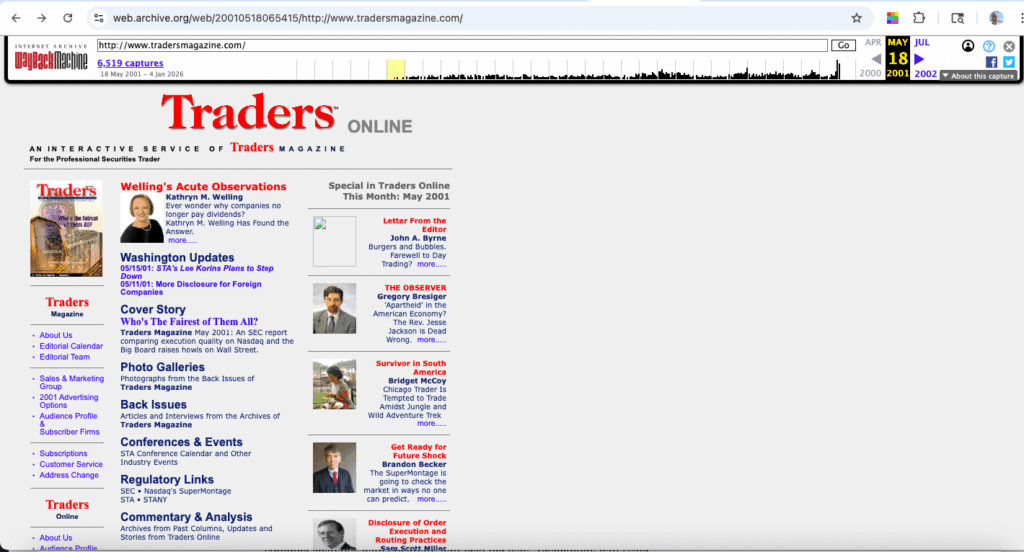
      But we found a gem from January 2001, 25 years ago, via the Wayback Machine

      ‘Traders Online’ launched in 2001.

      In an Editor’s Note entitled ‘Burgers and Bubbles. Farewell to Day Trading?’, there were no punches pulled on day traders, defined as individual market participants who leave no positions open overnight. In fact, the prevailing tone is almost comically one of schadenfreude and ‘don’t let the door hit you…’

      Note the backdrop was the Nasdaq Composite Index dropping by almost half in 10 months, from a high above 5,000 in March 2000 to about 2,600 in January 2001.  

      “The carnage, of course, has eliminated large swaths of hyperactive day traders,” the editor’s note stated. “At the height of the stock market boom — some prefer the word bubble — their momentum trading was sometimes laughable. In effect, day traders had collectively become the axe in some technology issues. Several pundits compared day trading to casino-style gambling in Atlantic City. What was the redeeming feature as day trading jocks held shares for say, 10 seconds or maybe even 60 minutes, then dumped and reloaded after munching on their greasy burgers?” 

      DepositPhotos burger.

      The note was prescient in a way, in that as bad as the charts looked in January 2001, the market had another leg down and didn’t bottom until October 2002. Many many day traders were indeed shaken out of the market and didn’t return for a long time, if ever.

      Fast forward a quarter century, the stock market hovers near record levels and retail market participation continues to be robust – a scenario that begs the question of what day traders, now commonly known as ‘protail’, would do if there’s a big drop. 

      Executives of brokerage firms and exchange operators say retail traders are more educated, more empowered and better-informed than they were a generation ago, and they can reasonably be expected to hang in for the long term. But that’s just speculation that won’t be proved or disproved until a plunge actually happens.

      If a market drop does cause protail traders to bail, they certainly will be missed more than the 2001 editor’s note conveys. Retail activity generates about one quarter to one third of overall trading volume, according to industry estimates, up from about one fifth in the years prior to the Covid pandemic. 

      Institutional investors would miss that liquidity, even if those trades are executed by people who eat greasy burgers. 

      SimCorp, MSCI Expand Collaboration on Private Market Data

      SimCorp and MSCI expand collaboration to streamline investment managers’ access to private market data

      ●      Buy-side firms using SimCorp One will gain access to MSCI’s managed data collection service and industry-leading private capital datasets – empowering SimCorp clients with actionable data, intelligence and operational efficiency.

      New York – January 8, 2026 – SimCorp, a global leader in financial technology, today announced an expansion of its data collaboration with MSCI, giving buy-side firms using the investment management platform SimCorp One direct access to MSCI’s private market data service and datasets.

      Through this collaboration, SimCorp clients will benefit from easy access to datasets at the fund-, asset-, and deal-level directly within SimCorp’s award-winning platform. Private market investments lack standardized disclosure and consistent reporting, leaving data fragmented and difficult to access. This collaboration addresses that challenge by providing clients with easy access to aggregated, high-quality datasets.

      SimCorp and MSCI first came together in 2022 to provide SimCorp clients access to private investment benchmark data. Building on this successful foundation, the expanded collaboration now offers SimCorp One users access to MSCI’s Private Asset Transparency Data, providing detailed visibility into private capital investment holdings. Additionally, access to MSCI’s managed service for automated document collection and data management, including transactions, will help clients automate workflows for fund financial documents.

      Both products are underpinned by MSCI’s comprehensive private capital datasets and benchmarks spanning nearly 28,000 funds and funds-of-funds across all private asset classes, complete with historical holdings, performance data, and cash flow profiles. This underscores SimCorp’s commitment to simplifying data access and driving successful business outcomes for clients.

      “Despite the rise of AI technology, many clients are still searching for turnkey solutions that remove complexity from private market operations,” said Hugues Chabanis, Head of SimCorp Alternatives. “In their perpetual quest for efficiency, this continued collaboration with MSCI delivers exactly that, acting as an extension of their operations teams to handle everything from document processing to capital calls and reporting.  This enables our clients to focus on what truly matters for their customers: evaluating the best investment opportunities and driving portfolio performance.”

      SimCorp One enables investment managers to manage both public and private market assets within a single, integrated platform. The integration marks the next step in expanding SimCorp’s partner ecosystem, giving clients the optionality to combine the platform’s advanced capabilities with easy access to data providers and innovative third-party solutions across the investment management value chain. The partner ecosystem is designed to ensure data flow within clients’ operating environments while reducing adoption costs, minimizing vendor lock-in, and accelerating time-to-value.

      Luke Flemmer, Head of Private Assets at MSCI, commented: “MSCI is committed to bringing greater transparency, efficiency, and data accessibility to the private assets investment process. By embedding MSCI data, indexes, and analytics into SimCorp One, we are equipping investors with powerful tools to better manage complexity, address regulatory demands, and drive better outcomes.”

      This announcement follows SimCorp’s recent introduction of SimCorp Alternatives, a unified solution that connects LP and GP operations with the technology, scale, and innovation to transform the management of private markets. To learn more about how SimCorp can help simplify and scale your investment business, visit www.simcorp.com.

      About SimCorp  

      SimCorp is a provider of industry-leading integrated investment management solutions for the global buy side.

      Founded in 1971, with more than 3,500 employees across five continents, SimCorp is a truly global technology leader that empowers more than half of the world’s top 100 financial companies through its integrated platform, services, and partner ecosystem. 

      The Axioma analytics suite provides comprehensive factor risk models, multi-asset enterprise risk management, portfolio construction, and regulatory reporting solutions.

      SimCorp is a subsidiary of Deutsche Börse Group. 

      For more information, please visit www.simcorp.com. 

      Four Trends to Shape Capital Markets in 2026

      Capital markets are entering a decisive phase, where tokenisation, faster settlement and interoperability are converging to reshape how markets function. Richard Baker, Founder and CEO of Tokenovate, writes that in 2026, competitive advantage will increasingly be defined by modern, automated post-trade infrastructure rather than execution alone.

      As capital markets head into 2026, they are no longer debating whether change is coming, but how quickly they can adapt. Tokenisation is moving into production, settlement cycles are tightening, and regulators are putting long-term frameworks in place.

      What’s becoming increasingly clear, however, is that these shifts are not happening in isolation. They are converging, and together, they will redefine how markets operate in 2026 and beyond.

      Here are four forces set to shape the next phase of capital markets evolution.

      1. The focus shifts from tokenised assets to tokenised settlement

      Tokenisation has been one of the fastest-growing areas in capital markets this year. Institutions are actively exploring digital representations of bonds, funds, collateral and alternative assets in pursuit of capital efficiency and improved risk management.

      However, much of the industry’s effort has been concentrated on tokenising the asset itself, while the workflows that underpin those assets remain slow, fragmented, and manual. When tokenised instruments still rely on legacy post-trade processes, liquidity remains trapped and operational risk persists.

      In 2026, the emphasis will move decisively toward tokenising the settlement layer. Modernising how value moves after the trade, including lifecycle events, settlement finality, and data synchronisation, will unlock continuous liquidity, materially reduce counterparty exposure, and lower operating costs in faster, always-on markets.

      2. T+1 becomes a stepping stone, not the end goal

      Momentum around the UK’s transition to T+1 settlement has grown, but the pace of preparation remains uneven. As markets move into 2026, the window for meaningful action is narrowing, particularly as some critical service providers continue to underestimate the scale of change required.

      T+1 should not be viewed as a destination. It is simply another milestone in a broader journey toward real-time markets. Faster settlement alone does not address the structural fragmentation that continues to increase risk and constrain liquidity.

      The firms that will differentiate themselves in 2026 are those already preparing for what comes next. Research indicates that moving from T+1 to real-time settlement could reduce exposures by up to 80% during periods of market stress. Achieving that requires investment now in automation, shared data standards and event-driven workflows capable of supporting an increasingly compressed post-trade environment.

      3. Interoperability moves from theory to necessity

      As tokenisation expands and settlement cycles shorten, fragmentation is becoming more visible rather than less. Multiple blockchains, data standards and legacy systems continue to operate in silos, each holding its own version of a trade.

      Even in digital markets, this lack of alignment limits asset mobility and traps liquidity.

      In 2026, interoperability will become non-negotiable. Markets need consistent lifecycle models and workflows that operate across infrastructures, rather than being tied to a single platform or network. Industry efforts are increasingly focused on standardised lifecycle logic and automated processes that allow trades to move cleanly regardless of the underlying technology.

      True modernisation will depend on ensuring assets can interact and settle seamlessly across the financial ecosystem.

      4. Post-trade becomes the next frontier of competitive advantage

      For years, innovation in capital markets has focused primarily on execution. In 2026, post-trade will increasingly define competitive differentiation.

      As settlement cycles compress and markets move closer to real-time, firms will need operating models built on automation, shared data and event-driven processes. Those that continue to rely on manual interventions and disconnected systems will struggle to manage risk, scale efficiently or meet client expectations.

      The firms that succeed will be those that treat post-trade infrastructure not as a cost centre, but as a strategic enabler of liquidity, resilience and growth.

      Bonus trend: The UK’s measured approach becomes a competitive advantage

      Beyond the structural shifts reshaping market infrastructure, a further trend is emerging at the national level and may prove just as influential in 2026.

      Globally, governments are accelerating initiatives around stablecoins, tokenised securities, blockchain-based settlement and smart contract-driven workflows. Yet many of these efforts are being developed in isolation, introducing new complexity rather than removing it.

      The UK has taken a more measured, legally grounded approach. Initiatives such as the Digital Securities Sandbox, the DIGIT framework and forthcoming legislation, including the Property Bill demonstrate a focus on legal certainty and practical adoption. 

      Industry-wide efforts like the Common Domain Model are also gaining importance, providing a shared language that bridges legacy systems and emerging digital platforms.

      In 2026, this emphasis on coordination and interoperability will be critical. Success will depend on collaboration between policymakers, market infrastructures, technology providers and firms across the sector.

      Looking ahead

      For years, innovation in capital markets has followed a familiar pattern: isolate a problem, innovate in silos, then attempt to integrate later. While progress has been made, this approach has also entrenched fragmentation.

      That model is now being challenged. Tokenisation, faster settlement, interoperability and legally grounded innovation are beginning to converge. Together, they are reshaping markets to function as connected, end-to-end systems rather than a patchwork of disconnected processes.

      In 2026, the firms that succeed will be those that recognise this shift and act on it, building operating models designed for continuous settlement, shared data and systemic resilience. Those that do not risk being left to manage legacy workflows in markets that have already moved on.

      Broadridge Invests in DeepSee, Provider of Agentic AI Technology

      Broadridge Invests in DeepSee, Further Harnessing Agentic AI to Transform Post-trade Operations

      Investment accelerates innovation in capital markets, enhancing efficiency, compliance, and client service– starting with AI-powered email orchestration

      NEW YORK, January 8, 2025 – Building on its strategy to harness AI and harmonized data to optimize global post-trade operations, global Fintech leader Broadridge Financial Solutions Inc. (NYSE: BR), today announced a strategic investment and expanded partnership with DeepSee, a leader in agentic AI technology based in Utah, U.S. The agreement includes Broadridge taking a minority ownership stake in DeepSee and marks a significant milestone in Broadridge’s strategy to leverage AI and harmonized data to optimize global post-trade operations.

      Along with the investment, Tom Carey, President of Broadridge Global Technology and Operations (GTO), will join DeepSee’s Board of Directors, further aligning the two companies’ shared commitment to accelerating AI transformation across capital markets. The collaboration will initially focus on deploying AI-powered email orchestration, turning traditional inboxes into intelligent, automated workflows for post-trade operations teams.

      “This latest investment and partnership underscores Broadridge’s commitment to delivering innovative AI-powered solutions that transform operations, reduce risk, and enhances the client experience,” said Tom Carey, President of Broadridge Global Technology and Operations. “Working with DeepSee, we are bringing agentic AI directly into post-trade workflows, helping clients move from manual email handling to intelligent automation—unlocking new levels of productivity and operational resilience.”

      Broadridge is a leading provider of post-trade processing technology, clearing over $15T in daily trades across global markets every day. By embedding AI into workflows such as fails research, inventory optimization, and now email orchestration, Broadridge is further empowering clients to simplify complex ecosystems, improve decision-making, and unlock new levels of efficiency.

      “From the beginning, DeepSee’s vision has been to leverage the power of AI agents to transform the complex processes of financial services into actionable outcomes that drive immediate, production-ready business impact,” said Steve Shillingford, CEO and Founder of DeepSee. “Working with Broadridge enables us to scale that vision globally, bringing AI innovation directly to the core of capital markets operations. Together, we are helping firms dramatically reduce manual processes, improve client responsiveness, and unlock new levels of efficiency.”

      Together, Broadridge and DeepSee are redefining post‑trade operations by transforming in-bound email requests into connected workflows where AI agents, systems, and people operate seamlessly together. Pre-trained and pre-configured agents power automated operations and industry-specific AI capabilities convert communications into real actions—delivering faster responses, stronger compliance, and measurable operational results.

      Key benefits of the AI solution include:

      • Increased productivity: Automates workflows by connecting to underlying systems to retrieve critical data and enhances efficiency through intelligent organization, prioritization, and drafting of emails
      • Smarter resource optimization: Elimination of unnecessary emails, AI based categorization of work types and prioritization of importance of emails powered by insights into email volume and trends, enables proactive workload management and freeing teams for higher-value work.
      • Enhanced transparency and supervision: Real-time dashboards display SLA metrics, operational trends, and actionable insights across teams.

      The solution has already been deployed across Broadridge’s Business Process Outsourcing Operations which serves over 60 clients. The solution is also integrated with Broadridge post-trade capabilities providing the opportunity for firms to deploy with-in their own four walls with the Broadridge Platform or on a standalone basis.

      About DeepSee

      DeepSee is the control plane for agentic operations in financial services. We help banks and capital markets firms convert fragmented, manual workflows into software-defined services—powered by AI agents that plan, orchestrate, and execute across applications and teams. Built for production operations, DeepSee delivers secure integration, robust governance, continuous evaluation, and human oversight—so you can scale from experimentation to enterprise-wide transformation.

      For more information about DeepSee, please visit www.deepsee.ai.

      About Broadridge

      Broadridge Financial Solutions (NYSE: BR) is a global technology leader with trusted expertise and transformative technology, helping clients and the financial services industry operate, innovate, and grow. We power investing, governance, and communications for our clients – driving operational resiliency, elevating business performance, and transforming investor experiences.

      Our technology and operations platforms process and generate over 7 billion communications annually and underpin the daily average trading of over $15 trillion in equities, fixed income, and other securities globally. A certified Great Place to Work®, Broadridge is part of the S&P 500® Index, employing over 15,000 associates in 21 countries.

      For more information about us, please visit www.broadridge.com.

      Outlook 2026: Meaghan Dugan, Cboe

      Meaghan Dugan is SVP, Head of U.S. Derivatives at Cboe Global Markets.

      Meaghan Dugan

      What were the key theme(s) for your business in 2025?

      2025 was defined by heightened volatility and an intensified focus on risk management. Growth in short-dated options trading and retail participation helped drive record volume in our S&P 500 (SPX) and Cboe Volatility (VIX) Index options, alongside record activity in the U.S. options markets. What were once seen as primarily institutional products have become instrumental in helping retail investors manage portfolios.

      To meet this growing demand, we’ve focused on expanding access and providing investors with more ways to unlock new trading opportunities. In December, we launched futures and options on Cboe’s Magnificent 10 Index (MGTN), giving market participants the ability to manage popular tech and AI stock exposure through a single futures or options contract. We also recently announced the planned extension of Russell 2000 Index (RUT) options trading hours in early 2026 to nearly 24×5 hours, enabling investors globally to manage small-cap exposure during their local trading hours.

      Beyond new products, we enhanced market structure to give traders greater flexibility and choice. We introduced a new FLEX vs. listed options functionality on Cboe Options Exchange, enabling more efficient and precise execution of complex strategies, and added complex order functionality to BZX Options Exchange. Together, our initiatives help ensure both retail and institutional participants have the capabilities they need to navigate today’s markets.

      What was the highlight of 2025?

      As I look back on 2025, I’m drawn to the collaboration and incredible dedication of our people, and the resilience of our technology platform amid the tariff-driven market turbulence in early April. Teams across the organization moved in lockstep to ensure our markets remained stable and liquid, enabling investors to transfer risk during volatile markets. The constant communication and customer-centric approach was a true show of Cboe’s commitment to best-in-class service. And it wasn’t just to support real-time efforts – we listened to market participants to learn what more we can do going forward. 

      The event further underscored the enduring value of open-outcry trading. Cboe’s Chicago Trading Floor remains one of the most vibrant in the world, playing a critical role in price discovery and liquidity – especially during periods of heightened volatility and when market participants need certainty in executing complex orders. Our trading floor community is a critical part of the Cboe ecosystem, and we are grateful for their support.

      The market uncertainty also highlighted the importance of investor education. Earlier this year, we celebrated the 40th anniversary of The Options Institute, and launched a new learning portal that offers free, on-demand content including tailored education journeys for specific audiences. I’m proud that Cboe remains an industry leader in education four decades later, and continues to expand our efforts globally.

      What trends are top of mind in 2026?

      Market uncertainty is expected to persist in 2026 with ongoing debates over Fed policy and valuation concerns. To navigate day-to-day volatility, investors have turned to zero-days-to-expiration options at a record rate, driven by increased utility, broader access and more back-tested data. 0DTE trading has drastically changed the way investors manage risk, and while this has been a key trend over the last several years, we expect the desire to express shorter-dated views to continue.

      We’re closely following this evolution and actively exploring where we can bring our derivatives expertise and history of innovation next, including the potential for daily expirations in select single stocks and in the event contracts space. We’re also bringing our established derivatives framework to digital assets, as we did with our recently launched Bitcoin and Ether Continuous Futures. These futures offer investors perpetual-style exposure through a U.S.-regulated tool. For Cboe, resilience, client collaboration and innovation were key to our 2025 success, and these themes will remain at the forefront as we work to help investors globally manage risk.

      Price Discovery Without Borders: How 24/7 Trading Is Rewriting Market Flows

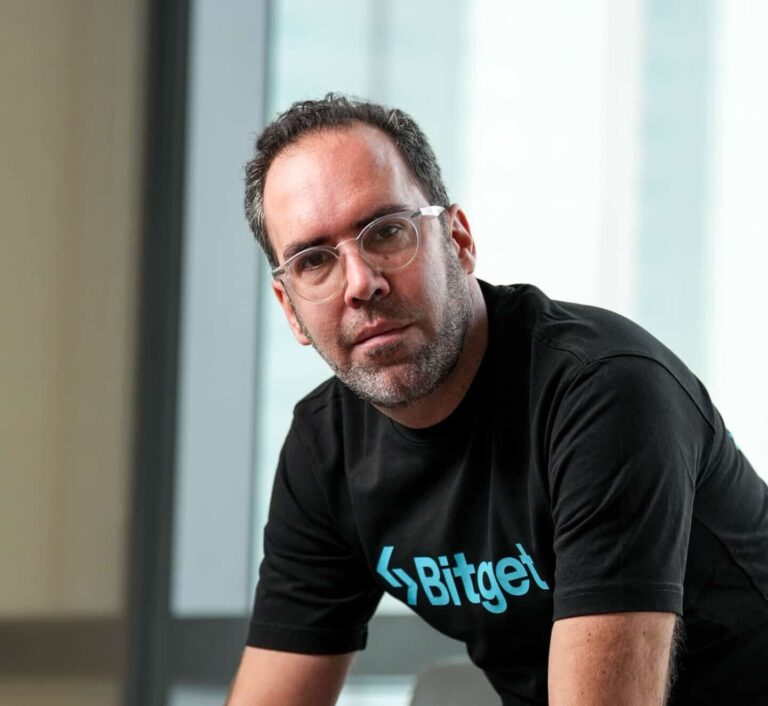
      By Ignacio Aguirre Franco, CMO, Bitget

      For many decades, there has been a global rhythm that traditional markets have followed: trading started in Asia, rolled into Europe, and finished in the U.S. Liquidity would peak and fade, and price discovery would largely be dictated by what happens when Wall Street wakes up.

      That rhythm has slowly been changing. Enabled by crypto, 24/7 hour trading is now on the rise, reflecting a major shift in how global capital moves, when decisions are made, and who gets to influence price discovery.

      Capital now circulates around the clock instead of being constrained by local schedules, and investors increasingly expect the ability to trade when they need it — not when an exchange in a particular region opens.

      This is a powerful, structural change. And as we step into 2026, it is bound to define the direction in which global markets develop next. In a world where the flow of information is constant and crucial news pieces can arrive at any point in time, delayed access now places traders at a disadvantage.

      Price Discovery No Longer Sleeps

      As already mentioned, one of the clearest changes brought about by this new “continuous trading” model is how price discovery is evolving.

      Traditionally, U.S. equity markets operated in fixed windows during New York hours. Even with pre- and post-market sessions, this caused liquidity to be fragmented and thin outside core hours, creating blind spots and complicating things, especially for investors operating outside the U.S.

      Yet now we’re seeing that across global markets, positioning is taking place well before Wall Street opens. One of the more significant developments is the growing importance of the Asian afternoon, roughly between 08:00 and 10:00 UTC. This window, which aligns with the U.S. pre-market and Asia’s active trading hours, has already become one of the most influential periods for price formation.

      During this time, investors are reacting to earnings releases, guidance updates, and macro headlines that hit after the U.S. close. Instead of waiting hours — or an entire night — to adjust exposure, positions are being built, hedged, or unwound immediately.

      We have already seen news pointing out that many major U.S. exchanges like Cboe and Nasdaq are making moves to extend trading hours toward a 24/7 setup to better serve investors trading from their local time zones. Notably, a good portion of this is due to the demand coming from Asia-Pacific regions like Hong Kong, Singapore, Japan, and others.

      That is a fundamental change. Trading demand is increasingly shaped by global participation instead of being confined to just one geography, and Asian session activity is becoming more relevant in the overall price formation. And we can see that the platforms themselves are responding to this shift.

      How Performance Mindsets Are Changing

      Given that the global financial landscape today is defined by volatility, geopolitical shocks, and rapid policy shifts, the ability to act immediately matters more than ever. And we can fully expect that this trend will continue in 2026 and for quite some time yet.

      But with continuous access enabled, traders no longer need to force themselves into overnight gaps just to retain better control over their exposure. They can operate on a schedule that fits their own needs.

      High-speed players can leverage this advantage to better manage short-term volatility and exploit new opportunities as they come up in real time. Longer-term investors, on the other hand, can use this to avoid execution risk and improve portfolio discipline.

      I believe that all investor types can benefit from 24/7 access, just in different ways: some will use it to move faster, others — to feel safer. It’s important to note that constant trading access doesn’t turn everyone into a high-frequency trader. It simply allows different strategies to coexist more efficiently within the same market structure.

      Infrastructure Is Catching Up — But It Needs to Happen Carefully

      While this shift has been greatly accelerated by the growing adoption of crypto assets, traditional market infrastructure is beginning to adapt. Like we previously observed, major venues are actively exploring extended trading models.

      Regulators and policymakers are also engaging more actively with the implications of always-on markets, which means they acknowledge that the existing framework was built for a different era. As one example of this, in the United States, the CFTC has formed a CEO Innovation Council that specifically focuses on developments in crypto, blockchain, tokenization, and around-the-clock trading infrastructure.

      That said, this transition will not — and should not — happen overnight. Extended trading hours redistribute liquidity rather than replicate peak conditions around the clock, and if this transition were to be too abrupt, it would come with its share of risks and frictions. After all, capital does not magically appear out of thin air just because the markets are open longer. It shifts across time windows.

      Participation will undoubtedly be uneven across hours, and there are also operational challenges to consider. When the trading environment is “always on,” market surveillance, risk management, and settlement processes must all be able to keep up and function seamlessly. If these systems aren’t fully prepared, there’s a high chance of inefficiencies piling up over time: mispriced risks, delayed adjustments, reduced confidence among traders in quieter sessions, and so on.

      Because of this, I expect that even with the introduction of 24/7 models, the majority of trading volume (roughly 70-80% of it) will remain concentrated during core U.S. hours, with off-peak sessions being thinner and more sensitive to individual trades. Spreads may widen at times, and short volatility bursts could become more common. But these would not be signs of failure; just normal market responses to changing patterns.

      The key to long-lasting success here is for the integration of continuous trading to be gradual and controlled.

      24/7 Access Is Now a Competitive Edge

      In today’s markets, information does not care about time zones. Earnings are released after hours, policy headlines can land at any time of day, and geopolitical risks might escalate overnight.

      Under these conditions, traders stuck in legacy hours are automatically forced into reactive positions. They have no choice but to adjust after narratives have already settled and after liquidity has shifted. Naturally, one can expect that such a disadvantage compounds over time.

      That’s why 24/7 access can’t — and shouldn’t — be treated as merely a “convenience.” It is now a fundamental edge that actively reshapes how individual and institutional traders alike approach execution quality and risk management.

      As we enter 2026, I believe that we’re going to see an increasing convergence between traditional markets and the crypto-native infrastructure. The lines between “crypto trading hours” and “market hours” will blur further. Price discovery will happen across venues, across time zones, and across asset classes simultaneously.

      More importantly, influence will continue to decentralize: Asian and emerging-market investors will increasingly shape sentiment before the U.S. opening bell ever rings. Markets are moving away from a scheduled mindset and toward a continuous one, where adjustments happen immediately. And once traders experience that level of access, it’s highly doubtful that a reversal of this trend could happen.