


Thursday, January 29, 2026
More
    More

      BMLL Introduces Industry-First Trades Plus Dataset

      0

      BMLL introduces industry-first Trades Plus dataset in response to key client challenge to achieve execution analysis at scale

      • Trades Plus is the first product developed in consultation with BMLL’s Client Product Advisory Board and designed to deliver greater market transparency in a single feed
      • Provides global market participants with combined trade-by-trade data, normalised trade classifications and market analytics to generate actionable insights into trading and executions 

      London, New York, 10 September 2025: BMLL, the leading, independent provider of harmonised, historical Level 3, 2 and 1 data and analytics across global equity, ETFs, futures and options markets, today announced the launch of its Trades Plus dataset, a groundbreaking new product that delivers deep execution insights, designed in collaboration with top global trading firms.

      BMLL Trades Plus is an advanced, multi-purpose equities dataset that provides a globally consistent view of every trade by combining granular historical trade data with BMLL’s proprietary trade classifications, L1 quotes, custom flags and extensive analytics across global exchanges. Trades Plus allows users to take analysis further, transforming trade records into actionable intelligence to produce detailed transaction cost analysis (TCA), backtest execution algorithms, and identify liquidity provision opportunities  – without the need for writing and maintaining the underlying code. This leads to considerable time savings and a significant reduction in the need for coding and compute resources.

      In response to demand from – and collaboration with – members of the BMLL Client Product Advisory Board (CPAB), BMLL has launched Trades Plus and added it to its product suite. 

      Dr Elliot Banks, Chief Product Officer, BMLL, said: “Traders and analysts need to combine trade data with quote data to generate TCA, Best Execution Analysis or compare Market Quality, using a combination of data feeds. To date, this has been a highly repetitive, iterative, and time-consuming process.


      But this is about to change. BMLL Trades Plus, our next generation dataset, removes this effort by capturing detailed trade information, BMLL’s proprietary trade classifications and quote-based analytics, into one single multi-purpose dataset.  What’s more, research built using 100 lines of code can now be achieved in just three.”


      “BMLL Trades Plus is solving a real-world problem. Our CPAB members told us they spend ‘all day long grappling with poor data’ and wanted to be able to get this new dataset off the shelf.  BMLL recognises that many other industry participants are facing the same challenge, and we are committed to ensuring they have access to high-quality, usable data that enables better decision-making and supports the wider market.”

      Paul Humphrey, Chief Executive Officer, BMLL, added: “When we set up our CPAB forum, we were very clear that this was not going to be a talking shop. Our mission is to elevate the standard of market data for the industry. Our CPAB members include sovereign wealth funds, global asset managers and sophisticated proprietary trading firms, including global banks and liquidity providers. These firms were grappling with the same issue – collating poor quality and disparate data sets into an acceptable, consistent and usable standard – so we knew we had to act. BMLL could perform this task by obsessing over the detail, so that they don’t have to. The CPAB members give us deep insights into their collective requirements and future needs as they navigate highly volatile markets and gain the opportunity to shape BMLL’s product roadmap.


      We are delighted to launch BMLL Trades Plus, the first dataset of its kind, and the first developed in consultation with the CPAB and driven by demand for a best-in-class product that facilitates complex execution workflows simply and efficiently. If this is a known issue for our CPAB members, then I am quite sure it is for other firms in our industry”


      The BMLL CPAB brings together leading financial institutions to collaborate and determine best-in-class data symbology and normalisation processes, data delivery methods and coverage needs, and make these available to the wider market. 


      A CPAB member and user of the new Trades Plus dataset said:
       “The enhanced Trades Plus dataset covers the computationally intensive approach of joining trades to quotes, which in itself is a huge value-add. In addition, the ability to alter the data, which is no longer the “raw feed”, opens doors for future flexibility. And the continued focus on excellent trade classification is very welcome, as this has been a real and significant challenge for us and most of our peers”. 

      To ensure a consistent view of every historical trade, Trades Plus combines detailed trade-by-trade data with: 

      • BMLL Trade Classifications: Distinct trade classifications providing a clear and comprehensive view of all on- and off-exchange trading activity across execution mechanisms (e.g. Dark above LIS, Closing Auction, etc.)
      • Extensive Trade Flags: Filter to Retail, Odd-lot, Block Trades, reference MMT Flags, etc.
      • Order Book Analytics: Leverage single venue or consolidated quote analytics to calculate metrics like Spread Capture, Price Improvement, Time or Volume-based Mark-Outs and more. 

      The Trades Plus data product is immediately available across Europe via the BMLL Data Lab, a scalable Python research sandbox, and the BMLL Data Feed – via AWS S3, API, SFTP and Snowflake. The US dataset will follow in early Q4 2025.

      About BMLL

      BMLL Technologies is the leading, independent provider of harmonised, Level 3, 2 and 1 historical data and analytics to the world’s most sophisticated capital market participants, covering global equities, ETFs and futures and US equity options.

      BMLL offers banks, brokers, asset managers, hedge funds, global exchange groups, academic institutions and regulators immediate and flexible access to the most granular Level 3, 2 and 1 T+1 order book data and advanced pre and post-trade analytics. BMLL gives users the ability to understand market behaviour, accelerate research, optimise trading strategies and generate alpha more predictably.

      Founded in 2014 in the machine learning laboratories of the University of Cambridge, the platform enables researchers and quants across global financial services firms to apply complex statistical techniques to BMLL’s unique big datasets with applications such as market impact, pre and post trade analytics, order book simulation and compliance. Users no longer need to buy, curate and harmonise data. With BMLL, they gain cost-effective, instant access to a cloud-native Data Science environment via a single web portal, with a long history of the most granular, full order book data across global equities, futures and ETFs for back-testing and simulation, delivered directly into their workflows.

      BMLL secured $21 million strategic investment in October 2024, led by Optiver, with participation from CTC Venture Capital and existing investors. This follows BMLL’s $26 million Series B investment from Nasdaq Ventures, FactSet, IQ Capital’s Growth Fund and Snowflake Ventures in 2022/2023. Prior to that, BMLL raised $36m through Series A and seed funding rounds.

      For more information please explore our website and follow us on X (Twitter) and LinkedIn.

      Robinhood Unveils Powerful New Tools for Active Traders at HOOD Summit 2025

      Robinhood

      Robinhood Unveils Powerful New Tools for Active Traders at HOOD Summit 2025

      Introducing Robinhood Social, AI-powered custom indicators and scans, futures on Robinhood Legend, and more

      Tonight, live from the F1 Grand Prix Plaza in Las Vegas, Robinhood announced a lineup of new trading products as we aim to make Robinhood the #1 place for active traders. We unveiled Robinhood Social, a new trading community within the Robinhood app featuring live, verified trades and authentic profiles, where you can discuss strategies, follow experts, and more; new AI-powered custom indicators and scans on Robinhood Legend to help you analyze trends and discover new opportunities; as well as new equities and crypto trading ladders, short selling, futures on Robinhood Legend, overnight Index Options, multiple individual brokerage accounts, and options simulated returns on Robinhood Legend. 

      “Robinhood is no longer just where you trade – it’s your financial superapp,” said Robinhood CEO Vlad Tenev.

      Robinhood Social

      We’ve heard from active traders that they rely heavily on social media to navigate the markets. But it’s harder than ever to understand what’s real and what isn’t. We’re changing that with Robinhood Social–where community is capital and you can follow other Robinhood traders, swap strategies, discuss market moves, and trade with clarity. With Robinhood Social you can: 

      • See trades unfold live: All posted trades by customers will be verified and live, meaning you can see exactly where other traders enter and exit positions, right when they make their move. No more second-guessing what’s real and what isn’t. 
      • Track, talk, and trade: Discuss strategies, follow traders and start your trade right from the feed. This is the first social platform where you can trade across stocks, options, futures, crypto, and prediction markets, all without switching apps.
      • See traders’ real performance. Check 1 year and daily P&L, profit rate, and dive into past trades for the people you’re most interested in. Plus, you can trust that every customer profile belongs to a real person, verified through KYC. 
      • Follow insiders, hedge funds, and politicians: Based on publicly reported trades, stay connected to some of the market’s biggest power players who aren’t on Robinhood including politicians, insiders, hedge funds, and others.

      Robinhood Social is launching by invitation only to a select number of customers in the US early next year with broader availability expected to follow. It will be available at no additional cost. 

      The Legend Continues

      A year ago at the first-ever HOOD Summit we announced Robinhood Legend, our browser based trading platform for active traders. But that was only just the beginning–we now offer 90+ indicators, launched a snapshot widget that helps you track quotes and news, rolled out support for crypto & index options, added more metrics to the options chain, debuted options charts and drawing synchronization, and much more.

      Today we’re taking Robinhood Legend to the next level. Not only are we expanding the number of assets available to trade on the platform, but we’re making it easier than ever for traders to analyze trends, research trades, and explore new opportunities with Robinhood Cortex, our AI-powered investing assistant.

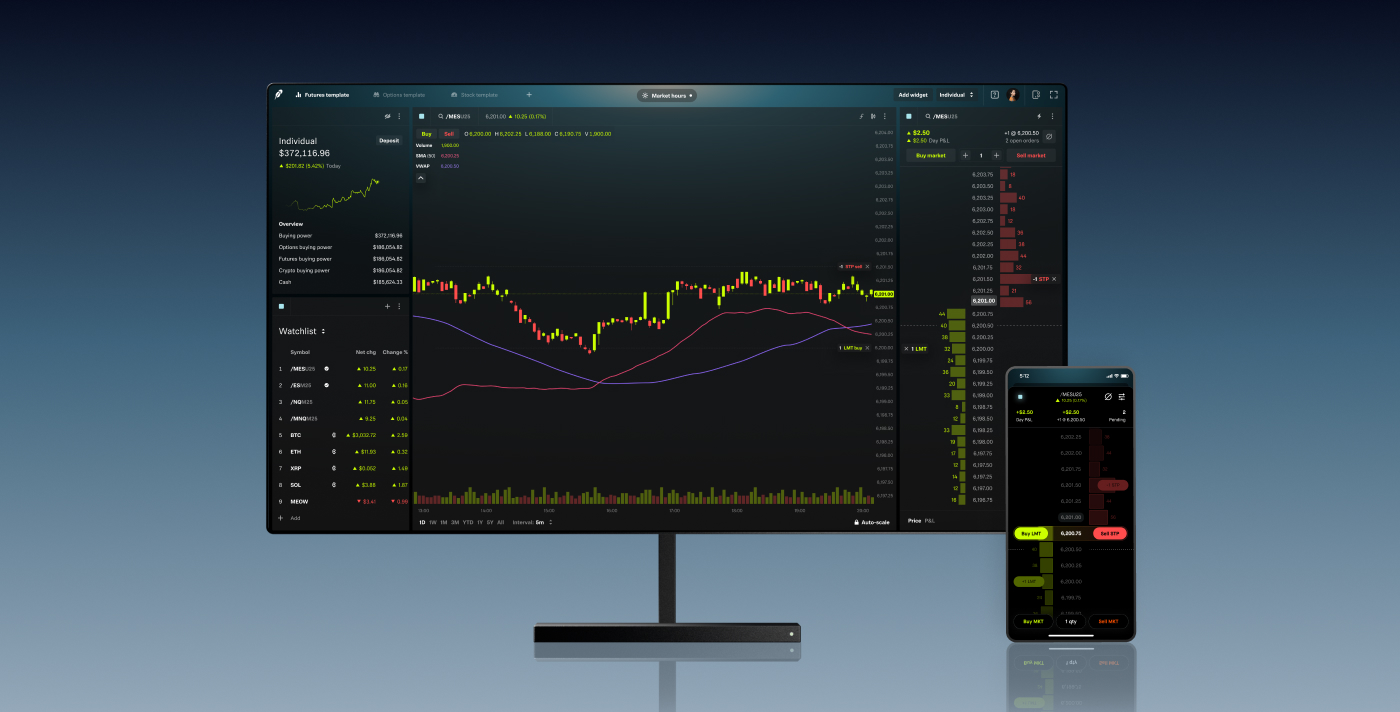
      • Futures on Legend: Trade 40+ different CME Group futures products including S&P 500, oil, Bitcoin, gold, and more–all without PDT rules, greeks, or time decay. Plus, get some of the lowest commissions in the industry–as low as $0.50 with a Robinhood Gold membership–and real-time L2 futures data at no additional cost. With futures on Legend, you can trade directly on any chart or widget quickly and confidently as soon as you spot a trend, or you can trade on the ladder with the same elegant and intuitive experience you’ve come to expect since launching on mobile earlier this year. 
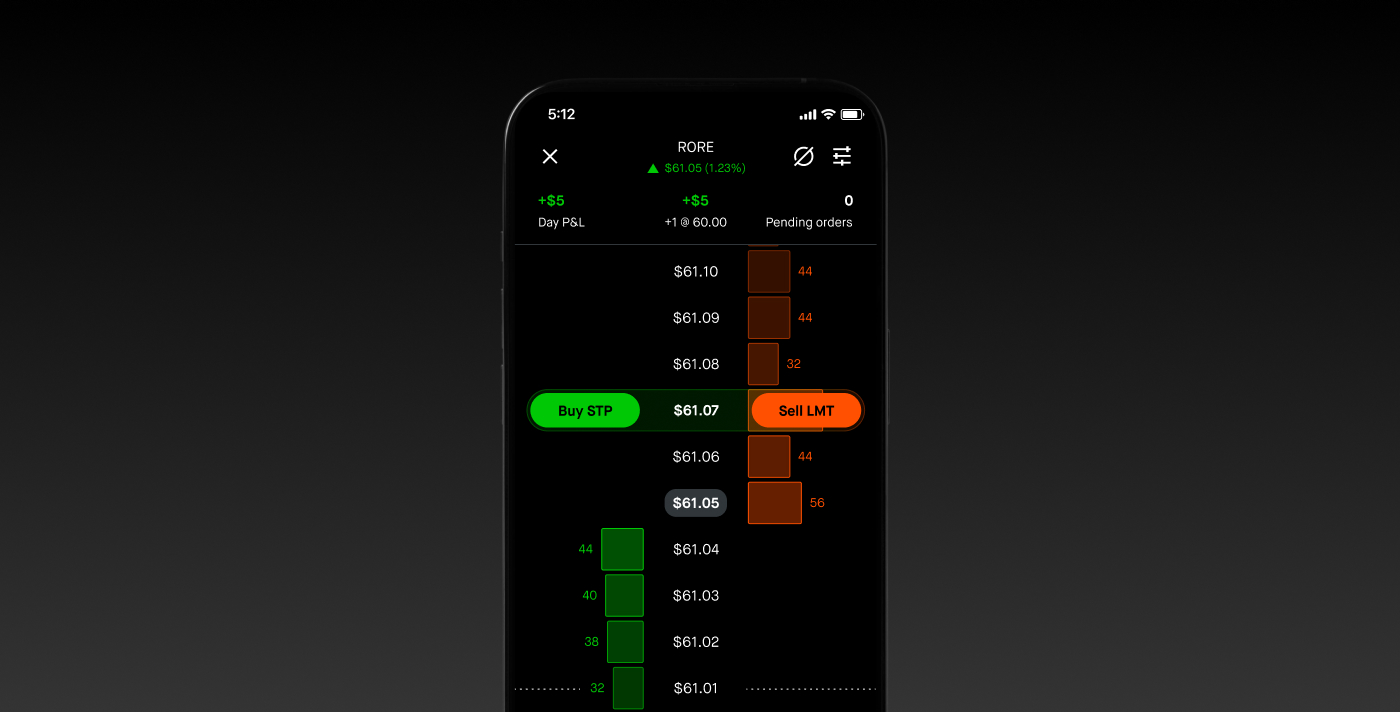
      • A new trading ladder on Legend: Our most active traders want the ability to move as fast as possible. That’s why we’re bringing our popular mobile futures ladder to Legend. With the new ladder widget, traders will be able to view L2 and P&L data while making one-click trades with auto-send enabled. Plus, it supports stocks, ETFs, and crypto, meaning you can get the same sleek experience for other asset classes that you’ve come to expect from Futures. The ladder widget on Legend launches in the US and UK today (note: crypto, ETFs and futures are not currently supported in the UK).
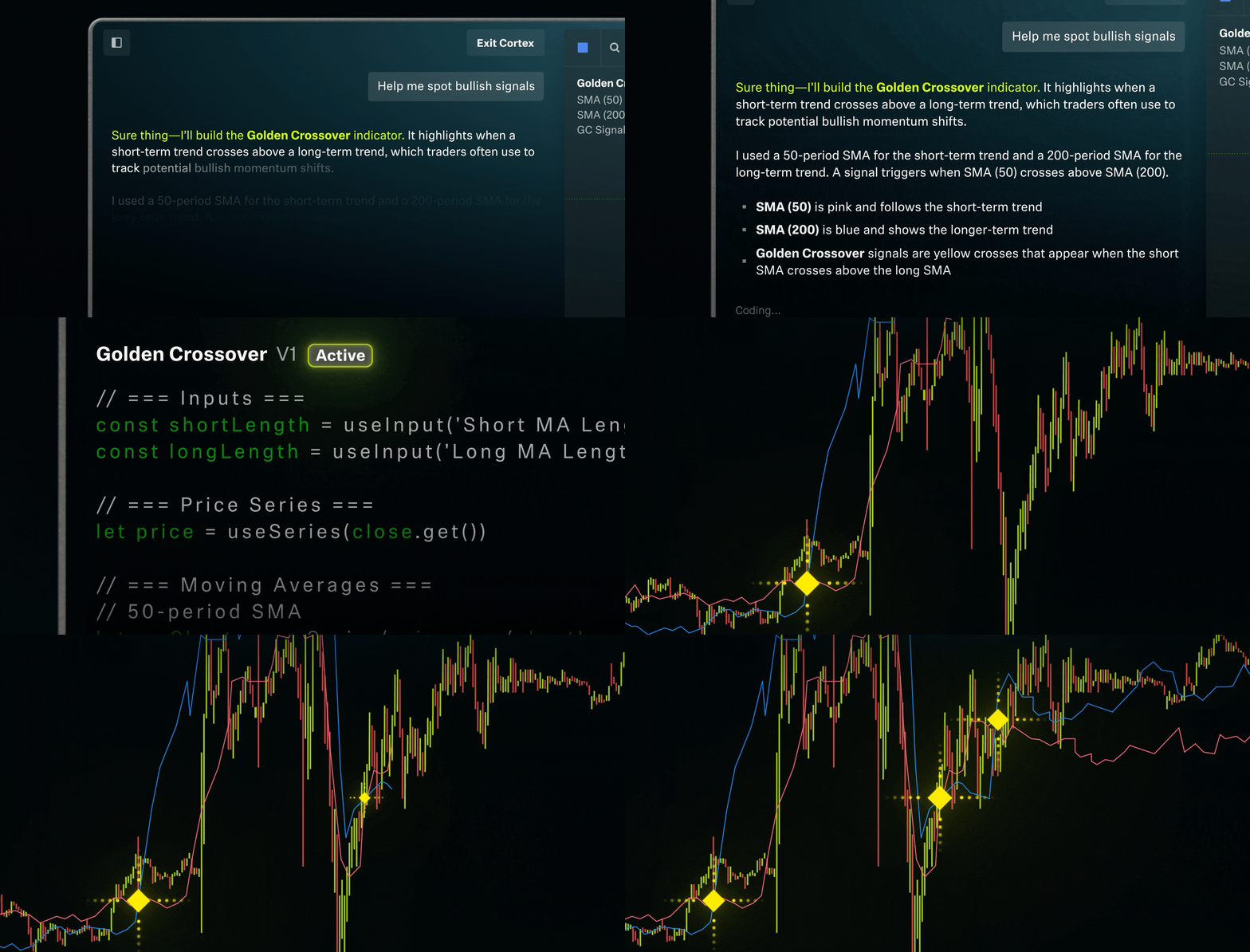
      • Custom indicators powered by Robinhood Cortex: One of the most common pieces of feedback we’ve received is that Legend customers want access to custom indicators. But the only way to build one today is to code it, and very few people actually know how. With custom indicators by Cortex, just tell Cortex what you want to see on your chart and it’ll build a custom indicator for you–with no manual scripting or coding required. Plus, once you build a custom indicator on Robinhood Legend, it’ll automatically show up on mobile with no exporting or syncing required.
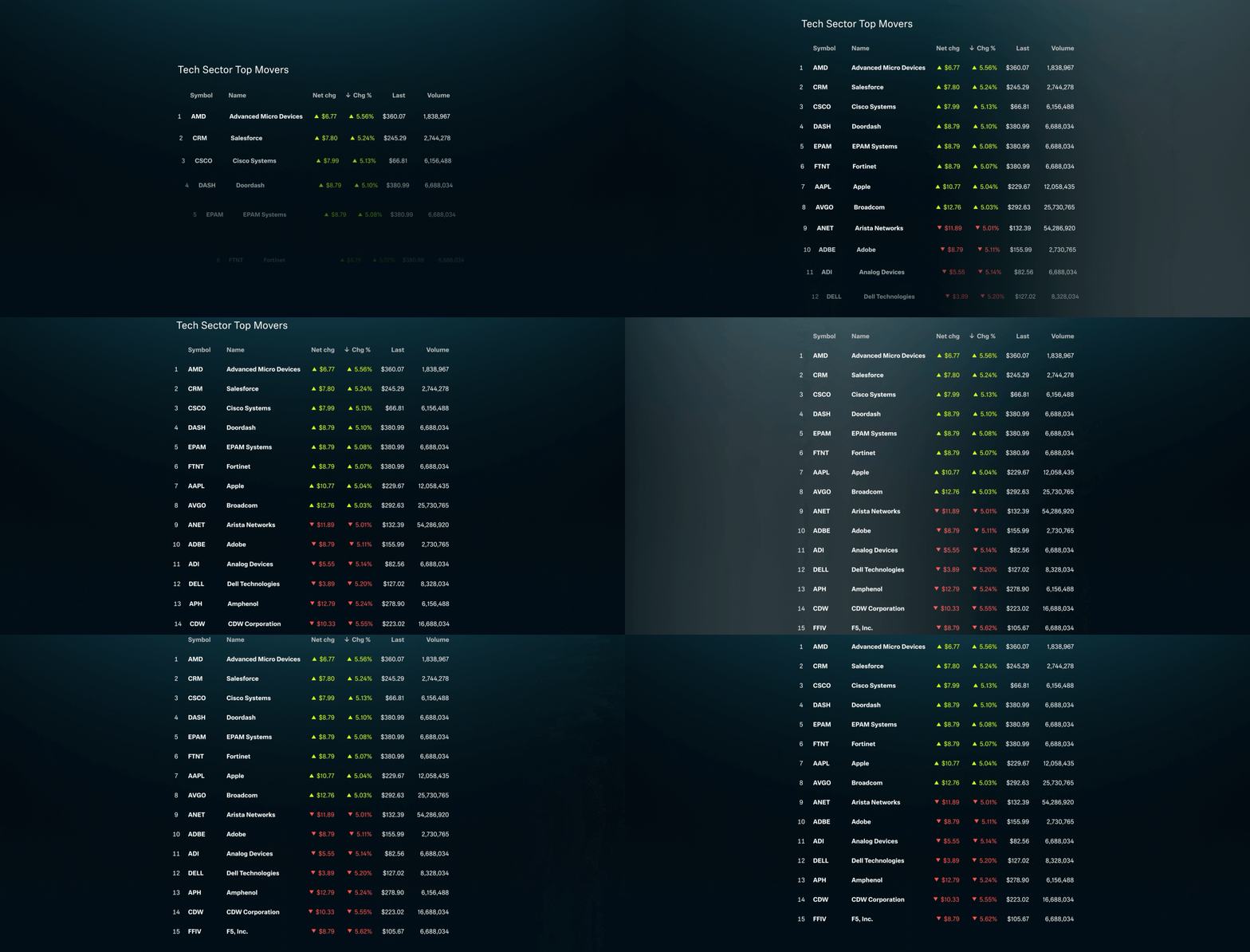
      • Custom scans powered by Robinhood Cortex: Active traders on Legend want more ways to discover new trading opportunities–but existing tools are either too rigid, too slow, or too disconnected. With our new scanner widget, just tell Cortex what you’re looking for and it will monitor the market for matches, providing feedback in near real-time to help you find new trades and go from scan to execution in just seconds. It will be easier than ever to scan across stocks, ETFs, crypto, and futures. 

      This is the next big evolution of Robinhood Legend. Futures trading on Legend is rolling out today with broad availability expected in the coming weeks. Custom indicators and scans by Cortex will launch early next year to all Gold customers. A Robinhood Gold membership costs $5 a month or $50 annually.

      Ladder Up Your Trading

      We’ve grown up alongside our customers as they’ve matured from novice investors to more sophisticated traders and it’s become clear we need to improve our core trading experience to better meet their needs. Just earlier this week we rolled out multiple individual brokerage accounts to all customers, enabling more effective management and tracking of different investing strategies, and today we’re introducing additional improvements to give active traders even more speed, precision, and flexibility around the clock.

      • Expanded mobile trading ladder: The futures ladder launched on mobile earlier this year, and just like on Legend, it will soon support stocks, ETFs, and crypto in the US. The stocks trading ladder will launch in the UK in the coming months (crypto, ETFs, and futures are not currently supported in the UK).
      • Device linking: This new feature will allow you to sync your mobile device with Robinhood Legend to remotely navigate your futures, equities or crypto ladder. Launching later this year, it will enable you to monitor charts on your big screen, while placing trades on the ladder from the palm of your hand. We’ll keep innovating so our mobile app and Robinhood Legend work seamlessly together. 
      • Short selling: This is one of the most requested features by our active traders as it gives you the potential to take advantage of bear markets or hedge against existing long positions and systematic market risks. Leveraging our new equities trading ladder, you will be able to quickly visualize the market and move in and out of short positions in just one tap. It will also be available for those not using the ladder. Short selling will begin rolling out on both mobile and Robinhood Legend in the coming months. 
      • Overnight Index Options: Starting early next year, select Index Options will be available to trade overnight. Once available, overnight trading will be available each night beginning Monday at 8:15pm ET and running through Friday morning at 9:25am ET.

      For more information about Robinhood and these new products visit go.robinhood.com. As a reminder, HOOD Month is in full swing, and there’s still time to take advantage of our limited-time promotions — running now through September 15th. Learn more at robinhood.com/hoodmonth

      HOOD Summit 2025 is made possible by our presenting sponsors Cboe and CME Group, and our supporting sponsors Amazon Web ServicesState Street Investment ManagementTipRanks, and VanEck

      Disclosures:

      HOOD Summit 2025: Enter the Mainframe is sponsored by Robinhood Financial LLC (“RHF”). Not all products presented at HOOD Summit 2025 are offered by RHF, but rather, through affiliates of RHF. 

      Short selling, offered by RHF, has the potential for unlimited losses and may not be appropriate for all investors. Additional fees may apply, see the fee schedule for more information. Short selling requires a margin account. RHF (member SIPC), is a registered broker dealer. Robinhood Securities, LLC (“RHS”) (member SIPC), is a registered broker dealer and provides brokerage clearing services.


      RHF and RHS are separate but affiliated entities. Cryptocurrency services are offered through an account with Robinhood Crypto, LLC. Futures and cleared swaps trading is offered by Robinhood Derivatives, LLC, a registered futures commission merchant with the Commodity Futures Trading Commission (CFTC) and Member of National Futures Association (NFA). Gold membership is offered by Robinhood Gold, LLC. All are subsidiaries of Robinhood Markets, Inc. (‘Robinhood’).

      Some products and services are only available in the US and may not be relevant for UK customers. For information on products and services available to UK customers, please visit the Robinhood UK website or contact our support team.

      Options trading entails significant risk and is not appropriate for all investors. Customers must read and understand the Characteristics and Risks of Standardized Options before engaging in any options trading strategies. Unlike equity and ETF options, index options have some unique features that should be understood before investing in them. This includes, but is not limited to, settlement, exercise, expiration, tax, and cost characteristics.

      Futures and cleared swaps trading involves significant risk and is not appropriate for everyone. Please carefully consider if it’s appropriate for you in light of your personal financial circumstances.

      There are additional, unique risks with trading during extended hours you should be aware of before making an investment decision, including the risk of lower liquidity, increased volatility, greater spreads, and pricing uncertainty. Please review the

      Extended Hours Trading Disclosure for more information concerning these risks.

      When using Cortex Indicators and Scanners, customers should consider their investment objectives and risks carefully before participating in any type of trading strategy. Robinhood does not recommend any particular technical or fundamental trading strategy nor that any strategy will be profitable. There is no guarantee that AI will improve investing performance, mitigate all risk, or reduce losses. 

      The statements, comments, and opinions expressed by customers on Robinhood Social are those of the individuals posting them and do not represent the views or recommendations of Robinhood Markets, Inc. or any affiliates. Content is provided for informational purposes only and is not investment advice, a solicitation, or an offer to buy or sell any security. Robinhood Social is planned to be offered through a newly created subsidiary of Robinhood Markets, Inc.

      Insider, Politician, and Hedge Fund trade data on Robinhood Social is obtained from a third-party provider, TipRanks, which sources the information from publicly available regulatory filings. Robinhood does not verify the accuracy or completeness of this data and makes no representations or warranties regarding its reliability. The individuals and entities referenced are not Robinhood customers. Data is for informational purposes only and is not investment advice.

      All investments involve risk and loss of principal is possible.


      A Cautionary Note Regarding Forward-Looking Statements

      This blog post includes forward-looking statements about Robinhood Markets, Inc. (together with its consolidated subsidiaries, “Robinhood,” “we,” or the “Company”), including statements regarding that Robinhood Social is launching by invitation only to a select number of customers early next year with broader availability expected to follow and that it will be available at no additional cost; that Futures trading on Legend is rolling out today with broad availability expected in the coming weeks; that custom indicators and scans by Cortex will launch early next year to all Gold customers; that with respect to the expanded mobile trading ladder, that it will soon support stocks, ETFs, and crypto in the US and that the stocks trading ladder will launch in the UK in the coming months (crypto, ETFs, and futures are not currently supported in the UK); that device linking will be launching later this year; that short selling will begin rolling out on both mobile and Robinhood Legend in the coming months; and that starting early next year, select Index Options will be available to trade overnight and once available, overnight trading will be available each night beginning Monday at 8:15pm ET and running through Friday morning at 9:25am ET. Our forward-looking statements are subject to a number of known and unknown risks, uncertainties, assumptions, and other factors that may cause our actual future results, performance, or achievements to differ materially from any future results expressed or implied in this blog post. Because some of these risks and uncertainties cannot be predicted or quantified and some are beyond our control, you should not rely on our forward-looking statements as predictions of future events. More information about potential risks and uncertainties that could affect our business and financial results can be found in the “Risk Factors” section in Part I, Item 1A of our Quarterly Report on Form 10-Q for the quarter ended June 30, 2025, and in other filings with the U.S. Securities and Exchange Commission at www.sec.gov. Except as otherwise noted, all forward-looking statements in this blog post are made as of the date of this blog post, September 9, 2025, and are based on information and estimates available to us at this time. Except as required by law, we assume no obligation to update any of the statements in this blog post whether as a result of any new information, future events, changed circumstances, or otherwise. You should read this blog post with the understanding that our actual future results, performance, events, and circumstances might be materially different from what we expect.

      BestEx Research Launches Pulse Analytics

      0

      BestEx Research Launches Pulse Analytics, Debuts Next-Generation Market Impact Model Designed for Futures

      STAMFORD, Conn., September 10, 2025 – BestEx Research Group LLC, an independent provider of high-performance algorithmic execution and measurement solutions for equities and futures, today announced the launch of Pulse Analytics, a new business line dedicated to pre-trade and execution analytics. Built as an API-first, multi-asset platform, Pulse Analytics is designed to help portfolio managers and traders estimate, measure and improve trading costs. Clients can integrate seamlessly via a REST API—or access Pulse Analytics through BestEx Research’s Algorithm Management System (AMS), the firm’s cloud-based front end.

      “Today’s trading analytics are often delivered as static PDFs or black-box GUIs, but we believe that model is outdated. The future is API-driven, because portfolio managers and traders want tools they can integrate directly into their workflows, connect to AI engines, or use to build their own dashboards. An API-first approach raises the bar for robustness and transparency–clients want to understand how models work in order to trust and adapt them. That’s why we built Pulse Analytics, a platform that reflects how trading and technology are evolving,” said Hitesh Mittal, Founder and CEO of BestEx Research.

      The platform’s first offering, the Pulse Market Impact Model for Futures, is now live, delivering symbol-specific transaction cost estimates that reflect the unique structural nuances of futures markets. The model provides both historical and forward-looking transaction cost estimates, broken down into market impact and order placement cost components. Estimates account for key factors affecting execution cost, such as order size, urgency, duration, and time of day. In addition to cost estimates, the model provides access to other execution-relevant analytics—including trade imbalance, spread, and depth of book—as well as benchmark prices such as VWAP, participation-weighted price (PWP), and arrival price. These capabilities enable institutional traders to back-test strategies with cost awareness, evaluate historical trading costs, and estimate the cost of future trading. Coverage currently includes 70 base futures products across Energy, Agriculture, Metals, FX, Equity Indices, and Interest Rates.

      Most futures transaction cost models have borrowed their approach from equities, but futures cost estimation faces unique challenges: shadow liquidity, large tick sizes, wide variation in intraday liquidity, and a limited amount of data—especially for large orders. Pulse addresses these challenges by using both high-frequency order book data and execution data, and employs product-specific models. BestEx Research uses a unique approach to normalize input variables to account for expected order book characteristics at the time of execution.

      Adam Orlov, COO of Aura Capital, a beta user of the Pulse Market Impact Model commented based on his experience, “With the recent uptick in volatility across products, getting a handle on trading costs has been a real focus for us. It’s not something you solve overnight, but having a reliable model that can be plugged in via API—and used to run multiple cost iterations across order size, duration, and participation—has allowed us to factor cost into position sizing and portfolio construction in a way we couldn’t before. It’s helped us avoid situations where trades look good on paper but give back too much in execution. That’s been really impactful.”

      Validated on a diverse sample of more than 72,000 executed orders, the methodology demonstrates strong performance across order sizes, participation rates, times of day, and market regimes—including volatile and illiquid contracts and expiries. The complete details of model development and performance are documented in a research paper available to clients upon request, underscoring BestEx Research’s commitment to transparency and rigor in cost estimation.

      While its Futures Market Impact Model is the initial release, Pulse Analytics will expand to include additional asset classes, a broker-neutral transaction cost analysis, execution optimization tools, and futures roll analytics. Institutional traders can explore the full capabilities of the Pulse Market Impact Model—including product coverage, performance metrics, and detailed API documentation—on the firm’s website. Access to the trial environment is available upon request.

      About BestEx Research

      BestEx Research Group LLC is a provider of sophisticated execution algorithms for equities and futures aimed at reducing trading costs for buy-side managers. The firm’s cloud-based Algorithm Management System (AMS) combines their execution algorithms with a user-friendly dashboard, transaction cost analysis, customization, and automation in the industry’s first multi-asset, independent algorithmic execution platform. BestEx Research also offers sell-side firms a seamless, customizable trading solution for their clients with no coding required. For more information on BestEx Research’s mission and products, or to request a product demo, visit www.bestexresearch.com. Please follow BestEx Research on LinkedIn and Twitter.

      Crypto’s Turning Point: How the Market Structure Bill Could Redefine U.S. Digital Asset Trading

      In a move that could fundamentally reshape how digital assets are traded in the U.S., lawmakers are advancing a bill that finally promises what the crypto industry has spent years demanding: regulatory clarity. For Brandon Mulvihill, Co-Founder and CEO of Crossover Markets, the Market Structure Bill is more than just legislation—it’s a turning point.

      Brandon Mulvihill

      “This is the first time ever in cryptocurrency trading that we’re talking about a national, regulatory framework,” Mulvihill said. “Every other asset class in financial services benefits from that. Crypto has been the exception,” he told Traders Magazine.

      The Financial Innovation and Technology for the 21st Century Act—better known as the Market Structure Bill—seeks to create a unified federal framework for regulating digital assets.

      The bill clarifies which digital assets fall under the jurisdiction of the Commodity Futures Trading Commission (CFTC) versus the Securities and Exchange Commission (SEC), while also defining key market roles such as digital commodity exchanges, custodians, and brokers.

      Importantly, it eliminates the need for firms to obtain a patchwork of state-by-state licenses, offering instead a streamlined national path to compliance. The bill passed the U.S. House of Representatives with bipartisan support on May 22, 2024, marking the first time a standalone crypto market structure bill cleared the full House.

      As of 2025, it remains under Senate consideration, with mounting pressure from the industry and investors for Congress to finalize a clear and comprehensive regulatory framework before more innovation and liquidity move offshore.

      Mulvihill has been closely involved in shaping the bill, and he sees it as a necessary evolution that brings digital assets closer to the standards of traditional finance, without smothering the innovation that defines the space. “The cryptocurrency market started—as most markets do—in an unregulated format,” he explained.

      “That led the industry to adopt state-by-state Money Transmitter Licenses (MTLs), which were never really built for this purpose. The result was a patchwork system that forced companies down a vertically integrated path, regardless of whether that made sense for their business model,” he said.

      The Market Structure Bill seeks to modernize the regulatory landscape by clearly defining the roles of market participants—custodians, market makers, and digital commodity exchanges—and aligning each with responsibilities suited to their specific functions.

      “It allows crypto to be regulated in a format analogous to traditional finance,” Mulvihill said. “If a firm wants to be vertically integrated, great. But if they want to specialize—like we do at Crossover—they can just tick that one box and operate accordingly.”

      Crossover’s business model, as an execution-only venue, doesn’t touch client funds or act as a counterparty, Mulvihill said. That operational simplicity allows the firm to focus exclusively on performance and infrastructure. “Our platform CROSSx currently matches trades in single-digit microseconds,” he noted, “with 1,151 FIX sessions already deployed in production. The DCE rules in the bill make it possible for firms like ours to scale efficiently without possibly being burdened by capital requirements intended for businesses that handle client money.”

      Mulvihill sees the bill’s dual-path compliance approach as a smart move—offering regulated entities a clearer, faster way to enter the market without starting from scratch. “There should be a very clean pathway for how traditional financial institutions can get involved in crypto, should they wish to do so,” he said. “We want the U.S. to be the focal point of the global crypto market, and that means making it easier for both incumbent players and crypto natives to operate here.”

      For years, regulatory ambiguity has driven liquidity and innovation offshore. Mulvihill believes this bill could reverse that trend. “The answer is a resounding yes,” he said when asked if this could make the U.S. a global crypto hub again. “We don’t need to reinvent the wheel—we just need to apply the kind of frameworks we already use in other asset classes, with tweaks for crypto’s nuances.”

      As other jurisdictions like the EU move quickly with comprehensive legislation such as MiCA, the U.S. risks losing its edge. “Speed is critical because the world is moving at an unbelievable pace,” Mulvihill warned. “We’re already seeing areas of critical mass develop offshore, and those are very difficult to undo.”

      He also pointed out that the current imbalance between crypto-native firms and traditional finance players could worsen without action. “Right now, it’s easier for crypto firms to buy their way into traditional financial products than it is for regulated TradFi firms to touch crypto,” he said. “That asymmetry needs to be addressed. This bill helps shut down that imbalance and promotes fair competition.”

      Ultimately, Mulvihill views the bill as a foundational piece of infrastructure—not just for firms like his, but for the broader maturation of the industry. “When firms understand the rules of the road, they’re more likely to invest, build, and scale in the U.S.,” he said. “There are many roles to play in this market, and it’s refreshing to finally see those roles clearly defined,” he concluded.

      LTSE Will Petition SEC to Allow Public Companies to Reduce Quarterly Reporting Frequency


      New York, NY — Sep 9, 2025

      The Long-Term Stock Exchange (LTSE) today announced that it plans to petition the SEC
      to allow public companies to report earnings semi-annually instead of quarterly. This marks
      the first formal regulatory proposal to reduce mandatory reporting frequency since current
      requirements were established.

      The petition potentially affects thousands of publicly traded companies currently bound by
      quarterly reporting requirements. While the Securities Exchange Act of 1934 provided the
      legal framework for periodic reporting, the SEC initially required only semi-annual reports
      starting in 1955 before moving to quarterly reporting in 1970.

      LTSE Founder and best-selling author Eric Ries said, “This has been a longtime dream of
      the business community and represents the culmination of efforts by many long-term
      investors, companies, and policymakers over decades. The time has come to create a
      capital markets system that rewards patient capital and long-term thinking.”

      The proposal addresses longstanding concerns about quarterly reporting’s impact on
      corporate decision-making. Business and political leaders, including the Trump
      administration (in 2018) and the U.S. Chamber of Commerce has suggested that
      companies should report every six months instead of quarterly. Extensive academic
      research has documented the negative effects of quarterly reporting pressure on long-term
      value creation.

      For long-term investors, the change could lead to more strategic company insights while
      reducing short-term volatility and better alignment of corporate management to investor
      interests. Under the proposed guidelines, all companies would retain the option to release
      quarterly earnings but would not be required to do so.

      This focus on long-term value creation directly addresses systemic market pressures that
      currently favor short-term thinking.

      “As CEOs, we absolutely have to deliver on short-term metrics; both our customers and
      investors depend on it,” said Maliz Beams, CEO of LTSE. “But the key is including
      short-term targets as deliberate mile markers on the path to long-term value creation. This
      petition takes a critical step toward enabling genuinely long-term companies to focus on
      sustainable growth rather than quarterly noise.”

      About the Long-Term Stock Exchange
      LTSE Group was founded by Eric Ries, creator of the Lean Startup methodology, to foster
      long-term value creation by evolving capitalism to support better business practices. LTSE
      operates the only SEC-approved stock exchange with listing standards that codify
      long-term practices, serving companies demonstrating exceptional commitment to
      sustainable growth and strong governance. The company also provides advisory services
      for late-stage private market companies.

      For media inquiries
      ● Steve Goldstein, steve@ltse.com

      Crypto Derivatives Come of Age

      Lynn Strongin Dodds provides a progress report on crypto derivatives and the impact of changing regulation and heightened volatility since the beginning of the year.

      Digital assets have been a hot topic for many years, but it is only fairly recently that there is more action than talk. Changing regulation in the US and product innovation have made these assets more attractive which is why as of July, figures from CoinLaw show a record $8.94 trn in monthly volume, surpassing their spot trading counterpart.

      Further data from CoinLaw reveals that the value of the overall crypto derivatives market is over $28 trn annually, making it one of the most active digital finance sectors. It currently represents around 76% of the total cryptocurrency trading volume, although Bitcoin and Ethereum derivatives still dominate the space, accounting for 68% of the total traded.

      Demand for crypto derivatives has soared as investors seek to maximise gains during the current historic bull run in digital assets triggered by Donald Trump’s re-election in November. The president’s Working Group on Digital Asset Markets, which was established soon after he took office, has called on Congress to pass the Digital Asset Market Clarity Act to eliminate gaps in regulatory oversight by providing the Commodity Futures Trading Commission (CFTC) authority to “oversee spot markets for non-security digital assets” and measures that embrace decentralised finance technologies.

      The working group has also recommended that that CFTC and Securities and Exchange Commission (SEC) join forces to develop a rulemaking process and using “their existing authorities to provide fulsome regulatory clarity.” The question of whether the CFTC or the SEC should be the primary regulator of digital assets has been the subject of years of debate and policy arguments.

      The popularity of digital assets is not just down to a more amenable regulatory framework but as a way to mitigate risk and enhance liquidity due to recent market volatility and the ongoing geopolitical tensions in the Middle East and between Russia and Ukraine.

      These instruments mirror traditional financial derivatives but are tailored to the volatility and 24/7 nature of crypto markets. They are bifurcated into centralised and decentralised with non-US markets leading in trading volume in the former. The latter, albeit slighter, is gaining traction for its security and transparency, with dYdX protocol being a major player in DeFi derivatives, according to a report from EY.

      As for exchanges, figures from CoinLaw report unregulated Binance is at the forefront with $15.5 bn in daily trading volume followed by counterparts – Bybit and OKX f- with the much smaller amounts of $6 bn and $4.5 bn respectively. The regulated CME Group lags far behind on just $311 m daily.

      However, there is growing demand for institutional-grade and focused venues, markets and technology infrastructure as digital asset trading volumes surge, according to a report by Crisil Coalition Greenwich –  Digital asset trading 2025: A market in transition.

      Author David Easthope, a senior analyst who heads up fintech research on the market structure and technology team at the consultancy, believes the market still has a way to go before it reaches full maturity. He notes that in order to access the full range of assets, institutions often need to participate in venues outside the US in places such as Dubai, Hong Kong or Gibraltar. 

      Historically, trading venues in the US have been careful to not list assets that were going to trigger regulatory scrutiny but given the Trump administration’s push for more adaptable rules, more nationally regulated venues are likely to emerge over time, similar to those in other jurisdictions.  “Given that 44% of investors prefer regulated venues for cryptocurrency trading, we expect trading to move more in that direction as fast as venues can get assets listed, assuming they can offer sufficient liquidity,” says Easthope. “This virtuous cycle should create more competition as well as deeper and more liquid markets across a wider range of crypto assets.”

      One of the most significant developments this year has been Coinbase’s launch of perpetual futures for trading Bitcoin and Ethereum. These contracts, which were introduced almost ten years ago, are the favourite comprising 78% of total crypto derivatives trading volume.  

      They have been mainly traded on overseas exchanges and are typically employed by offshore investors to gain exposure to crypto without holding the digital assets directly and to add leverage that can be as high as 100 times. Unlike traditional futures contracts, the prices are adjusted every eight hours with no expiration dates, allowing them to track the spot-market prices closely. 

      The country’s largest US digital-asset exchange said its offering complies with regulatory standards outlined by the CFTC which includes limiting the maturities of its contracts to five years and capping leverage at 10 times.

      The CFTC is also exploring whether to let some registered futures exchanges list leveraged digital assets like Ether and Bitcoin. The agency said this would be the first step in its recently crypto sprint initiative launched recently in line with the Working Group’s recommendations.

      There has also been movement on the futures front which has seen contracts on Bitcoin and Ethereum jump 26% year-over-year on the back of strong speculative demand (CoinLaw data). The Crisil Coalition Greenwich report notes that CME and CBOE are expanding their reach into these markets and are no longer dwarfed by derivatives marketplaces like Deribit. These contracts, often used by both individual and institutional investors, enable leveraged trading, allowing traders to profit from anticipated price movements or hedge against market risks.  

      New product development has also been a feature this year especially in the crypto exchange traded product (ETP) sphere with the SEC’s recent decision to allow in kind creations and redemptions. Both spot bitcoin and ether ETPs were previously restricted to creations and redemptions on in-cash grounds. The changes will allow them to generate and reclaim shares on an in-kind basis, similar to other commodity-based ETPs. 

      Although the outlook looks bright for crypto derivatives, there are inherent risks including high volatility, leverage exposure, operational challenges and platform-related uncertainties. Additionally, the complexity of these instruments requires a deep understanding of market mechanics, liquidity, and regulatory environments.

      However, as the Crisil Coalition Greenwich report points out, “the market is shifting toward a more robust and institutional-grade landscape, with firms like Bullish, LMAX Digital, Zodia, EDX Markets, Crossover, Coinbase, and Kraken providing upgraded venues, and BitGo, Galaxy Digital, Hidden Road, FalconX, and Coinbase building out prime brokerage operations.” 

      The report notes: “Custodians such as Etana, Anchorage, BitGo, and Copper also have aspirations to expand their institutional offerings to support the full trading life cycle, including in settlement and collateral movement. Moreover, the report adds “the emergence of full-stack prime brokerage operations will provide institutional traders a more comprehensive and coordinated approach to trading, custody and settlement and staking.”

      24X National Exchange, TNS Partner on Data Connectivity

      24X National Exchange Partners with TNS to Provide Market Data Connectivity Across 23/5 Trading in U.S. Equities

      09 September 2025

      Stamford, Connecticut, September 9, 2025 – 24 Exchange announced today a strategic partnership with Transaction Network Services (TNS), a leading global provider of mission-critical infrastructure and connectivity solutions for the financial markets. Through this collaboration, TNS will provide access to market data from 24X National Exchange, the first national securities exchange approved by the SEC to offer 23-hour weekday trading of US equities.

      Beginning with the launch of trading on 24X on September 29, broker-dealer firms that are members of the new Exchange will receive 24X market data via the TNS secure, low-latency infrastructure. This will enable 24X National Exchange members and their retail trading clients to receive real-time pricing information and trading updates with optimal performance, further establishing 24X at the forefront of market transformation to nearly round-the-clock trading.

      24 Exchange CEO and Founder Dmitri Galinov said: “Providing fast, dependable market data is fundamental to our mission of creating a modern, accessible and global equities marketplace for trading in US equities. Partnering with TNS allows 24X to deliver the high-quality connectivity our participants expect, supporting trading strategies that rely on accurate and timely information across standard and 23/5 trading sessions.”

      “Connecting to 24X National Exchange enhances TNS’ 24×5 trading capabilities, particularly for firms in the Asia-Pacific (APAC) region – including Hong Kong, Tokyo, and Singapore – that need to access US equities during their local trading hours,” said Jeff Mezger, Vice President of Product Management at TNS.

      “TNS is uniquely positioned as the only provider offering comprehensive access to every overnight U.S. equities trading venue. With growing demand from Asia and other international markets, our global network delivers the reliable, ultra low-latency market data that firms need – around the clock, anywhere in the world.”

      24X National Exchange will offer trading of U.S. equities from 4:00 a.m. to 8:00 p.m. ET on weekdays. The platform will operate under full SEC regulatory oversight and with all the standard investor protections afforded to national exchanges. The Exchange will initially focus on meeting the growing demand for overnight trading in U.S. equities among tech-savvy retail investors throughout the APAC region.

      Pending final approvals and market infrastructure alignment, 24X National Exchange will transition to operating from 8:00 p.m. ET on Sunday through 8:00 p.m. ET on Friday, with a one-hour daily operational pause for software maintenance and testing. The launch date for the Exchange’s second stage will be announced at a later date. 24X National Exchange is built on a robust, high-performance technology infrastructure powered by MEMX Technologies, ensuring a seamless, resilient, and cost-effective trading experience.

      “TNS will help ensure 24X delivers access to real-time, always-on data to retail investors everywhere who are trading U.S. equities on our new Exchange via broker-dealers,” Galinov added.

      About 24 Exchange

      24X Bermuda Holdings LLC (“24 Exchange”) is a privately held company with two primary operating subsidiaries: 24X Bermuda Limited, which allows seamless and cost-effective exchange of currency exposures; and 24X National Exchange LLC, the first national securities exchange approved by the SEC to operate 23 hours each weekday. 24 Exchange’s mission is to enable cost-effective trades across a growing range of asset classes around the clock. 24 Exchange lowers the cost of exchanging assets in the global markets while delivering creative and unique workflows catered to each asset class. More information is available at https://24exchange.com/. 24X National Exchange will enable retail and institutional customers around the world to trade in U.S. equities via broker-dealers who are approved members. More information about 24X National Exchange is available at https://equities.24exchange.com/home.

      About Transaction Network Services (TNS)

      Founded in 1990 and with headquarters in the USA and offices across Europe and Asia, TNS is a leading provider of mission-critical infrastructure, connectivity, market data and analytic services for the Financial Markets community. Delivered as a fully managed Infrastructure-as-a-Service offering, TNS provides an unrivalled, global, mission-critical footprint that can significantly help reduce the burdens, complexities and costs attributed to firms ‘going direct.’ Through its ultra-low latency connectivity, its global market data offerings and its dedicated 24x7x365 local support, TNS remains the trusted solution provider to more than 750 counterparties globally.

      Nasdaq Proposes Tokenized Securities Trading

      Nasdaq has filed a new proposal with the U.S. Securities and Exchange Commission (SEC) to enable member firms to trade tokenized versions of equity securities and exchange traded products (ETPs) on its markets.

      The filing, submitted on September 8, 2025 (SR‑NASDAQ‑2025‑072), outlines how equities and exchange-traded products (ETPs) may be traded in either traditional digital form or as blockchain-based tokens.

      Under the proposal, tokenized securities would trade alongside their traditional counterparts on the same order book, so long as they are fungible, share the same CUSIP identifier, and provide the same material rights—such as voting, dividends, and liquidation claims, according to the filing.

      Chuck Mack

      Chuck Mack, Senior Vice President of North American Markets at Nasdaq, explained in an interview with the Nasdaq Newsroom that the goal is to integrate digital assets seamlessly into Nasdaq’s existing architecture. “Our filing provides a simple and clear approach to enable trading of tokenized securities under the existing regulatory framework,” he said, noting that the Depository Trust Company (DTC) would handle the conversion to token form after trade execution.

      He described tokenized securities as nothing more than traditional financial instruments recorded on blockchain technology. “They still represent the same store of value as their traditional counterparts,” Mack stated, underscoring that the innovation lies in how ownership is represented, not what is represented.

      Blockchain technology has long been discussed as a way to modernize market infrastructure. By recording ownership on distributed ledgers, settlement could be faster, reconciliation more efficient, and record-keeping more transparent. These benefits, Nasdaq argues, can be achieved without compromising the safeguards that underpin the U.S. financial system.

      In a public post on LinkedIn, Nasdaq President Tal Cohen called the integration “an exciting leap forward for the global financial system,” pointing to blockchain’s potential to reduce friction and unlock efficiencies without sacrificing market safeguards. He stressed that Nasdaq intends to reinforce the core standards of fairness, resilience, and investor protection even as it modernizes trade infrastructure.

      The exchange is cautious to avoid fragmentation or unregulated enclaves of token trading. The filing highlights risks associated with token-like instruments offered in other regions—some of which fail to deliver full shareholder rights or transparency. Nasdaq warns that those platforms can mislead investors and undermine price discovery. In contrast, its proposal ensures that any tokenized security traded on Nasdaq would carry full shareholder rights and be subject to the same surveillance and trade reporting as traditional shares.

      Trade mechanics would remain largely unchanged. Market participants would use familiar order types and routing strategies. Selecting the tokenized settlement option—via a flag at order entry—would not alter execution priority. Surveillance protocols, best execution obligations, market data feeds, and Nasdaq’s fee structure would remain identical for all trades, according to the filing.

      According to Mack, one of the key drivers behind Nasdaq’s filing is responding to growing market demand for tokenized securities. The technology holds the potential to speed up settlements, improve audit trails, and streamline the flow from order to settlement. Moreover, once equity assets are tokenized, they open opportunities for new uses within financial markets and the broader economy. However, Mack also stressed the importance of embedding governance, resilience, and investor protections from the outset to avoid past market failures and ensure a trustworthy environment for all participants.

      Once a tokenized order executes, Nasdaq will relay settlement instructions to DTC, which is building the necessary infrastructure. DTC would then convert the book-entry position into a blockchain token and deliver it to the participant’s digital wallet, managing reconciliation against a reference control account.

      Mack emphasized that the U.S. markets are among the deepest and most resilient globally, capable of processing billions of transactions daily. He explained that any new infrastructure must match that level of scale, reliability, and regulatory oversight. The goal, he said, is to give market participants the choice to use tokenized settlement—provided it maintains market integrity.

      Tal Cohen, Nasdaq
      Tal Cohen

      According to Cohen, instead of creating a separate system, Nasdaq is enhancing the foundation of the current market infrastructure. “Leveraging the strength of our markets today, we are building scalable solutions that unlock the full promise of blockchain innovation for every stakeholder,” he wrote, adding: “We are confident that as an industry, together, we can deliver on the promise of innovative technologies in a manner that benefits all market participants.”

      The filing also positions tokenization as an option tailored to market demand. Mack said that when participants express a preference for tokenized settlement—and it can be done without compromising regulatory standards—they want to offer that option. This flexibility, he noted, is made possible without rewriting market rules or eroding protections.

      Nasdaq plans to launch trading in tokenized securities once DTC’s blockchain infrastructure is ready and any necessary regulatory approvals are in place. The Exchange has pledged to notify its members at least 30 days before tokenized securities become eligible for trading.

      While Nasdaq’s tokenization proposal marks a significant step in market innovation, the exchange has also been advancing other measures to strengthen market integrity.

      In addition to the tokenization filing, the Exchange has recently enhanced its listing standards, primarily focusing on improving liquidity and addressing trading concerns for certain microcap companies, according to Mack.

      While these developments are separate from the tokenized securities initiative, they reflect Nasdaq’s ongoing efforts to optimize capital markets with investor protections at the core, he said.

      “Each of these issues is separate, but they share a common goal: optimizing capital formation while protecting investors and ensuring market integrity,” he concluded.

      Why Direct Lending Still Has Room to Run

      By Trilliam Jeong, CEO, WealthBlock

      There’s no shortage of noise around the direct lending market right now. On one hand, deal activity remains strong, capital continues to flow in and investor appetite hasn’t wavered. On the other, competition is fierce, rates are edging down and macro conditions are less forgiving than they were a year ago.

      But strip out the headlines and the fundamentals still look solid. The demand is there, both from borrowers looking for speed and flexibility and from investors chasing yield and consistency. That puts direct lenders in a strong position, provided they’re prepared to adapt.

      One of the most significant shifts underway is operational. We’re seeing real adoption of technology across the mid-market from AI-assisted onboarding to fully digitised investor dashboards. This isn’t just cosmetic. Faster processes and clearer visibility mean capital can move more quickly, investors stay better informed and managers have more room to protect margins, even in a tightening spread environment.

      LP expectations are shifting too. Many now expect a consumer-grade digital experience from the platforms they commit capital to. They want real-time access to reports, frictionless communication and clarity around how their money is being deployed. That shift in expectations is accelerating the tech arms race across the mid-market. It’s no longer about who can show the best deck but rather can deliver the best infrastructure. And as investor sophistication grows, that infrastructure is becoming a non-negotiable.

      That shift is also influencing how mandates are awarded. Institutional investors increasingly view digital infrastructure not as a bonus, but as a sign of long-term readiness. Questions that once focused solely on deal pipeline and past performance now extend to data availability, reporting cadence and system resilience. It’s not just about what a manager can deliver but how transparently and reliably they can do it. As more allocators run tighter operational due diligence processes, digital maturity is quietly becoming a competitive edge. Platforms that can demonstrate consistent, tech-enabled processes are better positioned to win, and keep, capital.

      That matters, because rates may not stay where they are. Increased competition is already putting pressure on pricing. But firms with strong digital infrastructure are better placed to absorb it. Operational leverage, not just headline yield, is becoming a key differentiator.

      There’s also the issue of scale. Consolidation is real and it’s reshaping the market. The biggest managers are only getting bigger and their resources are hard to match. But size alone isn’t the whole story. Technology is giving smaller and mid-sized players a way to compete on experience even if not on balance sheet. A seamless, professional, tech-forward investor journey can carry real weight with LPs, particularly those who value speed and clarity over brand.

      That’s especially relevant for new entrants. There’s no shortage of managers in direct lending and standing out requires more than just a different strategy. Yes, some are carving out a niche in NAV lending, venture debt or structured credit but what really earns attention is trust. That comes from clear communication, repeatable processes and a level of transparency that goes beyond the marketing deck.

      The macro outlook is part of the equation too. With corporate defaults expected to rise, discipline is going to matter more than it has in recent years. Underwriting strength, sponsor alignment and proactive portfolio monitoring are back in focus. Investors will be watching for signals that managers are prepared for downside risk. The tougher the environment, the more exposed weaker systems become. Inconsistent reporting, vague valuation logic or delayed updates might have been tolerated in a bull market – but not now. Allocators want to know how a manager will behave under stress, not just how they perform when everything’s going to plan. That makes operational maturity as important as deal-level returns.

      Firms that pair credit discipline with real-time reporting will be in a better position to hold onto investor confidence. Allocators are already asking more pointed questions and looking for managers who can back up claims with data. There’s still plenty of room to grow in direct lending, but it won’t be enough to rely on past performance or broad market tailwinds. The firms that outperform from here will need to be efficient, responsive and trusted. In a more competitive, more transparent and more regulated market, those are the traits that will endure.

      IPC Appoints Vimal Vel as Chief Product Officer

      IPC Appoints FinTech & Enterprise Software Leader Vimal Vel as Chief Product Officer as the Company Moves to Redefine the Future of Global Trading Technology

      September 08, 2025 09:08 ET | Source: IPC Systems

      NEW YORK, Sept. 08, 2025 (GLOBE NEWSWIRE) — IPC, a global leader in trading communications technology and financial market connectivity, today announced the appointment of Vimal Vel as Chief Product Officer. Vimal, a visionary product and technology leader, will lead the next generation of product innovation at IPC.

      ”Vimal Vel’s track record of delivering market-leading products and building high-performing product teams in the financial services industry speaks for itself,” said IPC CEO Kurt Adams. “As we develop the next generation of industry-changing digital communications technology, we are thrilled to have Vimal leading the charge.”

      Vimal joins a c-suite led by Adams, who is known for his ability to attract top talent across industries and position companies for growth, innovation, and global expansion. Adams joined the company in 2024, and has already begun to embark on a new phase of growth, as the company scales its vision of delivering the next generation of frictionless trading experiences, while also building a strong and talented leadership team.

      Vimal joins IPC with a mandate to transform integrated trading communications, combining advanced cloud adoption, AI-driven workflows, and seamless multi-modal connectivity to create a unified global trading experience. His appointment underscores IPC’s commitment to delivering trusted, compliant, and reliable technology to its worldwide network of market participants.

      “Trading technology is at a pivotal inflection point,” said Vimal Vel, describing his vision for the CPO role at IPC. “I’m excited to bring a product vision to deliver a multi-modal communication experience that unites voice, chat, video, and data into one seamless platform — giving our customers the intelligent, frictionless, and connected workflows they need to compete in a rapidly evolving market. Kurt and the IPC leadership team are building something truly special, and I’m excited to be part of it.”

      Vimal joins IPC from Morningstar, where he served as the Chief Product Officer, overseeing an $800 million product portfolio in financial services, leading its SaaS transformation and growth. Prior to joining Morningstar, he served as Chief Product Officer at Trepp, Inc., and Head of Product at Cuebiq, and product leadership roles at Dun & Bradstreet where he spearheaded transformative product strategies across multiple industries.

      In addition to his professional accomplishments, Vimal holds an M.S. in Electrical Engineering from the University of Illinois at Chicago and an M.B.A. from The University of Chicago, Booth School of Business.

      About IPC
      A specialist technology and service leader powering global financial markets for over 50 years, IPC Systems is at the forefront of innovation in trading and market data connectivity and communications technologies, setting the standard for exceptional service, innovation, and expertise.

      IPC’s customer-first approach is bolstered by an extensive and diverse financial ecosystem that spans all asset classes and connects market participants anywhere in the world for enhanced communication, collaboration, and compliance.

      Global services include trading communications, electronic trading, data and analytics and infrastructure-as-a-service solutions. IPC is ideally positioned to anticipate change and remain aligned with rapidly transforming markets, and to empower customers to adapt to change, now and in the future.

      To learn more, visit www.ipc.com, explore our Insights page and follow us on LinkedIn.

      Media Contact
      Capital V
      Christine Park
      chrisp@capvstrategies.com