
Perpetual Futures Poised for Growth Beyond Crypto, but Regulatory Uncertainty Remains

Perpetual futures are gaining traction beyond cryptocurrency markets, with institutional interest growing in their potential applications across equities, energy and emerging asset classes, according to a new report from Crisil Coalition Greenwich.

The report, Perpetual Futures: The Next Wave, found that 40% of respondents expect the products to have a positive long-term impact on U.S. futures markets, compared with approximately 20% who anticipate a negative impact. However, regulatory uncertainty remains the biggest obstacle to broader adoption, particularly the unresolved question of whether perpetual futures should be classified as futures or swaps.

David Easthope, Head of FinTech at Coalition Greenwich, said the products could increase market participation, improve access to emerging asset classes and create new trading opportunities by eliminating the need to roll traditional futures contracts. According to the findings, more than half of respondents identified equities, including indices and single stocks, as the asset class with the greatest potential for perpetual futures adoption over the next two to three years. In an interview with Traders Magazine, Easthope discussed the drivers of institutional interest, regulatory challenges, potential liquidity fragmentation and how traditional futures exchanges may respond to the emerging market.

What is driving institutional interest in perpetual futures?

David Easthope

The wave of perpetual futures has been building and is now crashing on our shores. 40% of our respondents see the long-term impact of perps as positive for futures markets, with only about 20% decidedly negative. Positive impacts noted were an increase in overall market participation, improved access to emerging asset classes (e.g., crypto, compute), the potential for new trading strategies, and a more efficient way to gain exposure (via removal of the roll process and/or inherent leverage).

While still primarily trading on offshore venues, perpetual futures or “perps” have captivated U.S. derivatives traders and market structure experts in 2026. Perps are one of the most consequential exports of crypto market structure. The perp has given crypto traders a more capital-efficient way to gain market exposure (and a method of trading without having to hold the underlying, sometimes an onerous issue with crypto).

Outside of the United States, perps are actively trading on a variety of DeFi and TradFi platforms such as Hyperliquid. In the U.S., Kalshi offers perps trading in Bitcoin, gold, silver, and most recently, equities via its recently approved U.S. Large Cap Index future. Perps on U.S. Treasuries are still under review with the CFTC.

Outside of crypto, one of the primary rationales for perps versus traditional futures contracts is to eliminate the roll.

How is regulatory uncertainty affecting adoption in the U.S.?

Our study participants identified regulatory uncertainty as the greatest roadblock to the growth of perps trading in the U.S. (swaps vs. futures debate). As such, a resolution to this debate is paramount so everyone understands the rules of the road. Regardless of the final decision, however, we believe the use cases for perps remain intact.

Which asset classes offer the greatest growth potential beyond crypto?

While the majority of perps volume around the world today is focused on crypto, expansion into equities, energy and compute is coming. In fact, over half of our respondents believe equities (indices and single stocks) will see the biggest applications for perps over the next two to three years, while compute (an emerging part of the AI economy) is mentioned by a sizable group.

We believe compute, covered by both perps as well as traditional futures markets, could see the biggest acceleration in adoption as there is fresh appeal for this asset class as a commercial hedging product.

Could perpetual futures fragment liquidity in traditional futures markets?

While there is generally positive sentiment about these products, there are some concerns. One concern is indeed fragmentation.

Futures markets in the U.S., from agriculture to oil, are deep and liquid and have served traders and hedgers for decades. Product innovation has and will always be a way to challenge existing market structure (including exchanges) and certainly has the potential to improve market efficiency.

However, a growing list of contracts tracking the same or similar underlying assets in both on- and offshore markets could fragment liquidity and potentially cause concerns for commercial hedgers.

However, that concern does not appear to be pervasive across the respondents to our study and could depend on the actual asset class (i.e., equities, energy, metals, etc.). Moreover, we did not speak directly to corporates about this particular topic to get their opinion.

What is holding back broader institutional adoption?

Broader institutional demand depends on whether these products, so far successful offshore in crypto, can be tailored to institutional preferences and U.S. regulatory oversight. For instance, existing market structure will need to change to accommodate products that don’t roll and fund multiple times a day.

Bringing perps into institutional markets will also require the creation of new trade and post-trade workflows. Under current perps workflows, if a holder can’t post the needed margin, the position is automatically liquidated. This might work fine for retail but not for institutions or hedgers.

Not to mention, most institutional trade-processing systems are not built to handle derivatives that never expire. None of these things are insurmountable, but they are important.

How will traditional futures exchanges respond, and where is the market headed?

Retail-facing (for now) perps platforms see a genuine near-term structural opportunity to compete and innovate against the traditional futures industry in the U.S., including futures exchanges. A full-scale barring of perps in the U.S. is unlikely. Regulatory labels can also be debated.

At the same time, futures exchanges have an ability to adapt and respond. We believe it is likely that perps will be reformatted to emphasize the features that most futures market participants are seeking in a way that fits within the U.S. regulatory regime.

In other words, we believe the industry will focus less on what these products are called and more on how they are used and applied to existing, new and emerging sectors of the capital markets.

The City Faces a Very Different Regulatory Revolution Forty Years After the Big Bang

0

It is hard to believe, but four decades ago, London’s financial centre underwent a radical regulatory overhaul that swept away long standing restrictions on  the City of London to embrace computer based trading as well as international capital flows. The Big Bang, helped turn London into a global financial goliath to rival New York, it also ushered in an era that has tested the ability of financial institutions to keep risk and misconduct in check to their very limits.

From the collapse of Barings Bank in the 90s to UBS’s $2.3 billion rogue trading scandal in 2011, the prolonged period since has been littered with costly reminders of what happens markets fail to have the right levels of oversight. More recently, JPMorgan’s $920 million settlement over market manipulation in 2020 demonstrated that even the most sophisticated of surveillance systems are of limited use if warning signals aren’t properly looked into.

Today’s trading environment is faster and more automated than ever before. Securities are bought and sold in a matter of milliseconds across borders and time zones, but the systems financial institutions use to show full compliance have not necessarily evolved at the same pace. Across many financial institutions, the technology overseeing modern markets remains disparate. It is not uncommon for an investment bank to use one system to monitor trading positions, another to identify potential market abuse, and  a third to manage regulatory disclosures. Each performs an important function, but they do not necessarily communicate effectively with one another. As markets have become more and more globally interconnected, the infrastructure overseeing them has remained, highly disconnected.

In the 40 years since the Big Bang, trading has undergone major revolutions, but compliance has struggled to keep pace with ever more complicated markets. Financial institutions operating internationally are having to manage vastly different reporting requirements. If this wasn’t enough, the imminent expansion of trading hours in the cash equities space means that regulatory obligations will not suddenly go away when compliance teams clock off for the working day.

Consider an asset manager trading across London, New York and Singapore. A large trading position accumulated overnight could trigger a disclosure requirement, while unusual activity might warrant investigation. Identifying these issues is difficult enough, but having to do so when relevant information sits across multiple systems makes the challenge even harder.

Then there are the vast swathes of information financial institutions now need to deal with. Modern surveillance systems generate enormous numbers of alerts. Many are harmless erring on the side of caution, but compliance professionals still have to spend hours investigating false alarms while more significant and real risks compete for attention. It’s the regulatory equivalent of fire department being called out every time food burns on an unattended stove.

The industry needs to start thinking about how it can bring monitoring, reporting and surveillance together to better help financial institutions identify risks earlier, as opposed to investigating failures after the event. If these three elements can work in tandem through consistent data and more integrated workflows, then compliance teams would certainly have a much clearer understanding of where risk is residing.

The original Big Bang transformed the City’s ability to compete by modernising how markets operated, its sequel should prompt an equally ambitious rethink of the infrastructure supporting those markets. It is hard to imagine London’s next competitive advantage coming from making trading even faster than it is today, but it may just come from ensuring that oversight can keep pace with whatever the next front office innovation is. If the first Big Bang fundamentally changed how the City trades, perhaps the next forty years will be centred around how risk is managed.

Nasdaq Invests in Always-On Markets

0
Nasdaq Invests in Always-On Markets

Nasdaq has launched Eqlipse Digital to connect tokenized markets with trusted financial market infrastructure and Nasdaq Ventures has invested in One Trading, the regulated European 24/7 trading venue.

Nasdaq Eqlipse Digital went live on 28 October 2026 and Roland Chai, head of Digital Liquidity Networks at Nasdaq, said in a blog that markets are moving toward always-on trading and financial market infrastructures will play a central role in delivering scale. He added: “To do so in a durable way, they must consider how to bring tokenized assets into their markets without building parallel infrastructure, splitting liquidity or weakening investor trust.”

Financial market infrastructures can achieve this by either integrating with existing infrastructure, bridging mainstream and digital asset ecosystems or building trusted tokenization capabilities, according to Chai. He argued that Nasdaq Eqlipse Digital is built to support each approach and adapt as new token models emerge as it has a set of digital asset capabilities that extends the Eqlipse platforms and also works alongside other environments.

Roland Chai, Nasdaq
Roland Chai, Nasdaq

“Tokenized assets connect to the same systems as their mainstream equivalents, under the governance operators apply today, and participants reach them through the connections they already use,” added Chai.

Adena Friedman, chair and chief executive of Nasdaq, said on the third quarter results call on 22 October 2026 that the shift towards more connected and always-on markets is gaining momentum, and Nasdaq is shaping the next generation of market infrastructure.

In the results call Friedman said Nasdaq had signed a deal with Eqlipse Trading technology to power the 24/7 U.S. equities trading ecosystem. She added that Nasdaq remains on track to go live with 23/5 trading of U.S. equities on 6 December 2026, which will expand global access to the stocks.

In addition, Nasdaq is working with DTCC on the post-trade market infrastructure’s tokenization service which went live on 28 October 2026.

One Trading

On 8 October 2026 One Trading announced a strategic investment from Nasdaq Ventures to explore opportunities to combine their market infrastructure expertise, global reach and advanced derivatives technologies to support market innovation and enable 24/7 trading of equity futures.

Gary Offner, Nasdaq Ventures

Gary Offner, global head of Nasdaq Ventures, said in a statement: “One Trading has developed a differentiated approach to integrating trading, risk management and settlement, and we believe the company is well positioned to play an important role in the evolution of derivatives markets.”

Josh Barraclough, chief executive of One Trading, has a background in traditional finance as he previously worked at J.P. Morgan. Barraclough told Markets Media that he saw the “very cool” products being developed in crypto and became particularly interested in perpetual futures. Five years ago Barraclough sat down with regulators in Europe to discuss creating a framework to enable the launch of this “brilliant” product.

“We decided the Dutch regulators were the best for that, and spent two years going through a lengthy and extensive licensing process and building cutting-edge technology,” he added. “We have built a complicated tech stack that performs fully in real time with super-low latency, and is capable of servicing millions of order types a second.”

In July 2024 One Trading received regulatory approval for European crypto derivatives trading and operates a MiFID II-regulated organised trading facility (OTF) authorised by Dutch regulators. The OTF license allowed One Trading to become the only perpetual futures trading venue in the European Union and the first cash-settled perpetuals platform in Europe. It was also the first regulated crypto derivatives exchange in Europe accessible to retail clients.

One Trading launched perpetual futures a year and a half ago and changed to five-year dated futures around six months ago, with a floating funding rate that is consistent with perpetual futures. The exchange has been trading spot crypto for nearly five years and also trades index futures and equity futures 24/7. Barraclough said demand for equities outside the traditional hours is picking up as more macro events happen outside of market hours.

“We are veterans in the 24/7 trading space, and  focused on doing that for all asset classes and for all client types,” Barraclough added. “I think it is going to be really hard for traditional exchanges as it is very hard to retrofit these big technology platforms. The devil is in the detail.”

One differentiator for One Trading is that it recalculates margin for every client on every position twice a second, and then settles all positions every 60 seconds 24/7, according to Barraclough. He said: “We continuously settle between all our counterparties while a traditional clearinghouse settles twice a day, and not over weekends. I don’t know anyone who is margining or settling with that frequency.”

Josh Barraclough, One Trading

As One Trading does not have a weekend or out of hours gap risk, Barraclough said this means is that all the contracts can be traded the same. In contrast in traditional markets, prime brokers will significantly reduce the amount of leverage that can be used for more volatile contracts.

Friedman said on the results call that  always-on markets and AI will lead to the convergence of markets, asset classes and geographies, so risk management needs to be multi-asset class, global and real time.

One Trading is currently licensed to take stablecoins as collateral, as well as any fiat currency. The futures are dollar-denominated but any fiat currency can be used as eligible collateral 24/7 through the Kinexys by J.P. Morgan platform and it is fully cross-margined.

Clients of One Trading include direct retail clients and institutions, including Tier One banks, according to Barraclough. One Trading also provides white-labelling technology so that large companies with tens of millions of retail clients can offer the exchange’s products natively in their app. Barraclough said the exchange is working on more of these large partnerships, which will be announced shortly. The growth strategy also includes launching options and more equity products

LeveL Markets

While Nasdaq Ventures has invested in One Trading, Nasdaq announced the completion of its acquisition of LeveL Markets, the third largest U.S. alternative trading system (ATS), on 15 October 2026.

LeveL Markets sits within Digital Liquidity Networks, which was formed to unify the capabilities, investments, and solutions that Nasdaq has been developing to advance tokenization and always-on markets. Chai said in a statement: “LeveL Markets advances Nasdaq’s vision for more connected, always-on markets by adding a scaled off-exchange liquidity platform and execution expertise to Nasdaq’s technology, market capabilities, and client relationships.”

Balancing Market Integrity and FinTech Innovation to advance U.S. Competitiveness

0

By Kelvin To, Founder and President of Data Boiler TechnologiesBy Kelvin To, Founder and President of Data Boiler TechnologiesBy Kelvin To, Founder and President of Data Boiler Technologies

Kelvin To, Data Boiler Technologies
Kelvin To

The significancy of determining of whether certain Event Contracts are swaps, Securities Based Swap (SBS), or mixed swaps, or types of instruments that fall within statutory exclusions from the “swap” definition, would affect whether a product may or may not be subjected to the Title VII clearing, margin, and prudential oversight alongside other Financial Stability Oversight Council (FSOC) members. While prudential regulators require comprehensive risk-tracking tools to safeguard financial stability, a Title VII classification introduces a much heavier compliance burden for markets and participants. 

  • Operational Friction: Mapping a $1 retail contract into legacy Swap Data Repository (SDR) or SBSDR fields via slow, XML-based protocols creates an expensive data-processing tax.  
  • The SEC Overextension: The SEC’s “Event Contract Prong” errantly treats raw operational facts (e.g., factory counts or emissions) as security-based variables. 
  • Cause vs. Effect: Real-world operational inputs are broad economic commodity “causes,” not security-based valuational “effects”.  
  1. The Exposure to Cause versus Effect (E2CvE) Framework 

To eliminate duplicate policing, risk must be categorized by its true economic nature using three structural filters: 

  • The Operational Sorter (Settlement Mechanism Test): Evaluates settlement data sources. Contracts settling against raw, non-valuational facts are CFTC commodity swaps, while those settling against market appraisals are SEC SBS. 
  • The Legal Filter (Insulated Valuation Test): Requires the contract payout to be mathematically dependent on capital-market appraisals (e.g., stock tickers) to trigger SEC oversight. 
  • The Structural Gate (Operational Intent Test): (i) Trading venues with high-velocity bots generate a volatile “Valuation Mirage,” requiring SEC oversight. (ii) Pre-funded architectures function as passive parametric insurance pools under lean CFTC rules ® i.e., Routes products by operational vehicle. 

Policy Makers should amend 7 U.S.C. § 1a(47)(B) by striking clause (v) and inserting a statutory Two-Part Bright-Line Test. 

  1. The Enhanced Fiduciary Commodity Pool Operator (CPO)-Matchmaker Model  

Since the US cannot simply adopt the EU/UK’s Multilateral Trading Facility (MTF) model because of the Commodity Exchange Act (CEA) mandate to preserve the default waterfall model, policymakers should consider establishing a Safe Harbor to exempt 100% pre-funded CPO-Matchmaker model from traditional mutualized banking default funds – replacing manual paperwork with rigorous mathematical code audits of underlying smart contracts, liquidation scripts, and oracle price feeds to defend against flash-loan vulnerabilities.  

We urge the Commissions to utilize their general exemptive and joint rulemaking authority under §4(c) of the CEA and §§13(n), 15F, and 36 of the Securities Exchange Act (SEA) of 1934 to codify an alternative compliance pathway:  

  • Absolute Asset Isolation: Every account functions as an independent, legally segregated “series cell” under CFTC Rule 4.20, meaning assets and wagers cannot touch or cross-collateralize. 
  • Double-Layered Fiduciary Protection: Operators owe a federal fiduciary duty under Part 4 of the CEA alongside state-level corporate duties, strictly protecting participants from the conflicts native to exchange architectures. 
  • Tax Simplification: Bypasses K-1 routing to automate earnings reporting via standard Form 1099-B templates. 
  1. Structural Mechanics and Eliminating Systemic Risk 

The CPO model registers a net-zero risk signature across the four core-metrics of prudential oversight: 

  • Eliminating Systemic Credit Risk: Leverage is programmatically impossible because contracts require 100% upfront pre-funding, rendering mutualized banking default funds obsolete. 
  • Eradicating the “Valuation Mirage” via Anti-Bot Policies: Direct Retail Clearing models are vulnerable to secret internal affiliate algorithmic trading bots that fabricate activity and widen spreads. The Enhanced CPO model mandates a ban on affiliate algorithmic bots to eliminate artificial volume noise and anchor price discovery to objective third-party oracles.  
  • Orderly Wind-Down & Asset Isolation: Client assets sit in a distinct trust separate from the operator’s capital, isolating cash from corporate creditors if the startup goes bankrupt. 
  1. Streamlined Split-Ingestion Data Reporting 

To satisfy the data harmonization goals of SEC File No. S7-2026-22, we propose a three-module reporting architecture built on cloud-native web protocols: 

  • Module 1 – The Transactional and Identity Layer (Split Model): Decouples market data from identities. Track 1 streams anonymous transaction tapes via compressed JSON payloads over a read-only WebSockets connection. Track 2 keeps customer identity data localized. Regulators pull identity packages via an Electronic Blue Sheet (EBS) gateway only when surveillance nodes flag an anomaly. 
  • Module 2 – Daily Solvency Verification: Solvency reporting completely bypasses platform metrics. An independent custodian bank pushes daily cash logs to the NFA WinJammer Portal via automated APIs. 
  • Module 3 – Streamlined Compression Reporting: Net-risk summary logs are pushed every 1 to 5 minutes to an SDR event bucket, cutting gross exposure logs by over 90% and clearing out blank fields. 
  1. Concerted Surveillance and the Whistleblower Analogy 

We strongly oppose the current CFTC proposal to force exchanges to independently gather employee and occupation data under §16.03(g), as it breaks the dual-tier architecture established under CFTC Rule 166.3 and Part 38 Core Principles. Alternative compliance oversight should update CFTC §40.11 and Part 38 to mandate a tiered surveillance architecture that establishes a concerted coordination framework between execution venues and client-facing brokers. Instead of relying on generic “data-in-motion” transfers under Part 16 – which create data granularity deficits and vulnerable cybersecurity honeypots – platforms should use a pull-based model under CFTC Rule 38.254. Under this framework, the exchange operates a Tier 1 Agentic AI layer to monitor anonymous trade data for anomalies, while client-facing brokers maintain a Tier 2 Audit Trail Hub semantic database to house customer identities and KYC/AML records under Part 1 rules. 

This tiered architecture allows exchanges to summon localized participant identities and secure business communications when a Tier 1 automated surveillance node flags a specific symptom of market abuse. To comply with SEC Rule 17a-4 and FINRA Rule 3110 while permitting Bring Your Own Device (BYOD) cell phone use, broker-dealers use containerized work apps or eSIM carrier mirroring to isolate and record business data without violating privacy. This precision framework allows regulators to look beyond legacy volume metrics and deploy forensic simulation back-testing to reconstruct trade sequences, evaluate market-maker alignment, and flag onset signals of manipulation across interconnected networks. 

Finally, policymakers can evaluate these cross-market mechanics through the lens of corporate whistleblower programs, as both frameworks leverage frontline intelligence to reduce data asymmetry and expose hidden malfeasance. To resolve the “Insider Information Paradox” and prevent incentivized sabotage, the alternative compliance regime must enforce an Enforcement Safe Harbor. This policy permits expertise-driven analysis of fragmented public data, but legally bars corporate insiders from betting against their employers on prediction markets. Instead, it mandates that insiders would route sensitive tips through formal SEC and CFTC whistleblower channels, channeling true information into structured legal remedies rather than chaotic, anonymous market sell-offs. Download our full 60-page comment letter about SWAP at: https://www.databoiler.com/index_htm_files/DataBoiler%20CFTC%20SEC%2020260824.pdf  

Kalshi Sees Parabolic Institutional Growth in Prediction Markets

Prediction market participants and operators have a wide range of business models and approaches to the business, but there is at least one consensus viewpoint across the ecosystem: the market needs to evolve beyond its retail roots and gain a foothold with institutions to sustain growth.

That’s starting to happen, according to Kalshi executives who spoke at a Kalshi media event in New York on Wednesday afternoon.

Nicole Kagan, Markets & Head of Research at Kalshi, opened by noting prediction markets are important for two reasons: one, they fill a gap by providing price discovery in areas that lack it, and two, they enable specific risk hedging in a ‘market as a service’ model.

Kagan provided an update on Kalshi’s new product pipeline, including a structure that offers ladder payouts based on the proximity of one’s prediction, which differs from the traditional binary payout of prediction markets.

Andy Ross, Head of Institutional at Kalshi, said Kalshi’s institutional volume has surged more than 50-fold since March to $29.3 billion so far in October. Ross said 822 institutions have traded on Kalshi in October, up from 130 in January, and 242 institutions have traded more than $1 million. “I don’t feel this is the top of the hockey stick, I feel we’re at the bottom, with parabolic growth still to come,” Ross said.

Institutions trading on Kalshi include hedge funds and electronic liquidity providers such as Jump Trading, as well as traditional investment managers, executives said.

To be sure, prediction markets are growing rapidly, but off a relatively small base. By way of comparison, the New York Stock Exchange handles nearly $1 trillion in equity trades per month.

Prediction markets are a ‘shiny new thing’, and large financial institutions are historically risk-averse and reluctant to be early movers in any new market, especially one that some perceive to be more about gambling than investing. So institutions need to trust a prediction market operator first and foremost, before any discussion about liquidity or products.

Sudhir Jain, Chief Compliance Officer and Head of Regulatory Affairs at Kalshi, said the firm’s recent growth in institutional business is a direct result of building trust in the marketplace.

Jain contrasted the process of onboarding an institutional client, which can take months of each side doing due diligence on the other, with onboarding a retail client, which can be completed in minutes on a mobile phone.    

With regard to market integrity and surveillance, Jain said Kalshi’s safeguards include mandatory AML/KYC, the restriction of certain market participants, employee trading bans, 24/7 surveillance, and disciplinary enforcement. Jain said the general rule is “if you have an edge and you can influence the price, you’re not allowed to trade.”

Kalshi Chief Risk Officer Udesh Jha said risk management is important for prediction markets and for perpetual futures, and there are myriad offshore trading venues with limited risk management. By contrast, Kalshi offers safeguards including pre-trade risk checks, a clearing house to backstop trades, a robust margin risk model, and CFTC oversight. “We cannot compromise on risk,” Jha said.

Cboe Targets Retail Investors with Company-Specific KPI Options

Cboe Global Markets is preparing to launch a new category of binary options tied to company-specific financial and operational metrics, offering retail investors a more targeted way to trade corporate performance.

The exchange plans to introduce contracts covering 23 publicly traded companies, including metrics such as earnings per share, revenue and net income, alongside company-specific indicators such as Nvidia’s data center revenue, Amazon’s AWS revenue and Tesla’s vehicle production.

On October 23, Cboe announced that Cboe Clear U.S. (CCUS) had received temporary registration from the Securities and Exchange Commission (SEC) to operate as a Covered Clearing Agency, expanding its authority to clear securities products alongside futures and swaps. The new KPI contracts are expected to launch on Cboe Options Exchange and become available through Robinhood in the fourth quarter of 2026.

In an interview with Traders Magazine, JJ Kinahan, SVP, Head of Retail Expansion and Alternative Investment Products at Cboe Global Markets, discussed growing demand for more granular trading opportunities, the role of Robinhood as the initial retail distribution partner, the importance of SEC oversight and potential expansion into additional products.

What investor demand are you seeing for company-specific KPI contracts, and why launch them now?

JJ Kinahan

With the rise of options trading and prediction markets, investors are increasingly looking for more ways to trade and manage risk. Cboe’s KPI contracts add the ability to trade the specific company metrics investors already follow closely on a quarterly basis. It gives the investor a way to be more granular in their trading and eliminate the risk of movements on analyst expectations rather than the individual components of earnings that move the stock.

We are excited to have received SEC regulatory approval of the products and the temporary registration of Cboe Clear U.S. (CCUS) as a Covered Clearing Agency to clear these products.

How will the initial KPIs be selected, and which company metrics do you expect to attract the most interest?

We plan to list KPIs for 23 public companies at launch. We chose many of the most tracked and traded names in U.S. equities and options, focusing on metrics companies report each quarter.

These include Earnings Per Share, Revenue and Net Income, along with company-specific metrics like Nvidia’s Data Center Revenue, Amazon’s AWS Revenue, and Tesla’s Model 3/Y Production. One company metric that will be particularly interesting to track given the launch of the new iPhone is Apple’s iPhone Net Sales.

How do these contracts differ from event contracts currently offered on prediction markets?

The KPI binary options will be options listed on Cboe’s registered U.S. securities exchange and regulated by the SEC. They will trade within the same framework as listed options and be subject to the protections of the U.S. securities laws and regulations.

Why was Robinhood chosen as the first retail broker to offer the products, and what role will it play in building adoption and liquidity?

Robinhood’s a great partner of Cboe’s and one of the leading retail brokers in the industry in terms of options volume. Their reach puts these products in front of an engaged retail trader base.

I was at Robinhood’s annual HOOD Summit last month in Houston and there was a lot of excitement around what is coming next. We plan on expanding to other brokers just as we do in any other Cboe-listed product.

Why was it important to structure these as SEC-regulated securities products rather than CFTC-regulated contracts?

We believe products that are listed directly on a securities index or corporate performance metrics should fall under the SEC’s jurisdiction. The corporate performance metrics are pulled directly from the public company’s SEC filings.

That is, the issuers have made the affirmative decision to disclose these metrics to their investors because they deem that the metrics are material to their actual reported financial or operating performance. We think that’s important.

The SEC has long-standing experience protecting investors and enforcing rules against insider trading, and equity and options investors are used to this robust framework.

How could the offering expand beyond the initial 23 companies, including into tokenized binary security options?

We will closely track potential new contracts and companies to list based on client demand. The enhanced clearing capabilities of CCUS will allow us to explore new product categories.

Anthropic Pre-IPO Perpetuals Go Live

0
Anthropic Pre-IPO Perpetuals Go Live

The pre-IPO (initial public offering) perpetual futures market for AI firm Anthropic has gone live on the Hyperliquid blockchain, as previous contracts have closed within an average of 25% of the IPO issue price.

Perpetual futures are contracts without an expiration date that track the spot rate of the underlying asset through a funding rate. Pre-IPO perpetual futures allow traders to take a view on the company’s share price once it goes public. The Anthropic contracts were launched after Anthropic, the AI company behind Claude, filed its S-1 on 26 October 2026 with the U.S Securities and Exchange Commission.

The contracts provide synthetic exposure as they are not shares, IPO allocations, tokenized equity, or claims on the issuer, so holders do not receive ownership, dividends, voting rights, or primary-market allocation rights. Before listing, there is no public equity price so the pre-IPO perpetual market operates with a discretionary reference price. The market may also display an initial reference share count and an implied initial reference market cap.

The Hyperliquid Research Collective (HRC), a research hub for Hyperliquid, said on X that the pre-IPO perpetual future will convert to a standard perpetual derivative once Anthropic starts trading on Nasdaq, which is expected around 20 November, with a 60-day grace period if the IPO slips.

“How efficiently this market prices Anthropic ahead of the listing will matter a lot for the credibility of IPOPs (pre-IPO perpetuals) as a whole,” added HRC. “And with OpenAI likely not far behind, all eyes could stay on Hyperliquid for the foreseeable future.”

TradeXYZ, a perpetual futures exchange on the Hyperliquid blockchain, inaugurated the pre-IPO perpetual contract market on 1 May 2026 when it listed a contract for Cerebras Systems, the artificial intelligence chip manufacturer. On 18 May TradeXYZ subsequently launched a perpetual futures contract ahead of the IPO of SpaceX, Elon Musk’s rocket and artificial intelligence company.

Petro Dmytrilev, a decentralised finance (DeFi) analyst, has analysed six pre-IPO perpetuals on Hyperliquid have run all the way into a public listing.

@PDmytriiev added on X: “Four stocks opened above their perp and two below, and the split ran along geography: the US perps mostly ran too hot, while every Chinese listing opened higher than the perp implied.”

For Cerebras, @PDmytriiev said the perpetual priced at $284 on the morning of listing, and the stock opened 23% higher at $350. He added: “Most of that gap closed in the final hours before Nasdaq trading began, which keeps $CBRS the cleanest price-discovery case on the platform.”

For SpaceX, @PDmytriiev added that this was the deepest market, with roughly $800m of volume before listing. The $150 issue price was 15% lower than the $177 perpetual mark, after the contract had traded as high as $230 in the pre-IPO window.

“The perps got the direction right in five of six cases, and CBRS shows that with enough depth the gap can close almost entirely by the open,” added @PDmytriiev. “With Jio listing on Oct 28 and Anthropic filing publicly, the next few months should show whether that accuracy improves as liquidity grows.”

The pricing for the Anthropic pre-IPO perpetuals is available on Bloomberg, so it is available to traditional finance:

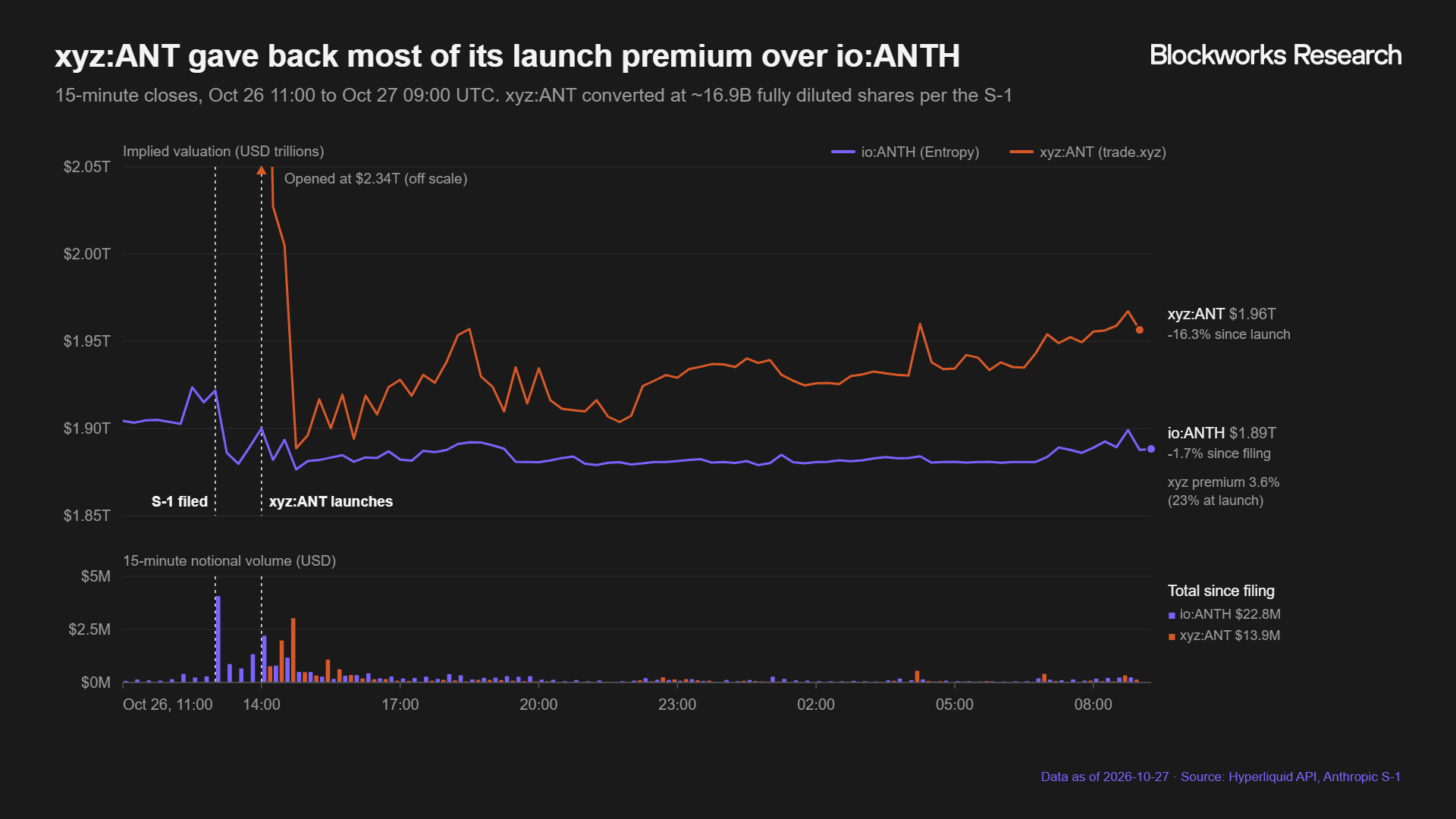
OxResearch, a newsletter from Blockworks, highlighted that Entropy, another Hyperliquid HIP-3 exchange, listed Anthropic valuation perpetuals in August this year. The newsletter said: “While the two markets differ in what they are anchored to, they both largely trade on their own order books, which have converged quickly to one another thus far. Both markets value Anthropic at nearly double its Series H valuation.”

Entropy’s io:ANTH pre-IPO Anthropic market has processed around $669m in cumulative volume since its launch, and has $53m in open interest, according to Blockworks Research.

“Until a price range is set closer to the IPO date, the xyz:ANT and io:ANTH markets remain the closest thing to a live market price for what is shaping up to be one of the largest IPOs on record,” added the newsletter. “Whether traders are correctly pricing the company at nearly double its last private round will become clear in mid-November, at which point xyz:ANT converts to a standard equity perp and io:ANTH converts under its IPO terms.”

Harrison Rolfes, senior analyst, private company coverage at PitchBook published a detailed analysis of Anthropic’s S-1 filing and valued the company  at $1.42 trillion, about 29% below the reported $2 trillion IPO valuation.

Rolfes said in a report that the business earns more than investors could see before the filing, but pay-as-you-go revenue and founder control give outside shareholders less.

“Our value of about $84 a share is 42% above the Series H share price,” added Rolfes. “We would own the shares at or below $1.25 trillion, near the low end of our range, at half size until the payment schedule is public.”

Payward partnership

Payward, the parent company of crypto exchange Kraken, announced in September this year that it intends to deploy onchain perpetual futures for US clients, starting with Hyperliquid HIP-3* markets, the blockchain protocol’s first builder-deployed permissioned perpetual markets. HIP-3* will provides additional functionally for permissioned markets in a future network upgrade, according to Hyperliquid.

Hyperliquid is the first protocol that Payward plans to deploy for U.S. clients to make DeFi products more accessible within established regulatory frameworks.

Calvin Leyon, head of onchain at Kraken, said in a statement: “Payward is pioneering a framework on Hyperliquid that we believe can be replicated across products and markets globally. By pairing Hyperliquid’s cutting-edge protocol with Payward’s infrastructure, liquidity and regulatory stack, we intend to bring a premier onchain product to users in the U.S. market.”

Bitnomial, Payward’s CFTC-regulated exchange and clearinghouse, would be the HIP-3* deployer: it would create, own and administer the market and clear and settle the contracts.

Arjun Sethi, Kraken

NinjaTrader Clearing, Payward’s CFTC-registered futures commission merchant, would carry the client accounts. Jon Pham, head of U.S. derivatives at Payward said in a statement that, if approved, a U.S. client would open a futures account with Payward’s registered broker and trade new perpetual futures contracts on Hyperliquid, cleared through the same clearinghouse that already supports the crypto perpetual contracts Payward already offers U.S. clients.

Arjun Sethi, co-chief executive of Payward, said in a statement that multiple venues run builder-deployed perpetuals on Hyperliquid. However, one holds 98% of the open interest, and no registered U.S. exchange or clearinghouse has deployed a market on Hyperliquid.

“Payward intends to be the first, holding the keys and carrying the regulatory obligations,” added Sethi. “We already list our own U.S. perpetuals and intend to deploy on Hyperliquid as well, putting clients first, not ourselves.”

Perpetual futures have traded outside the U.S. since 2016 and there was trading volume of more than  $85 trillion changed hands globally, according to CoinGecko’s 2026 State of Crypto Perpetuals Report.

Jeff Yan, co-founder of Hyperliquid, said on X:

TXSE Group Announces Equity Investment from State Street

0

DALLAS, October 27, 2026 — TXSE Group, the parent company of the Texas Stock Exchange, today announced an equity investment from State Street, the world’s largest ETF servicer and a pioneer of the U.S. ETF market. The investment further broadens the coalition of leading global financial institutions backing TXSE’s mission to bring greater choice to U.S. equity markets.

“Few firms have a deeper view of what sponsors and investors need from an exchange than State Street,” said TXSE Group Chairman and CEO James H Lee. “Their investment represents another significant institutional validation of what we have built at TXSE, and the growing demand from the largest global financial firms for more choice in our public markets.”  

State Street Investment Management pioneered the U.S. ETF market with the launch of SPY in 1993 and remains one of the world’s leading ETF managers, with approximately $2.3 trillion in reported ETF assets as of September 30, 2026. As the world’s largest ETF servicer¹, State Street also provides custody, fund accounting, basket creation and other essential services to fund sponsors.  

“Texas is an important market for State Street and many of the clients we serve, and a technology innovation hub for our firm,” said Ronald P. O’Hanley, Chairman and Chief Executive Officer of State Street. “Our investment in TXSE reflects our confidence in the continued growth of Texas as a center for financial services and capital markets innovation, and in market infrastructure that gives our clients more ways to access and participate in U.S. capital markets.”

State Street joins other TXSE Group equity holders including BlackRock, the world’s largest institutional manager; Charles Schwab, the world’s largest retail organization; Citadel Securities, the world’s largest global liquidity provider; as well as J.P. Morgan, Goldman Sachs, and Bank of America, three of the largest global investment banks.

About the Texas Stock Exchange

Texas Stock Exchange LLC, a wholly owned subsidiary of TXSE Group, is a fully integrated, electronic, national securities exchange headquartered and incorporated in Texas. Backed by many of the world’s largest financial institutions and liquidity providers, TXSE is purpose-built to bring real competition to corporate listings and expand access to America’s public markets. With issuer alignment and transparency at its core, TXSE serves as a global listing and trading venue for both public companies and the growing universe of exchange-traded products. For more information, visit us at www.txse.com, on LinkedIn, or on X.

Source: TXSE

DERIVSOURCE: Perpetuals, Prediction Markets Raise New Questions for Derivatives Market Structure

Traditional exchanges and blockchain-based trading platforms are taking different approaches to perpetual futures and prediction markets, with differences in clearing arrangements, liquidity provision and risk controls shaping how these products are brought to market.

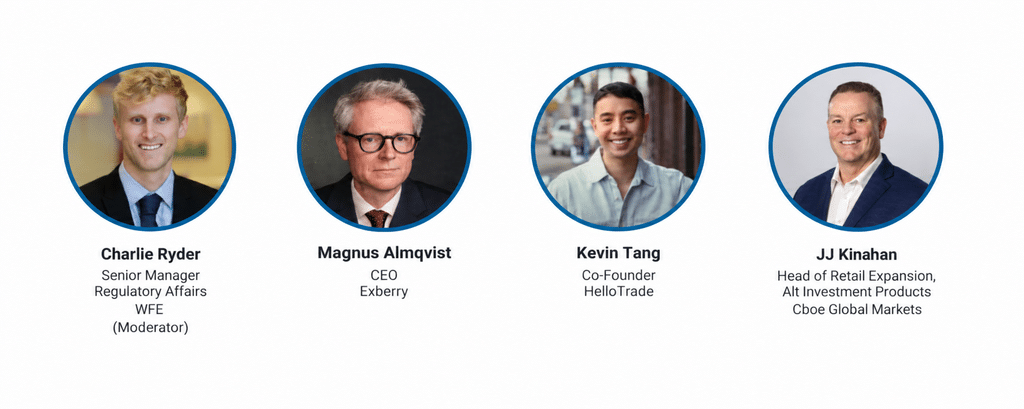
During a recent World Federation of Exchanges (WFE) webinar, Perpetuals and Prediction Markets: The New Derivatives Landscape, JJ Kinahan, Head of Retail Expansion, Alt Investment Products at Cboe Global Markets; Kevin Tang, Co-Founder of HelloTrade; and Magnus Almqvist, CEO of Exberry, discussed the operational requirements of these products, regulatory uncertainty and institutional participation. The discussion was moderated by Charlie Ryder, Senior Manager, Regulatory Affairs at WFE.

Tang attributed the growth of perpetual futures in cryptocurrency markets to their capital efficiency, simplicity and suitability for continuous trading. Unlike traditional futures, perpetual contracts have no fixed expiration date and use a funding mechanism to help keep prices aligned with the underlying asset. “The first one is perps are highly capital efficient,” Tang said, adding that their relative simplicity compared with traditional futures and options has also contributed to adoption.

However, Kinahan cautioned that funding payments could prove difficult for retail traders to understand, particularly when positions are held for longer periods. “You can actually be right,” he said, describing a situation in which an investor correctly anticipates a price increase but must still make a funding payment. Kinahan said the funding mechanism would require further investor education, particularly in the United States.

Turning to prediction markets, Kinahan discussed Cboe’s plans for contracts tied to corporate key performance indicators (KPIs), allowing investors to express views on specific financial outcomes rather than predicting the direction of a stock. He argued that investors can correctly anticipate strong corporate results but still lose money if the stock reacts negatively to earnings guidance or other factors. “What KPIs allow you to do is to really dig down and have an investment opinion on the areas of a company you’re actually observing,” he said.

Kinahan emphasized that Cboe is concentrating on financially relevant events rather than sports or entertainment contracts. “We are not doing sports, we are not doing culture. We’re doing things we feel are truly influencing the market,” he said.

He compared the potential adoption of KPI contracts to the development of zero-days-to-expiration (0DTE) options, where retail demand attracted market makers and subsequently institutional participation.

Kinahan described how Cboe’s plans for company KPI contracts have required changes to its clearing arrangements. While the exchange traditionally clears options through the Options Clearing Corporation (OCC), Kinahan said the clearinghouse’s ongoing technology modernization meant it could not immediately accommodate the proposed products.

Cboe has consequently been seeking regulatory approval to clear the contracts through its own clearing infrastructure, he said. Kinahan added the company had received regulatory permission for the product and was awaiting approval related to its clearing arrangements at the time of the webinar.

For blockchain-based platforms, Tang identified liquidity provision as a challenge when launching perpetual futures markets. “To bootstrap these markets, this requires capital, requires market makers, requires both taker and maker liquidity, and this can be challenging, especially for new platforms,” he said.

Tang argued that blockchain technology could facilitate capital formation through trading incentives, permissionless participation and liquidity arrangements. He also pointed to demand from investors in emerging and frontier markets who may have limited access to traditional brokerage platforms.

Infrastructure for Continuous Trading

Almqvist said regulatory uncertainty remains a common challenge across jurisdictions, alongside settlement arrangements, risk management and the operational implications of longer trading hours. According to Almqvist, moving toward continuous trading affects exchange operations, including IT systems, collateral transfers, settlement and internal risk management. “The rate of the change in the markets today is the fastest I’ve ever seen through my career,” he said.

Almqvist emphasized that infrastructure must accommodate new instruments, handle increases in trading volumes and allow exchanges to introduce upgrades without disrupting operations. He also highlighted the need for closer integration between trading, risk management and settlement systems. “You need a settlement and risk function that sits very, very closely with your matching engine,” he said.

Almqvist explained that this differs from traditional architectures in which matching engines, collateral management and clearing systems have often operated as separate components. He also highlighted the importance of infrastructure capable of handling sudden increases in trading activity, particularly in event-driven markets where volumes can be concentrated around specific outcomes.

Tang identified risk management as a priority, particularly for perpetual futures linked to traditional assets that lack reliable price feeds outside normal market hours. He said operators need to incorporate safeguards used in traditional markets, including price bands, open interest limits and circuit breakers.

Kinahan similarly emphasized the importance of maintaining market confidence. “If somebody has bad risk management, it actually reflects on the whole industry,” he said.

Tang said hedge funds and institutional market makers are already participating in cryptocurrency derivatives markets, although technological integration, compliance requirements and smart contract risks remain obstacles for institutions considering on-chain trading. “The biggest blocker right now that I see, especially with on-chain venues, is that there is smart contract risk,” he said.

Tang also noted that traditional portfolio managers are monitoring perpetual futures prices over weekends for indications of how underlying markets may open when regular trading resumes.

Looking ahead, Kinahan expects closer integration between traditional derivatives markets and blockchain-based trading platforms, particularly as exchanges explore extended trading hours and changes to clearing infrastructure. “You’re seeing a lot more merging of ideas and a lot more merging of firms willing to say, you know what, maybe both sides know a little something,” he said.

Tang also expects further convergence between traditional and decentralized markets, supported by regulatory developments and greater institutional participation. However, he does not expect perpetual futures and prediction markets to replace established derivatives products. “I don’t believe that we will see the end of options and traditional futures,” Tang said.

CIB in ‘Golden Window for Growth’

0
CIB in ‘Golden Window for Growth’

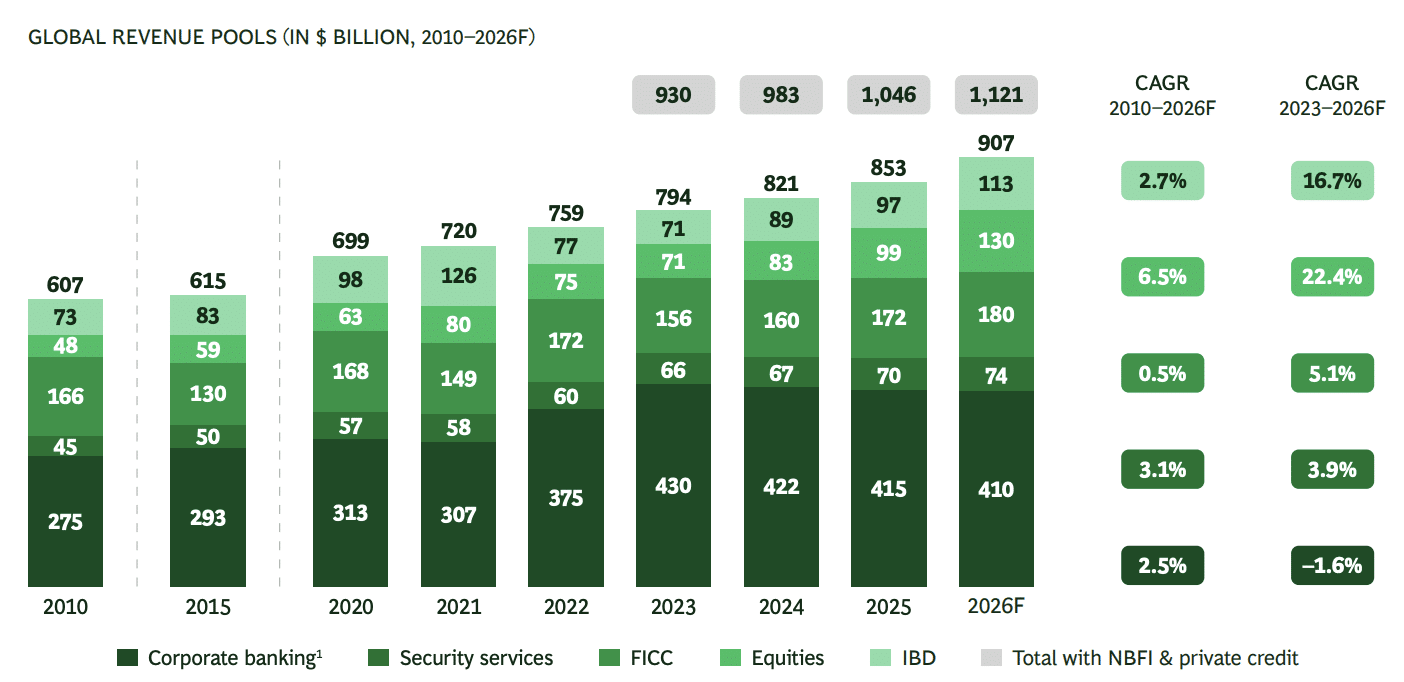
The combined revenue pool for corporate and investment banking (CIB) and nonbank financial institutions (NBFIs) this year will be more than 7% higher than in 2025, reaching $1.4 trillion by 2030, according to Boston Consulting Group.

In a study, A Golden Window for Growth: Corporate and Investment Banking Report 2026, BCG forecast that the combined revenue pool will reach $1.1 trillion by the end of this year, well ahead of the roughly 5% five-year compound annual growth rate. By 2030 this revenue pool will reach approximately $1.39 trillion according to the consultancy.

“That strength has opened a golden window for banks to fund the next phase of growth,” added the report. “But that window will not stay open indefinitely.”

Source: BCG

Corporate and investment banking has accounted for nearly half, 46%, of banking group revenues for the top seven banks since 2020, up from the low 40s between 2015 and 2019, said BCG. At the same time, the business has cut its cost-income ratio by 9.8%, almost twice as fast as the 5.2% cut by the banking groups

NBFIs

Although the overall fee pool is growing, BCG said growth is increasingly shifting toward sponsors and hedge funds. NBFIs made up 4% of the total CIB revenue pool in 2013 and that has grown to an estimated 19% by the end of 2026, and they are increasingly active in areas where banks have historically generated significant revenues. For example, BCG estimated that nonbank liquidity providers will capture about 38% of flow and market making by 2030.

“These institutions offer some of the most robust prospects, with revenues expected to compound at roughly 8% and 9%, respectively, through 2030,” said the report. “Overall, NBFIs will take a significant portion of the CIB revenue pool by that year, with a 23% share.”

As a result, BCG said banks need to decide which sponsors and hedge funds to partner in a full relationship and which to finance, and adapt their operating models. For example, NBFIs tend to buy advisory, financing, markets, and transaction banking together, yet most CIBs still price and staff those products separately. The consultancy said the 2030 mix will differ in three important respects – private credit will become a more direct revenue line, digital assets will move onto production rails, and financing and prime brokerage will focus more within markets as transaction banking loses share.

“The 2030 CIB revenue pool will be larger but redistributed across clients, products, and operating models,” added BCG. “NBFIs will gain share, financing and markets will account for a larger percentage of total CIB revenue, and technology will broaden the range of economics at which institutions can serve the same opportunities.”

Technology

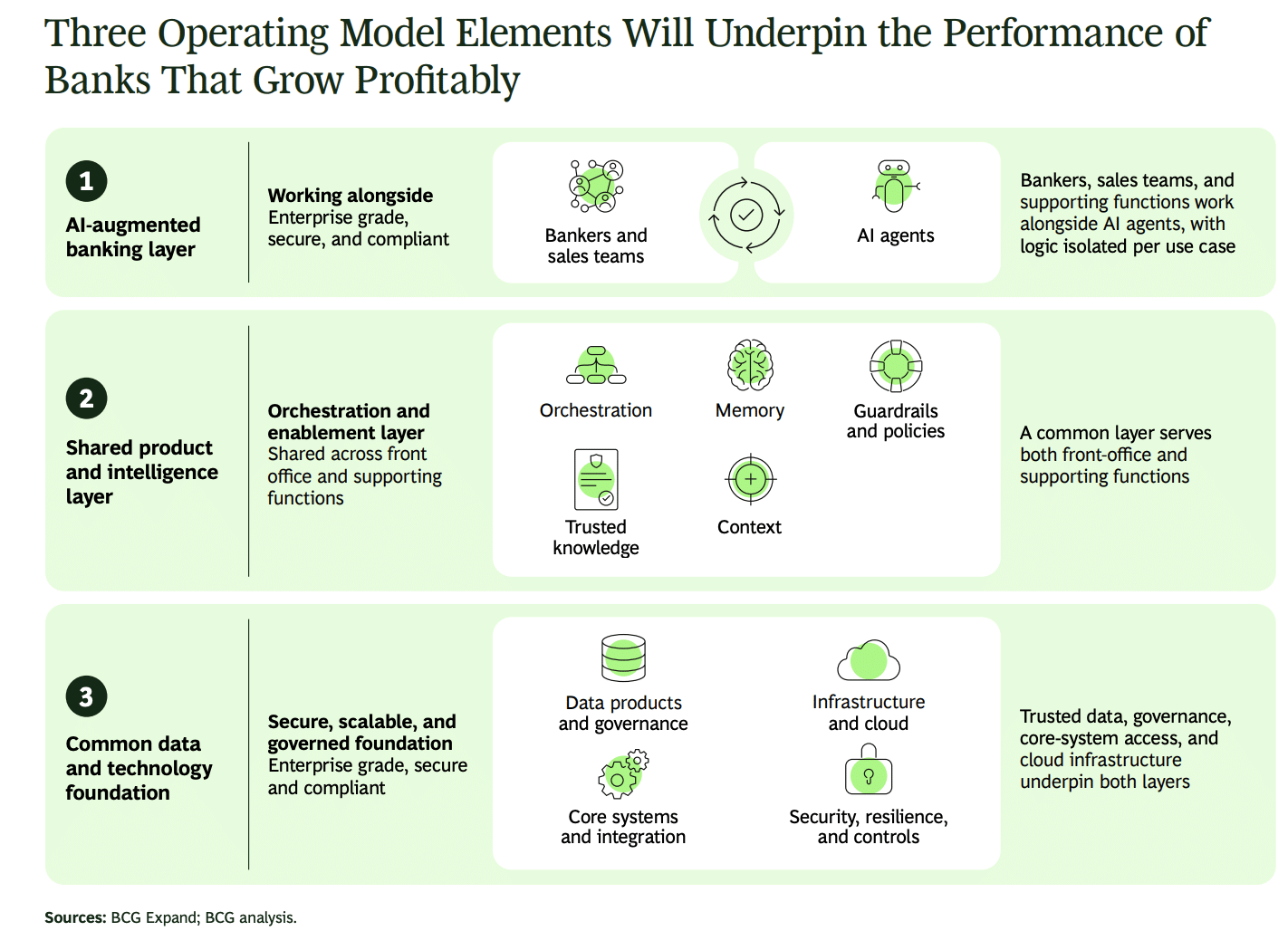
BCG said firms with AI-led operating models will be well placed to access their “fair” share of an expanding fee pool, while those still piloting productivity use cases will struggle to keep up.

The next stage of AI adoption will be less about individual tools than the shared data and intelligence layers beneath them, as the consultancy argued that the intelligence layer is where infrastructure investment becomes commercial advantage most directly. For example, a bank that surfaces pricing history, transaction flow, and counterparty signals directly to front-office staff brings more of what it knows into a client conversation. BCG expects leading CIBs will consolidate multiple AI use cases into a common front-office workbench.

Source: BCG

“Individual AI tools can improve productivity, but shared intelligence layers, integrated platforms, and unified data infrastructure can redraw the cost curve and expand where a bank can compete,” added the report. “Given the varying capacities for applying AI among banks, AI can widen the competitive gap.”

Three operating model elements will underpin the performance of banks that grow profitably according to the study – bankers, sales teams, and supporting functions working alongside AI agents; a shared product and intelligence layer serving front office and supporting functions; and a common data and technology foundation underneath both.