


Thursday, January 29, 2026
More
    More

      Proliferation of ETFs May Squeeze Balance Sheets

      Moves by the U.S. Securities and Exchange Commission in the exchange-traded fund market, which are likely to lead to a proliferation of new products, have led to concerns that the balance sheets of authorized participants may become constrained.

      The SEC has allowed Dimensional Fund Advisors to launch an ETF share class of an existing mutual fund, and the regulator is expected to quickly allow other fund managers to do the same.

      In addition, the U.S. regulator has approved generic listing standards for exchange-traded products that hold spot commodities, including digital assets, rather than requiring them to be approved on a case-by-case basis, which can be a lengthy process. Under generic listing standards, SEC approval is virtually guaranteed as long as a filing meets the stated requirements, so approval should take less than 75 days.

      The SEC adopted the “ETF Rule” in September 2019 which standardised requirements for the majority of ETFs and this led to  a proliferation of new products.  As a result, there are now more ETFs listed than individual stocks and generic listing rules for crypto products are likely to have a similar impact. Matt Hougan, chief investment officer of crypto asset manager Bitwise, said in his CIO memo that the adoption of generic listing standards is likely to usher in a “ton of new crypto ETPs.”

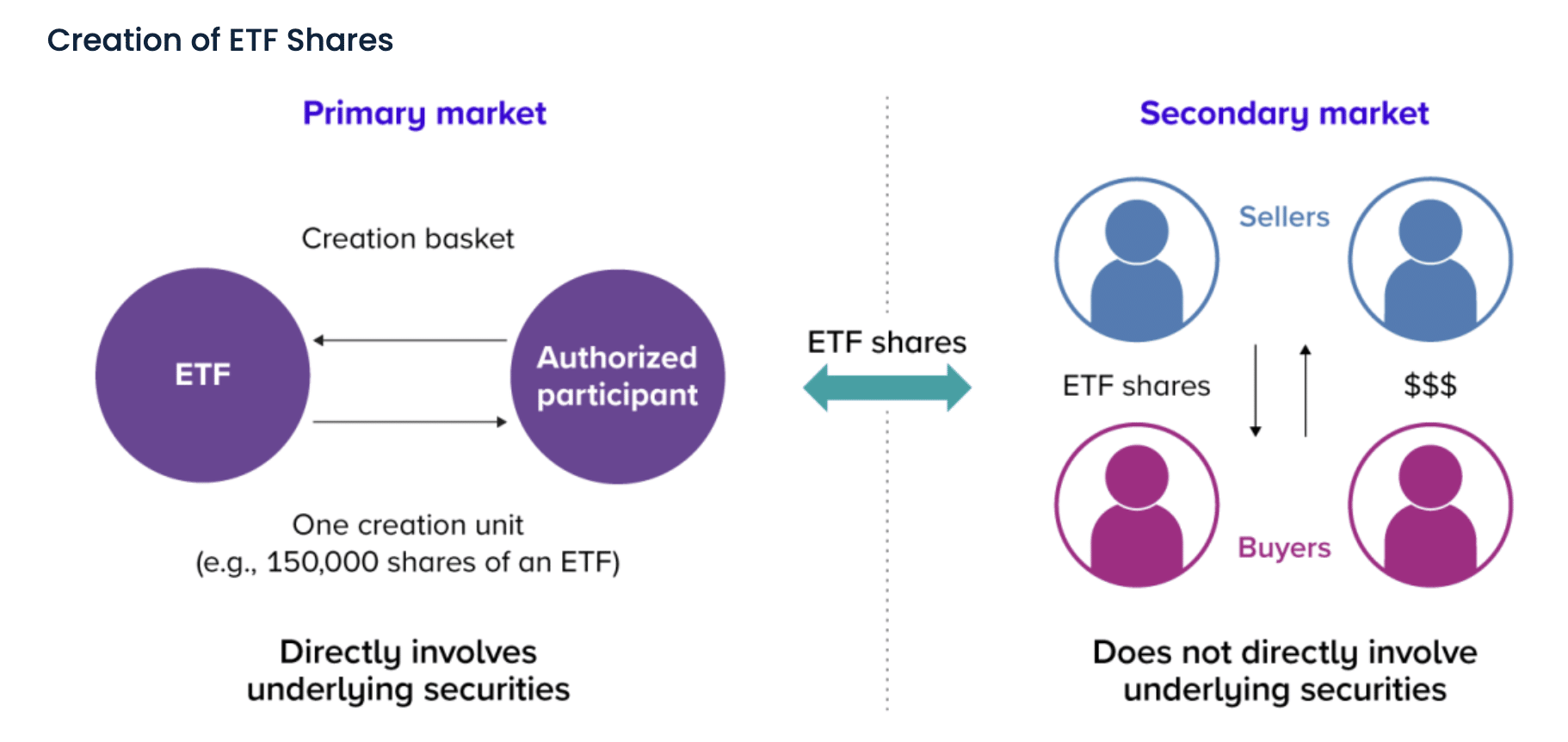
      ETF shares are created when an authorized participant, or AP, who is typically a large financial institution, provides a creation basket consisting of securities, cash, or both to the fund. APs are the only investors allowed to interact directly with the fund and as as dealers in ETF shares
       Source: ICI

      Jamie Harrison, head of ETF Capital Markets at asset manager MFS, told Markets Media that his desk focuses on accessibility for clients, making sure its ETFs products have tight spreads and are tax efficient. Therefore, the desk needs to partner with an AP for rebalancing through custom in-kind transactions.

      Rich Lee, Baird

      “This requires the balance sheet of our counterparties so we need to secure that partner,” Harrison added. “As ETFs proliferate there is concern about capacity in the marketplace, because balance sheets are going to start getting constrained among ApPs, and securing that balance sheet becomes harder.”

      Rich Lee, head of program trading and execution strategy at Baird, told Markets  Media in an email that the past quarter involved significant ETF volumes. The broker heard from several clients that counterparties were told about balance sheet constraints or were trying to lock up rebalances so that they could manage balance sheet usage.

      “As the assets under management of ETFs grow, so does the potential to soak up balance sheet to facilitate rebalancing needs,” Lee added.

      Growth in active ETFs

      SEC approval of the ETF share class is likely to lead to the launch of more active ETFs. Harrison said this was due to product innovation and investors realizing the benefits of the ETF wrapper such as  efficiency, tradability and transparency.

       Jamie Harrison, MFS

      “It is early days and hard to predict the actual impact of the ETF share class but it could result in a tectonic shift for the industry,” Harrison added. “At MFS are going to continue to stay close to industry partners and participants, and continue to vet and monitor the situation.”

      He highlighted that a lot of work needs to be done to implement the ETF share class from the standpoint of compliance, legal, administration, custody and broker-dealer distribution.

      MFS launched the firm’s first actively managed ETFs in December last year across five investment categories: US Value, US Growth, International Equity, US Core Plus and Intermediate Muni Bond. They have already gathered approximately $750m in assets as of 31 August 2025.

      Harrison argued that the biggest differentiator for MFS is that the asset manager launched the first mutual fund in 1924 and has bought that same investment capability to ETFs.

      “A fundamental research-driven investment process in the active space is in our DNA and clients and investors see a natural extension in the ETF wrapper,” he added. “You can expect us to continue that strategy and lean into our core capabilities and strengths.”

      In September this year MFS added to its ETF suite with the launch of an Active Mid Cap ETF. MFS said its six funds represent major segments of both the equity and fixed income markets for investors to build core market exposures.

      Active ETFs in Europe

      MFS has launched ETFs in the U.S. but Harrison highlighted there has been an uptick in launches and growth in Europe, even though the region does not enjoy the same tax efficiency as in the U.S.

      “We are eyes wide open about the growth in Europe, and continue to vet that space,” he added.

      Assets in the ETF industry in Europe surpassed $3 trillion for the first time at end of September this year, according to ETFGI, an independent research and consultancy. Net inflows to the end of September this year were a record $290.9bn, beating the previous high of $176.2bn in 2024.

      Active ETFs in Europe gathered $5.8bn in September taking year-to-date inflows of $27bn, more than double the $10.7bn collected in the same period last year

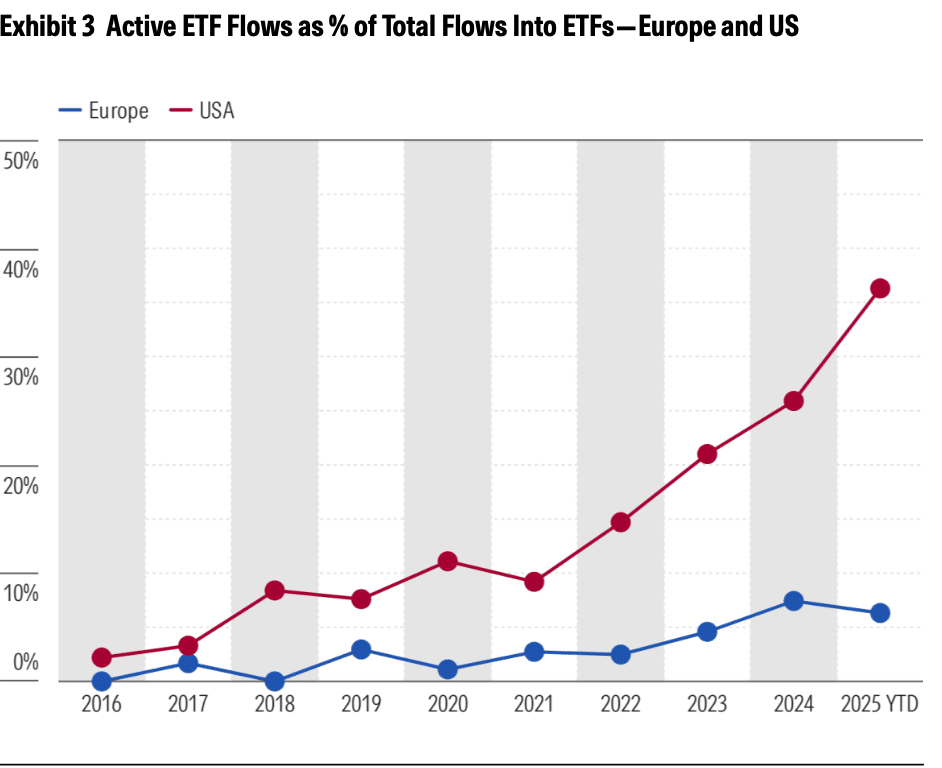
      Morningstar, the fund management data provider, said in a report that assets in active ETFs in Europe were €62.4bn at the end of August this year, up from €55.5bn at the close of 2024. The active ETF segment has doubled in the past two years but still only accounts for 2.6% of total assets invested in ETFs in Europe, compared with 10.2% in the U.S., according to the report.
      Source: Morningstar

      Flows into active ETFs in Europe accounted for 6.3% of total flows into ETFs at the end of August 2025, compared to 36% in the U.S.

      Morningstar said the pace of new entrants in the ETF market in Europe has accelerated significantly in 2024 and 2025.

      “Some have a long-standing passive ETF business and now want a slice of the growing active pie, but many are managers of active mutual funds who previously had shunned the ETF wrapper and now see a clear path to benefit from its popularity without having to set foot on the passive side,” added the report.

      TS Imagine, Gentek.ai Partner on Agentic Workflows

      0

      TS Imagine and Gentek.ai Announce Strategic Development Partnership to Deliver Agentic Workflows to Global Financial Institutions

      New York, NY – October 13th 2025 – TS Imagine, a leading global provider of trading, portfolio, and risk management solutions for capital markets, today announced a strategic development partnership with Gentek.ai, a pure-play horizontal AI platform with deep domain experience in financial services.

      This collaboration will accelerate the adoption of AI in capital markets by embedding Gentek.ai’s horizontal AI infrastructure directly into TS Imagine’s front-to-back platform, which is used by over 500 global financial institutions. Users will benefit from faster, more tightly integrated workflows, reporting, and data products. The integration will enhance decision-making, automate manual processes, and provide richer insights through advanced analytics and reporting.

      Rob Flatley, CEO of TS Imagine, commented: “AI is reshaping how capital markets operate. Our clients are demanding more speed, precision, and intelligence in their workflows. By partnering with Gentek.ai, we can seamlessly embed cutting-edge agentic workflows into our applications, creating a powerful advantage for banks, asset managers, and wealth managers who want to unlock new efficiencies and opportunities.”

      Pierre Khemdoudi, CEO of Gentek.ai, added: “Our mission is to make AI accessible, powerful and transformative. Working with TS Imagine will allow us to extend our technology into some of the financial industry’s most sophisticated trading, financing, risk, and wealth platforms, bringing customers truly integrated, AI-driven solutions at scale.”

      The initial focus of the partnership will be to co-develop AI-powered modules for the following specialized industries:

      • Trading and Execution, to enhance market connectivity, client and regulatory reporting, price discovery and order routing with predictive intelligence.
      • Risk Management, to deliver real-time, AI-powered risk monitoring, stress testing and margin optimization.
      • Financing & Prime Services, to streamline lifecycle management and regulatory reporting within financing and collateral workflows.
      • Wealth Management, to provide next-generation portfolio insights, client personalization, and AI-enabled reporting.

      By uniting Gentek.ai’s pure-play AI capabilities with TS Imagine’s proven applications, the two companies will deliver modular, enterprise-grade solutions designed to reduce complexity, improve performance, and set a new standard for data-driven capital markets technology.

      -ENDS-

      About Gentek.ai

      Gentek is an AI-native enterprise platform built to automate complex business processes through intelligent, agent-driven workflows for capital markets. It drives automation across trading, risk, compliance, client engagement, and beyond. By providing enterprise-grade agentic infrastructure that unites large and small language models, machine learning, and natural language processing, Gentek enables next-generation automation and real-time decision-making. With Gentek, organizations can transform data into action through adaptive agentic workflows that streamline even the most sophisticated business operations.

      About TS Imagine

      TS Imagine delivers a best-in-class SaaS platform for integrated electronic front-office trading, portfolio management, and financial risk management tools to the buy-side and sell-side. Formed following the merger of TradingScreen and Imagine Software in 2021, TS Imagine innovates by drawing on nearly 30 years’ experience serving the world’s most sophisticated financial services firms through changing markets and a shifting regulatory landscape.

      The TS Imagine team is focused on developing technology that empowers its clients to succeed every day, in every asset class. TS Imagine employs the best technology talent, alongside former senior traders who understand first-hand their client’s pressure points and how to address them. This complementary expertise, unique to the industry, enables TS Imagine to dive deep into areas such as data science, automation, and development. As a result, clients can focus on what they do best: generating and protecting alpha within fast evolving markets.

      By offering a range of purpose-built solutions developed from the ground up, TS Imagine technology has become an essential tool for the modern investor, working seamlessly across asset classes and geographies. With greater transparency, better efficiency, and infinite scalability, TS Imagine clients are empowered to avoid distractions and unnecessary tasks so they can maintain their focus on driving returns.

      ON THE MOVE: CalPERS Names June Kim; David Myers to ClearBridge

      June Kim

      The California Public Employees’ Retirement System (CalPERS) has hired June Kim as its new Deputy Chief Investment Officer for Public Markets, effective December 1, according to a press release. Kim will report to Chief Investment Officer Stephen Gilmore and work closely with the agency’s managing investment directors to lead decision-making across the portfolio. Kim has nearly three decades of investing experience, most recently as senior investment director of total fund management at the California State Teachers’ Retirement System (CalSTRS). Before joining CalSTRS, Kim served as head of equities for the Los Angeles County Employees Retirement Association. She also worked as an investment officer for the City of Los Angeles.

      David Myers has joined ClearBridge Investments as a senior trader on the global trading team, Global Trading reported. Based in Edinburgh, he reports to head of trading Patrick Collier. He will lead the firm’s global emerging markets portfolios and cover European trading in partnership with fellow trader Anthony Lucas. Prior to this, he was a trader at single-manager hedge fund O’Connor – sold to Cantor Fitzgerald by UBS earlier this year.

      Berenberg has promoted Peter Kraus to head of portfolio management for equities, Global Trading reported. Based in Switzerland, Kraus has been head of small cap equities at the firm since 2017. Kraus has 25 years of industry experience, having spent more than a decade as a portfolio manager at Allianz Global Investors before joining Berenberg. Prior to this, he was a research manager at German advisor Deka Investment.

      Slava Malkin

      Northern Trust Asset Management has appointed Slava Malkin as senior portfolio manager to develop and manage Northern Trust Asset Management’s long/short offerings, according to a press release. Based in New York, he reports to Global Co-Chief Investment Officer Anwiti Bahuguna. Malkin is an accomplished investment professional with 25 years of experience managing quantitative active portfolio strategies, including tax-advantaged long/short equity, designed for high-net-worth and institutional investors. Prior to joining Northern Trust Asset Management, Malkin was a director at Aperio/BlackRock, leading research and portfolio management for tax-aware long/short equity strategies. 

      Blue Ocean Technologies has promoted John Willock to Chief Revenue Officer, according to a press statement. He joined Blue Ocean Technologies in 2023 as Head of Strategy overseeing the market data business and business planning for the organization. In his new expanded role, Willock will oversee all revenue aspects of sales, business development, client success, and market data.

      FINBOURNE Technology has appointed Gareth Evans as Chief Product Officer (CPO), according to a press release. He will be responsible for driving the company’s product vision and accelerating innovation across its investment management technology platform. Evans brings over two decades of experience in financial technology, having held senior roles at Mosaic Smart Data, UBS, Deutsche Bank, ION, and Morgan Stanley. 

      Thomas Pluta, former President of TradeWeb, and long-time JP Morgan executive where he managed Rates and FX trading in Fixed Income products, has joined XSY’s Advisory Board. According to a press statement, he brings a wealth of experience and perspective to XSY’s team in the areas of fixed income markets and technology, electronic trading, strategic investments, and market structure and regulation. He has also served on the CFTC’s Global Markets Advisory Committee (GMAC), the Federal Reserve Bank of New York’s Treasury Markets Practices Group (TMPG), and SIFMA’s Board of Directors and Executive Committee, including a year as Board Chair. He currently serves on SIFMA’s Advisory Council.

      If you have a new job or promotion to report, let me know at alyudvig@marketsmedia.com

      Institutions Double Down on Tokenization

      • Majority of institutional investors expect their digital asset exposure to double within three years, with over half anticipating 10–24% of investments to be tokenized by 2030.

      State Street published its 2025 global research on digital assets and emerging technologies, revealing a decisive shift in adoption and strategic commitment among institutional investors toward tokenization and blockchain-enabled transformation. The study, based on a global survey of senior executives across asset management and asset ownership1, captures sentiment, strategy, and operational readiness across regions and institution sizes.

      “The acceleration in adoption of emerging technologies is remarkable. Institutional investors are moving beyond experimentation, and digital assets are now a strategic lever for growth, efficiency, and innovation,” said Joerg Ambrosius, president of Investment Services at State Street. “As tokenization, AI, and quantum computing converge, early adopters are leading the way in shaping the future of finance.”

      Key Takeaways:

      Digital Assets Gain Strategic Ground Across Institutional Portfolios:

      • Institutional investors are signaling a decisive shift in how they approach digital assets. Nearly 60% plan to increase their allocation in the coming year, and average exposure is expected to double within three years. This momentum reflects growing confidence in digital assets as a long-term investment strategy.

      Tokenization of Private Markets is First Stop:

      • Private equity and private fixed income are projected to be the first asset classes to undergo tokenization. This reflects a strategic focus among institutional investors on unlocking liquidity and efficiency in traditionally illiquid markets. By 2030, a majority expect 10–24% of institutional investments to be executed through tokenized instruments.

      Transparency and Speed Among the Benefits Driving Adoption:

      • Increased transparency (52%), faster trading (39%), and lower compliance costs (32%) are the top benefits of digital assets cited. Nearly half anticipate cost savings exceeding 40% due to increased transparency.

      The Rise of Digital Asset Units:

      • 40% of institutional investors have a dedicated digital assets team or business unit, and nearly a third say digital operations (e.g., blockchain) are now integral to their organization’s wider digital transformation strategy.

      GenAI and Quantum Computing Are Accelerators:

      • Over half of respondents believe generative AI and quantum computing will be more impactful on investment operations than tokenization or blockchain, but most see these technologies as complementary to digital asset programs.

      “We’re seeing clients rewire their operating models around digital assets,” said Donna Milrod, chief product officer at State Street. “Many are building dedicated teams, and nearly one in five plan to follow suit. From tokenized bonds and equities to on-chain wrappers, Central Bank Digital Currencies, stablecoins, and tokenized cash, the shift isn’t just technical—it’s strategic.”

      Click here to learn more about the research and to download the report.

      Source: State Street

      Goldman Sachs’ Neema Raphael: Enterprise Data Is Key to AI’s Future

      In a recent episode of Exchanges at Goldman Sachs, Neema Raphael, Chief Data Officer and Head of Data Engineering at Goldman Sachs, sat down with George Lee, Co-Head of the Goldman Sachs Global Institute, and Allison Nathan, Senior Strategist in Goldman Sachs Research, to discuss the evolving role of data in artificial intelligence and how the enterprise world may hold the key to AI’s future.

      Neema Raphael

      Reflecting on the shift in computer science over the last several decades, Raphael described a major turning point. “For the first 50 or 60 years of computer science, humans had to code rules to tell the computer what to do. And so there was a fundamental shift…which is like learn by example instead of learn by rules.”

      He said generative AI is part of that same trajectory: “In some ways, the generative AI stuff is just a continuation of learn by example. But I don’t think people naturally saw it go from, hey, I could learn maybe how to predict some patterns, to now the computer could create anything.”

      According to Raphael, this ability to generate content (language, images, audio) is what marks generative AI as a “novel step change”.

      When asked about how people inside organizations are adapting to the probabilistic nature of AI, Raphael said finance may be somewhat more prepared than other industries. “In finance, people maybe have understood that because of our pricing models and derivatives pricing… it was always stochastic in that way anyways.”

      “So I think there was maybe a willingness to sort of understand that here in the finance world,” he added.

      Still, he acknowledged the challenge in helping non-engineers understand that AI is not a magical prediction engine. “When non-engineers sit at a computer, they sort of want a thing to be a repeatable pattern. That’s how we build workflows here…So I think it’s really about teaching people: this isn’t just some magic crystal ball. What it’s really doing is taking a lot of examples and giving you an extrapolation.”

      Raphael said he has historically been a skeptic of new technology hype, citing blockchain as an example. But AI has been different. “I think, from an AI perspective, it’s obvious that it’s real. It’s here to stay. There is absolutely a hype to it…But also, when you go on your phone and you ask Claude, Gemini, GPT, take a picture…and you get great answers…It’s definitely, definitely real in the sort of consumer world.”

      The shift in his own view came through a hands-on experience. “Agent coding, for example, is the thing that sort of flipped my brain from this might be vaporware to like, wow, this is really real…It was helping me with problems that I’ve never been able to solve before.”

      He described it as “incredibly powerful as a superhuman ability”.

      When asked whether AI might eventually run out of data to learn from, Raphael replied bluntly: “We’ve already run out of data.”

      He pointed out that many recent model advancements appear to be happening with less training data or lower compute costs. One hypothesis, he said, is that “they trained against another model,” meaning that newer models are being trained on the outputs of older models.

      What’s more important now, he argued, is how synthetic data and trapped enterprise data will shape the next wave of progress. “The explosive nature of the synthetic data and the fact that now the computer could generate an infinite amount of more data…I don’t think it’s going to be a massive constraint.”

      He added: “There’s still a lot of data here at Goldman that can be used” to augment the capabilities of employees—salespeople, traders, clients, and portfolio managers—through tools that provide “information synthesis” and support hypothesis testing.

      Raphael explained that data within companies was long treated as a byproduct of operations. “It’s always historically been thought of as like business exhaust in some way, right? Like, trader executes a trade—they’re sort of like, okay, I’m done now. I’m just managing the risk.”

      But beneath that surface is a wealth of structured and unstructured data that, if properly integrated and understood, can power AI applications. The key challenge, he said, is to “get that disparate data into some place where you could organize it in a sane way” and normalize it “where the data is correct”.

      Understanding how different pieces of data connect is essential. “You have to understand, are these two concepts the same? Are they linked differently?” Raphael said. That’s the foundation of data engineering: “People are like, we need a practice of engineering that’s like software for data.”

      Asked whether AI models themselves could help with this process, Raphael said: “Definitely. People have built software agents…to do this cleansing, this normalization, this linking.”

      He described a growing synergy between model development and data quality improvement: “There’s also a feedback loop of data cleansing and normalization and wrangling too.”

      The Future is Now: ‘Emerging’ Technologies are Today’s Market Structure Mainstays

      0

      FLASH FRIDAY is a weekly content series looking at the past, present and future of capital markets trading and technology. FLASH FRIDAY is sponsored by Instinet, a Nomura company.

      Tom Carey, Broadridge

      “Emerging” technologies are no longer emerging, they have arrived. From artificial intelligence to digital assets and tokenization, technologies that just a few years ago seemed like they were pushing the limits of possibility are now becoming embedded in financial market structure.

      As yesterday’s emerging tech matures and takes root, it is making markets faster, more efficient and more dynamic than even the most optimistic tech boosters could have envisioned just a decade ago.

      The evolution of technology from cutting edge to mainstream is accelerating in step with the innovation cycle overall. The 500+ financial services companies participating in Broadridge’s 2025 Digital Transformation & Next-Gen Technology Study expect to allocate 29% of their total IT spend to technology innovation over the next two years— an increase of seven percentage points from last year’s study. Firms are spending more, and a large part of that extra spending is aimed squarely at integrating technologies like AI and the blockchain into workflows and markets. That industry-wide focus is compressing the amount of time it takes for emerging technologies to mature into everyday tools.

      Trigger Events

      Throughout history, rapid technological advances have often been triggered by important events or crises. That was certainly the case in 2024, when the U.S. Securities and Exchange Commission shortened the trade settlement cycle from two business days (T+2) to one.

      To make the shift to next-day settlement, market participants were forced to adopt new technologies and approaches that automated parts of the trade cycle and enhanced data management and analytics. Firms worked internally to develop and deploy better and more centralized data systems, as well as robotic process automation (RPA) and other post-trade automation solutions. The move to T+1 also prompted firms to make wider use of cloud computing and SaaS solutions from external technology providers. That adaptation has in turn made it easier for firms to adopt and integrate other new external technology solutions down the road.

      Despite all this great innovation, capital markets are still plagued by trade breaks, failed settlements, and other complex operational frictions that will not be acceptable in a T+0 environment. The fact that the SEC is already looking at this inevitable next step is providing capital markets firms with additional incentive to continue experimenting with and adopting emerging technologies.

      Specifically, firms are introducing artificial intelligence applications with the potential to drastically reduce and someday perhaps even eliminate most of that inefficiency. Capital markets firms have already deployed AI Agent workers that autonomously identify, research, and remediate the most high-volume operations tasks—and solve them independently. 

      And that’s just the tip of the AI iceberg. Nearly three-quarters (72%) of firms participating in the Broadridge study are making moderate to large investments in GenAI this year, up from 40% in 2024. These firms expect their AI investments to pay off most in the areas of enhanced employee productivity (68%), better reporting (51%) and reduced operational costs (50%).

      This rapid integration of AI represents one of the best examples of how quickly emerging technologies can gain widespread acceptance today. As individual employees incorporate AI into everyday tasks, they are becoming more comfortable with the technology and more familiar with the sometimes radical enhancements AI models and applications can deliver when embedded into workflows.

      The Digital Assets Revolution, Driven by DLT

      Meanwhile, another formerly “emerging” technology is poised to have possibly an even more revolutionary impact on capital markets. As we speak, digital assets and tokenization are helping banks and broker dealers unlock billions of dollars of liquidity and cost-savings. Those benefits could expand exponentially based on the massive levels of investment now flowing into distributed ledger technology (DLT).

      In 2024, 59% of the firms participating in the Broadridge study said they planned to make moderate to large investments in blockchain/DLT in the next 12 months. In 2025 that share jumped by 12 percentage points to 71%.

      Even at prior levels of investment, distributed ledger technology (DLT) has already produced big benefits to capital markets firm, including delivering the “Holy Grail” of repo markets: “intra-day” repo trades. Same-day repo trades were virtually impossible before the advent of the blockchain. Today, these DLT-enabled trades are saving the sell side billions of dollars per year. 

      This is just the tip of the blockchain iceberg. CBDCs and other stable coins are already beginning to transform how cash gets transferred around the globe and even within firms.

      DLT allows for near instantaneous settlement—a leap that cuts costs, reduces counterparty risk and can potentially free up trillions of dollars in capital. The process of tokenization has the potential to unlock continuous 24/7 trading with real-time settlement.

      By eliminating so many of the barriers and so much of the friction found in the traditional market structure, tokenization can also democratize capital markets, drawing in retail investors and investors from countries and areas who previously lacked access. This influx could in turn vastly expand market liquidity as new investors enter the market.

      The Next Wave of Innovation

      Of course, such radical changes to the way capital markets operate will create challenges for brokers, custodians and other central players in the traditional market structure. It’s possible that this looming threat could represent another of those epoch-defining trigger events. Or perhaps the next trigger event will arise from the ongoing shift to central clearing for trades of U.S. Treasuries. The industry’s need to make massive operational change to facilitate that shift could well produce a new wave of innovation that firmly embeds a host of previously novel technologies into the market structure, and sets the stage for the next generation of “emerging” technologies.

      Tom Carey is Corporate Vice President, President of Global Technology and Operations at Broadridge

      Nasdaq eVestment Offers AI-Ready Data Infrastructure

      AI-Ready Data Sets, Next Best Action Intelligence and Platform Integration Accelerate Mandate Targeting and Grow Assets Under Management

      As financial firms face mounting pressure to navigate data complexity and accelerate AI adoption, Nasdaq eVestment today announced a major leap forward in institutional intelligence: the launch of Nasdaq eVestment AI-ready datasets and Next Best Action for Institutional Capital, enabling asset managers to activate agentic workflows directly within their own environments.

      As institutional mandates grow more competitive, firms face increasing pressure to respond with speed and precision. At the same time, nine in ten investment advisors plan to implement AI workflows in 2026, signaling a rapid shift toward intelligent automation. Nasdaq eVestment’s new capabilities eliminate manual data manipulation and fragmented workflows, replacing them with embedded intelligence that scales across teams and systems, empowering firms to make smarter decisions at market speed.

      “We’re not just delivering data, we’re enabling institutional decision-makers to act on intelligence at the speed of opportunity,” said Daniel Brickhouse, Vice President & Head of Product, Nasdaq Analytics. “This represents the infrastructure layer that will power the next generation of institutional investing, where firms compete on the speed and precision of their market intelligence.

      This milestone signals Nasdaq eVestment™’s evolution from a global institutional data and analytics platform into a strategic data infrastructure partner, delivering intelligence not only through dashboards, but through real-time decision engines embedded directly into the systems asset managers rely on, enriched by their own proprietary data.

      Next Best Action: Intelligence at Market Speed

      Nasdaq eVestment’s Next Best Action for Institutional Capital solution combines proprietary institutional data with intelligent scoring to help distribution teams surface high-probability mandates before RFPs are issued, as well as identify replacement opportunities, andrisk exposure to current mandates.  Opportunity scores, recalculated daily on a 0.00–5.00 scale, help prioritize outreach and reduce prospecting time from hours to seconds. In live testing across 3,700 managers and 20 mandates, early adopters reported 10x faster prospect identification and a 20-30% lift in win rates.

      This solution includes:

      • Real-time mandate scoring and prioritization
      • Identification of underperforming incumbents for competitive displacement
      • Early visibility into emerging opportunities and risk exposure
      • CRM-integrated workflows for seamless outreach and tracking
      • AI-Ready Data Infrastructure: Built for Institutional Intelligence

      Custom delivery options:

      • Native BI dashboards with embedded Next Best Action scoring
      • Snowflake and Databricks integrations for enterprise data stacks
      • Direct API access for custom analytics and proprietary models
      • Salesforce and CRM integration for unified workflow management
      • Automated reporting and near real-time portfolio tracking

      AI-Ready Data: Built for Agentic Intelligence

      To support the rise of agentic AI models, Nasdaq eVestment now offers AI-ready datasets optimized for natural language querying, model training, and real-time decision support. These datasets—spanning over 27,500 institutional strategies and 25,500 investor profiles—can be licensed and integrated via Snowflake, secure APIs, and other delivery channels.

      These AI-ready datasets are specifically optimized for natural language querying and model training, enabling conversational interactions such as “Which investors are under-allocated in core fixed income and have open mandates?” with ranked, contextualized responses delivered in seconds.

      Platform Integration Capabilities:

      • Unlike raw data dumps, AI-ready data is structured for immediate use in portfolio modeling, manager screening, scenario simulations, and near real-time reporting enabling faster decisions and deeper insights without manual prep.
      • Users can tailor data queries to reflect their firm’s priorities, values, and strategies. The semantic model supports both broad and deep questions—ideal for both strategic planning and tactical outreach.
      • Agentic workflows embedded in Snowflake introduce autonomous AI agents that reason, plan, and act—turning data into decisions without manual effort.
      • Ready-to-run application for rich conversational AI experiences on top of your Snowflake and business application data.
      • AI-enriched data with Q&A pairs and entity clusters, delivered directly into Snowflake, Databricks, and BI tools—no additional processing required
      • A standalone application that can invite anyone in the business to surface insights and take action from your data.
      • Integrated with Snowflake governance and access controls.

      Nasdaq EDGe 2025: The Launchpad for Institutional Innovation

      These capabilities will be showcased at Nasdaq EDGe 2025, the firm’s inaugural global forum for institutional leaders, broadcasting worldwide on October 15. The event features panels with leading consultants, asset managers, and technology partners, offering first access to Nasdaq’s latest innovations and a strategic look at how AI, data infrastructure, and intelligent workflows are reshaping institutional investing.

      Source: Nasdaq

      TXSE Regulatory Approval Signals ‘Potentially Meaningful Competition’ for NYSE, Nasdaq

      The Texas Stock Exchange has secured approval from the U.S. Securities and Exchange Commission to operate as a national securities exchange, marking the first such approval in decades for a fully integrated platform offering listing, trading, clearing, settlement, and market data services.

      Announced on September 30, 2025, the SEC’s decision formally recognizes TXSE as a peer to the New York Stock Exchange and Nasdaq, both of which the Texas-based exchange has openly positioned itself against in previous statements.

      With $161 million in backing from major players such as BlackRock, Citadel Securities, and Charles Schwab, TXSE is entering the market with considerable resources and high expectations.

      Shawn Severson

      “This is the first serious challenge we’ve seen to the NYSE-Nasdaq duopoly in over two decades,” said Shawn Severson, CEO and Co-Founder of Water Tower Research.

      “They’re not just entering with capital—they’re focused on the part of the business that drives exchange profitability: listings, not just trading,” he told Traders Magazine.

      Severson noted that trading activity at launch will likely be modest. “We’re probably looking at 2 to 5 percent market share in TXSE-listed securities initially. That’s typical for new entrants. The real pressure point is on the listings side. They’re going after dual listings, private equity-backed IPOs, and mid-sized firms that have been priced out of the traditional exchanges.”

      Attorney David Wolpa, a partner at Troutman Pepper Locke, emphasized that while TXSE’s approval was anticipated, it still marks a shift in the competitive landscape. “Most observers expected approval, but now that it’s official, it signals the beginning of potentially meaningful competition. Whether it becomes real, long-term competition is a separate question.”

      Wolpa pointed out that TXSE’s decision to maintain a single, high-tier listing standard will limit its ability to compete for smaller-cap companies, which have traditionally been the focus of Nasdaq’s Capital Market and NYSE’s American exchange. “By opting not to include a lower tier, they’re excluding a big part of the market. That could be a constraint,” he said.

      Still, the TXSE’s model is designed around a different kind of value proposition. According to Severson, “They’re going after quality. Under TXSE’s proposed rules, about 1,700 currently public companies wouldn’t qualify. They’re aiming to build a premium brand that attracts high-value private companies.”

      One of the more notable features under consideration is the potential to share market data revenue with listed companies. “Today, exchanges keep all the market data revenue. TXSE is talking about sharing that with issuers—the companies whose securities generate the data in the first place. That’s a major shift in incentives,” said Severson. “It could be a reason for companies to choose TXSE even if liquidity takes time to build.”

      Technology is another point of differentiation. “They’re using simplified technology with fewer order types,” he added. “That reduces complexity and levels the playing field a bit for participants who don’t benefit from high-frequency trading infrastructure.”

      Wolpa cautioned that despite TXSE’s messaging about being more issuer-friendly, the exchange’s initial rulebook largely mirrors those of NYSE and Nasdaq. “The SEC’s approval order even said that since it had already approved these rules for other exchanges, it had no reason to object here. TXSE will need to do more than repackage familiar rules if it wants to truly stand out.”

      David Wolpa

      The approval comes as both NYSE and Nasdaq have taken early steps to reinforce their presence in Texas. Earlier this year, both exchanges opened regional offices in the state—a move Severson described as “preemptive.”

      “They know TXSE is serious. You don’t open new offices months before a competitor launches unless you think it poses a real threat,” he said.

      While changes to trading fees across the industry are unlikely in the near term—given how competitive those fees already are—listing fees may be another story. “Annual listing fees today range from $56,000 to nearly $200,000,” Severson said. “TXSE is expected to come in at 30 to 50 percent lower. Even if TXSE only picks up a small share of the market, that alone could force NYSE and Nasdaq to reconsider their pricing.”

      Wolpa agreed that competitive pressure is likely. “Fee changes usually follow competitive threats. If issuers have another viable option—and if that option proves reliable—then the incumbents may have to adjust.”

      Still, TXSE faces the well-known liquidity dilemma faced by all new exchanges. “Issuers want liquidity. But liquidity providers follow volume. It’s a chicken-and-egg problem,” Severson said. “That’s why the first 90 days of trading will be critical. If they stumble out of the gate on technology or routing, it could undermine everything.”

      What both experts agree on is that TXSE’s success or failure will have broader implications for the structure and regulation of U.S. markets. “TXSE is a live test case for whether competition can address the concentration we’ve seen in exchange services,” Severson said. “It could inform SEC policy on Regulation NMS, order type complexity, and especially market data pricing.”

      He also pointed to differences in corporate governance policy. “TXSE doesn’t follow Nasdaq’s board diversity rules. And Texas law sets a 500-times-higher threshold for shareholder proposals. That’s a very different environment for public companies. It may appeal to firms looking for more control.”

      Wolpa said that in the short term, the exchange will be judged on how many companies list and how quickly. “A handful of high-profile dual listings would send a message. But landing a major IPO—that’s the real milestone.”

      He also stressed the importance of seeing how far TXSE’s influence reaches geographically. “If this becomes a regional exchange serving mostly Texas and the Southeast, that’s one thing. But if they start pulling listings from New York or Silicon Valley, that’s another.”

      For now, both agree that the focus should be on a few key indicators: technology reliability, pricing strategy, early listings, and market participation. “I’d watch whether Fortune 500 names test the waters,” said Severson.

      “Look for three to five significant IPOs in the $500 million to $2 billion range by the end of 2026. And keep an eye on market maker spreads. If they can get within 15 percent of the incumbents on spreads and 5 to 10 percent on routing, they’ll be in a good position.”

      Even if the TXSE captures only a modest share of the market, its presence may be enough to influence behavior across the industry. “It doesn’t need to dominate,” said Severson. “If they bring in 40 dual listings, 10 solid IPOs, and offer meaningful price competition, they’ve done their job. They’ll have changed the market by existing.”

      “For the first time in years, companies have a real alternative. That alone could change the conversation,” Wolpa concluded.

      S&P Index Combines Crypto & Public Crypto-Linked Equities

      S&P Global announced plans to expand its S&P Dow Jones Indices (“S&P DJI”) crypto index offering with the launch of the S&P Digital Markets 50 Index. Dinari, a leading provider of tokenized U.S. public securities, has collaborated with S&P Global on the index design and will create a token tracking the benchmark. The index is designed to track a wide range of companies and digital assets connected to the crypto ecosystem, combining cryptocurrencies and publicly traded crypto-linked equities into one index.

      “Cryptocurrencies and the broader digital asset industry have moved from the margins into a more established role in global markets. S&P DJI’s expanded index suite offers market participants consistent, rules-based tools to evaluate and gain exposure. From North America to Europe to Asia, market participants are beginning to treat digital assets as part of their investment toolkit – whether for diversification, growth, or innovation strategies,” said Cameron Drinkwater, Chief Product & Operations Officer at S&P Dow Jones Indices.

      “Independent, reliable and user-friendly benchmarks are a key component of financial markets. As with traditional financial markets, independent benchmarks can help bring transparency and accessibility to the digital asset ecosystem,” Ms. Drinkwater continued. “With this latest expansion, S&P DJI reinforces its role as a trusted provider of benchmarks across traditional and alternative asset classes – offering market participants clarity and confidence as new markets like cryptocurrency emerge.”

      The planned launch of the S&P Digital Markets 50 Index comes as demand for broader and more diversified exposure to decentralized financial markets continues to rise. The new index will include 35 companies involved in digital asset operations, infrastructure providers, financial services, blockchain applications and supporting technologies, but will also be combined with 15 cryptocurrencies selected from the S&P Cryptocurrency Broad Digital Market Index. S&P Global believes this will provide market participants interested in exploring crypto-linked opportunities with a measure of performance across both sides of the crypto ecosystem.

      “By making the S&P Digital Markets 50 investible via dShares, we are not just tokenizing an index, we are demonstrating how blockchain infrastructure can modernize trusted benchmarks,” said Anna Wroblewska, Chief Business Officer at Dinari. “For the first time, investors can access both U.S. equities and digital assets in a single, transparent product. This launch shows how onchain technology can expand the reach of established financial standards, making them more efficient, accessible, and globally relevant.”

      This latest index will join S&P Dow Jones Indices existing series of digital asset benchmarks, the S&P Cryptocurrency Indices and S&P Digital Market Indices.

      S&P Global’s digital asset capabilities support transparency and informed decision-making at the intersection of decentralized innovation and traditional finance. To access S&P Global’s DeFi insights, please click here

      Source: S&P

      ICE Invests $2bn in Prediction Market Polymarket

      Intercontinental Exchange, a leading global provider of technology and data, announced a strategic investment in Polymarket, the prediction market and information platform tracking event probabilities across markets, politics, sport and culture.

      Under the terms of the agreement, ICE will invest up to $2 billion in Polymarket, reflecting a valuation of approximately $8 billion pre-investment.

      Alongside its investment, ICE will become a global distributor of Polymarket’s event-driven data, providing customers with sentiment indicators on topics of market relevance. Additionally, ICE and Polymarket have also agreed to partner on future tokenization initiatives.

      “Our investment blends ICE, the owner of the New York Stock Exchange, which was founded in 1792, with a forward-thinking, revolutionary company pioneering change within the Decentralized Finance space,” said Jeffrey C. Sprecher, ICE Chair & Chief Executive Officer. “Shayne Coplan has assembled a team at Polymarket to create a user-driven company relentlessly focused on product, building usage and distribution. There are opportunities across markets which ICE together with Polymarket can uniquely serve and we are excited about where this investment can take us.”

      “Our partnership with ICE marks a major step in bringing prediction markets into the financial mainstream,” said Shayne Coplan, Founder and CEO of Polymarket. “Together, we’re expanding how individuals and institutions use probabilities to understand and price the future. Jeff and his team have redefined how modern markets operate, establishing ICE as the gold standard for trusted financial infrastructure. By combining ICE’s institutional scale and credibility with Polymarket’s consumer savvy, we will be able to deliver world-class products for the modern investor. Realizing the potential of new technologies, such as tokenization, will require collaboration between established market leaders and next-generation innovators. We couldn’t be more excited to build together.”

      Polymarket allows users to express their views on events by buying and selling shares of potential outcomes, with every trade matched peer-to-peer through smart contracts. Markets grow in size and scale based on the number of users participating. Founded by Shayne Coplan in 2020, Polymarket has gained momentum from users globally interested in expressing their opinions on current events, politics, business moves, culture and sports. The platform has gained prominence for the accuracy of its markets and is now the Official Prediction Market Partner of X, and Stocktwits, among others.

      The investment consideration will be in cash and is not expected to have a material impact on ICE’s 2025 financial results or expected capital return plans. ICE will further discuss its strategic investment in Polymarket on its third quarter earnings call scheduled for October 30, 2025.

      Source: ICE