


Wednesday, January 28, 2026
More
    More

      FalconX Acquires 21shares

      FalconX, an institutional digital asset prime brokerage, has agreed to acquire 21shares, a provider of the world’s largest suite of cryptocurrency exchange-traded funds and products (ETFs/ETPs).

      The transaction represents a major milestone in FalconX’s strategy to accelerate the convergence of listed markets and digital assets, while strengthening its global presence across the US, Europe, and Asia-Pacific.

      The acquisition brings together 21shares’ expertise in asset management product development and distribution with FalconX’s institutional-grade infrastructure, structuring capabilities, and risk management platform.

      Together, the two firms will accelerate the creation of tailored investment products that meet growing institutional and retail demand for regulated digital asset exposure.

      Since its founding in 2018 by Hany Rashwan and Ophelia Snyder, 21shares has grown into a global leader in digital asset ETPs, managing over $11 billion in assets across 55 listed products as of September 30, 2025.

      Its proprietary technology platform and highly established network of partners underpin its ability to bring new products to market quickly and at scale.

      Raghu Yarlagadda

      FalconX, co-founded by Raghu Yarlagadda, has facilitated over $2 trillion in trading volume and a global client base exceeding 2,000 institutions, powered by its crypto-native trading, credit, and technology infrastructure.

      “21shares has built one of the most trusted and innovative product platforms in digital assets,” said Raghu Yarlagadda, CEO of FalconX.

      “We’re witnessing a powerful convergence between digital assets and traditional financial markets, as crypto ETPs open new channels for investor participation through regulated, familiar structures.”

      “FalconX has built the institutional backbone for trading, derivatives, and credit, and extending that infrastructure into listed markets through 21Shares is a natural next step toward strengthening market efficiency. For FalconX, this is a deliberate, long-term investment in building durable enterprise value across market cycles.”

      “Over the past 8 years, we have built the 21shares business from $0 to more than $11 billion in AUM. We have scaled to reach millions of customers in every corner of the globe and brought them into crypto with our products and our research,” said 21shares founders Ophelia Snyder and Hany Rashwan. “We are sincerely looking forward to FalconX continuing to build on this strong foundation for the next chapter of 21shares’ development.”

      “Our goal has been to make crypto investing available to everyone through industry-leading exchange-traded products,” said Russell Barlow, CEO of 21shares. “Now FalconX will enable us to move faster and expand our reach. Together, we’ll pioneer solutions that will meet the evolving needs of digital asset investors worldwide.”

      Following completion, 21shares will remain independently managed under the FalconX umbrella. Barlow will continue as CEO of 21shares, working closely with the leadership team at FalconX to advance a shared vision for the future of the digital assets ecosystem. No changes to the construction or investment objectives of the existing 21shares ETPs (Europe) or ETFs (US) are planned.

      This acquisition builds on FalconX’s 2025 strategy to strengthen its global franchise across trading, asset management, and market infrastructure. It follows the integration of Arbelos Markets and the majority stake taken in Monarq Asset Management earlier this year, alongside expansions in Latin America, APAC, and EMEA.


      The High Cost of European Central Securities Depositories

      Lynn Strongin Dodds explores why European CSDs cost more than their North American peers.

      European Central Securities Depositories (CSDs) are significantly more expensive than their international counterparts, according to a new report – Analysis of CSD Fees in Major European Markets-  from the Association for Financial Markets in Europe in collaboration with ValueExchange (AFME report).

      The report, which analyses different CSDs in the EU against each other and their North American counterparts, found settlement fees averaging 65% higher and safekeeping charges up to 650% steeper than across the pond.  

      The research shows that these costs are not a reflection of market size or regulatory burden. European CSDs are, in fact, healthy organisation, which are 30% more profitable than their North American peers. They generate revenues from their main and lucrative non-core businesses, such as tri-party collateral management. There is also little evidence that scale or vertical integration translates into lower costs for users and there is limited competitive pressure to force changes.

      The result is a maintained status quo which erodes investor returns and makes Europe a less attractive place for both issuers and investors. This is directly at odds with the goals of the Savings and Investment Union initiative, a pan European financial system that aims to deepen financial markets, enhance investment opportunities for investors such as pension funds and individual citizens, as well as improve Europe’s economic competitiveness amid global geopolitical shifts. (https://www.imf.org/en/Publications/fandd/issues/2025/06/europes-elusive-savings-and-investment-union-ravi-balakrishnan).

      Adam Farkas, AFME

      As Adam Farkas, CEO of AFME, notes, “policy makers have a clear opportunity in the upcoming European Commission market integration proposals to strengthen Europe’s post-trade markets by promoting competition between CSDs, standardising fee structures, and increasing transparency.”

      The report notes that the problem is compounded by complexity. Fee schedules are opaque, fragmented, and vary dramatically between CSDs, with invoices containing dozens or even hundreds of line items. This makes it nearly impossible for market participants to compare providers on a like-for-like basis.

      The report lists several reasons for these issues. Most notable custody fees are disproportionately excessive, with safekeeping often being the single largest item on the invoice. For example, non-core fees such as for penalties and partials can account for up to 59% of settlement costs.

      Moreover, the European Central Bank’s T2S (TARGET2-Securities) has not delivered the predicted benefits. The platform, which was introduced in 2008 and fully operational in mid 2015. was supposed to facilitate settlements and lower cost by having a large number of CSDs outsourcing their processing traffic to the platform.

      This did not materialise because the number of CSDs and currencies connecting falls below expectation. Those that do, continue to apply their own additional transaction processing fees. CSDs also apply T2S charges in different ways, with some embedding them within a single settlement instruction fee, while others invoice as a separate line item.

      Numbers crunched show that for T2S CSDs, the average settlement instruction fee including explicit T2S charges is €0.34, 10.5 eurocents higher than the basic T2S instruction fee.

      Efforts to improve the situation have also been hampered by the lack of publicly available historical data that makes it nearly impossible to track how CSD costs and structures have evolved over time.

      To rectify the situation. AFME published a seven bullet point action list for near-term, practical measures to inject greater competition, increase disclosure, reduce costs, and improve client outcomes. First on the list is to harmonise and standardise fee schedules. This means clear, accessible, and consistent breakdowns of core against ancillary charges.

      Second is issuing transparent invoices. Costs must be easily reconcilable, with explicit separation of T2S charges and removal of duplicative or opaque line items. There should also be fair treatment of all participants. In other words, no discrimination between local, international participants, or versus brokers and custodians.

      At least three months’ advance notice for changes to fee schedules should be required while participants should not bear the cost of CSDs adapting their own systems to regulation.  CSDs should pick up their own tab.

      AFME also recommends the elimination of quasi-discipline fees such as recycling fees on settlement fails, and to allow reverse billing for reporting costs. This will enable economies of scale on pass-through costs such as SWIFT charges, with full transparency.

      Looking at the longer term, the trade group calls on European policymakers to bring forward ambitious legislative proposals to increase further competition between CSDs. This could involve, amongst other measures: removing barriers to freedom of issuance and reviewing the current Issuer-Investor CSD model that creates an unlevel playing field.

      It could also comprise allowing for the unbundling of CSD functions to catalyse new technologies and the review of the requirement of CSDR Article 3 for all transactions to be recorded in a CSD.  

      Ron Kruszewski Unveils Reform Priorities at SIFMA 2025

      At SIFMA’s 2025 Annual Meeting on Tuesday, October 21, Ronald J. Kruszewski, Chairman of the Board and Chief Executive Officer, Stifel and Incoming 2026 Chair of the SIFMA Board of Directors, laid out a broad agenda for financial regulation, urging policymakers to modernize outdated rules while keeping investor trust and access at the center of reform.

      Ron Kruszewski

      He began with what has become one of the most drawn-out regulatory debates in the industry: the fiduciary rule. “It’s been 15 years,” he said, recalling the Department of Labor’s original 2010 proposal to expand who qualifies as a fiduciary. That effort has since evolved into a prolonged and still-unresolved policy struggle, he said, adding that SIFMA’s goal remains straightforward: preserve investor choice and access to advice. But that clarity, he warned, is undermined when multiple regulators, including the SEC, DOL, and FINRA, attempt to govern overlapping aspects of financial advice.

      From there, he moved into the complex issue of recordkeeping, especially as it relates to off-channel communications. Kruszewski criticized enforcement actions that penalized firms for texts as simple as confirming dinner plans, calling the approach a regulatory overreach rooted in outdated assumptions. “These were business texts,” he said. He emphasized that current recordkeeping rules “were written when paper and email weren’t even around” and “don’t fit a world of texts, chats, and social media.” He emphasized the need to modernize these standards by eliminating unnecessary rules, establishing safe harbors, and harmonizing expectations across the industry. The goal, he said, is to align regulation with how people actually communicate—using “clarity, consistency, and a little common sense.”

      Kruszewski also addressed the SEC’s new Treasury clearing mandate, which aims to reduce systemic risk. While he acknowledged the intent, he warned that the rule touches “the deepest and most liquid market in the world” and could have unintended consequences if implemented poorly. SIFMA, he said, has been working closely with regulators and market participants to make the rule more practical and emphasized the need for further clarity on several technical points. The challenge, he said, is to “enhance stability and transparency while preserving efficiency and liquidity.”

      He turned next to the outdated rules surrounding electronic delivery of documents. Many of these rules, he noted, haven’t been updated “in over a quarter of a century” and were designed for a world of physical mail. Today’s investors expect digital access to their financial information, and Kruszewski advocated for making e-delivery the default. Paper delivery, he said, should still be available — but only upon request. Updating the rules, he argued, would reduce costs, enhance security, and improve the overall investor experience. “We don’t need to kill so many trees,” he added.

      The conversation then shifted to the Consolidated Audit Trail (CAT), which Kruszewski described as a good idea that has expanded too far. He took issue with the volume of personal data collected under the current framework, calling it costly and potentially intrusive. “Oversight should never come at the expense of investor trust or market efficiency,” he said. He stressed that “privacy is not partisan, it’s constitutional,” noting that just as law enforcement can’t search every home without probable cause, “regulators should not have open access to every investor’s personal data.” He called for reforms to balance necessary oversight with protecting investor trust and privacy.

      On capital requirements under Basel III, Kruszewski again made the case for balance. Strong, well-capitalized banks are essential, he said, but overly restrictive rules risk choking off credit and pushing lending into the less-regulated corners of the financial system. “If they’re set too high, they’ll just strangle the economy,” he warned. SIFMA, he said, supports resilient banks — but also rules that allow banks to lend and support growth.

      He also raised concerns about the shrinking public markets, pointing out that companies today are deterred from going public due to cost and complexity. Kruszewski pointed out that companies are deterred from going public by the growing complexity of disclosure requirements, saying, “I sit in boardrooms. I’m not going public. I’m not taking what used to be a 20-page prospectus—that’s now 400 pages.” He added that SIFMA supports “modernizing disclosures and retiring the two-decade-old research settlement rule” to encourage more IPOs and provide better coverage, especially for small and mid-cap companies.

      Arbitration, too, came under scrutiny. “The system’s broke,” he said. While arbitration remains useful for small-dollar disputes, he argued that it’s no longer appropriate for complex, high-value cases. He urged reforms that would introduce alternative forums with discovery and more formal adjudication. SIFMA, he added, has already begun conversations with FINRA on the issue.

      On digital assets, Kruszewski said the policy conversation had moved from the margins to the mainstream. “Stablecoins represent the digitization of cash. Tokenization is the digitization of everything else,” he said. These technologies, he argued, could improve settlement, enhance transparency, and reduce friction — but only if they’re built on trust. That includes segregation of funds, independent audits, and the enforcement of long-standing protections around conflicts and duties.

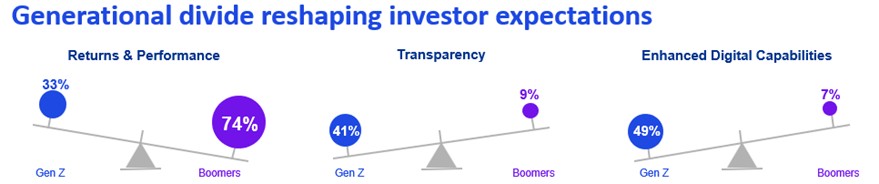
      He also mentioned the results of SIFMA’s 2025 VISTA (Voice of Investor Satisfaction, Trust, and Advocacy) Investor Survey conducted with KPMG. The findings showed strong overall confidence in the financial industry, with eight in ten investors satisfied and seven in ten believing their advisors act in their best interest. But beneath that confidence, Kruszewski noted a growing generational divide. “Three quarters of baby boomers say performance matters most. One third of Gen Zers, only a third of Gen Zers, talk about performance. They want immediacy, transparency, and control. They like speed and access, and they prefer to invest on their own.”

      According to Kruszewski, “technology has opened the doors to finance wider than ever, but has also brought impulses of gambling into the world of investing… The line between investing and gambling is blurring.” With the rise of prediction markets and zero-day options, the investing landscape is increasingly infused with short-term, speculative behavior, he said. “The art of investing is beginning to share space with the dopamine rush of speculation,” he warned. His message to young investors was clear: understand the difference between compounding and consumption. “That is the foundation of success,” he said, adding that some truths don’t need algorithms to prove them.

      Composer Introduces ‘Trade With AI’ to Enhance Investment Platform

      Composer, an AI-native, no-code investing platform that allows retail investors to build, automate and execute trading strategies, has announced the launch of its new Trade with AI feature.

      Through this enhancement, Composer automates investing by turning intuitive inputs – like single clicks or plain English prompts – into fully executable, back-tested trading strategies in under 60 seconds, bringing institutional-grade technology to the retail investment community.

      Since its inception over five years ago, Composer has grown into a vertically integrated, purpose-built trading ecosystem designed to bring intelligence to algorithmic investing. Its proprietary trading language enables large language models (LLMs) to build and deploy strategies, perform sub-second back-testing and trade seamlessly across stocks, crypto and options.

      Combining automation with human control, Composer has reached over $200 million in daily trading volume – advancing its mission to make sophisticated trading more accessible to all.

      With the launch of Composer’s Trade with AI, investors can now access features like:

      1. “Find My First Symphony”: Browse top performing algorithms from Composer’s collection of over 3,000 community-built strategies.

      2. “Help Me Choose”: Conduct a guided discovery to understand an investor’s interests with three simple questions and no heavy lifting. Based on each investor’s responses, Composer will provide three automated strategies based on your input in under 60 seconds. Questions include:

      a. “What kind of performance are you looking for?” (e.g., outperform the S&P 500; move independently of the S&P 500)

      b. “Which assets or sectors interest you most?” (e.g., growth stocks, tech/AI, crypto, ETFs, multi-asset strategies)

      c. “Is there a specific trading approach you prefer?” (e.g., momentum, contrarian, adaptive).

      Benjamin Rollert

      3. “Make My Own Symphony”: Leveraging the advanced clustering of thousands of real user strategies, Composer can identify common trading patterns, such as dynamic technical signals and all-weather or macro approaches, and ask users personalized questions about asset preferences and market conditions. In under 60 seconds, Composer builds, tests and presents a strategy through an intuitive interface that visualizes performance and structure, empowering traders to execute strategies with ease.

      “Retail traders have long faced an impossible choice: simplify their best ideas or abandon them entirely. Today, we are redefining what’s possible for sophisticated individual investors,” said Benjamin Rollert, CEO and Founder of Composer.

      “Composer changes the game for investors looking to implement trading strategies or seeking new sources of diversification within public markets. We’ve developed the first true AI-for-trading offering, instantly turning any strategy idea into a fully automated, back-tested and executable strategy. Trade with AI amplifies those capabilities, allowing sophisticated, automated investing to be accessible to more investors than ever before.”

      Source: Composer

      VISTA Investor Survey Finds High Satisfaction and Trust

      0

      Washington, D.C., October 21, 2025 – Today, SIFMA and KPMG released the results of the 2025 Voice of Investor Satisfaction, Trust, and Advocacy (VISTA) study titled “The Future of Investment Advice” at SIFMA’s Annual Meeting, showing a healthy baseline of investor confidence and a clear mandate for the industry.

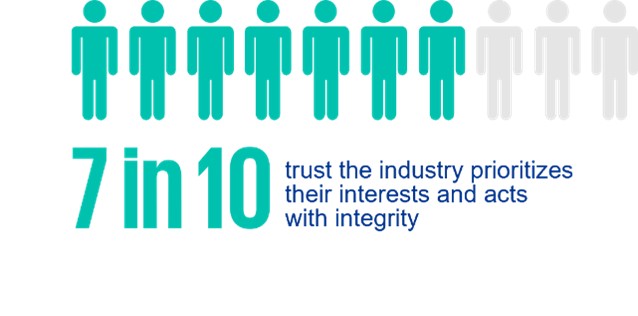
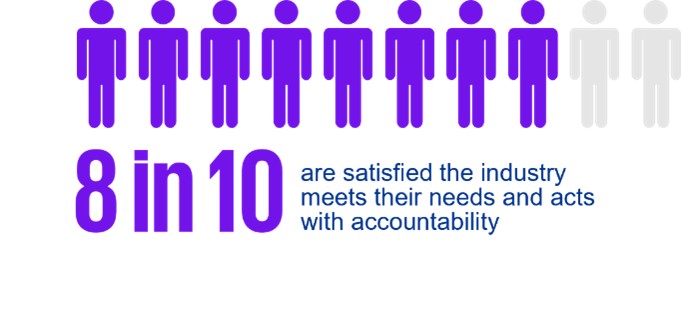
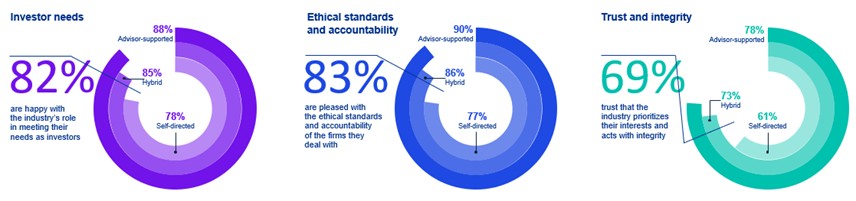
      A KPMG independent study sponsored by SIFMA, the survey of over 2,000 U.S. individual investors found that eight in ten investors are satisfied with the financial services industry overall, and nearly seven in ten say they trust it. Advisor-supported investment relationships remain central, with satisfaction close to 90% and peaking at 91% for Boomers. Ethical standards also scored well, with 83% of investors expressing satisfaction.

      Source: The Future of Advice: Why Combining Trust and Technology is Key to Attracting New Generations of Investors

      While advisors remain the foundation of trust and satisfaction for millions of investors, the VISTA survey found that generational divides are reshaping investor expectations and perceptions. The results underscore a mandate for the financial services industry to improve the delivery of advice and enhance the digital experience to better engage the next generation of investors.

      Chart from the VISTA study

      Source: The Future of Advice: Why Combining Trust and Technology is Key to Attracting New Generations of Investors

      Younger investors are increasingly self-directed, demanding more transparency and digital-first experiences. Gen Z is the only generation where satisfaction (77%) and trust (64%) are higher with self-directed models than with advisor-supported ones (72% satisfaction, 63% trust), signaling a fundamental shift in expectations.

      While Boomers prioritize returns and performance above all else, Gen Z places over four times greater emphasis on transparency and seven times greater emphasis on digital capabilities than Boomers.

      This digital focus also drives loyalty: Gen Z is 2.5 times less likely than Gen X and 4 times less likely than Boomers to remain with their provider when better digital options are available, and nearly twice as likely as Gen X and seven times as likely as Boomers to switch providers for improved technology.

      The study also highlights opportunities for hybrid models that combine advisor support with self-direction, which emerge as the most effective approach to meeting evolving investor needs.

      Gen divide chart from the VISTA study

      Source: The Future of Advice: Why Combining Trust and Technology is Key to Attracting New Generations of Investors

      Financial advice remains central to investor satisfaction and trust, but the results reveal that communication, delivery, and product offerings must adapt to better appeal to younger generations: advice must be available in the ways investors want to receive it. The future of advice will depend on the industry’s ability to deliver stronger digital capabilities across all models and seamlessly integrate technologies to meet the expectations of the next generations of investors.

      Ronald J. Kruszewski

      “These results show a healthy baseline of investor confidence, and they also deliver a clear mandate,” said Ronald J. Kruszewski, Chairman of the Board and Chief Executive Officer, Stifel and Incoming 2026 Chair of the SIFMA Board of Directors. “Advisors remain the foundation of trust for millions of investors, but the next generation is asking for more transparency and better digital experiences. SIFMA will use this survey as a benchmark to help the industry bridge the generational gap, improve digital offerings, and build trust across every generation.”

      “The VISTA survey provides valuable insights on how investors view our industry,” said Kenneth E. Bentsen, Jr., President and CEO of SIFMA. “While satisfaction and trust remain high, the results highlight the importance of transparency and accountability in sustaining confidence in the capital markets. As the leading voice of U.S. broker-dealers, investment banks, and asset managers, SIFMA is committed to ensuring our markets remain effective, resilient, and responsive to the needs of investors across generations and asset classes.”

      For more information and results from the survey, The Future of Investment Advice report can be found here.

      Source: SIFMA

      Capital Markets Tech Survey Assesses Resource Deployment

      The Modernization Mandate: Who Calls the Shots on Trading Tech?

      Capital markets are at a critical inflection point, with firms navigating a complex transition from legacy systems to a more agile, modern tech stack. The path forward is full of strategic choices, from how to deploy new technology to who holds the decision-making authority.

      Global Trading partnered with Adaptive to interview 50 capital markets professionals across the US, APAC, and EMEA to uncover key trends and evolving patterns in technology deployment. This report provides a benchmark for your firm to assess its own strategy against that of its peers in a rapidly changing industry.

      The Industry Research Covers:

      • Technology deployment models (On-premise, Hybrid, Cloud)
      • Drivers of trading desk modernization
      • Adoption trends for new tech: AI, Cloud, Open Source, and Blockchain
      • Technology provisioning and vendor strategy
      • Decision-making authority for tech investments
      • Sector-specific differences looking at sell-and buy-side firms

      This post first appeared on site publication Global Trading

      Access full report here:

      In an Age of Financial Noise, Data Integrity Is the Real Signal

      0

      By Kirsten Wegner, CEO, Index Industry Association

      Kirsten Wegner

      Imagine waking up to a world without “the market.” No Dow. No S&P 500. No Nasdaq-100® ticker rolling across your screen. No benchmark to tell investors when the market is up or down – or how a retirement or college savings plan performed.

      Without index data, investors, policymakers, and savers alike would be flying blind.

      Data is the foundation. Index providers transform that data into trusted signals that define the market. Indexes are built from raw market data. Once constructed, they become benchmarks, tools investors use to measure performance. The data derived from these indexes, known as index data, supports everything from portfolio construction to economic policy.

      Indexes are the unsung infrastructure of modern finance – transforming billions of daily data points into a single, trusted signal. They show how markets are performing, define the boundaries of economies, and give investors a common language for measuring success. As the world marks the United Nations’ World Statistics Day this October 20, it’s worth reflecting on the importance of reliable data in economic life. In line with this year’s theme, “quality statistics and data for everyone,” a recent study by the Index Industry Association explores how access to trusted index data strengthens transparency and accountability across global markets. The findings show that consistent, high-quality data help ensure markets serve investors and economies more effectively.

      A Transparent Engine for the Global Economy

      Every day, index data guides decisions worth trillions of dollars. When the news outlets describe “the markets are up,” they are referring to indexes. When investors evaluate a portfolio’s performance or manage risk, they rely on indexes. When they choose low cost, index-based mutual funds or ETFs, those products are built from index data.

      Indexes not only measure markets, but they also make them understandable. They distill vast, complex information into insight, giving shape and clarity to a financial world that would otherwise be incomprehensible to the human eye.

      From Railroads to AI

      The idea isn’t new. In 1884, journalist Charles Dow created an average of eleven railroad stocks to track the industrial economy’s heartbeat. His invention – the ancestor of today’s Dow Jones Industrial Average – transformed scattered numbers into knowledge. Just as

      Dow’s average brought order to industrial chaos, today’s indexes bring clarity to a data-saturated digital economy.

      From railroads to artificial intelligence, indexes continue to measure progress, risk, and innovation. More than three million indexes now measure every corner of the global economy: equities, bonds, commodities, futures, emerging markets, and even the next wave of technology.

      The Data that Builds Trust

      Indexes are not investment products themselves, yet their data supports nearly every corner of modern finance: from portfolio research and risk management and to data tied to mutual funds and ETFs, and even economic policy decisions. Without index data, investors couldn’t benchmark performance or manage risk, and policymakers would lose vital signals about economic health.

      Better Data, Better Decisions

      So much of finance depends on data. When data is consistent, transparent, and trusted, markets work better for everyone. Index data, invisible yet essential, is what turns billions of data points into understanding. Especially in an age defined by uncertainty, index data fosters trust, transparency and clarity while helping investors and policymakers navigate a complex financial world.

      As we celebrate World Statistics Day, let’s remember: every time we say “the market,” we’re referring to indexes, built from data, trusted by investors, and essential to understanding economic reality.

      CME, FTSE Russell Extend Index Derivatives License to 2037

      CME Group, the world’s leading derivatives marketplace, and FTSE Russell, the global index provider, announced a 12-year extension of CME Group’s exclusive license to offer futures, options on futures and OTC-cleared products based on FTSE Russell indexes.

      Tim McCourt, CME Group
      Tim McCourt

      “We are very pleased to extend our licensing agreement and partnership with FTSE Russell to continue providing global market participants with tools to effectively manage their equity index exposure,” said Tim McCourt, Global Head of Equities, FX and Alternative Products at CME Group.

      “Our FTSE Russell futures and options have grown substantially over our decades-long partnership, offering clients deep liquidity and the potential for greater capital efficiencies when they trade across our equity complex.”

      “We’re delighted to extend our long-standing partnership with CME Group, reinforcing our joint commitment to delivering robust, transparent index-based solutions to global investors,” said Fiona Bassett, CEO at FTSE Russell, an LSEG business.

      “The continued growth in trading volumes across FTSE Russell-linked products reflects the strength of our indexes and the value they bring to investors looking to measure performance across the global equity market.”

      CME Group offers futures on the Russell 1000 and Russell 2000, Russell 1000 and Russell 2000 Growth, Russell 1000 and Russell 2000 Value, FTSE Emerging Market, FTSE Developed Europe, FTSE China 50, and FTSE CoreCommodity CRB indexes. Since entering into the previous license agreement in 2015, more than 573 million FTSE Russell index-related futures and options on futures contracts have traded. More recently, year-to-date average daily volume across the Russell futures and options complex is at 306,000 contracts.

      Source: CME

      ON THE MOVE: UBS Names Daniele Magazzeni; Charlie Collins to RTX

      Daniele Magazzeni

      UBS has appointed Daniele Magazzeni as Chief Artificial Intelligence Officer to further advance the firm’s AI strategy, boost innovation and increase adoption of new technologies, according to a press statement. Magazzeni brings deep knowledge of AI research as well as expertise in the effective deployment and scaling of impactful AI solutions. He joins UBS from J.P. Morgan, where he served as Chief Analytics Officer for both the EMEA region and the Commercial and Investment Bank, driving their global analytics agenda across markets, banking, payments and securities services.

      RTX Fintech has hired Charlie Collins as Head of Markets, Europe, to spearhead the company’s launch in the region. Collins, formerly Head of European Credit at Tradeweb and Trumid, brings over a decade of experience building cross-asset electronic trading solutions. With his leadership, RTX is leading the electronification of a traditionally voice-driven part of the swaps market, with 18 bank dealers live in the U.S. and more being added globally.

      Will Jeffries

      Will Jeffries has started a new position as Executive Director – Global Head of Sell-Side Trading Services Sales at J.P. Morgan, he shared on LinkedIn. In his new role, Jeffries will focus on strengthening the integration of regional teams to provide a more cohesive client coverage approach, aligning with the firm’s global Tri-party platform. Jeffries has been with J.P. Morgan for over six years. Previously, he was Executive Director – Head of International Sell-Side Trading Services Sales, where he lead a team of sales professionals based in London, Paris, Hong Kong and Tokyo, focused on providing tri-party collateral management solutions for Sell-Side institutions across the EMEA and APAC regions.

      T. Rowe Price Group’ Board of Directors has elected Allan Golston and Richard Verma as independent directors of the company, according to a press statement. Golston is the president of the United States Program at the Gates Foundation, a private organization dedicated to advancing initiatives in education, global health, and community development. Verma is the chief administrative officer for Mastercard Incorporated, an American multinational financial services corporation. Previously, he served as the deputy secretary of state for management and resources, the general counsel and head of global public policy at Mastercard.

      Don Nilsson has been appointed as Chief Product Officer at Siepe, while Daniel Williams has joined as Vice President of Engineering, and Jerry Sullivan as Director, Sales. According to a press release, Nilsson brings over 30 years of proven success in developing and delivering solutions for large and complex financial information services software platforms. Before joining Siepe, he served as Chief Product Officer at Addepar, overseeing all aspects of the Addepar platform. Williams has more than 25 years of experience building technology platforms for the financial services industry. He joins Siepe after spending over two decades in technology focused on the WSO platform, now owned by S&P. Sullivan brings over 18 years’ experience across structured finance and capital markets. Before joining Siepe, Jerry was Director at Deutsche Bank in the Trust and Agency Services division.

      FinScan has added Becki LaPorte as Principal, AML Strategy and Innovation, and Christopher Ostrowski as Product Management Leader, according to a press release. With more than 25 years of experience, LaPorte is a Certified Financial Crime Specialist (CFCS) and Financial Intelligence Specialist (FIS), and a sought-after speaker and recognized authority in AML, fraud prevention, and financial crime compliance. Prior to joining FinScan, she served as Strategic Advisor for Fraud & AML at Datos Insights. Ostrowski joins FinScan’s product management team as Product Management Leader, bringing more than 17 years of experience in banking, product management, and compliance technology. Most recently, he served as Chief Operating Officer and Head of Product at FinClusive.

      If you have a new job or promotion to report, let me know at alyudvig@marketsmedia.com

      Hard-Pressed Electronic Trading Desks See Hope Ahead

      0

      Sell-side electronic equity traders under pressure from understaffed desks, sub-par technology systems and growing compliance demands are looking forward to getting some relief from an expected uptick in hiring, the positive impact of artificial intelligence (AI), and a friendlier relationship between the industry and regulators.

      A combination of declining commissions, rising costs and intense competition has made life difficult on sell-side electronic trading desks. The U.S. sell-side electronic equities professionals participating in a recent study from Crisil Coalition Greenwich say these conditions have led to a lack of staffing, complaints of inadequate customer service, and inefficient trading technology on their desks. At the same time, execution and connectivity costs, such as venue access fees and OEMS and analytics tolls, are consuming a large portion of trading commissions, leaving less budget for trading desks.

      Jesse Forster, Crisil Coalition Greenwich
      Jesse Forster

      “Despite these challenges, sell-side electronic equity traders are optimistic about the future, believing that tailwinds such as increasing volatility and trading volumes, the emergence of new trading venues, and the adoption of AI and automation are positioning the industry for growth and expansion,” said Jesse Forster, Senior Analyst, Market Structure & Technology at Crisil Coalition Greenwich and author of U.S. Equity Electronic Trading: The Broker View 2025.

      On the staffing front, almost half of study participants expect to add headcount to their frontline trading-desk coverage in the coming year. A similar share expects to add more juniors and trading assistants, which could help to alleviate some of the staffing pressures and provide a pipeline of talent for the future.

      Traders also expect relief from what they see as an increasing compliance burden. Study participants believe that the SEC’s renewed focus on market structure and trading issues will lead to more effective and efficient regulation, which will ultimately benefit investors and the broader market.

      “Electronic brokers are optimistic about the potential for greater cooperation between the SEC and the industry, with many seeing the new leadership as an opportunity to work together to address common challenges,” said Forster.

      AI’s Long-Term Impact

      Only about 30% of electronic brokers are currently incorporating AI into their equity trading workflow, with most of those deployments taking the form of algo optimization and venue selection. But electronic equity traders believe AI will become a core requirement for effective customer service and are excited to leverage AI more proactively for tasks such as alerting on orders going limit away, prints going up, participation rates, auction sizing, and more—things that low-touch coverage already does. Finally, the introduction of AI is making algos more autonomous.

      “In the not-so-distant future, it’s likely that brokers will no longer have to build different algos for different situations,” said Forster. “With AI, a single algo will be able to handle multiple scenarios.”

      U.S. Equity Electronic Trading: The Broker View 2025 presents the complete results of the Q2/Q3 study. The report reveals traders’ 12-month outlook for the industry and their own desks, identifies top challenges and pain points facing desks in the year ahead, discusses what traders see as the top selling points or differentiators of their desks, and examines the current and expected impact of AI on sell-side electronic equity trading.

      Source: Crisil Coalition Greenwich