



“What the Future Holds for the Stock Markets” Steve Hughes, NYSE, New York.


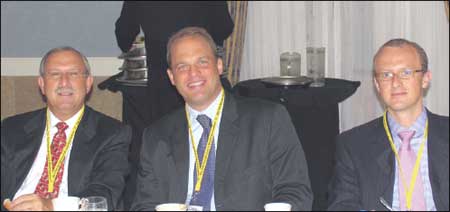
“What the Future Holds for the Stock Markets” Steve Hughes, NYSE, New York.

Jay Meagrow, President, Keybanc
Capital Markets; Rob Isreal, Board of
Governors, Victory Capital Mgmt.;
Brian Cavalier, Board of Governors,
Intergrity Asset Mgmt.; Lindsey
Wenzinder, Board of Governors,
Baker & Company; Linda Heuman,
Board of Governers, National City
PCG, all Cleveland.
It's good to be back at Traders Magazine after a nearly nine-year hiatus. You might ask, "Where you been, guy?" Well, I went on to run conferences on equity trading for five years and then proceeded into Wall Street brokerage. All very interesting, but like markets, careers sometimes have a way of correcting themselves: I'm back to my journalistic roots and excited about working at the industry's premier magazine on equity trading. It's a great opportunity, and, of course, challenge.
My return, in an odd way, is reminiscent of the plight once faced by Stanley Woodward, former sports editor and columnist of the now-defunct New York Herald-Tribune. Woodward refused to print the golf scores from the weekly golf outing of the owner's wife and her friends, saying it was beneath the dignity of such a fine paper. Woodward's stand led to his firing. Years later tempers cooled. Woodward was brought back for a second time.
In almost predictable fashion, the sports-writing legend and iconoclast began his first column at the Trib, "As I was saying before I was interrupted…." Regarding my own interruption, much has changed since 1996. And I feel blessed to have come full circle.
The theme at Traders Magazine has always been to stay on top of the news and ahead of industry developments. That philosophy served me well at II's TraderForum after leaving this publication. Think of all the developments in the industry between 1996 and today. The pace of change-especially the two recent mergers-has been mind boggling.
One benefit of running a conference organization was the tremendous access it afforded me to buyside traders. It provided insight into their issues and the challenges they face, as well as some great friendships. A trade publication needs to understand the business of its readership. That brings added depth and insight into stories. With Peter Chapman, promoted to executive editor, and Greg Bresiger, managing editor, our goal is to cover new ground and bring new perspectives.
I've been fortunate to have been employed by great organizations on Wall Street, but without question, the most impressive person I have ever worked for was legendary trader John Mulheren. I did marketing for him until recently at a small brokerage unit in the Bear Wagner stable. A head trader at a major bank once asked if John would visit his desk to talk about trading and markets. John did, of course, and spoke with precision for 90 minutes and answered questions. As the teacher spoke, some of the 15 or so traders rapidly took notes, while others simply looked on in amazement. Count me in that latter group. A great trader-but an even greater man-has gone.
Traders Magazine has been fortunate to have had one of the true pros in journalism as its editor, John Byrne. Under John, Traders Magazine made tremendous strides editorially to reach its lofty perch in the industry. During his tenure, Traders Magazine became a must-read in the industry, and, for that, its readership should be grateful. We wish John well.
Michael Scotti
Editorial Director
Citadel's New Line
*Citadel Execution Services (CES), the broker-dealer arm of the large hedge fund, is entering the wholesale equities business. The Chicago-based shop will "soon" use computers to make markets in all Nasdaq and listed names," according to Andy Kolinsky, in charge of sales and client services at CES.
Citadel is the second big financial firm recently to announce plans to become a wholesaler. Earlier this year, Citigroup started its broker-dealer servicing business. Wholesalers execute orders for retail brokerages. The major players are Knight Capital Group, Bernard L. Madoff Investment Securities, E*Trade Financial Group and Automated Trading Desk.
Citadel has made markets in options on the ISE for about two years. It began offering retail brokers routing services to options exchanges in January. The move into wholesaling is a logical extension, say Citadel execs. CES has no plans to hire human market makers. Computers will do all the work.
Harborside Docked
*Harborside Plus is gone. Last month the firm closed Harborside Securities, ending its anonymous matching system, Harborside Plus. The reason? A liquidity crunch: The firm needed cash to continue. Harborside, which rarely traded more than a few million shares per day, finally ran out of money.
The three-year-old electronic brokerage spent its last months unsuccessfully trying to secure a buyer, sources tell Traders Magazine. Morgan Stanley was rumored to be interested, as was a "similar-type firm," according to one source. Both passed on the deal. Morgan Stanley declined comment.
NSX Violates MOE
*The National Stock Exchange (NSX) and its top leader failed to enforce its market order exposure (MOE) rule, according to the SEC. Both have been censured. The NSX, at the direction of CEO David Colker, neglected to file a proposed rule amendment for its limited enforcement of MOE, regulators said. Consequently, investors lost opportunities for potential price improvement during the 1997-2003 period, said the SEC, which ordered NSX to spend $1 million on a regulatory auditor.
An SEC official wrote that SROs need to "vigorously" enforce their rules. The settlement includes Colker's censure and a $100,000 civil fine. It also requires structural changes in the NSX. An NSX attorney told Traders Magazine it "was a good settlement and we look forward to enhancing our regulatory and enforcement programs."
Blocking & Trading
*Block traders, under Reg NMS, will find the SEC's new trade-through rule a bigger challenge than will small-order traders, according to top Street executives speaking at a recent SIA market structure conference. Chris Concannon, a Nasdaq executive vice president, and Andy Madoff, of wholesaler Bernard L. Madoff Investment Securities, explained why. "The problem is on the institutional side," Madoff said. "We've been living inside the NBBO for many years." Of block traders, Concannon asked: "Do you sweep the market? Or is your attempt to comply enough?" Under the new rule, block traders have two choices. They can comply by printing trades at the inside. (And keep records that prove the trade was inside when it was negotiated.) Or, if they choose to print outside the NBBO, they must sweep the market's better quotes.
The regulators are going to closely watch that floor trading has the "appropriate controls, particularly with regard to specialists," the New York Stock Exchange's top regulator recently told a Security Traders Association conference in Washington.
"Were I you," Richard Ketchum announced to a roomful of attentive securities officials, "I would be looking at the misuse of confidential information and how you handle large blocks and volume weighted orders." He added that trading at the close continues to be "a worry."
Issuer fraud, the bulletin board and the unlisted market in general will be areas that the NASD will focus on, added Stephen Luparello, executive president for market regulation for the NASD.
"We see that there are fewer players so it is an area that we are going to closely look at," he added.
Luparello also predicted that those trading firms that have high "failure to deliver" rates will be scrutinized. Options trading will also be under review, another regulator promised.
"We're really pressing the options traders to rationalize what they do," according to John McCarthy, associate director of the Securities and Exchange Commission's Office of Market Oversight.
Nasdaq's much delayed exchange application, now over four years old, will come before the Securities and Exchange Commission members sometime this year.
"I feel sure that we'll make it in less than five years," said Commissioner Cynthia Glassman. She addressed the recent STA Congressional Conference. Annette Narazeth, director of the SEC's Division of Market Regulation, said the application will come before the commissioners "this year."
The cost of conducting business will decline a bit beginning in October. That's because Section (31) fee rates will be going down this fall by about 27 percent. They will decline from $41.80 per million dollars to $30.70, according to the Securities and Exchange Commission.
The Section (31) fee-which generally applies to exchanges and over-the-counter markets-is used to finance the costs of regulation. It was reformed several years ago to ensure that the fee didn't take in more money than was needed to fund regulatory costs.
When trading volume is rising, the rate usually can be cut. And when the reverse happens, it usually rises, according to a spokesman for the Securities Industry Association.
"The rate cut shows that the system is working and that firms aren't paying more than they should," he added."And that's a good thing."
The NYSE and the NASD should no longer be allowed to restrict access to arbitration award records, an attorney suing the NASD asks in a request for rulemaking filed with the SEC.
"I want these records to be easily available to everyone," Daniel Solin, an attorney in Pittsfield, Mass., told Traders Magazine. He says NASD and the Big Board are limiting access to the awards to those who are part of the arbitrations. However, an NASD spokesman says all awards "are available to anyone free of charge."
The spokesman added that Solin wants "unrestricted access" for the purpose of his own commercial product. Solin says he wants the records, in part, for a law review article. However he argues that it is in the public interest that these records be widely disseminated to everyone.