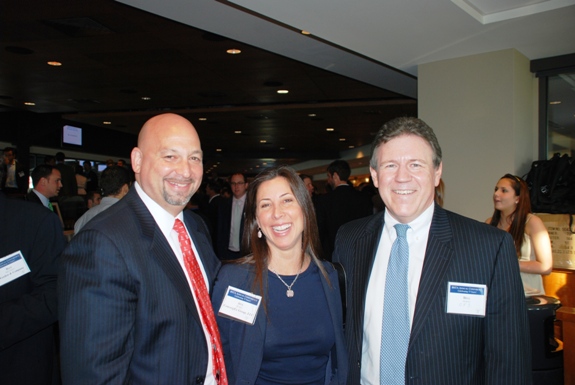
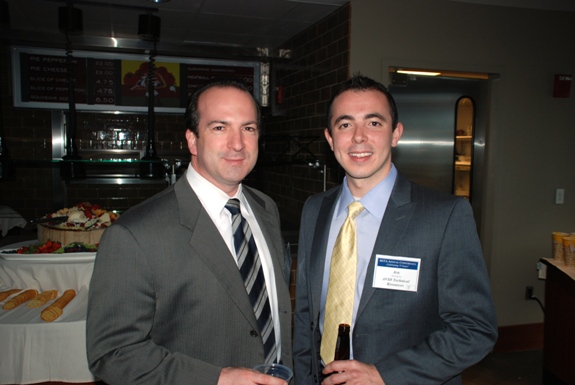
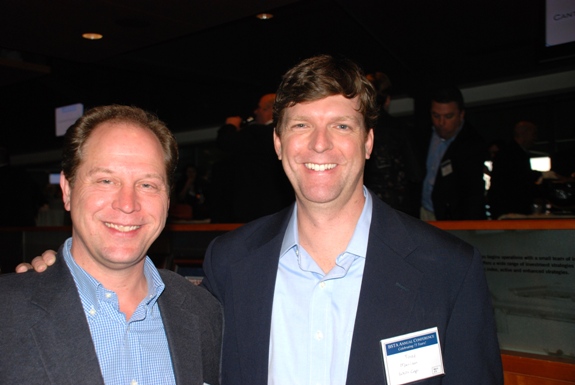
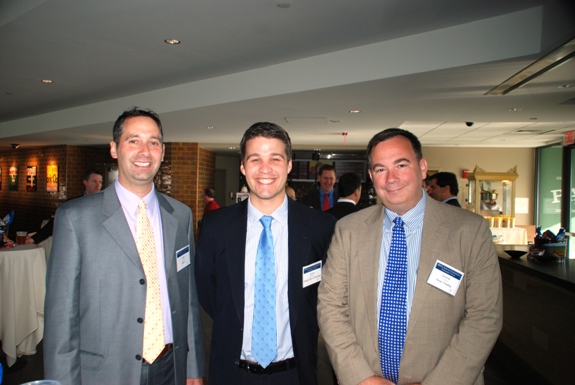
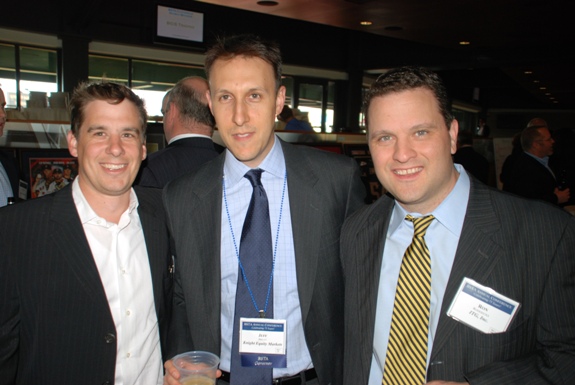
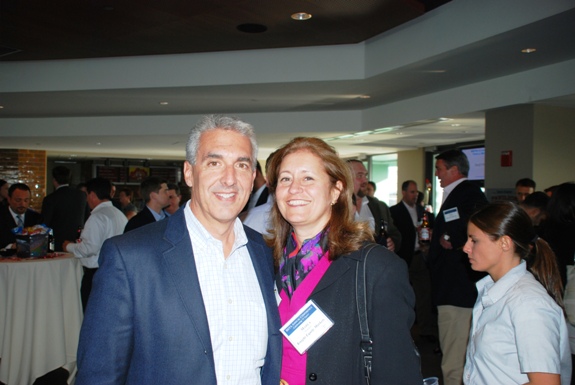
Beth Gottleib, Knight Capital Group, Jersey City; Margaret Quigley, JMP Securities, Elise O´Connell, Lee Munder, both Boston.
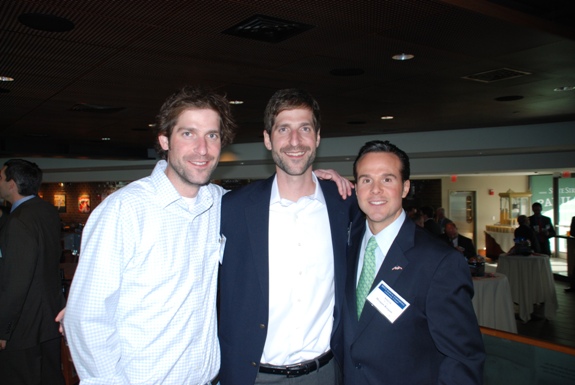
Joe Cangemi, Ana Burke, both ConvergEx Group; Bill Hebert, CFS Consulting, Boston; Dylan Ade, JMP Securities, boston; Brandi Gatlin, Merriman Curhan Ford, New York.
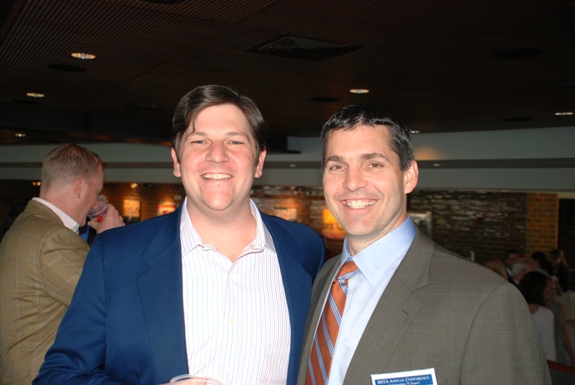
Richard Knox, Bull & Finch Group; Matt Enos, guest, both Boston.
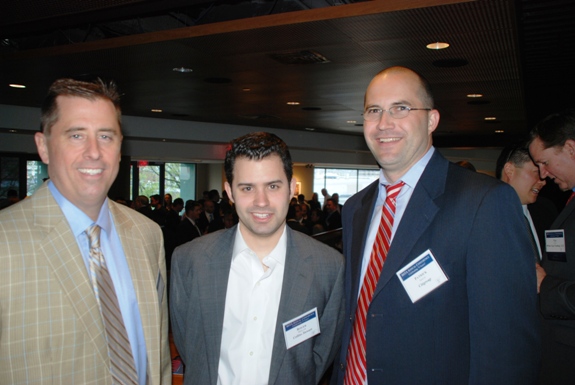
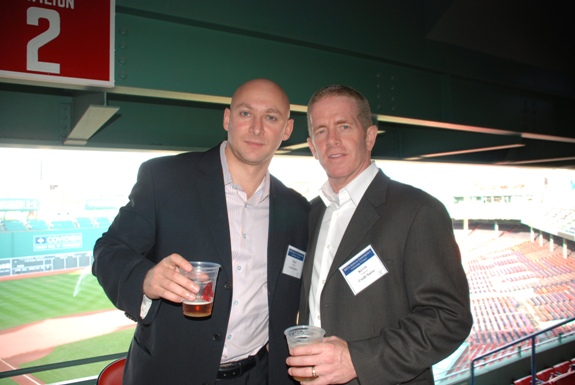
Bob Cawley Wellington Management, Boston; Roger Meilleur, Collins Stewart, New York; Patrick Smith Citi, Boston.
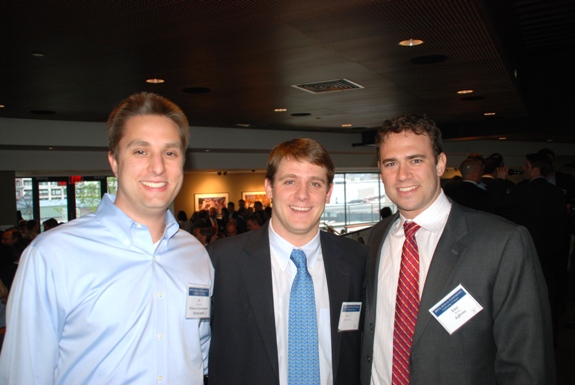
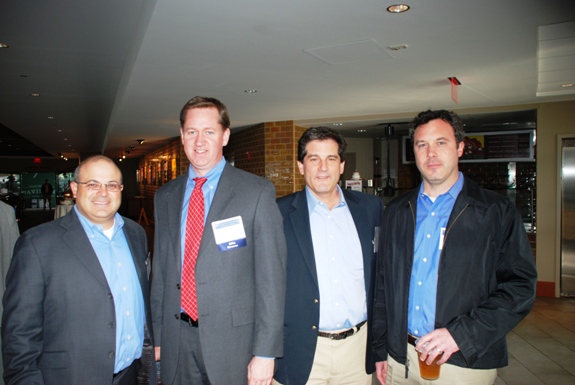
JP Jagusiak, Winward, Boston; Dan Stroka,, Vandham Securities, Woodcliff Lake; Eric Sonis, Jefferies, Boston.
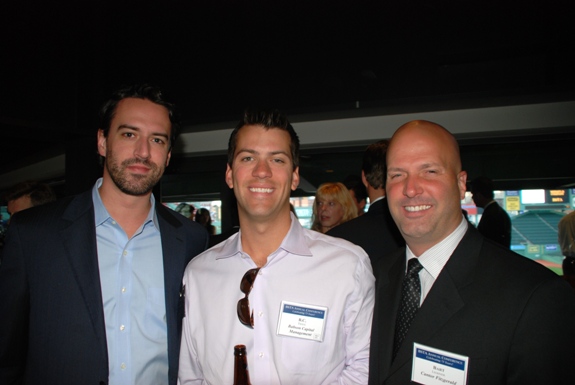
Ryan Baker, Cantor Fitzgerald; B.C. Tieste, Babson Capital Management, both Boston; Bart Leohner, Cantor Fitzgerald, New York.
Michael Palamaro, Abel Noser, Ana Burke, ConvergEx Group; Mary McDermott Holland, Nasdaq OMX, New York; Chris Corwin, Abel Noser, Joe Cangemi, ConvergEx Group, New York.
Matt McDermott, Susquehanna; Mark McDermott, Collins Stewart, both boston; Tom King, Cuttone, New York; Patty Mitchell, Weeden, Elizabeth Giroux, Essex Investment Management, both Boston.
Matt Enos, guest; Brad Austin, Execution Noble; Trip Carey, Michael Negron, both Wunderlich Securities, all Boston.
David Belanger, Joe Antocci, both Avid Technical Resources, Boston.
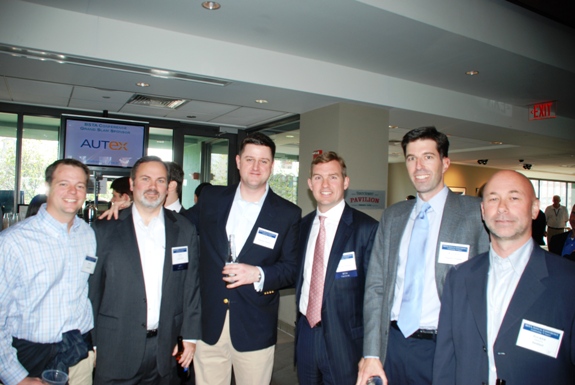
Chris DeMaso, Bank of America Merrill Lynch, New York; Ralston Roberts, Jamie Corrigan, both SunGard, Jersey City; Paul Clarke, Portware; Michael Ceppetelli, Autex, both New York.
Tom Kane, Rosenblatt Securities, Colleen Connors, Catherine Lee, Adam Dix, Joe Franchi, all Autex, all Boston.
Noreen McCloskey, UBS, Boston; Dan Yu, Realtick, New York; Rebecca Taverine, Helen Rim, both Direct Edge, Jersey City.
Ellen Green, Susquehanna, Gus Phelps, Seacoast Securities, both Boston; Mary Freeman, Mixit, New York.
Francis Corcoran, Scotia Capital; Mary McDermott Holland, Nasdaq OMX, Andrew Frank, NYSE, all New York, Wally, Boston Red Sox, Boston.
Amrita Gupta, UBS, Stanford; John Silvestri, Aqua Equities, Val Sanchez, UBS, both New York; Phil Bruno, Direct Edge, Jersey City; Dave Hagan, Linedata, Boston.
Dave Hagan, Linedata, Todd Morrison, Wells Capital, both Boston.
New prime brokerages with deep pockets now have a better chance to pirate business from the big boys or get more business from existing clients.
That’s what officials of Fidelity Investments’ prime brokerage unit are hoping as they expand the scope of their service. So they will start providing executions of European stocks beginning this summer.
"Clients have been asking us to do this and now we’re ready to offer it with select clients starting in July," according to Thomas Tesauro, executive vice president of Prime Services at Fidelity Capital Markets.
The Fidelity prime brokerage unit had previously been restricted to long and short U.S. equities. But that put some clients at a disadvantage.
"Many times we were one of a number of primes, but they could only give us a percentage of their portfolios; they couldn’t give us more because we could only do their U.S. business," he added. The expansion will include international custody, clearing and trading services, Fidelity officials said.
Fidelity’s little known prime brokerage unit has some 105 hedge fund clients. The average fund holds roughly $1 billion in assets under management, the firm said. That puts Fidelity in the middle of the pack of prime brokerage providers, according to industry observers.
Tesauro hopes that the European option will improve Fidelity’s presence in the prime brokerage market. Until recently, Fidelity was little regarded as a serious prime brokerage player. Even two years ago, a company spokesman said the firm hadn’t been communicating its message publicly.
Indeed, the prime brokerage unit, which is actually six years old, was hardly known by most hedge fund managers until about a year ago. That’s when Fidelity officials thought that problems in the marketplace could actually benefit relative newcomers to the prime brokerage business and they started making a new push.
Fidelity, still not one of the heavyweights of prime brokerage, said the market meltdown of 2008 provided an opening for them. The failures of Lehman Brothers and Bear Stearns have changed the outlook of some hedge funds, Fidelity officials said.
"Fidelity’s strategy can work," said Denise Valentine, a senior analyst with Aite Group. She added that many hedge funds are still worried about having the assets frozen if another market meltdown happens.
Consequently, hedge funds are now more likely to have more than one prime brokerage relationship than before the market turmoil, one market observer said in a recent report.
"Medium-sized hedge funds will gravitate toward a pairing of a bulge bracket broker and a secondary player," the TABB Group wrote in its latest annual survey of prime brokerage.
"This enables them to diversify counterparty risk while maintaining meaningful account balances at two firms," according to TABB’s "U.S. Prime Brokerage 2009: The Hedge Fund Perspective."
For the survey, the TABB Group interviewed 62 U.S.-based hedge funds with assets under management averaging between $500 million and $3 billion.
The downside of multiple primes is that a fund must pay more than it would with a single provider. In addition, potential operational problems can increase.
Valentine said Fidelity and others aiming for secondary prime relationships will offer services that will ease the potential operational problems of having two or three prime brokers.
Still, the reason for a secondary prime is to reduce the risk of frozen client assets should one prime fail. That happened to numerous hedge fund clients whose assets were tied up when Lehman Brothers and Bear Stearns collapsed.
Fidelity officials also argued that they have a stable, non-conflicted offering, noting this will entice mid- to large-size hedge funds looking for another prime or a secondary relationship.
"We don’t do distressed securities and we only do agency trading, so we are not competing with our clients," Tesauro said. Fidelity officials also underscore that their parent, a giant fund company with huge assets, has deep pockets.
Tesauro conceded that "the crisis allowed us to get in the door with the clients." But he added that offering European equities alongside the unit’s emphasis on its financial stability will lead either to a greater percentage of a fund’s business or new relationships altogether.
Fidelity’s target? The biggest prime brokers in the business are JPMorgan, Goldman Sachs and Morgan Stanley, according to recent numbers by Hedge Fund Research. Would clients of these prime brokerage heavyweights consider defecting or dividing their business among several prime brokers?
Some 12 percent of funds recent surveyed by TABB Group said they were looking for another prime broker. And another 39 percent of the same group said they will consider an additional prime broker if assets under management grow.
But what Fidelity didn’t discuss is how some fund officials are still spooked by the Lehman-Bear Stearns blowups. Indeed, TABB Group reported that bank failure concerns have led to a 20-percent increase in prime relationships.
"Hedge fund participants," TABB Group wrote, "say that the events that occurred within the industry have led them to believe that bank failure is real and counterparty risk needs to be reduced."
On June 10, the SEC approved new single-stock circuit breakers in response to the May 6 market "flash crash." The SEC action permits the national securities exchanges and FINRA to implement uniform, market-wide "circuit-breakers" so that U.S. equity markets can take a "pause" in the event that there are rapid, excessive price movements in certain individual stocks.
These new rules will supplement the existing market-wide circuit breakers, which halt trading for varying periods of time if the Dow Jones Industrial Average falls 10 percent, 20 percent or 30 percent from the previous day’s closing price. Those market-wide circuit breakers were not tripped during the flash crash, even though a number of individual securities dropped precipitously–and almost as suddenly reversed the plunge. The new circuit breakers are intended as a more targeted mechanism that will not depend on overall market declines.
The single-stock circuit breakers will pause trading in any component stock of the S&P 500 Index in the event that the price of that stock has moved 10 percent or more in the preceding five minutes. The pause generally will last five minutes, and is intended to give the markets a hiatus to attract trading interest at the last price, as well as to give traders time to think rationally.
The new circuit breakers will be effective on a pilot basis through December 10. In order to begin this pilot program promptly, the single-stock circuit breakers initially will apply only to S&P 500 component stocks. As currently adopted, these single-stock circuit breaker rules will not be in effect during market opening and closing, but only from 9:45 a.m. until 3:35 p.m. They are expected to be rapidly expanded–by additional rule proposals–to include ETF and other securities before the end of the pilot period. Several exchanges already have filed for rule amendments to halt trading in options when an underlying security is the subject of a trading pause.
The mechanics of the new rules provide that if a covered stock experiences a 10 percent change in price in a five-minute period, the stock’s primary listing market will issue a five-minute trading pause and will immediately notify the other exchanges, FINRA, and market participants by disseminating a special indicator over the consolidated tape. Once the primary market issues the trading pause, each other exchange also will pause trading and FINRA will pause trading by its members in the OTC markets–including trading on alternative trading systems and by market makers.
At the end of the five-minute pause, the primary listing market will reopen trading. However, in the event of a significant imbalance on the primary listing market, it may delay reopening for up to an additional five minutes. Trading on the other exchanges and in the OTC markets will resume once trading has resumed in the primary listing market or, if the primarily listing market has not resumed trading within 10 minutes, the other exchanges may resume trading without waiting for the primary listing market. FINRA’s rule permits OTC participants to resume trading only if trading has resumed on at least one exchange.
The SEC is hoping these single-stock circuit breakers will be a starting point in the effort to prevent another flash crash or runaway market. During the trial period, the SEC will consider, among other things, whether the 10-percent threshold is the proper measure for all securities (or whether the threshold should be commensurate with a stock’s volatility), whether the length of the pause is sufficient to restore rationality to the market (if in fact it does that at all), whether these circuit breakers also should be in effect during the high-volume periods of market opening and closing and whether the reopening procedures work well. They may also be considering proposed alternatives to the circuit breaker mechanism.
Will the new circuit breakers be effective? Only time will tell. It’s likely that at some point in the next six months, the circuit breakers will trip in at least some stocks. However, since they are starting with only the S&P 500 stocks, which historically have not had as much volatility as non-S&P 500 stocks, we may not see many circuit breakers tripping. The markets will most likely react to these temporary pauses rationally, and the regulators will declare these rules a victory.
It is more difficult to imagine how well the circuit breakers will work when thousands of stocks are included, especially if broader crashes cause large numbers of circuit breakers to trip simultaneously. Will five- and 10-minute pauses allow the markets to discover correct prices? Of course, it would be easier to make predictions about the next flash crash if we knew what caused the last one, and the cause is still largely a mystery.
We now live in a world where high-frequency trading has gone a long way toward replacing human traders with computers. In some sense, single-stock circuit breakers provide an automated replacement for the now-defunct specialists, who used to be able to call for trading "breathers" if there were rapid and irrational price movements. Slowing trading, with circuit breakers or by other means, may seem like a step backward. But sometimes you have to take one step back to move two steps forward. The hope is that single-stock circuit breakers will give computerized markets the time to cure temporary market imbalances, rather than instantaneously executing automated trades at irrational prices.
We can expect to see much more rulemaking in this area, possibly including a recalibration of the market-wide circuit breakers that were not triggered on May 6. The SEC continues to look for the cause of the flash crash. And if they find it, new and improved regulation is likely to follow.
Beth Lowson is senior securities counsel with The Nelson Law Firm, LLC in White Plains, N.Y. She can be reached at bnlowson@nelsonlf.com.
The views represented in this commentary are those of its author and do not reflect the opinion of Traders Magazine or its staff. Traders Magazine welcomes reader feedback on thiscolumn and on all issues relevant to the institutional trading community. Please send your comments to Traderseditorial@sourcemedia.com
Liquidnet said it received a second patent on its equity trading system from the U.S. Patent and Trademark Office and that counterclaims in a suit it initiated against Investment Technology Group on a previously issued patent had been dropped.
But ITG said Tuesday that it believed that patent was invalid and that its move was made to simplify the overall issues in the patent infringement dispute.
The new patent, No. 7,747,515, is entitled "Electronic Securities Marketplace Having Integration With Order Management Systems," which Liquidnet said protects proprietary methods for generating liquidity for institutional block trades using computers.
"This is further recognition of the continued innovation that we have led over the last decade in making trading more efficient for the institutional trading community," said Seth Merrin, founder and chief executive for Liquidnet.
Liquidnet also disclosed that ITG in April voluntarily dropped a counterclaim filed in 2006 against Liquidnet involving the previous patent that it had received.
Liquidnet has alleged that ITG infringes that trading technology patent and ITG had sought, Liquidnet said, more than $200 million for "tortious interference with prospective business relations."
Liquidnet said the dismissal of the counterclaim means that ITG’s claim cannot be asserted against Liquidnet in the future. Liquidnet said it will continue to pursue its patent infringement claims against both ITG and Pulse Trading, Inc.
Liquidnet Holdings, the parent of Liquidnet, was previously issued U.S. Patent No. 7,136,834 on Nov. 14, 2006. This is the patent that ITG, while dropping its counterclaim, believes is not valid.
"We do not believe that ITG has in any way infringed Liquidnet’s ‘834 patent, and furthermore, we believe the patent is invalid," said Mats Goebels, managing director and general counsel at ITG. "ITG voluntarily dismissed its counterclaim for tortious interference, a small element of the larger lawsuit, in order to simplify the issues in the case. In our view, this move does not change the overall picture of the patent infringement lawsuit."
Liquidnet’s patent infringement suit "is wholly without merit," Goebels added. ITG contends that Liquidnet derived its patent from work done in 1997 and 1998 by other parties.
Liquidnet operates a block-trading venue that serves 36 equity markets across five continents.
This story originally ran in Securities Industry News.
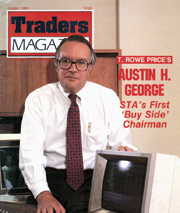
Good traders often have a gut feel for what’s about to happen next, an uncanny timing that can be prescient at times. Austin George, the one-time head trader at T. Rowe Price, who’s been retired since 1992, recently fit that description. George penned a letter to this editor on May 5–the day before the Dow Jones Industrial Average plunged nearly 1,000 points before recovering.
The rapid drop in the marketplace on May 6 is still under investigation, but many believe that an individual trading a high volume of e-mini contracts started the spiral. The movement in the underlying stocks was further exacerbated when the exchanges showed a lack of harmonization of their rules during a time of stress. Consequently, stocks continued to plummet.
The gist of the letter from the man, who received his first order from a portfolio manager on the back of an envelope in 1962, is how dramatically equity trading has changed and how difficult it is for someone from his era to follow or even associate with it. "I seldom see any names I know and most of the firms have ceased to exist or merged with others," George wrote in a clear penmanship. "And the trading lingo and techniques of today might as well be a totally foreign language."
The letter prompted this editor to call George, a gracious man of 77 years and also a loyal reader of this publication. "Sheer coincidence," is how George described the timing of his letter and the unraveling of the markets. George said he was unsure what long-term effect the plunge would have on investor confidence, but he said that when trades occur "much faster than a human’s ability to react to them, you know you’re going to have problems like this crop up." Still, he said investors will always buy and sell stock based on their fundamental value.
In retirement, George hasn’t distanced himself completely from the market and trading. He still might find himself checking the market at noon to see what’s going on. To this day, however, George has vivid dreams about trading. And he’s not always on the winning side. Trading is that ingrained in his psyche, he said, mainly because he has such fond memories of the business.
"It was a different world," said George, who was chairman of the Security Traders Association in 1989 and one of the first buyside participants of a group that was almost entirely comprised of OTC traders. "I’m not saying a better world, but for someone who liked meeting interesting people, it was almost like heaven on earth."
George said that given his personality and orientation toward people, he came into trading at the perfect time. He said he wouldn’t have enjoyed working in today’s market because it is too technical for him. That’s why he left his first job as an engineer at DuPont, after graduating from Princeton University in 1955. He took a job at T. Rowe Price to run operations four years later.
The trading desk was initially just him. Portfolio managers would return from their Friday lunch meeting and hand him a sheet of paper with a list of stocks to buy or sell and how much. His first block trade was done with Salim "Cy" Lewis, the giant of a trader at Bear Stearns who ran trading, he recalls. And since T. Rowe was a no-load fund, it didn’t need to remunerate brokers for selling its fund, so George was free to trade with many of the third-market firms that traded on a net basis. This helped lower commissions before Mayday-which ended fixed commission rates in 1975 and made brokerage commissions competitive. Firms like Weeden & Co. and Blyth & Co. were frequent calls of his, as they made tight markets without a commission, he said.
Goldman Sachs, First Boston and Salomon Brothers also threw their financial muscle around then, looking to attract the big block trades, he said. "Some of them would commit capital at the drop of a hat, while others would take a bit longer to think about it," he said. A capital trade was significant then, he added, because that was in the day when Wall Street consisted of private partnerships, so the risk was on the shoulders of the firm’s employees, not shareholders like today.
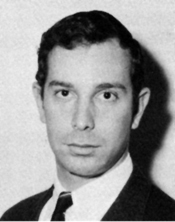
Within the first five minutes of the phone call, George reached for a block trading directory from 1968 that was on his shelf. He recounted the names of firms long out of business and the names of traders who haven’t traded in decades, including Michael Bloomberg, who ran equity trading at Salomon Brothers from 1976 until 1981, before venturing out to start his own data and information company. (He also read the names of Bob Mnuchin of Goldman Sachs and Jay Perry of Salomon, two legends in block trading.)
George met Bloomberg when he first took the reins at Solly. His OTC coverage, Howard Levine, introduced them at the STA national convention in Boca Raton, Fla. "He was very shy and feeling his way at first," George said. Their relationship grew during Bloomberg’s tenure. The two would meet for breakfast, George said, when Bloomberg would attend functions at Johns Hopkins University, his alma mater in Baltimore. "We did quite a bit of business with Mike when he was on the desk," he said.
Before electronic trading became prevalent, George said that each brokerage firm had its own personality and area of specialty. It was his job to give an order to the appropriate broker in each situation. For example, one firm might have a great utility trader, while another firm might have a great floor broker that was good at "hiding in the woodwork" or knew how to deal with a difficult specialist. "It was all about knowing people," George said.
George likened himself to a conductor of a symphony orchestra. "Sometimes I needed woodwinds and sometimes I needed brass," he said. George was a traders’ trader in the sense that he never wanted to micro-manage his brokers. "I’d give a guy instructions, but I never wanted to tie his hands," George said. "I was much more willing to give him scope and let him use his prowess. You have to have faith in the people that you are dealing with."
Still, there were no free rides, and brokers knew their performance was being critiqued. "I’d simply tell them, ‘I’ve got a lot of faith in you, but if you don’t fulfill it, you might not see me for a while.’"
George remembers the back-office crunch, when the markets were closed on Wednesdays so firms could keep up with the processing of trades. In fact from today’s perspective, it is almost unbelievable that he actually had to warn firms that he would stop trading with them if their fail rate didn’t improve.
Later would be the bear market of 1973, which he called the most painful time, likening it to a balloon losing air. Stocks declined day after day, and worse, there was no trading volume. For the T. Rowe Price Growth Stock Fund it was a painful time because the world had turned its back on growth stocks and their high price-to-earnings ratio, George said. The Crash of 1987 was just the opposite in its duration, he said. Although many feared their firms wouldn’t survive, he said that worry was short lived and subsided after the markets recovered.
But it was the people that made George’s 30 years in trading memorable, he said, particularly the "characters." He recalled the time an Ivy League-educated portfolio manager was invited to a traders’ dinner. He accepted the invitation. Not used to being around traders after the bell, the stock picker of Brahmin heritage was aghast at some of the shenanigans that went on during dinner.
But it wasn’t just portfolio managers who questioned George’s friendships. Even the traders would ask him how a Princeton graduate could be so comfortable around a group of OTC traders like themselves and fit in.
Looking back, George said, "They were some of some of my best friends; they were just wonderful, extraordinary people." And from a business perspective, he said, they knew their stocks and how to trade.
George ended his letter with an endorsement of the trading profession and an enduring optimism that both an industry and those in it will always strive to do what is best for their customers. And that a trader’s word is his bond, or Dictum Meum Pactum, which is the STA’s credo.
"I was lucky enough to have traded in a great era well populated by many of the finest people I’ve known," George wrote. "And yes, I still believe it–Dictum Meum Pactum."
(c) 2010 Traders Magazine and SourceMedia, Inc. All Rights Reserved.
A pricing change by Nasdaq Options Market (NOM) slated to go into effect on Thursday highlights a trend underway at the options exchanges that has market makers seeing their costs go down, while brokers handling customer orders are seeing theirs go up.
In the midst of a heated battle for market share, exchanges are rolling out the red carpet for dealers, hoping they will quote aggressively and draw flow to their platforms. To win their liquidity, maker-taker exchanges are increasing their rebates. Meanwhile, traditional exchanges are introducing rebates for the first time.
To fund the rebates, the exchanges are increasing the fees they charge for customer orders, or introducing fees, where before there were none.
Because market makers provide most of the liquidity on options exchanges and customers do most of the taking, the moves put more money in dealers’ pockets and leaves less in brokers’.
For the traditional exchanges this is a fundamental shift. At exchanges such as Nasdaq OMX PHLX and the International Securities Exchange, market makers have historically paid transaction fees, while customers traded for free. Dealers say the changes are necessary.
"In the past, market makers were making enough money that they could afford to bear the costs," said Slade Winchester, a director in Citigroup’s U.S. equity derivatives division. "But markets have tightened up to a level where market makers can’t continue to bear the cost and make tight markets. So the costs are shifting." Citi is one of the largest market makers in the options industry.
The trend began earlier in the year when Nasdaq OMX PHLX, sister exchange to NOM, adopted maker-taker pricing for some of its more actively traded options. The Philly replaced fees with rebates for market makers providing liquidity and began charging customers for the first time.
The result was a sharp spike in the Phlx’s market share; a windfall for dealers; and increased costs for brokers.
The Phlx now rebates market makers 23 cents per contract for providing liquidity. It charges "regular" customers 25 cents to take liquidity and professional, or very active, customers 40 cents to take liquidity. The program now applies to about 80 of the Phlx’s most heavily traded options, accounting for at least half of Philly’s volume.
The ISE quickly followed the Philly with a maker-taker pricing program of its own. The ISE program is less aggressive than the Phlx program: it pays market makers less and does not charge small-lot customers.
ISE pays its most aggressive market makers a 10-cent rebate. It charges professional customers 25 cents to take liquidity. It charges customers trading large lots–100 contracts or more–20 cents to take liquidity. It does not charge customers trading fewer than 100 lots.
The ISE, which has seen its market share in non-index options drop by one-third in the past year, now includes about 50 options classes in its maker-taker program, accounting for about half of its traded volume.
In April, NYSE Arca, which saw its market share drop as the Philly’s rose, took steps of its own to compete. It increased its rebates for market makers in 15 of the most actively traded classes. It also increased rebates for trades in all other penny names for its biggest market makers by tiering its fee schedule. (Options in the penny pilot now account for nearly 90 percent of all traded volume.)
For market makers supplying liquidity in the QQQQs and 14 other names, Arca now pays 35 cents per contract. That’s 5 cents more than its standard pricing. In the remaining options, for market makers posting quotes in at least one million contracts per month, Arca will also pay more than the standard rate.
NOM is the latest exchange to react. Effective July 1, it will increase both rebates and take fees for trades in penny pilot names. The exchange will pay member market makers 30 cents per contract to quote, up from 25 cents. It will charge customers 40 cents to take liquidity, up from 35 cents.
For NOM, the pricing move is a reversal of tactics from last year when it eliminated all take fees for customers trading the penny names. NOM’s customer take fee is now headed back up to where it was when NOM launched in 2008. Rebates for liquidity providers will reach that level on Thursday.
With the Phlx and the ISE now applying maker-taker pricing to half their flow, the pricing scheme is becoming mainstream. (Executives at NYSE Amex have said they may take the plunge as well.)
The impact can be seen in the statistics for options based on the SPDR S&P 500 exchange-traded fund, or SPY. For the month of May, two-thirds of all volume in the SPY contract was done on a maker-taker basis. Excluding the ISE’s volume, for which small-lot customers pay no fee, that figure was still half of all volume.
That’s huge. It means market makers are catching a big break and customers–or their brokers anyway–are spending more to trade. With customer take charges ranging from 25 to 45 cents on maker-taker platforms, industry officials expect retail customers or their brokers to start feeling more pain.
That doesn’t sit well with retail brokers. "Our job is to show the customer a quote, an NBBO quote," Pete Bottini, executive vice president of customer service at optionsXpress, said at this year’s Options Industry Conference. "They access that quote. They have a great experience. They get charged the fee they knew when they placed the order. We don’t pass through maker-taker fees. We don’t want to introduce new fees to our clients."
High-frequency trading remains the story, the subject, the thread, the gossip and the conversation of the day in the equities business.
This was evident in the marketing efforts by vendors at this year’s Securities Industry and Financial Markets Association Technology Expo, held at the Hilton New York. Technology providers highlighted how high-frequency trading has become more mainstream, as they’ve begun to tailor HFT tools into their products.
Vendors talked up how their neighbors at the SIFMA technology expo mentioned ultra-low latency on display banners and in marketing literature in reference to HFTs. Whereas recently, speedy technology often referred to the processing of market data to support rapid decision-making and trading, now it also connotes HFT. And more than a few vendors at the expo noticed.
"This year, a lot of people seem to have discovered high-frequency trading," said John Bates, chief technology officer and head of corporate product development and strategy for Progress Software. "I’m seeing [firms like] IBM and Cisco advertising products and services for high-frequency traders."
Progress, an infrastructure software builder and complex event processing provider, has been building technology for high-frequency trading for years, Bates said. For the expo, the firm promoted its pre-trade risk check product, geared toward HFTs using sponsored-access arrangements to reach the markets.
For ULLink, the high-frequency trading space was a natural fit, said Mark O’Hara, a vice president in the sales department who was manning the firm’s booth. This year, the HFT marketplace became a major part of the U.S. sales effort for the firm, which provides direct-market-access, trading and low-latency connectivity technology.
"We already had a lot of the pieces in place," O’Hara said about selling HFT tools and services. "It was just a matter of fine-tuning and gearing them specifically for that client."
The attendants at the FTEN booth, which was decorated in an "Alice in Wonderland" theme, said that they’ve noticed how the conversations about HFTs have changed. Only last year, the firm’s biggest chore was to explain what HFT and sponsored access meant. This year, they said SIFMA attendees were much further along the learning curve.
This year, the SIFMA technology expo remained a smaller affair than in years past. There were 200 vendor booths–the same as in 2009. The number is down by 33 percent from 2007 and 2008, when 300 vendors opened booths, according to SIFMA.
In addition, 62 of those vendors were new to the expo, according to the industry trade group. Last year, that number was 43.
Attendance also climbed, as more than 9,000 people registered for this year’s show, SIFMA reported. It’s a jump of more than 20 percent from last year, when roughly 7,500 people registered. Registration for shows over the past six or so years averaged around 8,000 people.
The reform bill that was agreed upon by House and Senate conferees today is not likely to resolve what activities get split off from banks and how other specifics of its provisions get implemented, financial industry executives said Friday.
Many specifics in the bill are being left to interpretation by various regulatory bodies, noted Ajay Rajadhyaksha, head of U.S. Fixed Income & Securitized Product Strategy for Barclays Capital and Larry Kantor, the head of research at Barclays Capital.
In particular, it’s not clear how the bill’s version of the Volcker Rule, which wants to keep banks for trading in securities in their own accounts, will be implemented. Because it’s hard to separate when a bank is trading for its own account or to satisfy a customer trading for its account.
"I’ll be honest with you, Kantor said. "We don’t know ourselves how you separate it from what you do for clients, because every single transaction we do for a client, involves implicitly taking a position."
If a client wants to buy a security from Barclays, he said, Barclays’ job is to sell it to them. If the client wants to sell, Barclays’ job is to buy.
In the case where, "we’re buying and we add to our position [we] have to decide do we want to hedge that? Do we want to sell it to somebody? Do we want to keep it?” said Kantor. "Now is that proprietary? What does this mean, exactly?"
As the impact of the bill gets worked out, definitions will have to come. But, right now, Kantor said,"the answer to most of these questions is, I don’t know."
Even with a new set of questions to answer, the Securities Industry and Financial Markets Association said the financial services industry "will begin to implement these changes." "Much of this new law should help to restore and maintain confidence in U.S. financial markets,” said SIFMA chief executive Tim Ryan. The confidence-builders, he said, include the establishment of a systemic risk regulator, a resolution authority for handling failing firms and a new federal fiduciary standard for retail investors.
"But this is a tough law that will also have profound effects on the operations and cost structure of most financial services companies and financial markets,” he said.
The Business Roundtable, which counts as its members the chief executives of large American corporations, said, however, it was "extremely disappointed by the conference committee’s final report," which it said did not " address the causes of the financial crisis."
"The nearly 2,000-page bill was rushed to conclusion without due consideration of the consequences, intended and unintended, for U.S. global competitiveness, long-term sustainable economic growth and job creation,” said John J. Castellani, the president of Business Roundtable.
In particular, the Roundtable is concerned about provisions granting the Commodities Futures Trading Commission authority to impose margin requirements on buyers and sellers. This, it said, "will increase business risk and substantially raise costs for the more than 12,000 public companies that had nothing to do with the financial crisis." The cost, in this case, could be 100,000 or more jobs, it estimated.
Throughout the bill, the restrictions on financial firms seemed to augur for reduced availability of credit, to help spur an economic expansion, said Barry Knapp, head of U.S. Equity Strategy at Barclays Capital in New York.
Who gets appointed head of the new Consumer Financial Protection Board is critical, he said. "If they name someone who makes a lot of restrictive rules, you’re not going to have an expansion of consumer credit,” he said.
In fact, " I would have to say, based on everything that’s gone on with these bills, as well as Basel III and what is to follow, none of this argues for an expansion of credit creation."
The latest round of reserve requirements being proposed in the third round of the Basel Accords will require, for instance, the 35 largest banks in America to set aside $1 trillion of additional working capital, to be considered safe, he said.
This story originally ran in Securities Industry News.
Dave Memmott joins International Strategy & Investment Group as a senior managing director and head of trading. Memmott, a 25-year veteran, previously spent 14 years with Morgan Stanley, where he held various roles in equity trading, including head of North American trading, head of the block desk and co-head of Nasdaq trading. Before joining Morgan, Memmott was a trader with Credit Suisse and Dillon, Read & Co. He oversees a desk of 21 traders and sales traders.
Paul Sangimino is expected to soon join Nomura Securities International as co-head of U.S. cash sales and will oversee sales trading. A Lehman Brothers veteran from 1995 until 2008, he joins from Citi, where he headed U.S. equity trading. He is expected to serve as co-head with Pascal Bandelier, who oversees risk. Both report to Ciaran O’Kelly, who heads U.S. equities for the Americas.
Needham & Co. hired three traders from GFI Group to establish an equity options sales and trading desk. The trio included Brett Marcus, previously head of trading for the CS Capital division of GFI; Sam Frankfort, who co-launched the CS Capital desk; and Marc Menachem, a derivatives sales trader at GFI.
Evercore Partners has brought on two trading executives to support its institutional equities operation, which it launched recently. Douglas DePietro is a managing director in charge of sales trading and trading execution. Scott Smith is a director in the group. Until March 2009, DePietro was a director in the U.S. equities division at Citigroup, where he served for 16 years. He was a position trader focusing primarily on the technology, media and entertainment sectors. Smith was a sales trader at DeMatteo Monness. Before that, he spent three years at Leerink Swann as a sales trader and four years at Morgan Stanley as a position trader.
Steve Panning joins KeyBanc Capital Markets as a sales trader in Chicago. Panning, a 15-year veteran, was previously with Banc America Securities/Merrill Lynch. He has been both a trader and sales trader in his career. Panning reports to Kevin Kruszenski, the firm’s director of equity trading.
Paul Manelis joins WJB Capital as a sales trader in Chicago. Manellis, a 12-year veteran, was previously a managing director in sales trading for Soleil Securities in Chicago. Prior to Soleil, he spent two years at money manager NorthPointe Capital, where he launched the firm’s trading desk. A sellside veteran, Manelis also had stints as a sales trader at WR Hambrecht & Co. and Piper Jaffray, where he began his career.
Linda Heuman joins Huntington National Bank as a senior trader in the firm’s private financial group trading equities, options and global securities. The 26-year veteran comes from National City Bank’s private client group, which is now part of PNC, where she worked for 12 years as a trader. She reports to William Doughty.
Paul Viviano joins Jefferies & Co. as head of U.S. event driven sales. Viviano, a 17-year veteran, oversees the sales of U.S. equities for companies that are involved in transactions or restructurings. He joins from Morgan Stanley, where he spent four years as a sales trader and co-head of special situations. He reports to Jim Carmack.