WASHINGTON, DC, September 12, 2024 – The Foreign Exchange Professionals Association (FXPA) has published a white paper entitled Regulated FX Derivatives Trading Venues: Promoting Fair and Orderly Markets. The paper is the outcome of several months’ work by FXPA’s Trading Platforms Working Group and explores the potential risks posed by the current, uneven playing field that exists between regulated and unregulated trading venues operating in over-the-counter FX derivatives markets.
The paper focuses on the varying structures of trading venues, the potential impacts on market integrity, and the benefits of regulatory oversight for these venues. “While unregulated FX derivatives trading venues may, in some cases, offer higher leverage, lower deposit requirements to trade, lower fees for customers and less onerous onboarding requirements, when compared to regulated FX derivatives trading venues, those benefits may come at the expense of reduced customer protections resulting from lack of comprehensive regulatory oversight,” the report states.
“The presence of unregulated FX derivatives trading venues also introduces the possibility of regulatory arbitrage for FX markets. These dynamics raise concerns about fairness and market integrity around the operation of unregulated FX derivatives trading venues. Market participants should be aware of the regulatory status (or lack thereof) and attendant protections and risks of the platforms on which they decide to trade. The presence or absence of regulatory oversight can impact a range of issues, including the role of affiliated market makers, permitted trading practices, market surveillance, and overall market integrity,” the paper further states.
With the publication of this paper, FXPA aims to provide regulators, policymakers, and market participants with helpful insights into the industry, and promote informed decision-making.
–END–
Since 2014, the Foreign Exchange Professionals Association (FXPA) has been representing the collective interests of the institutional FX market to advance a sound, liquid, transparent, and competitive global currency market to policymakers and the marketplace through education, research, and advocacy. Current members include Bloomberg, Cboe Global Markets, CME Group, State Street Global Markets, Euronext, GlobalLink, Portware, Atlassian, CalPERS, Colorado PERA, Eaton Vance, Fidelity International, Insight Investment, Mesirow, and Microsoft. The white paper does not represent the specific individual opinion of any one particular member.
New exchange-traded solution designed to hedge against and capitalize on U.S. equity market volatility moves
Product debuts at a critical time as market participants navigate uncertain macro environment
Reflects Cboe’s ongoing efforts to expand access and functionality of its volatility product suite
CHICAGO, Sept. 11, 2024 /PRNewswire/ — Cboe Global Markets, Inc. (Cboe: CBOE), the world’s leading derivatives and securities exchange network, today announced that its new Cboe S&P 500 Variance Futures (Ticker: VA) are planned to begin trading on Monday, September 23, on the Cboe Futures Exchange, LLC (CFE).
As investors continue to navigate an uncertain macroeconomic environment, the new Cboe S&P 500 Variance Futures will aim to provide market participants with an additional tool to calculate implied volatility of the U.S. equity market as measured by the S&P 500 Index, and to manage volatility risks and express directional views. The futures are designed to offer a streamlined approach to trading the spread between implied and realized volatility, enabling market participants to take advantage of discrepancies between market expectations and actual outcomes.
“Cboe’s suite of proprietary products, including the highly popular SPX options and VIX options and futures, has served the needs of market participants globally for many decades,” said Catherine Clay, Head of Global Derivatives at Cboe. “As investor needs for hedging, trading, diversification and asset allocation continue to evolve, we are committed to expanding our offerings to meet their demands. We look forward to launching the next generation of volatility products – including Cboe S&P 500 Variance Futures and options on VIX futures coming later in October, subject to regulatory review – which we expect will further equip our customers with new and efficient tools to trade volatility.”
“The launch of Cboe S&P 500 Variance Futures comes at a crucial time when risk management is top of mind for many market participants, amid the backdrop of the upcoming U.S. election, shifting monetary policy and ongoing geopolitical tensions,” said Rob Hocking, Head of Product Innovation at Cboe. “As demand for hedging and income generation rises, our goal is to broaden access to the derivatives markets by simplifying complex, capital-intensive strategies and making them more easily tradable in an exchange-listed, centrally cleared environment. For those looking to hedge against or capitalize on volatility moves, we believe this new product will offer an accessible and capital-efficient way to replicate the exposures of OTC variance swaps.”
Cboe S&P 500 Variance Futures are expected to appeal to a wide range of market participants with diverse investment objectives, including volatility traders and hedge funds seeking capital efficiency and transparency, institutional investors managing equity volatility risk and expressing directional views, portfolio managers aiming for enhanced diversification and risk premia capture, and dealers and market makers transitioning from OTC variance swaps to standardized products.
Noel Smith, Managing Partner and Chief Investment Officer at Convex Asset Management, said: “The introduction of Cboe S&P 500 Variance Futures will be a useful and welcome addition to the volatility toolkit. Variance futures have a convex payoff structure compared to a linear payout with volatility. If long variance, holders might enjoy the benefits of enhanced tail convexity, and if there are liquidity issues at distant out-of-the-money strikes, long variance could continue to mitigate risk. Variance futures fill a useful gap in dispersion trading, tail hedging and relative value volatility arbitrage.”
Keith DeCarlucci, Chief Investment Officer at Melqart Asset Management, said: “Having traded variance since 2002, being able to trade a simple cleared variance product will be a very welcome addition to our portfolio.”
Bill Looney, Head of Global Business Development at X-Change Financial Access (XFA), said: “XFA is encouraged by the relaunch of the Cboe S&P 500 Variance Futures contract and its ability to provide the marketplace a listed alternative for trading variance. As a committed TPH holder, XFA, with its trading floor and electronic execution capabilities, looks forward to helping our clients – in all customer segments – access this innovative product.”
The Cboe S&P 500 Variance Futures contracts will settle based on a calculation[1] of the annualized realized variance of the S&P 500 Index. The realized variance will be calculated once each day from a series of values of the S&P 500 Index beginning with the closing index value on the first day a VA futures contract is listed for trading and ending with the special opening quotation (SOQ) of the S&P 500 Index on the final settlement date of that contract.
The contracts will quote and trade directly in variance units, offering a simplified approach to managing and trading variance exposure. With a contract size of $1[2] and settlement aligned with standard SPX options (generally settling the third Friday of the month), these futures are designed to integrate seamlessly into market participants’ existing trading strategies.
Additionally, Cboe expects to introduce trading in options on VIX Futures starting October 14, subject to regulatory review. The planned launch of these products underscores Cboe’s ongoing efforts to expand the accessibility and functionality of its SPX and VIX product suite to meet growing customer demand. For more information about Cboe S&P 500 Variance Futures and product use cases, please visit the product page here.
About Cboe Global Markets
Cboe Global Markets (Cboe: CBOE), the world’s leading derivatives and securities exchange network, delivers cutting-edge trading, clearing and investment solutions to people around the world. Cboe provides trading solutions and products in multiple asset classes, including equities, derivatives, FX, and digital assets, across North America, Europe and Asia Pacific. Above all, we are committed to building a trusted, inclusive global marketplace that enables people to pursue a sustainable financial future. To learn more about the Exchange for the World Stage, visit www.cboe.com.
Cboe®, CFE®, Cboe Futures Exchange®, VIX®, and Cboe Global Markets® are registered trademarks of Cboe Exchange, Inc. All other trademarks and service marks are the property of their respective owners. The S&P 500 Index is a product of S&P Dow Jones Indices LLC (“S&P DJI”), and the S&P 500 Index has been licensed to Cboe Exchange, Inc. for the purposes of creating the Cboe S&P 500 Variance Indicator. “Variance Indicator” means a series over time of realized or implied variance values, which series uses as input for its calculation, among other values, one or more of the following values: the value of one or more Standardized Options Contracts based on an Underlying S&P Index, the value of another financial interest based on an Underlying S&P Index, or the value of an Underlying S&P Index. S&P®, S&P 500®, SPX®, DSPX®, DSPBX, US 500 and The 500 are trademarks of S&P DJI or its affiliates, and have been licensed by Cboe Exchange, Inc. for certain purposes. Cboe S&P 500 Variance Futures settling into the Cboe S&P 500 Variance Indicator are not issued, marketed, sponsored or promoted by S&P Dow Jones Indices or its affiliates, and S&P DJI will have no liability with respect thereto.
Trading in futures and options on futures is not suitable for all market participants and involves the risk of loss, which can be substantial and can exceed the amount of money deposited for a futures or options on futures position. You should, therefore, carefully consider whether trading in futures and options on futures is suitable for you in light of your circumstances and financial resources. You should put at risk only funds that you can afford to lose without affecting your lifestyle. For additional information regarding the risks associated with trading futures and options on futures and with trading security futures, see respectively the Risk Disclosure Statement Referenced in CFTC Letter 16-82 and the Risk Disclosure Statement for Security Futures Contracts. Certain risks associated with options, futures, and options on futures and certain disclosures relating to information provided regarding these products are also highlighted at https://www.cboe.com/us.
Cboe Global Markets, Inc. and its affiliates do not recommend or make any representation as to possible benefits from any securities, futures or investments, or third-party products or services. Cboe Global Markets, Inc. is not affiliated with S&P, Convex Asset Management, Melqart Asset Management or X-Change Financial Access (XFA). Investors should undertake their own due diligence regarding their securities, futures, and investment practices. This press release speaks only as of this date. Cboe Global Markets, Inc. disclaims any duty to update the information herein.
Nothing in this announcement should be considered a solicitation to buy or an offer to sell any securities or futures in any jurisdiction where the offer or solicitation would be unlawful under the laws of such jurisdiction. Nothing contained in this communication constitutes tax, legal or investment advice. Investors must consult their tax adviser or legal counsel for advice and information concerning their particular situation.
Cboe Global Markets, Inc. and its affiliates make no warranty, expressed or implied, including, without limitation, any warranties as of merchantability, fitness for a particular purpose, accuracy, completeness or timeliness, the results to be obtained by recipients of the products and services described herein, or as to the ability of the indices referenced in this press release to track the performance of their respective securities, generally, or the performance of the indices referenced in this press release or any subset of their respective securities, and shall not in any way be liable for any inaccuracies, errors. Cboe Global Markets, Inc. and its affiliates have not calculated, composed or determined the constituents or weightings of the securities that comprise the third-party indices referenced in this press release and shall not in any way be liable for any inaccuracies or errors in any of the indices referenced in this press release.
Cautionary Statements Regarding Forward-Looking Information
This press release contains forward-looking statements within the meaning of the Private Securities Litigation Reform Act of 1995 that involve a number of risks and uncertainties. You can identify these statements by forward-looking words such as “may,” “might,” “should,” “expect,” “plan,” “anticipate,” “believe,” “estimate,” “predict,” “potential” or “continue,” and the negative of these terms and other comparable terminology. All statements that reflect our expectations, assumptions or projections about the future other than statements of historical fact are forward-looking statements. These forward-looking statements, which are subject to known and unknown risks, uncertainties and assumptions about us, may include projections of our future financial performance based on our growth strategies and anticipated trends in our business. These statements are only predictions based on our current expectations and projections about future events. There are important factors that could cause our actual results, level of activity, performance or achievements to differ materially from those expressed or implied by the forward-looking statements.
We operate in a very competitive and rapidly changing environment. New risks and uncertainties emerge from time to time, and it is not possible to predict all risks and uncertainties, nor can we assess the impact of all factors on our business or the extent to which any factor, or combination of factors, may cause actual results to differ materially from those contained in any forward-looking statements.
Some factors that could cause actual results to differ include: the loss of our right to exclusively list and trade certain index options and futures products; economic, political and market conditions; compliance with legal and regulatory obligations; price competition and consolidation in our industry; decreases in trading or clearing volumes, market data fees or a shift in the mix of products traded on our exchanges; legislative or regulatory changes or changes in tax regimes; our ability to protect our systems and communication networks from security vulnerabilities and breaches; our ability to attract and retain skilled management and other personnel; increasing competition by foreign and domestic entities; our dependence on and exposure to risk from third parties; global expansion of operations; factors that impact the quality and integrity of our and other applicable indices; our ability to manage our growth and strategic acquisitions or alliances effectively; our ability to operate our business without violating the intellectual property rights of others and the costs associated with protecting our intellectual property rights; our ability to minimize the risks, including our credit, counterparty, investment, and default risks, associated with operating a European clearinghouse; our ability to accommodate trading and clearing volume and transaction traffic, including significant increases, without failure or degradation of performance of our systems; misconduct by those who use our markets or our products or for whom we clear transactions; challenges to our use of open source software code; our ability to meet our compliance obligations, including managing potential conflicts between our regulatory responsibilities and our for-profit status; our ability to maintain BIDS Trading as an independently managed and operated trading venue, separate from and not integrated with our registered national securities exchanges; damage to our reputation; the ability of our compliance and risk management methods to effectively monitor and manage our risks; restrictions imposed by our debt obligations and our ability to make payments on or refinance our debt obligations; our ability to maintain an investment grade credit rating; impairment of our goodwill, long-lived assets, investments or intangible assets; the impacts of pandemics; the accuracy of our estimates and expectations; litigation risks and other liabilities; and risks relating to digital assets, including winding down the Cboe Digital spot market and transitioning digital asset futures contracts to CFE, operating a digital assets futures clearinghouse, cybercrime, changes in digital asset regulation, and fluctuations in digital asset prices. More detailed information about factors that may affect our actual results to differ may be found in our filings with the SEC, including in our Annual Report on Form 10-K for the year ended December 31, 2023 and other filings made from time to time with the SEC.
We do not undertake, and we expressly disclaim, any duty to update any forward-looking statement whether as a result of new information, future events or otherwise, except as required by law. Readers are cautioned not to place undue reliance on these forward-looking statements, which speak only as of the date hereof.
1 For more information on the calculation of the final settlement value, please refer to the Product Specifications for Cboe S&P 500 Variance Futures on Cboe’s website here. 2 Multiplied by the futures price
The recent increase in the scale and applications of artificial intelligence (AI) presents a range of new possibilities and potential risks to retail investors, according to the Ontario Securities Commission (OSC).
The report developed by the Ontario Securities Commission (OSC) in collaboration with the Behavioural Insights Team (BIT), Artificial Intelligence and Retail Investing: Use Cases and Experimental Research, detailed the results of a behavioural science experiment that focused on the role of AI in supporting retail investor decision-making.
Results showed that participants who received the investment suggestion from a human using an AI tool (blended) adhered to the investment suggestion most closely, although this difference was not significant.
Notably, there was no discernible difference in adherence to investment suggestions provided by a human or AI tool, indicating Canadian investors may be receptive to taking advice from an AI system.
Leslie Byberg
“This research highlights the opportunities AI can create for Canadian investors and market participants,” said Leslie Byberg, Executive Vice President, Strategic Regulation at the OSC.
“It is important that we are agile and able to harness these opportunities while ensuring investor protection remains at the forefront of how we regulate,” she said.
OSC researchers also examined the current investor-facing use cases of AI in Canada and abroad. In doing so, they identified three broad use cases: Decision support involves AI systems that provide recommendations or advice to guide investment decisions; Automation consists of AI systems that automate portfolio and/or fund (e.g., ETF) management; and Scams and fraud includes AI systems that either facilitate or mitigate scams targeting retail investors, as well as scams capitalizing on the “buzz” of AI.
The report detailed both benefits and risks of using AI.
For example, AI systems could provide increased access to more affordable advice for investors, but there is also the possibility that systems may provide investors with advice that is biased or not relevant, appropriate, or accurate.
As AI-enhanced scams and frauds may pose significant risks to investors, the OSC continues to research its use, as well as ways to provide effective investor protection and potential mitigation strategies.
The OSC said that regulators are already proposing approaches to address these risks.
For example, in the US, the SEC proposed a new rule that would require investment firms to eliminate or neutralize the effect of any conflict of interest resulting from the use of predictive data analytics and AI that places the interests of the firm ahead of the interests of investors.
More broadly, industry regulators and stakeholders should seek to leverage data collected by investing platforms and investor-facing AI tools to investigate the extent to which these tools are resulting in positive or negative outcomes for investors.
The research builds on the OSC’s existing research in the area of artificial intelligence and reinforces the benefit of using behavioural science as a policy tool by regulators.
The OSC said that as AI continues to advance in capabilities, more research is needed to help capital markets stakeholders better understand the implications for retail investors.
Industry Coordination Led to Successful Transition, Reducing Risk and Costs in the System
Washington, DC, September 12, 2024 – The Securities Industry and Financial Markets Association (SIFMA), Investment Company Institute (ICI), and The Depository Trust & Clearing Corporation (DTCC) today released the “T+1 After Action Report,” which reviews the general project timeline for the shortened settlement cycle, including its key milestones and achievements. It also discusses several of the obstacles overcome in the three-plus year transition, the groundswell of global participation with the U.S. move, and some of the initial data points and positive impacts of the shift.
SIFMA, ICI, and DTCC first began working on accelerating settlement from two days after trade date (T+2) to one day after trade date (T+1) in 2021, intending to reduce settlement risk across U.S. capital markets. The organizations collaborated on leading the industry’s efforts to plan, coordinate and implement the successful transition to T+1, which became effective on May 28, 2024. Firms now can make better use of their capital and resources while promoting financial stability. Ultimately, T+1 has provided the appropriate balance between increasing efficiencies and mitigating risk for the industry.
The move to T+1 was successful, as demonstrated by various metrics:
Affirmations:
Nearly 95% of transactions are meeting the affirmation criteria by the 9:00 PM ET cutoff on the trade date, as set by The Depository Trust Company (DTC). This marks a notable improvement from the 73% affirmation rate recorded at the end of January 2024.
Clearing Fund:
In a T+1 environment, the NSCC Clearing Fund decreased on average by US$3.0 Billion (23%) from the prior three-month average value of US$12.8 Billion in a T+2 environment to US$9.8 Billion. The NSCC Clearing Fund decreased on average by US$2.4 Billion (20%) from the prior month average valueof $12.2 Billion in a T+2 environment to US$9.8 Billion post T+1 implementation.
Fail Rates:
The average CNS Fail Rate for July 2024 was 2.12%, consistent with T+2 settlement rates.
Similarly, the average DTC non-CNS fails rate was 3.31%. Again, consistent with T+2 settlement averages.
The report highlights the workstreams undertaken to achieve T+1 including ETFs and international issues as well as the need for close coordination across the industry, with the participation of market participant firms, infrastructure providers, and industry associations in the U.S. and internationally.
The report covers the coordinated support and work the industry did before, during and after transition weekend, including an Industry Command Center hosted by SIFMA that was critical to the success of the go-live and was a key enabler of the smooth transition.
Finally, the report discusses why, despite the success of the U.S. move to T+1, moving to T+0 (or same-day settlement) is not simply the next step in the process. It would require a comprehensive independent review. While T+1 has brought many benefits, further accelerating to T+0 as an industry standard could introduce significant risks and complexities. Instead, the focus should remain on global market adoption of T+1.
—
About SIFMA SIFMA is the leading trade association for broker-dealers, investment banks and asset managers operating in the U.S. and global capital markets. On behalf of our industry’s one million employees, we advocate on legislation, regulation and business policy affecting retail and institutional investors, equity and fixed income markets and related products and services. We serve as an industry coordinating body to promote fair and orderly markets, informed regulatory compliance, and efficient market operations and resiliency. We also provide a forum for industry policy and professional development. SIFMA, with offices in New York and Washington, D.C., is the U.S. regional member of the Global Financial Markets Association (GFMA).
About ICI The Investment Company Institute (ICI) is the leading association representing regulated investment funds. ICI’s mission is to strengthen the foundation of the asset management industry for the ultimate benefit of the long-term individual investor. ICI’s members include mutual funds, exchange-traded funds (ETFs), closed-end funds, and unit investment trusts (UITs) in the United States, and UCITS and similar funds offered to investors in other jurisdictions. Its members manage $35.1 trillion invested in funds registered under the US Investment Company Act of 1940, serving more than 100 million investors. Members manage an additional $9.1 trillion in regulated fund assets managed outside the United States. ICI also represents its members in their capacity as investment advisers to certain collective investment trusts (CITs) and retail separately managed accounts (SMAs). ICI has offices in Washington DC, Brussels, and London and carries out its international work through ICI Global.
About DTCC With over 50 years of experience, DTCC is the premier post-trade market infrastructure for the global financial services industry. From 20 locations around the world, DTCC, through its subsidiaries, automates, centralizes, and standardizes the processing of financial transactions, mitigating risk, increasing transparency, enhancing performance and driving efficiency for thousands of broker/dealers, custodian banks and asset managers. Industry owned and governed, the firm innovates purposefully, simplifying the complexities of clearing, settlement, asset servicing, transaction processing, trade reporting and data services across asset classes, bringing enhanced resilience and soundness to existing financial markets while advancing the digital asset ecosystem. In 2023, DTCC’s subsidiaries processed securities transactions valued at U.S. $3 quadrillion and its depository subsidiary provided custody and asset servicing for securities issues from over 150 countries and territories valued at U.S. $85 trillion. DTCC’s Global Trade Repository service, through locally registered, licensed, or approved trade repositories, processes more than 20 billion messages annually. To learn more, please visit us at www.dtcc.com or connect with us on LinkedIn, X, YouTube, Facebook and Instagram.
86% of North American corporates are planning on increasing hedging activity
66% intend to increase hedge length while 29% intend to increase hedge ratios
93% of corporates’ bottom lines were affected by the strong dollar
London, 11 September 2024 – A new report from FX-as-a-Service pioneer, MillTechFX, has revealed that over eight in ten (86%) of North American corporates intend to increase their hedging activities ahead of the upcoming US election on 5 November 2024, despite 73% reporting an increase in hedging costs.
Nearly two-thirds (66%) plan to extend the length of their hedges, while 29% aim to increase their hedge ratios, providing them with more protection from any impact on currency markets. The most hedged currency pair is USD/CAD, with 30% of respondents prioritizing it, followed closely by USD/CNY (28%), EUR/USD (25%), and GBP/USD (25%).
Corporates’ biggest FX-related concerns surrounding the coming election are the impact of policy changes on currency values (44%), unpredictable market movements (38%), increased volatility (37%) and counterparty risk (35%).
The MillTechFX North American Corporates CFO FX Report 2024 is the latest instalment of the firm’s global research series, surveying 250 senior finance decision-makers at North American corporates to reveal their FX challenges, hedging strategies, their drive towards automation and how they plan on managing currency risk around the upcoming US election.
It also found that the stronger dollar has impacted 93% of North American corporates’ bottom lines, while 93% said the stronger dollar has weakened their company’s competitive position in international markets. Other stronger dollar-related concerns include profit margin erosion (43%), forecasting financial performance (41%) and reduced international sales (38%). Looking ahead, more than nine in ten (92%) respondents believe that the dollar will continue to strengthen over the next year.
Other notable findings include:
The rise of AI – 100% of corporates are now exploring the use of AI in FX processes. Risk management (46%), process automation (39%) and FX operations (36%) were the key areas of focus.
Increased hedging – 82% of corporates now hedge their forecastable currency risk, a slight increase from last year’s 81%. The mean hedge ratio was 49% which is likely to increase as we approach the election. Meanwhile, the mean hedge length was 5.05 months.
Reasons for not hedging – The primary reasons for not hedging were that capital could be better deployed elsewhere (47%), expense (33%) and insufficient credit lines (33%).
Credit crunch – Securing credit lines was the biggest challenge corporates faced when handling their FX operations (31%), suggesting banks’ risk appetite is falling and costs are rising.
The automation of manual processes – 36% of corporates said automating manual processes was a key priority, up from 32% the previous year.
Outsourcing FX processes – Settlement (34%), risk identification (33%) and trade execution (32%) were the key FX processes corporates are considering outsourcing in 2024.
“Corporates also had to contend with the unexpected resilience of the US dollar which is causing significant challenges. Against this backdrop, it is crucial for CFOs to reassess their FX strategies. Hedging serves as a vital tool for managing uncertainty, similar to how fire insurance protects against unexpected damage, so it’s positive to see corporates are taking a proactive approach to risk management.
“It’s clear that the hype around AI is now too big to ignore with every corporate surveyed now actively exploring its potential. The primary focus of this exploration is risk management, with 46% of corporates applying AI to predict and mitigate risks, safeguarding against adverse currency fluctuations. Given corporate’s reliance on manual processes for executing transactions, it’s no surprise to see AI and automation emerge as a top priority.”
MillTechFX is an FX-as-a-Service (FXaaS) pioneer that enables corporates and fund managers to access multi-bank FX rates via an independent marketplace.
Its end-to-end solution automates the FX workflow and ensures transparent best execution – saving clients time and costs. It offers a fixed fee service model, including third-party transaction cost analysis to ensure total transparency.
MillTechFX harnesses the purchasing power of Millennium Global, one of the world’s largest currency managers, with $25.9bn group hedges assets and transactions over $592bn in annual FX volume**. Via the MillTechFX marketplace, clients can directly access preferential FX rates and credit terms from up to 15 Tier 1 counterparty banks.
Headquartered in London, the world’s largest FX hub, MillTechFX is authorised and regulated by the UK’s Financial Conduct Authority (FCA), registered with the USA’s National Futures Association (NFA) and Canada’s Financial Transactions and Reports Analysis Centre (FINTRAC). Our European subsidiary, MillTechFX (Europe) SAS is authorised as an Investment Firm by The Prudential and Resolution Control Authority (ACPR in France) and authorised and regulated by The Financial Markets Authority (AMF).
This document, including the information provided herein, is provided for information purposes only and does not constitute an invitation or offer to subscribe to or purchase any of the products or services mentioned.
The information contained is intended for Professional Clients (or elective professional clients only). MillTechFX does not target retail clients as the products offered by MillTechFX are not suitable for or made available to retail clients.
The information herein is not intended to provide, and should not be relied upon for, accounting, legal or tax advice or investment recommendations. You should consult your investment, tax, legal accounting or other advisors.
*Group Hedged assets as 1 January 2024 and is a combination of USD 14.7 billion hedged assets (all strategies that include hedging, up to the maximum amount that can be hedged) managed by Millennium Global Investments Limited and USD 11.2 billion executed by MillTechFX. Millennium Group comprises Millennium Global Investments Limited, Millennium Global (SAS) Europe and Millennium Global Treasury Services Limited.
**The 2023 annual traded volume refers to all Millennium Group activity. Millennium Group comprises Millennium Global Investments Limited, Millennium Global (SAS) Europe and Millennium Global Treasury Services Ltd.
MillTechFX is the trading name of Millennium Global Treasury Services Limited (MGTS). MGTS is authorised and regulated by the Financial Conduct Authority (FRN 911636) and is a company registered in England and Wales with company number 11790384. The registered address is 88 Wood Street, London, EC2V 7QR, United Kingdom.
MillTechFX Americas Inc is registered with the National Futures Association as a Commodity Trading Advisor (NFA ID: 0545635).
*This white paper examines the data and results of a survey conducted by Censuswide on MillTechFX’s behalf conducted between 14 June and 25 June 2024 of 250 CFO’s, treasurers and senior finance decision-makers in mid-sized corporates (described as those who have a market cap of $50mil up to $1 billion), in North America.
*The full list of job titles surveyed and included within this report is as follows: Accountants, Chief Financial Officers (CFO) Financial Analysts, Financial Accountants, Financial Consultants, Financial Manager, Analysis Managers and Treasurers.
Firm is a growing participant in options trading and will ring closing bell at Cboe on Sept. 23
Velocity Clearing, a global financial services firm, today announced it has opened a new office in Chicago, as it expands its execution, clearing and custody operations including the options markets.
To help commemorate the growth milestone, representatives from Velocity Clearing will ring the closing bell at the Cboe Global Markets trading floor in Chicago on Monday, September 23 at 3:15 pm CT.
Options trading is one of multiple asset classes trading by Velocity Clearing, which offers a full breadth of execution, clearing, settlement, custody and technology services. Velocity is also a leader in the securities lending business.
Velocity Clearing President Brian Schaeffer said, “Options trading is a core area of growth for Velocity and our trajectory in this business is increasing rapidly. Our new Chicago office and on-the-ground presence in the city is needed to effectively service growing customer demand in options trading along with other asset classes.”
Velocity Clearing already maintains a growing network of offices in New York City, Hazlet, New Jersey, Boca Raton, Florida, and Dallas, Texas. Velocity Clearing is a member of numerous equity and options exchanges including Cboe and is also a full member of the Depository Trust Corporation and the Options Clearing Corporation, the sole clearing house for options contracts in the United States.
Security Traders Association sent out a message, Miracles are in the Eyes of the Beholder, written by president and chief executive Jim Toes in 2021. An extract is below:
"Yes, there were miracles of all kinds on September 11, 2001, and while they could not reverse the tragedies experienced that day, they provided us with the inspiration, will and resolve to move forward." Read @JimToesSTA's full piece here: https://t.co/RpcXJJAYo5
“It was a miracle that more than 17,000 people who were in the WTC when the first plane hit were able to evacuate. It was also a miracle that brave souls aboard United Airlines Flight 93 had the self-awareness to realize their plane was a weapon and after taking a vote followed Todd Beamer’s war cry of “let’s roll,” overpowering the terrorists and sacrificing their lives for others. Yes, there were miracles of all kinds on September 11, 2001, and while they could not reverse the tragedies experienced that day, they provided us with the inspiration, will and resolve to move forward.”
On the morning of September 11th, 2001, I was taking my son to his first day of kindergarten. My phone kept ringing and disconnecting. I later learned it was my brother Gary trying to call to say goodbye. Cantor Fitzgerald was located on the 101st to the 105th floors of the World… https://t.co/UYM4vl3fVN
The Cantor Fitzgerald Relief Fund was established to help the families of the 658 Cantor Fitzgerald and 61 Euro Brokers colleagues who were killed on 9/11. Today, our expanded mission includes financial support to victims of acts of terrorism, natural disasters, and other… pic.twitter.com/1QCYJrURge
Please be advised the MIAX Exchanges will observe one minute of silence at 9:20 AM ET on Wednesday, September 11, 2024 to honor 9/11 victims, survivors, and their families.
While trading will not be affected, we encourage our members and participants to join us in this silent tribute.
Source: MIAX
Cboe will observe a moment of silence today at 9:20am ET to commemorate the anniversary of the 9/11 attacks and honor the victims, survivors and their families. pic.twitter.com/OSQKyvppKs
AMERIBOR, a reference rate based on overnight interbank loans, has much better cyclical properties than the other alternative overnight rates, according to a new white paper by the American Financial Exchange (AFX).
The new research, AMERIBOR: A Better Credit Sensitive Reference Rate, in coordination with the University of Massachusetts Amherst’s Marco Macchiavelli, Assistant Professor of Finance with the Isenberg School of Management and former Principal Economist at the Federal Reserve, examines reference rate options following the cessation of LIBOR in July 2023.
Marco Macchiavelli
The paper’s author, Professor Macchiavelli, said: “My research has indicated that access to CSRs are important for smaller financial institutions, especially during times of market stress.”
“Since the cessation of LIBOR last year, rates like AMERIBOR have filled the void and supplied these institutions with a beneficial benchmark rate that fulfills the requirements of their borrowing and lending needs,” he added.
The new white paper demonstrates the benefits of credit-sensitive rates (CSRs), with key takeaways including: CSRs are beneficial for smaller financial firms during times of market stress; during the COVID-19 pandemic, commercial banks indexing their credit lines to SOFR may have received lower returns while facing higher borrowing costs; and SOFR does not capture the marginal funding costs of commercial and regional banks.
“In a horse race among alternative rates, AMERIBOR is significantly and positively correlated with LIBOR. This is true both in normal times and especially in crisis times, when SOFR and EFFR negatively comove with LIBOR,” he said.
Professor Macchiavelli said that banks should index their loans to AMERIBOR in order to better manage interest rate risk and keep net interest margins stable and positive at all times, even during crises.
The index is calculated as the transaction volume weighted average interest rate of the daily transactions in the AMERIBOR overnight unsecured loan market on the AFX platform.
As the provider of AMERIBOR, AFX offers a credit-sensitive benchmark interest rate that is a true reflection of the lending and borrowing costs for America’s regional and community banks.
AFX CEO, John Shay, said: “The research conducted by Professor Macchiavelli underscores the need for a credit-sensitive rate. Community and regional banks are the backbone of America’s financial system. At AFX, we are proud to continue offering the AMERIBOR rate to best serve our 250 member banks across the country.”
Cboe Global Markets is due to complete the last of the migrations from its recent acquisitions to a common technology platform in the first quarter of 2025, which chief executive Fredric Tomczyk said will unleash growth.
Fred Tomczyk, Cboe Global Markets
Tomczyk is approaching the one-year anniversary of his appointment as chief executive. Cboe said in a statement on 19 September 2023 that Tomczyk would become chief executive with immediate effect. He was previously on the board of Cboe Global Markets and a former president and chief executive of financial services group TD Ameritrade.
He succeeded Edward Tilly, who resigned from the company following the conclusion of an investigation led by the board of directors and outside independent counsel that was launched in late August 2023. Cboe said in a statement that the board determined that Tilly did not disclose personal relationships with colleagues, which violated Cboe’s policies and stands in stark contrast to the company’s values.
Senior Cboe executives spoke at the Barclays Global Financial Services Conference in New York City on 9 September. Tomczyk said he feels really good about the company and a number of things have changed from two or three years ago. He argued there is much more expense discipline and margins have been stabilized. At the same time, he said strong organic growth has continued and the balance sheet is in great shape as it kicks off a lot of free cash flow.
In addition, CBOE has stopped making small M&A deals which “weren’t moving the needle” and take up a lot of internal resources. Any future M&A will need a strong strategic and financial rationale, and will probably be more substantive. Cboe will also continue to look at M&A around derivatives market infrastructure, with a focus on options, and also around data and analytics.
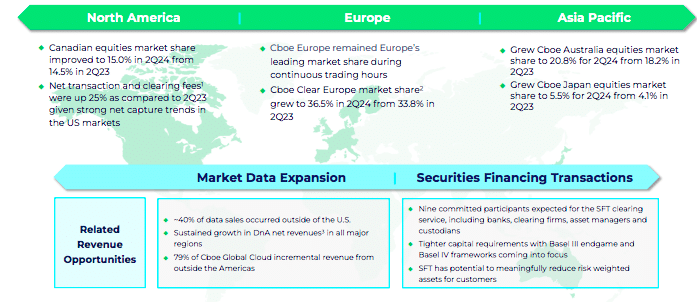
After acquisitions in Australia and Japan, both countries completed their migration to Cboe’s technology platform last year. The remaining technology integration of its acquisition in Canada is planned for early 2025.
Tomczyk said: “After the first quarter of 2025 when the Canada migration is done and all of the technology resources that have been consumed on migrations are done, we can unleash the full power of the organization in terms of growth.”
Source: Cboe
In Canada, a number of customers have been waiting for the technology to be put onto a common technology platform before engaging in the marketplace according to David Howson, global president of Cboe Global Markets.
Howson said: “Combine that with the listings business in Canada and that makes for an interesting set of differentiated data for customers to think about once it’s on one platform.”
He also highlighted at the conference that the “horsepower” of Cboe’s technology resources are incrementally freeing up as the migrations have been completed. This year, Cboe added a new access layer architecture to its core trading platform that runs all its equities and derivatives markets around the world.
“That innovation opened up a monetization opportunity for that access layer architecture itself, but we could also add new instrumentation, new data and new insights, which institutional customers are asking for,” added Howson.
In terms of growth, Tomczyk argued that Cboe is well positioned for secular trends, especially as overseas investors want access to the US. The management team’s focus will be on using the firm’s technology, internal resources and capital to capitalize on those secular trends.
“There’s now $14 trillion invested in foreign holdings of US securities so there is a big market and big demand,” Tomczyk added. “Governments and regulators are taking away a lot of the restrictions to investing more globally and causing demand back to the US, and the fastest growth area is Asia Pacific.”
In addition, Tomczyk noted that $16 trillion is indexed to the S&P index, where Cboe has a good presence in terms of product.
Cboe’s strategic review has led to thinking about its business model in terms of an import business providing access to the US market, and an export business in taking US products and market structure into overseas markets. For example, Cboe has added single stock options to CEDX, its derivatives exchange in Europe. Interactive Brokers joined CEDX in the second quarter of this year and Howson said volumes have continued to trend upwards, and more market makers and liquidity providers are looking to come onto the European platform.
“One of the advantages that Cboe has is that once we have everybody on one technology stack, that will be unique,” he added. “ I don’t know another exchange that has that ability.”
Howson argued that customers are increasingly global, so the ability to offer their own customers new functionality in a new region with little effort is powerful.
“We have added 500 basis points of market share in Australia and doubled market share in Japan since we have taken possession of the assets,” said Howson. “It is early innings and we have only just re-platformed the technology, so that ramp up begins from here.”
Tomczyk does not expect more geographic expansion. Cboe continues to see if it can find a way to participate in the Indian market and Tomczyk said he would like the firm to be bigger in Japan, with an ambition to be the number two player in that market over time.
Options growth
Howson continued that the options industry is on track for its fifth record year in a row and there is a new phase usage for the complex of volatility products with new users and new use cases coming to market. Major liquidity providers in asset classes are coming into the index options complex, existing users are using a greater diversity of functionality and asset managers are deploying new defined outcome products.
David Howson, Cboe Global Markets
“It is a new phase of usage patterns which has been much more resilient,” Howson added.
Customers have also come back to Cboe Volatility Index (VIX) options, according to Howson. August was the second highest month on record for Vix options as customers hedge risk and monetize those upwards moves in volatility. So far, the third quarter is looking like a number two record for Vix options and the number three quarter for S&P 500 index (SPX) options.
“The options market tells us more volatility is coming in the rest of the year,” he added. “US elections are often a big catalyst for volatility and customers are positioning on both the upside and downside.”
In addition, there has been a greater proportion of institutional engagement. Howson highlighted that on 5 August, when there was a spike in volatility following the actions of the Japanese central bank, institutional customers wanted to manage risk across the curve. Cboe can also now provide two years of data on zero days to expiry products, which quantitative and systematic desks can use to train more algorithms.
Cboe said in a statement in August this year that it plans to launch options on VIX futures on Cboe Futures Exchange on October 14, subject to regulatory review. The firm currently offers securities-based VIX Index options but Howson said the new options will open up volatility trading to a new customer segment who do not trade securities.
In the retail market, Robinhood Markets has said it intends to add index options and futures for active traders. Howson argued that Cboe has products that are in the sweet spot for the active trader base, especially cash-settled index options. Cboe will be investing in incremental sales and marketing aligned with Robinhood and other retail brokers.
By Isabel Baransky and Dasha Dyomkina-Reece, Directors, Senior Product Managers, FX Payments, Bank of America
Corporations streamlining their cross-border processes are enjoying broad gains
Rapid globalization has brought exciting times to the foreign exchange (FX) market. With the accelerated rise and integration of artificial intelligence and big data into global finance, FX operations are being reinvented. Corporate treasurers share in this optimistic outlook, while also acknowledging that the rate of change makes it difficult to get ahead.
Data and analytics improving decision-making
Isabel Baransky
Coupled with their deep market knowledge, global financial institutions are well equipped to use data and analytics to provide corporates with tools and insights that can drive more informed decisions. The practical impact on business operations is proving profound. Data analytics helps corporates to maximize FX cost reductions on the front end when making payments, while ultimately minimizing or even eliminating any overage costs throughout a transaction.
A few examples of how data can help corporates reduce costs:
By analyzing certain factors such as destination countries, frequency, and volumes of transactions, corporates can look to further automate their cross-border workflows while also taking advantage of alternative payment methods, like Cross Currency ACH, to lower their settlement costs. The data evaluation that analytics generates also improves straight-through processing (STP) rates, reducing the reliance on slower and error-prone manual activities and other processing delays. This also offers corporates greater transparency and extensive cost- and time-saving benefits.
When paying customers or suppliers in certain markets with more complex FX regulations, corporates can partner with a financial institution that uses the power of its global reach and intelligent data analytics to route transactions into these markets in more efficient and cost effective ways. These benefits are most evident when paying suppliers in restricted markets, such as China, Taiwan, and South Korea, as cross-border transactions are generally more complex due to tighter regulations, which in turn can lead to unanticipated costs. With analytics, sophisticated data elements automatically account for these irregularities and diminish their cost impact on transactions.
Empowering corporates with unprecedented insights and transparency
Dasha Dyomkina-Reece
As the FX market is evolving, so are the expectations of corporates operating within it. They are looking for certainty and transparency in the multiple unknowns of a cross-border transaction.
Industry led tools such as SWIFT GPI and ISO 20022 are paving the way for financial institutions and their clients to further embed data into their core processes and infrastructure.
The SWIFT GPI initiative compels financial institutions to share vital information throughout the payment life cycle with their corporates, including hidden fees and routing decisions. This allows corporates to gain greater control, certainty, visibility into end-to-end transaction and make better decisions to drive optimal processing outcomes.
ISO20022 is aimed at standardizing the communication language between parties on the SWIFT network, allowing for richer data to be passed, creating opportunity to drive new, more detailed insights on transactions.
Specific to FX transactions, risk management tools, such as Guaranteed FX Rates, are available to corporates to gain greater certainty over FX rates applied to their cross-border transactions. This is becoming ever more important as the market is facing continued uncertainty and volatility in the face of various geopolitical and economic events. Algorithms and machine learning techniques are used by financial institutions to power such solutions, helping corporates effectively manage their FX risk.
Relying on data analytics to determine the optimal currency
When it comes to cross-border transactions, the decision of which currency to initiate a payment in is not always clear. Commonly, the currency of the beneficiary account is unknown, which creates downstream implications of how to route the transactions.
Financial institutions can apply data intelligence which helps corporates make informed decisions on the optimal currency to initiate payments in, gaining the ability to reduce cost, while gaining control and transparency over FX rates used for conversion.
The FX market will become even more intricate and challenging
Experienced financial institutions are well positioned to create more sophisticated and accurate tools that will continue to optimize cross-currency transactions.
Looking ahead, corporations will benefit the most by partnering with financial institutions that properly service them. At Bank of America, our highest priority is placed on being a trusted advisor to our clients. Using data tools and insights, we help our clients make intelligent and informed decisions needed for their businesses to compete in this constantly evolving marketplace.
Authors:
Key Takeaways
Banks are using data analytics to drive incremental value for corporates in their cross-currency treasury management practices. Partnering with an experienced financial institution whose advice and guidance is powered by data will be critical for corporates to compete in FX markets.
Data analytics are empowering corporates to rethink their operational approach to cross-currency transactions.
With data, corporates can gain greater oversight with end-to-end transparency on transactions, reduce costs, and improve decision making to further optimize their cross-border flows.