









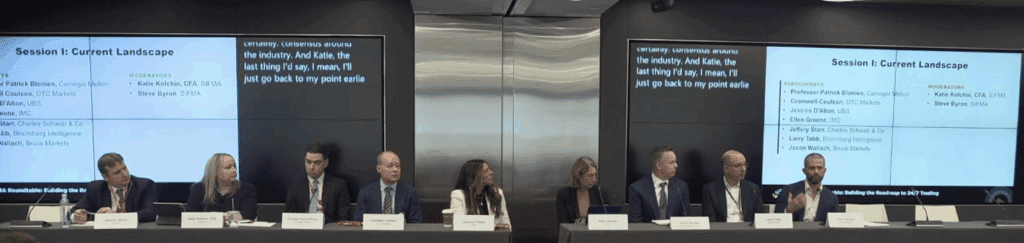
Overnight equity trading is happening whether Wall Street’s traditional players like it or not. That was the message at SIFMA’s Roundtable: Building the Roadmap to 24/7 Trading on Tuesday, January 28, where market operators, academics, and buy-side representatives tried to figure out what to do about a market structure shift that’s already underway.
Speaking on the panel: Session I: Current Landscape, Jason Wallach, CEO at Bruce Markets, said the overnight market has been doing about 130 million shares a night in January, roughly $3.2 billion in executed notional.

Wallach noted there are three ATSs currently open to all subscribers: Blue Ocean, Moon (operated by OTC Markets), and Bruce Markets, plus Interactive Brokers, which offers access only to its own customers. Across these venues, roughly 10,000 names have been quoted this month, he said.
“The market for January to date has been about 130 million shares a night,” Wallach said, noting that executed notional tells an interesting story beyond just share volume.
Retail Drives the Market
Kevin Sharbek, Managing Director Order Routing, Relationship Management & Market Structure, Charles Schwab, noted that the typical overnight trader isn’t a 20-year-old ‘kid at home’. “We’ve noticed that mainly between 30 and 50 year old clients who are retail investors are actually trading when it’s available to them, when they have free time,” he said. Schwab currently offers over 1,200 symbols for overnight trading, up from just 24 when AmeriTrade first started in 2018, he said.
The data shows retail isn’t just participating, they’re providing liquidity. “Retail was the adder on 40% of the shares we executed, and they were the remover on 70%,” Wallach said. “So what this is showing is retail trading with retail, and that doesn’t happen a lot in our markets today.”
Ellen Greene, Head of Business Development and Market Structure Strategy, IMC, one of the market makers active overnight, said her firm is watching volumes carefully. “Global macro events, corporate news and activity in international markets increasingly influence US equity prices overnight, and participation during these hours allows firms to observe and contribute to that price formation in real time,” she said. IMC expects the market to breach 1% of consolidated US equity average daily volume soon, which would signal overnight trading is “moving beyond episodic activity toward a more durable liquidity environment.”
Professor Patrick Blonien from Carnegie Mellon presented research showing overnight trading has wider spreads, about three times higher than regular hours for frequently traded securities, and 10 to 20 times higher for randomly selected stocks. About 10% of price discovery occurs overnight, jumping to 20% for international firms and ADRs. His research also noted that the market close serves as a coordinating mechanism that concentrates liquidity, raising questions about what happens if trading truly goes 24/7.
Institutions Remain Cautious
Jessica D’Alton, Head of America’s Market Structure and Liquidity Strategy, Executive Director, UBS represented the institutional perspective, and UBS isn’t trading overnight yet. “Our approach to evaluating participation in overnight trading starts with assessment of client demand,” she said.
“US securities regulators expect broker dealers like UBS to have effective supervisory arrangements in place,” D’Alton noted. “That means having registered personnel available in real time, making decisions, monitoring flow, identifying problematic activity.” For now, UBS is taking a “thoughtful, measured approach.”
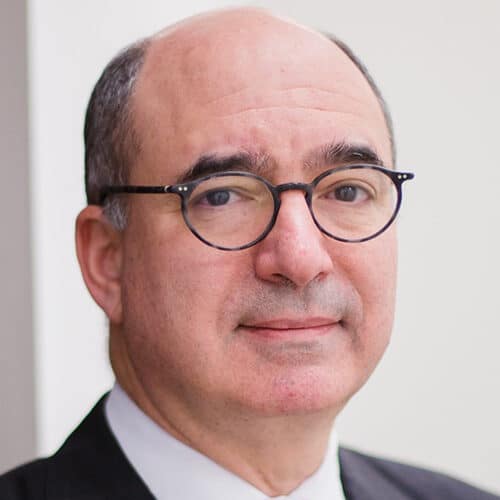
But Larry Tabb from Bloomberg Intelligence said institutions will get “pulled in eventually”. “There are going to be events that occur at two or three o’clock in the morning, and the market’s going to react to it,” he said. “Portfolio managers are going to start putting pressure on traders saying, how come we weren’t involved? The market is open.”
Bloomberg’s survey data showed sentiment shifting. A year ago, Tabb said, traditional asset managers were probably 100% against 24/7 trading. Now it’s down to 76% against. “24% progress, I’ll take it,” he said.
The Coordination Challenge
Wallach and Cromwell Coulson, President and CEO, OTC Markets Group, both said the three ATSs are trying to maintain consistency even while competing. Corporate actions emerged as a critical issue. All three ATSs halt symbols with material corporate actions like splits to allow brokers to update their systems, but it’s an imperfect process.
“Corporate actions are a big piece, and this is really going to force everybody in the industry to sharpen their focus,” said Coulson. “Getting corporate actions right, because it’s an easy way to screw up and add costs overall.”
Wallach agreed: “Competing on something like a price band or a reference price or corporate actions, that is the wrong thing to compete on. That’s the right thing to be aligned and actually ensure a safe and solid, resilient investor experience.”
Greene raised the regulatory question: “The harmonization of regulatory practices overnight is outside of Reg NMS. So I think it’s really incumbent on all of the exchanges, the ATSs, to consider that.”
Wallach added that the world is watching: “We are establishing a model that other jurisdictions, other countries, will use as a standard,” he said. “I think it’s on us as an industry to ensure that we are representing what we have today and where we want to go.”
