









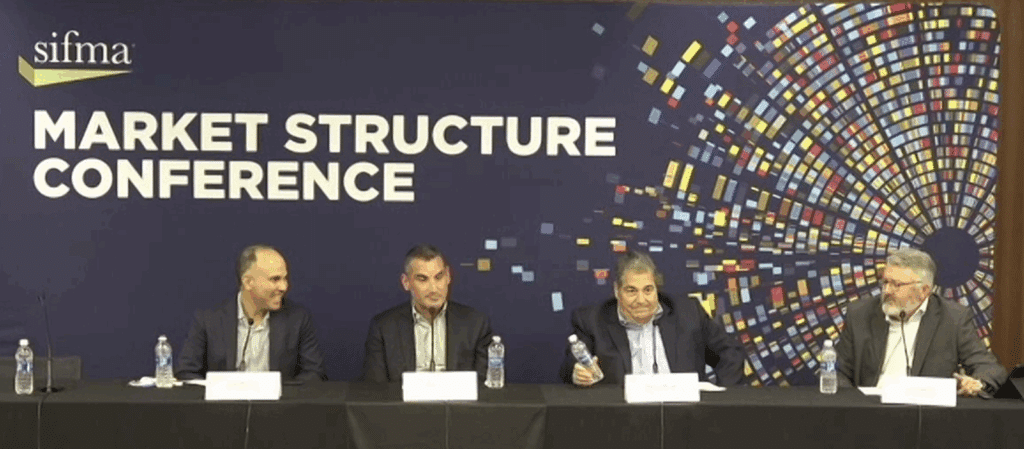
The options trading landscape is undergoing rapid transformation, driven by technological advancement and product innovation. At SIFMA’s Market Structure Conference on November 19, industry leaders from Jane Street, DASH, and MIAX gathered for a panel discussion moderated by Scot Galvin, Senior Director and COO at Robinhood Securities, to discuss how artificial intelligence, machine learning, and new product development are reshaping the market, and the challenges that come with balancing innovation against the need for standardization.
When asked how AI and machine learning are being practically applied in areas like order routing, volatility modeling, and liquidity provision, Dave Kovtun, Institutional Sales & Trading, Jane Street, said this isn’t new territory.
“We’ve been using machine learning tools, machine learning analytics, AI for years now, it’s just, it’s an iterative thing,” Kovtun explained. The firm has long recognized that anything that can sharpen their trading edge is worth pursuing.
What has changed, however, is the complexity of the market itself. Kovtun pointed to the explosion in options maturities as a prime example.
David Dooman, Head of ATS & Retail Consolidator at DASH, described a more pragmatic approach. His firm is incorporating data science and machine learning across their analytics stack – from pre-trade market microstructure analysis to post-trade analytics. The goal is efficiency: “optimizing how and when orders are placed for different algorithmic purposes and execution styles”, he said.
“We’re focused ultimately, for our business, our bread and butter is simplifying what’s becoming more and more complex in terms of more venues in the options industry,” Dooman said.
For exchanges, the application of AI is more limited by design, according to Shelly Brown, EVP and Chief Strategy Officer at MIAX and CEO, MIAX Futures. “As an exchange, our specialty is building matching engines. We’re not going to use any artificial intelligence in those matching engines,” Brown explained. “It’s not our place to create quotes for the market makers. It’s our responsibility, except those quotes and match trades.” While MIAX will leverage AI for back office functions, reports, and analysis, the core matching function remains deliberately algorithmic and deterministic, he said.
Galvin then steered the conversation to balancing standardization with innovation. With flex options, new product types like single stock listed ETFs and leveraged ETFs, new strike intervals, daily expirations, and complex order books all entering the market, he asked how firms and exchanges navigate this landscape.
For Brown, innovation as an exchange operator comes with unique frustrations. “It’s really hard to innovate as an exchange in that everything we do, we have to file rules for the SEC. And if it’s something new, it goes out for public comment. All of our competitors get to see it before it goes live,” he explained. The result? “If it’s something good, everybody’s going to copy it.” The one area where exchanges can truly differentiate is through proprietary products, he said.
Dooman acknowledged these structural constraints, noting that much of the industry’s rigidity stems from operating within the confines of critical infrastructure. “You have to operate within the confines of limitations to opera, limitations to OCC and all the constructs that make the standardization good,” he said. While standardization brings tremendous benefits—particularly in spreading risk and eliminating counterparty risk, it also limits how quickly and creatively the industry can move, he said.
Kovtun from Jane Street said: “We’re leaning into innovation. As far as what products should exist, we leave that to exchanges and regulators. As a market maker, our job is to produce the best prices we can to make sure the customer gets a resilient, positive experience.”
“We feel less strongly about what specific decisions are made, as long as they’re well communicated to market participants and well harmonized. But in terms of innovation, there’s just no denying it’s the major driver of growth,” he said.
“There are going to be things that come out that don’t work, that don’t take off. But I think that’s just a price the industry should be willing to pay,” he concluded.
