








In a recent episode of Nasdaq TradeTalks, host Jill Malandrino sat down with Barb Morgan, Chief Product & Technology Officer at Temenos; Jacqueline O’Flanagan, Head of Financial Services, Americas at Microsoft; and Dr. Christos Makridis, Associate Research Professor at Arizona State University, to discuss the biggest cybersecurity and innovation risks in financial services and how to address the concerns.
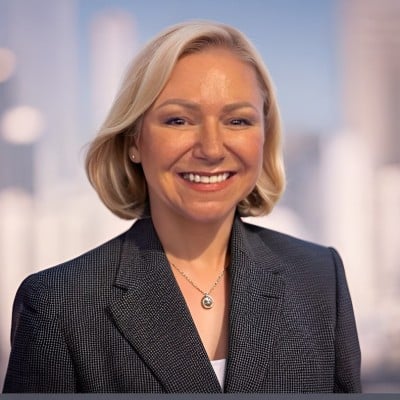
“Cybersecurity is one of the number one concerns for banks,” said Morgan, noting how the issue dominates discussions among chief risk officers. She referenced a recent Temenos study showing that 85% of banks identify cybersecurity as their top challenge, with more than three-quarters predicting it will only become more critical in the coming years.
“Banks are prioritizing moving to a modern core platform,” she explained, adding that the shift allows for greater scalability, resiliency, and protection. “These platforms give them better scalability and stronger protection,” she said, emphasizing the value of partnering with trusted hyperscalers like Microsoft to embed security at the core of their infrastructure.
O’Flanagan highlighted how the company’s massive data footprint gives it unique visibility into global cyber threats. “Microsoft processes over 78 trillion security signals daily from billions of endpoints, devices, and cloud services,” she said. “That gives us a unique vantage point to see emerging attack vectors months before they become visible, allowing financial institutions to strengthen their defenses proactively.” O’Flanagan noted that financial services remain among the top ten industries most impacted by cyber threats, according to Microsoft’s Digital Defense Report. “This is dramatically changing the landscape, not just for banks but for their end users as well,” she added.
Dr. Makridis addressed the economic side of cybersecurity risk, explaining that while executives consistently rank it as a top priority, short-term pressures often delay the necessary long-term investments. “For the median firm, it’s costing about $90 million a year to have these incidents,” he said. “Even though it might not make headlines, it’s one of the lurking risks in every organization.”
Morgan underscored how outdated infrastructure compounds these risks. “Legacy systems weren’t built for today’s speed or sophistication,” she said. “Banks spend the majority of their IT budgets just trying to keep the lights on.” She warned that the inability to patch systems quickly creates serious exposure, making cybersecurity “not just a technology issue but a business imperative.”
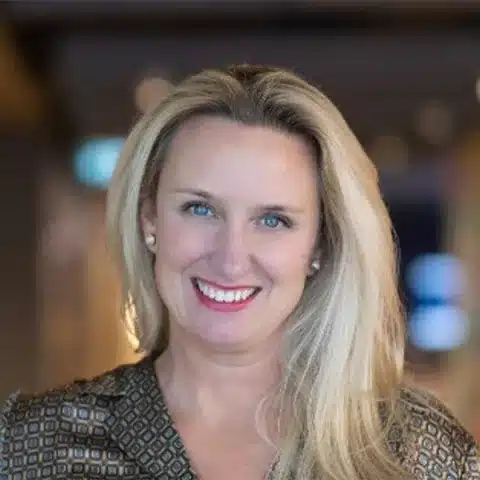
The conversation turned to the transformative role of artificial intelligence in strengthening resilience. “Banks today are becoming AI-operated institutions,” O’Flanagan observed. “Many have moved beyond proof-of-concepts to embed AI throughout their organizations—from operations to fraud detection.”
Morgan explained that Temenos is embedding AI directly into its core banking systems, enabling continuous monitoring of transactions, compliance checks, and security risks. “Every transaction, every compliance check, every security risk is continually being monitored,” she said. She cited Temenos’ Financial Crime Mitigation solution, which has helped clients reduce false positives in screening “from as high as 99% to nearly zero.”
When asked about the emergence of agentic AI—systems capable of autonomous decision-making, Morgan stressed the importance of responsible governance. “Every decision must be auditable,” she said. “We must augment human judgment, never replace it fully. It’s AI with accountability.”
O’Flanagan echoed that sentiment, urging financial institutions not to let fear of risk stifle innovation. “At Microsoft, we have our own AI framework to ensure safe, ethical, and transparent use,” she explained. “It’s people, process, and technology. You have to double down on why you’re using AI. Early on, people worried about job loss, but what we’ve seen is new roles emerging as a result. It’s a mindset shift—and the opportunities are endless.”
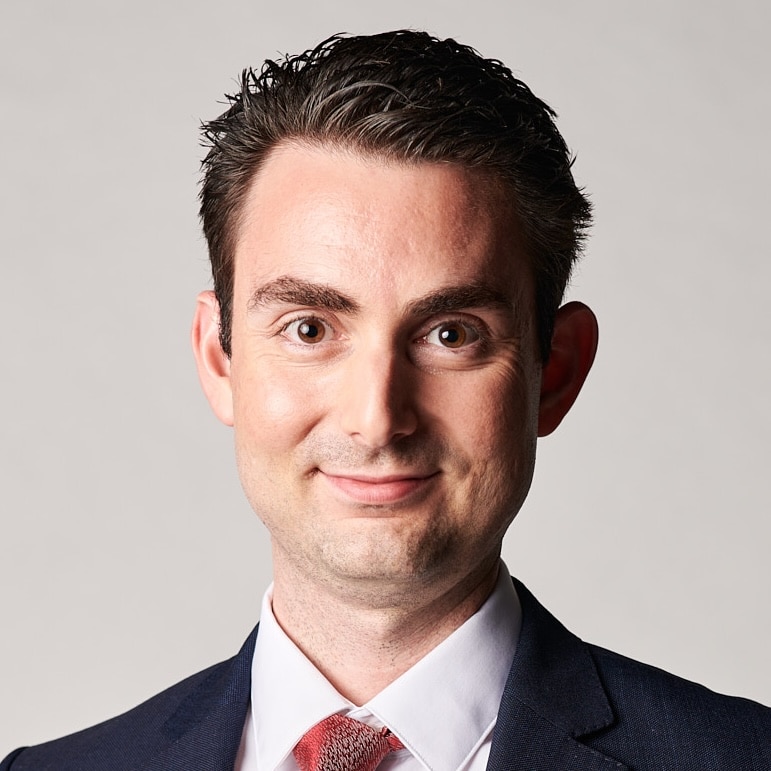
Makridis added perspective on emerging technologies like blockchain and digital assets, explaining how they can enhance trust through transparency and traceability. “Blockchain provides a digital paper trail and greater transparency,” he said. Unlike cryptocurrency applications, he noted that banks are adopting permissioned blockchain for internal functions such as inventory management and compliance tracking. However, he cautioned that transformation requires more than technology. “You can’t just plop technology into an organization and say you’re done,” he said. “It requires changing how people think and the processes they use.”
All three guests agreed that cybersecurity culture must begin at the top. Makridis pointed out that many breaches stem from human error rather than sophisticated attacks. “Many vulnerabilities come from clumsy mistakes—someone forgetting a basic procedure or overlooking an update,” he said. “That’s why cybersecurity must start at the top and extend all the way to the front lines.” O’Flanagan agreed, adding, “Simple things like multi-factor authentication, done consistently across the organization, can have a massive impact.”
The future of finance will belong to organizations that integrate technology, governance, and human judgment seamlessly, according to Morgan. “When you combine human intelligence with AI that’s accountable, you unlock both security and innovation. That’s the future our customers are building toward,” she said.
