










In an episode of Inside the ICE House podcast recorded on August 5, James Rutledge reflected on his nearly 60-year career at the New York Stock Exchange (NYSE), from his first job as a teenage “squad boy” on the trading floor to his time as a member and director, and the technological and structural changes he witnessed along the way.
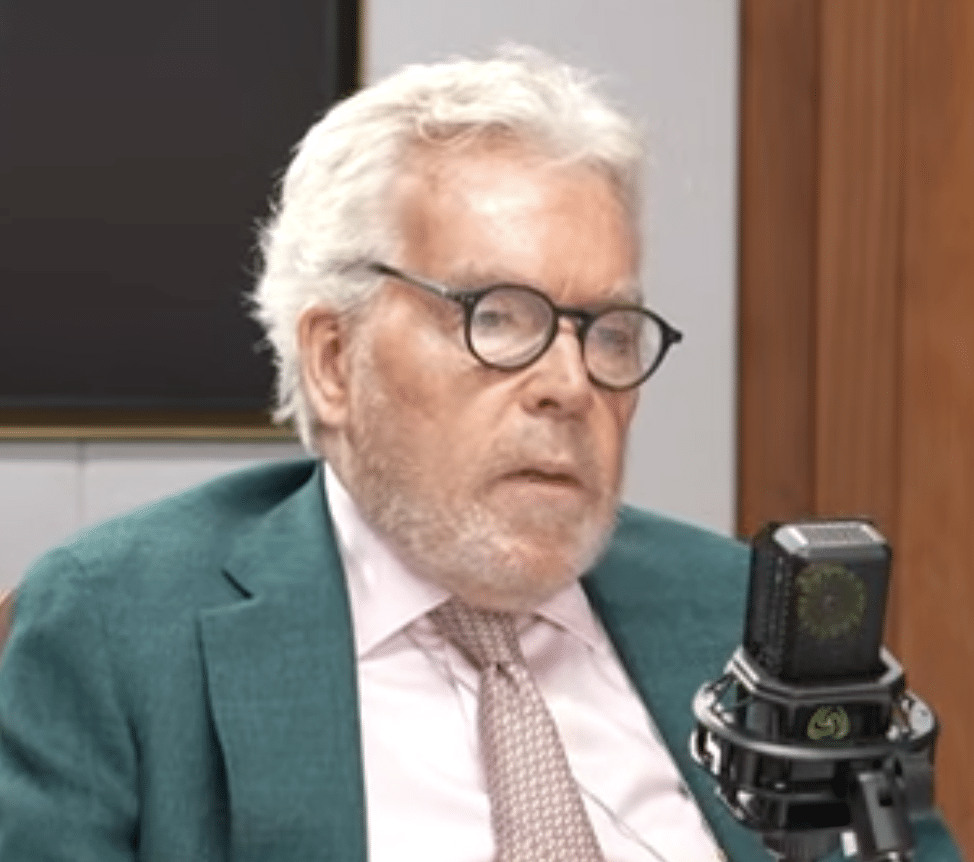
Rutledge graduated from high school in 1967 and was drafted during the Vietnam War.
He was ultimately classified as “4-F” (not qualified for military service) and did not enter the service.
“So I said, ‘Hmm. Now I got to get a real job,’” Rutledge recalled.
He said that his mother had worked for a small brokerage on Wall Street in the 1930s, so he decided to look around the financial district.
“I roamed up Broad Street, and as I walked along, I saw a place with a sign out front, ‘Help wanted,’ and it was the New York Stock Exchange,” he said.
He answered the advertisement and was interviewed for a job as a “squad boy.”
“They interviewed me for about one and a half minutes and said, ‘Okay, kid, let’s see your draft card,’” Rutledge recalled.
When he first walked onto the trading floor, he said: “In all honesty, I thought I walked into Yankee Stadium. It was just the coolest thing I ever saw. And I mean, I immediately fell in love with the place, and that’s almost 60 years ago. I still love the place.”
Rutledge described the squad boy role as “kind of the low end of the totem pole.” His job was to move around the floor and respond when brokers raised their hands.
“You would run over and you would run back, and that’s how the whole process worked,” he said.
He later became a “tube man,” carrying leather pneumatic tubes around the floor. He had to know where booths in his zone were located and which tube served each booth. He also handled incoming orders and sent reports through the tubes.
“I always thought the pneumatic tubes, which I believe were installed when the building opened, was a phenomenal accomplishment,” Rutledge said. “I don’t think they were anywhere else in the world, and they worked. They worked really well.”
By late 1968 or early 1969, he had become a clerk, taking orders and reports and making calls for five firms.
In March 1973, Rutledge got his first seat and became a broker at 23: “At the time I was, and I’ll brag, I was one of the four or five youngest members in the history of this place,” he said.
From pneumatic tubes to handhelds
Rutledge started at the NYSE during the paperwork crisis. He said employees were allowed to leave early on some days and that the exchange was closed on Wednesdays.
“I didn’t understand what a paperwork crisis was. I’m 18 years old,” he said.
As he became more aware of what was happening, he volunteered for additional work. “So we came in on Saturdays and we helped do the floor work that was required to coordinate with the upstairs desk,” he said. “The mood was pretty somber.”
“A lot of people were looking over their shoulder thinking they may lose their job because firms were going toes up,” he added.
The mood improved: “As the crisis started to abate, I would say we started to see improvement in the mood as we went into the early ’70s, ’70, ’71,” he said.
After becoming a member, Rutledge saw new technology installed around the trading posts. “We started to see installations at the various posts of new technology, flat screen. Not flat screens, but they looked like televisions, but they were installing them around the posts,” he said.
Rutledge said brokers initially worried the changes would interrupt trading: “We all thought it was going to interrupt our normal trading model,” he said. But, “I don’t think I missed one order because of technology,” he added.
The next major transition came with handheld computers. “It’s kind of difficult to compare the pneumatic tubes to the handhelds. It’d be like comparing the horses to cars,” he said.
According to Rutledge, the handheld technology initially presented problems. “The handheld … did not work so well when it first was introduced,” he said.
Rutledge said he believed he could execute an order faster with a pad and pen: “But truth be told, we all had to adjust, and they did eventually get faster than me.”
In 2006, the NYSE merged with Archipelago and became a public company. Rutledge said he was involved in the transition and that John Thain “orchestrated the whole thing.”
The exchange moved to a hybrid model. “The hybrid model was a difficult transition for all of us, including our clients,” Rutledge said. “We could have done a little bit of a better job before we went full boat implementing it.”
But he said the change was necessary to remain competitive, and the trading floor continued to adapt: “We adjusted, which this building and particularly the trading floor has always been known to adjust to survive.”
Price discovery and the trading floor
Rutledge believes the trading floor should remain: “The trading floor should not be replaced because human interaction and intuition replaces some of the speed of technology in my view,” he said. “And true price discovery requires interaction.”
He also pointed to the NYSE’s integrated electronic trading technology platform, Pillar, which he initially doubted. “I was suspicious that it wouldn’t work, and I was very wrong. It not only worked, it thrived.”
“Pillar, I think, really helped us transition into today’s marketplace,” he said.
Rutledge discussed current debates around trading rules, tokenization and artificial intelligence. “Most of the dialogue is (about) rules. “How is the SEC going to change trading rules? Tokenization, AI, speed, speed, speed,” he said.
He expects price discovery to continue to evolve, particularly as markets move toward overnight trading. “I’m sure it’s going to continue to change, and it’s going to change significantly when we go to 24-hour trading,” he said.
When asked about the most memorable person he met on the trading floor, Rutledge named Arthur D. Cashin III. “He was always willing to teach. He was always willing to help out,” Rutledge said.
Rutledge recalled the sheer size of the trading floor during his career. “We had 5,000 people on the trading floor and 1,366 seats,” he said. “My inner circle of maybe 500 or 1000 guys, I knew their wives, I knew their kids, I knew their grandkids.”
“We played golf together, we drank together, we traded together. We were one big family,” Rutledge said.
His favorite place in the building remains the trading floor. “Nothing compares,” he said.
