








The Securities and Exchange Commission (SEC) is advancing a regulatory agenda spanning equity market structure, tokenization, extended trading hours and capital formation, as the agency considers how existing rules should adapt to changes in U.S. capital markets.
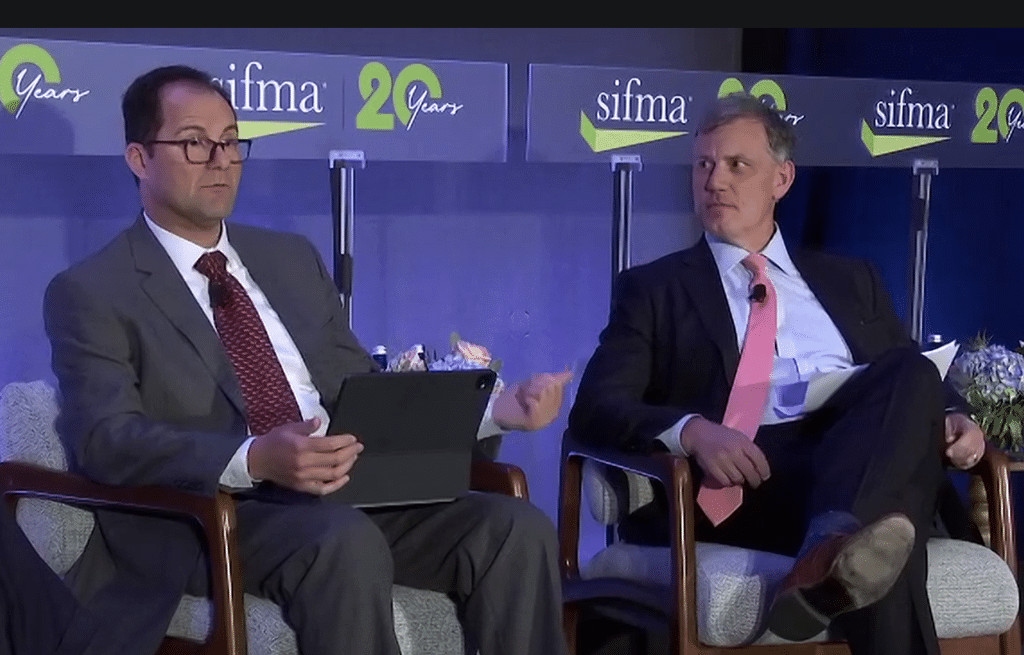
Speaking at SIFMA’s 2026 Annual Meeting on Tuesday, October 20, Jamie Selway, Director of the SEC’s Division of Trading and Markets, and Sebastian Gomez, Deputy Director of Legal and Regulatory Policy in the Division of Corporation Finance, discussed the Commission’s priorities with SIFMA President and CEO Kenneth E. Bentsen, Jr.
One of the Commission’s priorities is the proposed rescission of Rule 611 of Regulation NMS, commonly known as the Order Protection Rule, alongside the prohibition on locked and crossed markets under Rule 610(e). Selway said the SEC had received approximately 1,200 comments as part of its review, which included two industry roundtables. Market participants raised concerns about the potential impact on the National Best Bid and Offer (NBBO).
The agency is also examining how changes to Rule 611 should align with the modernization of best execution requirements. “There’s lots of reasons to update best execution, not just 611, but also after-hours trading, overnight trading, or tokenization,” Selway said.
He emphasized that best execution remains a FINRA responsibility and that the SEC is working closely with the organization. Selway indicated that FINRA could initially issue guidance alongside SEC action on Rule 611, with additional rulemaking potentially following. “I think that 611 for us is a Q1 event in all likelihood,” he said, referring to the first quarter of 2027.
The expansion of U.S. equity trading hours is approaching a milestone, with exchanges preparing for 23-hour, five-day trading beginning December 6. Selway said the transition would introduce exchange trading, public market data and clearing during overnight hours. “What’s new here is exchanges offering 23 by 5 trading, and there being public market data and clearing overnight,” he said.
He identified corporate actions and investor protection as two areas the SEC will monitor closely. “Corporate actions will now be compressed into the hour pause between eight and nine Eastern,” Selway said, highlighting the operational challenges involved.
The SEC will also monitor the effectiveness of overnight limit-up/limit-down protections. Despite these developments, overnight trading volumes remain relatively small. Selway estimated that overnight activity currently represents approximately 1% of consolidated equity trading volume, compared with roughly 20 basis points one or two years earlier.
He said estimates from market participants vary, with some expecting overnight trading volumes to reach 5%, while one projection of 30% struck him as “outlandish.” He pointed to demand from international retail investors, particularly in Asia-Pacific, as a potential source of growth. Selway also suggested that fully continuous trading could arrive sooner than anticipated, noting plans by alternative trading systems to introduce 24/7 operations.
Tokenization and Investor Protection
The SEC’s September 17 innovation exemption for tokenized securities was another focus of the discussion. The exemption permits trading of tokenized NMS stocks through automated market makers on eligible tokenized security venues, subject to conditions including volume limitations and issuer notification requirements.
Selway said the Commission intends to use the framework to assess market activity before moving toward permanent rules. “We want to do something exemptive, collect data, see how the market reacts, and then head to formal rulemaking,” he said.
He stressed that existing securities protections would continue to apply, including trading halts, antifraud and anti-manipulation requirements, and applicable broker-dealer best execution obligations.
Gomez addressed concerns from public companies about the impact of tokenization on their securities and corporate actions. He explained that issuers can object to participation on particular tokenized venues following notification, with a 30-day period to respond. “The issuer can say no,” he said.
Gomez also said tokenization was unlikely to significantly change existing processes for shareholder communications and dividends. “Nothing in the order changes Schedule 14A. Nothing in the order changes the communications requirements and the delivery requirements to shareholders,” he said. He explained that much of the activity is expected to involve tokenization of securities entitlements rather than changes to the underlying shares.
The SEC is also working with the Commodity Futures Trading Commission (CFTC) on securities-based derivatives, including single-stock futures and perpetual futures. Selway identified several platforms preparing to introduce securities-based perpetual futures in early November, including Kalshi, Coinbase, Bitnomial and affiliates of Kraken and Crypto.com. “We’re communicating frequently and we’re in a bit of a hurry,” he said.
The agencies are working with FINRA and the National Futures Association to develop monitoring arrangements for the products. Selway noted that the earlier market for single-stock futures had failed to gain traction, adding that the objective is to facilitate innovation while maintaining investor protections.
Gomez outlined the Commission’s efforts to address the declining number of publicly listed companies and the tendency of businesses to remain private for longer. He said one proposal would simplify issuer reporting classifications by establishing a $2 billion public-float threshold for large accelerated filers, while extending disclosure accommodations to smaller and mid-sized companies. Another proposal would expand Form S-3 eligibility, allowing newly public companies to raise additional capital without repeating the more extensive Form S-1 registration process, he added.
Gomez also discussed proposed changes to the accredited investor definition, which currently relies heavily on income and net worth. The proposals contemplate additional pathways based on professional qualifications and a potential accredited investor examination. “Can we actually allow someone to qualify to participate in one of these offerings, not just because they’re rich, but because they actually have the sophistication to do so?” Gomez said.
He also highlighted the potential impact of expanded Form S-3 eligibility on investment research, allowing broker-dealers to initiate coverage of newly public companies earlier under the Rule 139 safe harbor. “My hope is that we’ll see more research coverage among those newly IPO companies,” he said.
The discussion also covered mandatory central clearing of U.S. Treasury transactions. Bentsen referenced cash Treasury clearing at the end of 2026 and repo clearing in the middle of 2027. Selway expressed confidence in preparations for cash clearing but acknowledged the additional complexity of repo transactions. “We feel very good about cash. Repo is a complicated asset,” he said.
Selway said the SEC has been working with SIFMA on implementation issues, including an affiliate exemption, and expects further questions to emerge as repo clearing preparations continue. “We’re absolutely intent on implementing next year, but I think we’re still in learning mode, and we’ve got more to do,” he said.
The Commission’s agenda also includes electronic delivery, transfer agent modernization and updates to research-related rules. “Very, very busy, good progress, but plenty more to do,” Selway said.
Both officials emphasized that they were speaking in their personal capacities rather than on behalf of the Commission.
