









Galaxy Digital, has become the latest firm to launch an institutional over-the-counter prediction markets trading desk which the digital assets fund manager used to execute a “first-of-its-kind” crypto portfolio hedge.
On 2 June 2026 Galaxy said in a statement it was launching institutional OTC (over-the-counter) prediction markets trading through its global markets trading desk. The firm said it can enable hedge funds, family offices, and other institutional clients to access prediction market liquidity at sizes and with a level of discretion not available through retail platforms.
In March this year BitGo Prime, a subsidiary of digital asset infrastructure company BitGo Holdings, and proprietary digital asset trading firm Susquehanna Crypto said in a statement they were partnering to provide eligible institutional clients with access to prediction market liquidity through BitGo’s OTC desk and platform. BitGo’s digital asset platform is being combined with Susquehanna Crypto’s bilateral execution capabilities and liquidity.

Chase Lax, chief executive at Susquehanna Crypto, said in a statement that prediction markets have matured into a genuine institutional asset class, but adoption has been constrained by the lack of integrated infrastructure for custody, collateral management, and OTC execution.
Matt Ballensweig, global head of trading at BitGo, said in a statement: “This offering is designed to give clients a more seamless way to access that liquidity through bilateral OTC execution and digital asset collateral frameworks built for institutional use – clients can post USD, stablecoins, BTC or other crypto as collateral to trade any listed contract for $100k or greater.”
In May this year Wintermute announced that the algorithmic trading firm and OTC desk is quoting two-sided markets across event contracts on leading venues, which collectively have seen more than $20bn per month in trading volume, as of early 2026. Jake Ostrovskis, head of OTC trading at Wintermute, said in a statement that for prediction markets to become a reliable real-time source of probability estimates, they need sustained two-sided liquidity.
“Prediction markets have the demand profile of a major asset class but the liquidity profile of an early-stage one,” added Ostrovskis.
Wintermute will post continuous bid and offer prices across event contracts, which Ostrovskis said will help reduce spreads, support larger trade sizes and improve the reliability of market-implied probabilities.
Clearing
In May this year Clear Street, a cloud-native financial infrastructure technology firm, announced that it had become the first institutional futures commission merchant (FCM) to join Kalshi’s exchange and clearing house. Clear Street said it will bring prediction markets onto the same infrastructure as its equities, options, futures, fixed income, derivatives and digital asset businesses.
In addition, Clear Street launched swap capabilities for ETF issuers structuring listed investment products around prediction markets.
Max Crowley, vice president of business development at Kalshi, said in a statement: “Institutional demand for prediction markets is at a tipping point, and our clients have been clear about what they need to scale into the asset class: regulated clearing, deep institutional liquidity and the operational rigor of a modern infrastructure provider.”
Hedging
Galaxy can pair prediction market positions with hedges in equities, commodities, and other assets, and has put this offering to work by executing a $10m trade with Arca, a crypto-native hedge fund, on the outcomes associated with the passage of the CLARITY Act, the U.S administration’s proposed legislation for digital asset market structure. Jason Urban, global co-head of digital assets at Galaxy, said in a statement: “Event-driven markets are becoming core to how sophisticated investors express macro views, and they deserve institutional infrastructure to match.”

Jeff Dorman, co-founder and chief investment officer at Arca, said in a blog that the crypto hedge fund has executed what it believes is a “first-of-its-kind crypto portfolio hedge.” He described the transaction as the fund’s “most interesting trade yet.”
Arca is currently investing across three themes that will be affected by the passage of the CLARITY Act – the growth of stablecoins and payments, decentralised finance (DeFi), and real world asset tokenization.
“While we have historically hedged our portfolio with many instruments, including BTC and ETH puts, a basket of token shorts, and even equity derivatives, these instruments have become less and less correlated with the broader crypto market,” added Dorman. “Moreover, it was clear that, in this case, hedging via prediction markets on CLARITY would be the most appropriate vehicle.”
In order to execute meaningful size, Arca contacted Galaxy Digital to ask whether they could find potential buyers of the “CLARITY enters into law by 2027” contracts in an OTC transaction, and Galaxy eventually took the other side of this transaction.
Arca made a bid on “NO.” Dorman argued that if CLARITY is signed into law by 2027 Arca will lose its entire premium, but will be compensated by the gains in its core portfolio. Similarly, if the act does not pass Arca will gain ~$0.63/contract to offset losses.
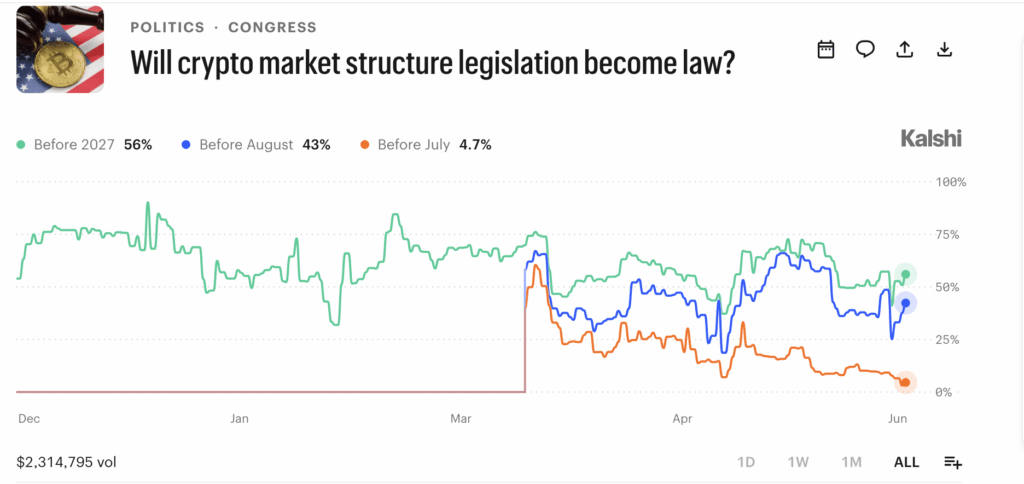
The transaction is marked-to-market based on the reference index on prediction market Kalshi, although the OTC transaction did not execute on prediction platforms themselves.
In contrast, during the U.S. election night in November 2024, Arca had bought “Harris Yes” and “Trump No” in case there was an unexpected shift in the results on prediction markets. Dorman believes that the OTC transaction via Galaxy is more indicative of how most of these trades will be executed in the immediate future.
“These prediction markets via large block OTC trades are starting to make more sense than traditional hedging instruments,” added Dorman. “In fact, this was easier, cheaper, and likely had a higher correlation to our portfolio than any crypto instrument itself.”
Research
As institutional capital flows into prediction markets, Galaxy believes the prices on prediction platforms should become more reflective of professional analysis and more useful as signals for investors, policymakers, and corporates.

In March this year asset manager Ark Invest said in a statement that it had partnered with Kalshi to evaluate how prediction market signals can inform its research process and portfolio strategy. For example, Kalshi enables prediction markets on nonfarm productivity and the U.S. deficit-to-GDP ratio.
Tarek Mansour, chief executive of Kalshi, said in a statement: “As institutional adoption of prediction markets grows, Kalshi is seeing increased demand for a formal market request pipeline to help investors leverage the wisdom of the crowd.”
Growth
When Kalshi announced a $1bn Series F round at a $22bn valuation in May this year, it said there was accelerating institutional demand. In the previous six months, institutional trading volume had increased 800%.
Kalshi said this reflects a broader shift as institutions are increasingly turning to event contracts to hedge real-world risk and access continuous, market-based signals on future outcomes. The firm will use the funds raised to scale adoption across hedge funds, asset managers, proprietary trading firms, and insurance companies.
Mansour said: “Event contracts could become a trillion-dollar market, and we’re still in the early stages of that transition.”
