








Order management systems and execution management systems generally keep up with the evolving needs of buy-side traders – but there’s always room for improvement, and artificial intelligence in particular holds promise to raise the bar.
That was a takeaway from a Wednesday morning panel at Equities Leaders Summit in Miami, entitled ‘Blueprints for Better Trading – Buy-Side Priorities Shaping the Next Generation of O/EMS’. Panelists were Lauren Weintraub, Head of High Touch Trading at Nomura Asset Management International, and Michael Warlan, Head of Trading and Operations at Third Avenue Management.
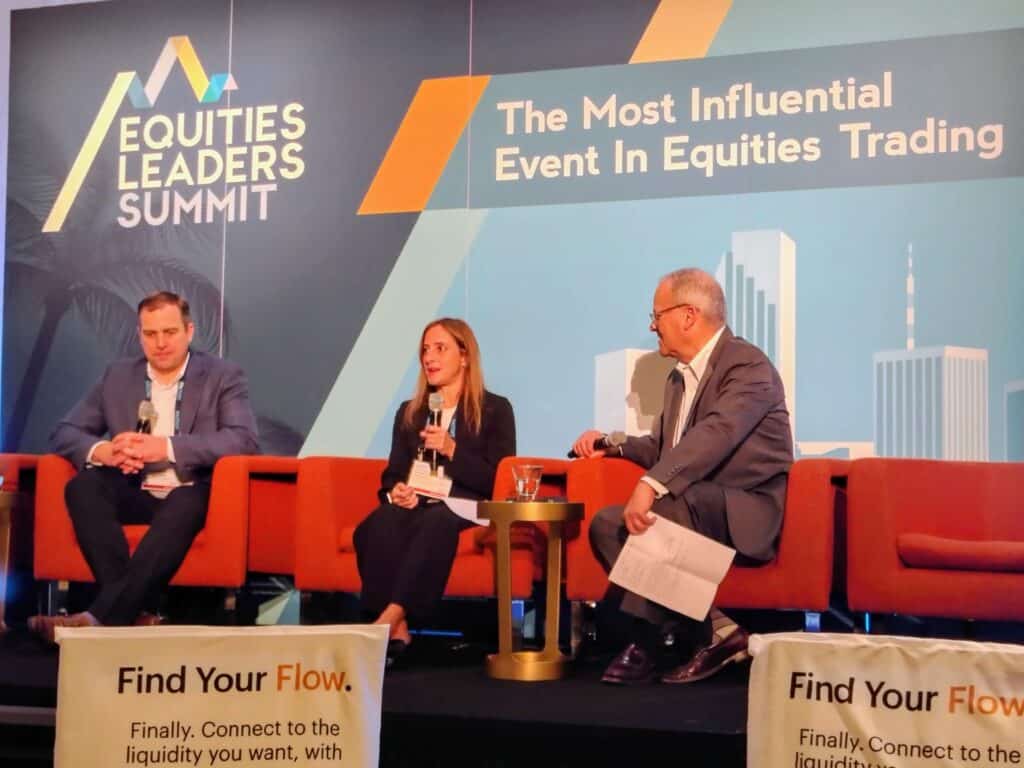
To the question of what traders for global asset managers need from OMSs and EMS, it was stated that market and position data needs to be accurate and updated in as close to real-time as possible, with a seamless transition between trading days across time zones.
Systems should have proper connectivity and provide cloud-based flexibility for remote work, as well as safeguards against trading errors that can be especially costly in an automated environment. Also, Warlan said larger trade orders that may take days to execute should be processed seamlessly and entail no manual effort to adjust positions.
For data, Weintraub said the use of custom FIX tags — which enable firms to exchange non-standard, user-defined data bilaterally – can make data management and data available in the back end of systems more robust.
While traders are the ones directly working through OMSs and EMSs, compliance and risk teams are also involved with the trading function and therefore have a stake in the operations of the systems. Having efficient and compliant OMSs and EMSs largely comes down to having experience with the systems and having the right people managing processes, Warlan said.
From the discussion around AI, it’s clear that buy-side traders are using the technology on a limited basis but it remains mostly a tomorrow story. Panelists said they use it for applications such as predicting how many shares will trade at the market close, or to learn more about what trading strategies have worked best in what market conditions.
Warlan said the best use of AI right now is in an ‘assistant’ role, for tasks such as more quickly drawing out and utilizing information, summarizing market action, and generating ideas for more efficiencies. Weintraub cited a ‘wish list’ for AI, including better automated daily trading analytics and deeper insights into why a trade order didn’t perform well.
A perspective from an attendee stated that buy-side traders aren’t ready for AI to take on fiduciary responsibility in a way that would need to pass muster with compliance and risk. But AI can be very useful in helping traders interact with portfolio managers in a more data-driven way, and also handle more rote tasks to free up junior staffers to be more creative and productive.
