









As recent turmoil in Japan’s bond market and tariff threats over Greenland show, exogenous events can spike equity-market volatility at any time.
Optimizing trading amid volatility was the topic of a Tuesday morning panel at Equities Leaders Summit in Miami: ‘Cracking the Code on Liquidity – Winning Strategies and Tools to Source and Access Liquidity in a Stressed and Volatile Market’.
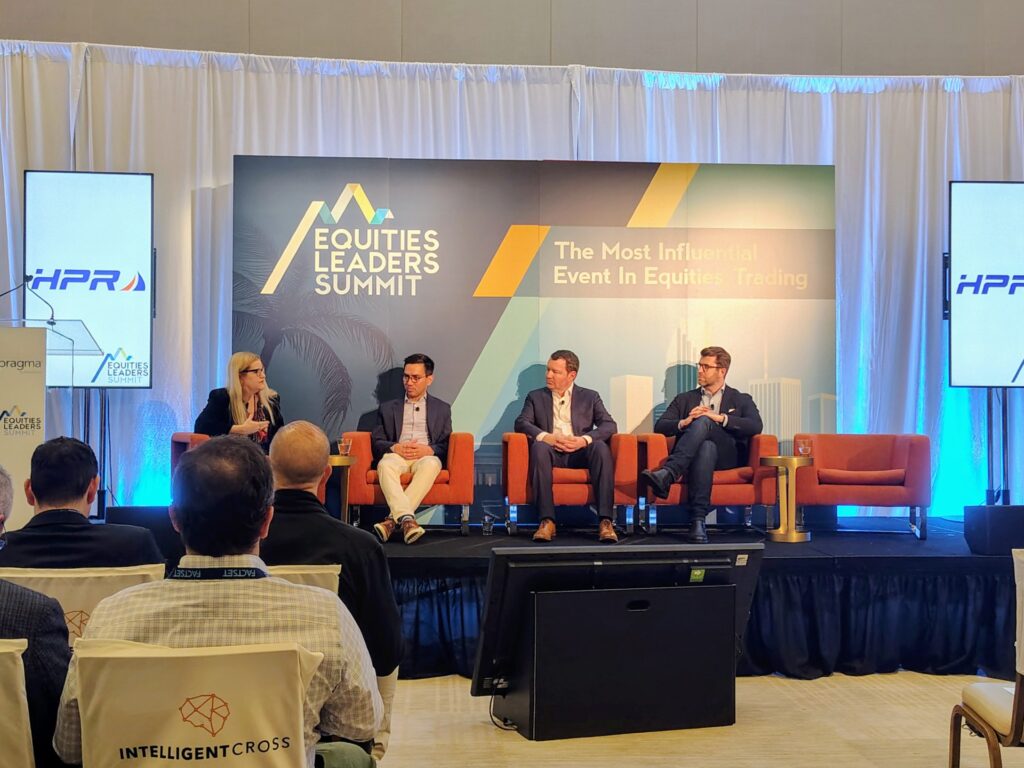
Noel Reyes, Head of America Electronic Trading Product at Goldman Sachs, cited three key questions for market participants: when to trade, how to trade, and where to trade.
For the ‘when’, With an overnight macro event that moves markets, asset managers whose views have changed will likely look to trade at the market open, while managers whose views haven’t changed will be inclined to trade later in the day. Regarding ‘how’, Reyes noted that volatile conditions often prompt traders to lean into more aggressive liquidity-seeking strategies; ‘where’ is more likely to be on exchanges where there is more certainty that an order will get filled.
Robert Bowles, Distribution and Liquidity Management at XTX markets, noted that in the market ecosystem of market makers, buy side, and brokers, market makers typically act as “shock absorbers” in stressed markets, and as a result they see more order flow.
Kevin Tyrrell, Head of Markets at New York Stock Exchange, cited the increase in non-displayed liquidity within the spread, which offers market participants a greater chance at price improvement when trading on an exchange.
The panel discussed single-dealer platforms (SDPs), where a broker-dealer acts as the sole liquidity provider in a gated venue, and private rooms, which are hosted within larger alternative trading systems (ATS). SDPs tailor liquidity to the client and the best ones offer diverse liquidity; private rooms can get murky when it comes to best execution; at the same time, if the host of the private room offers the right transparency, quality liquidity can be found.
Lastly the panel covered the emergence of tokenization and the rise of overnight trading, both of which can potentially siphon off liquidity from the regular trading day. These trends are likely to boost the influence of the already-important closing auction at the end of the trading day.
“We are trying to make sure the close works well, and this will become a bigger point as liquidity continues to fragment,” Tyrrell said. The close “is when liquidity is being put back together. Especially with tokenization and 24/5 trading, institutions will look more to unique events that bring liquidity back together.”
“We are spending as much time as we ever have to understand the close and to optimizing engaging in the close,” Reyes said, adding that his team has also been sending more order flow to ATSs that offer liquidity innovations such as periodic auctions and price streaming functionality.
